In brief
Article 9 distinguishes property location, activity-connected assets and substantial share participations. Its 25%-or-more profit-rights test differs from Article 14 A’s more-than-25% wealth wording; domestic liability and benefit conditions remain separate.
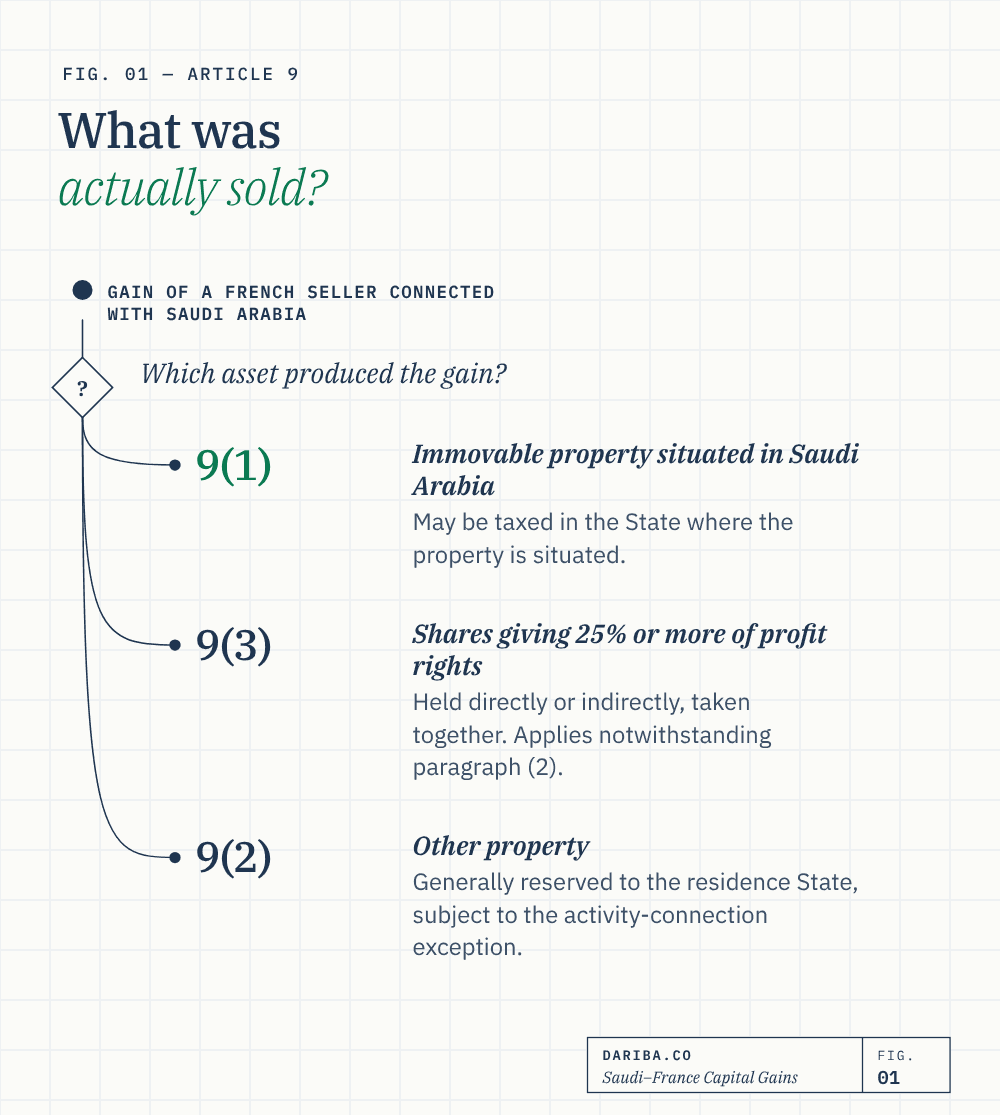
A gain connected with Saudi Arabia and a French seller needs the treaty’s actual asset and participation rules. Article 9 of the Saudi–France treaty distinguishes immovable property, other assets connected with an activity, and shares representing a substantial participation. It does not impose one uniform percentage tax on every sale receipt.
The dividend and debt-income guide explains the separate income categories, residence and current-period framework. A dividend from owning shares and a gain on selling them require different treaty provisions even where the same company and shareholder are involved.
Establish the seller, disposal and domestic charge
Treaty Articles 1 and 4 require identification of the relevant resident. Establish the seller, the property or shares disposed of, the legal transaction, consideration and applicable period. A Saudi payer, French group name or foreign bank account does not independently determine the seller’s treaty residence or the character of the proceeds.
Dariba recommendation: determine any domestic tax charge, exemption, basis and filing requirement before applying the treaty limit. A treaty permission to tax does not itself prescribe Saudi tax rates, create a domestic liability that does not otherwise exist, or make gross sale proceeds the taxable gain.
Likewise, a return of capital, liquidation distribution, debt repayment and disposal can involve different legal components. Identify those components rather than selecting Article 9 from an account description alone. This guide explains the selected treaty allocation; it does not certify a particular domestic exemption or securities transaction.
Source: treaty Articles 1, 4 and 9, consolidated pp. 6–9, read with the relevant domestic Income Tax Law provisions, including Articles 5 and 9–10.
Immovable-property gains have a location rule
Article 9(1) permits taxation in the other State where a resident disposes of immovable property referred to in Article 5 situated there. Article 5(2) uses the law of the State where the property is situated and includes the stated property interests and natural-resource rights; ships and aircraft are not treated as immovable property under that definition.
Dariba analysis: establish what was legally sold and where it is situated. A direct sale of a building and a sale of shares in its owner are different transactions. A property investment’s commercial label does not remove the need to identify the legal asset and applicable provision.
The statement that a gain may be taxed in the property’s State does not establish an exclusive allocation or independently decide the residence State’s tax or double-tax-relief computation. Applicable domestic and treaty relief provisions must also be examined.
Source: treaty Article 9(1), authentic compilation p. 4, read with Article 5 at p. 3.
Other assets have a separate activity-connection exception
Article 9(2) generally reserves gains on property outside paragraph (1) to the seller’s residence State. It excepts property effectively connected with a professional, industrial or commercial activity carried on by the seller in the other State.
The words concern the seller’s actual activity and the asset’s connection with it. The buyer’s business, a related company’s operations and a Saudi address do not independently establish that complete test. Conversely, absence of a separately incorporated Saudi subsidiary does not answer every activity question.
Dariba recommendation: retain ownership and use records, the seller’s relevant activity, the asset’s place in that activity and any attribution analysis. The France activity and MFN guide explains Article 14’s distinct framework. Do not substitute a generic threshold from another treaty for the actual France provisions.
Source: treaty Article 9(2), authentic compilation p. 4, read with the applicable activity, residence and benefit provisions.
Substantial share participations override the general other-asset rule
Article 9(3) applies notwithstanding paragraph (2). It permits taxation in the company’s State for gains on shares representing a substantial participation in its capital. The paragraph defines that participation by shares held directly or indirectly that, taken together, give the seller rights to 25% or more of the company’s profits.
This is not a universal 25% tax rate. Nor should profit entitlement automatically be replaced with voting power, nominal capital, the percentage printed on one share certificate or an unrelated company’s ownership threshold. Different share classes and indirect interests need the actual rights examined.
Dariba analysis: reconcile the legal ownership chain and profit rights without counting the same economic interest twice. The paragraph’s source-State taxing permission does not supply the gain’s domestic tax basis, exemptions, charge, filing process or eventual double-tax relief.
Source: treaty Article 9(3), authentic compilation p. 4, also displayed in the consolidated text at p. 9.
Keep the exact 25% boundary and the measurement distinct
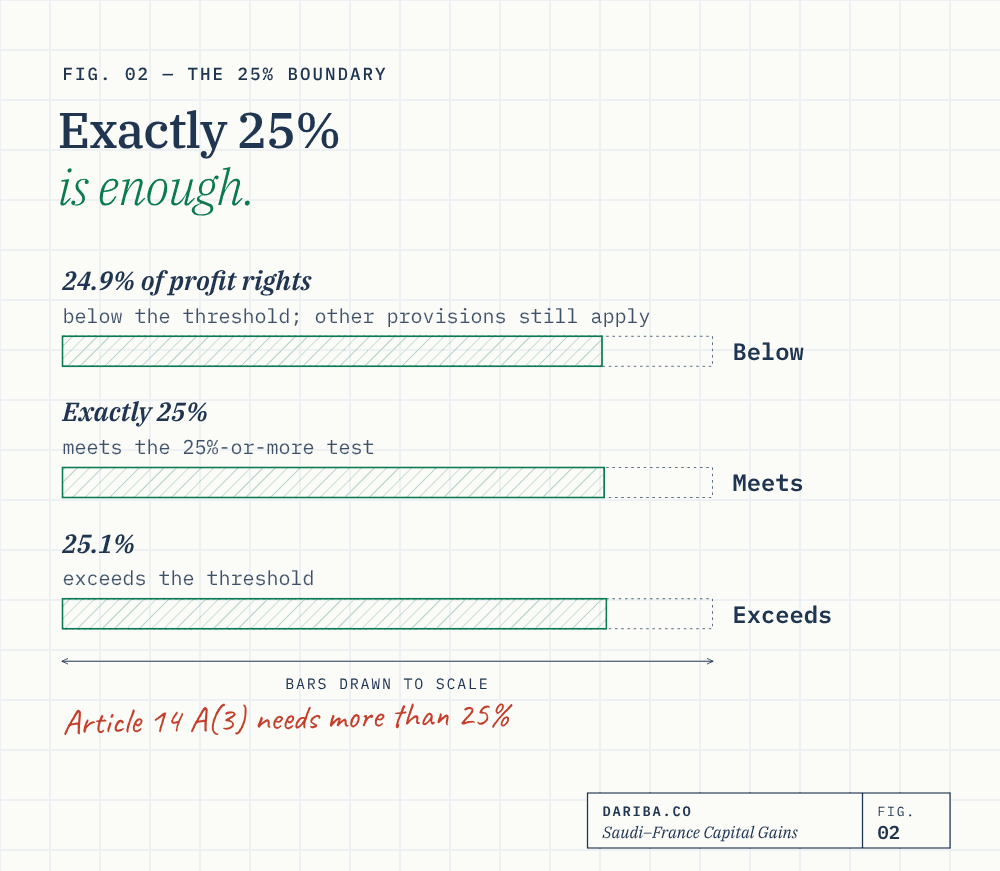
The following are Dariba boundary illustrations, assuming the stated percentages accurately measure the relevant direct and indirect rights and that all other facts are unchanged. They test only the identified participation wording.
| Assumed relevant profit entitlement | Article 9(3) participation threshold |
|---|---|
| 24.9% | Below the 25%-or-more threshold; other provisions still need analysis. |
| Exactly 25% | Meets the stated threshold. |
| 25.1% | Exceeds the stated threshold. |
Falling below this particular threshold is not a conclusion that the transaction is tax-free. Paragraphs (1)–(2), the seller’s residence, other applicable provisions and benefit conditions remain relevant. Meeting it is also not a calculation of the actual tax.
For a separate Dariba gain-measurement illustration, assume gross proceeds of SAR 2 million and a legally supported deductible basis of SAR 1.5 million, with no other adjustment. The arithmetic gain is SAR 500,000. This merely distinguishes a gain from gross proceeds; the example does not establish the legal basis, domestic rate or final liability of an actual sale.
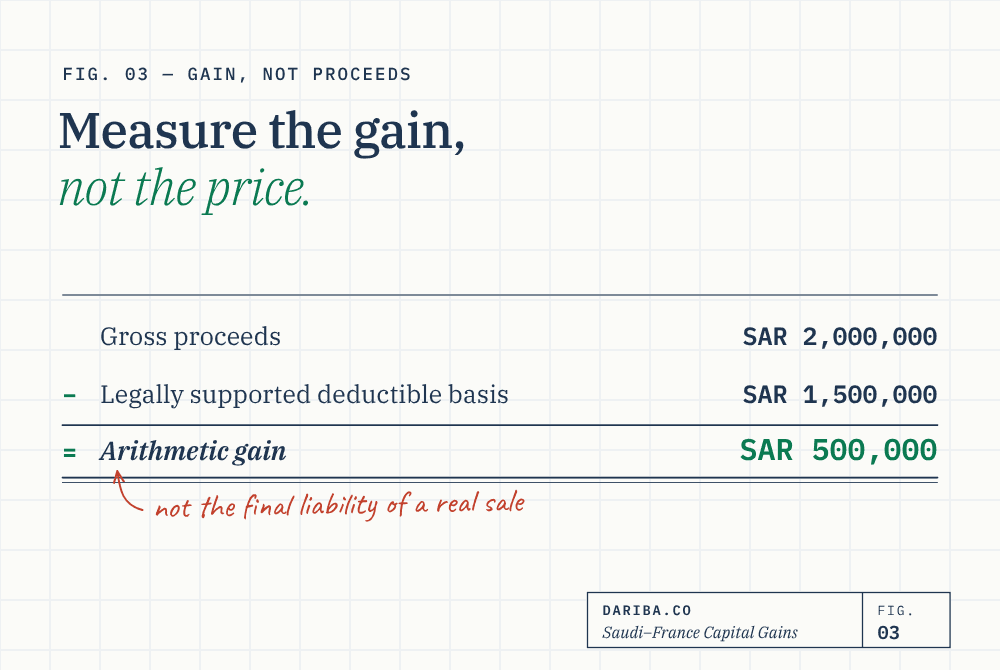
Source: treaty Article 9(3), p. 4, with original illustrative assumptions as stated.
Do not substitute the wealth article’s threshold or grouping rule
Article 14 A concerns wealth and has separate provisions for immovable property and substantial participations. Its paragraph (3), for the companies within its stated scope, uses holdings directly or indirectly, alone or with related persons, giving rights to more than 25% of profits. That wording differs from Article 9(3)‘s 25% or more for capital gains.
Dariba analysis: exactly 25% meets the selected Article 9(3) numerical test, while equality alone does not satisfy Article 14 A(3)‘s more-than wording. The comparison explains the texts; it is not a complete wealth-tax conclusion. Article 14 A’s other conditions, related-person grouping, exclusions, interpretation and applicable domestic tax have their own analysis.
Likewise, Article 14 A(2)‘s real-estate composition and associated exceptions are written for that article’s stated purpose. They should not simply be copied into Article 9 as if both provisions had identical wording. A share transaction must be analysed under the actual capital-gains provisions and applicable instruments.
Source: treaty Article 9(3), consolidated p. 9, compared with Article 14 A(2)–(3), p. 13.
Apply actual-inclusion and anti-abuse provisions where relevant
Article 18 A(2) addresses income whose taxation is allocated to the other State but is not actually included in that State’s tax base, subject to its express dividend exclusion and specified Saudi exceptions. A disposal gain should not be classified as a dividend solely to borrow that exclusion.
The MLI Article 7(1) principal-purpose test also remains relevant to treaty benefits. The French administration’s consolidated text displays it separately. A residence certificate and an ownership percentage do not independently establish that a sale or arrangement passes every benefit condition.
The financial-income companion explains the actual-inclusion wording and why it is not silently replaced with a universal positive-cash-tax test. The actual French or Saudi tax-base treatment, any claimed exception and commercial arrangement need evidence.
Source: treaty Article 18 A(2), consolidated p. 16, consolidated benefit provision, p. 5, and MLI Article 7(1), pp. 9–10.
Build a transaction-specific file and follow the applicable procedure
Retain the seller’s residence and capacity, transfer agreement, asset description and location, ownership chain, share-class and profit-right documents, basis and consideration evidence, activity-connection analysis, tax-base treatment and benefit review. Explain which Article 9 paragraph applies before stating a result.
A capital-gains allocation is not automatically the same filing or withholding procedure as an ordinary dividend remittance. Identify the actual domestic compliance route and any claim process. The Saudi tax-treaty and MAP guide explains the separate competent-authority process; sending a treaty analysis does not itself extend a domestic challenge deadline or certify a refund.
This selected guide leaves other France payment categories, complete wealth/estate analysis, historical amendments and transaction-specific conclusions to their appropriate sources and facts. It provides a reasoned Article 9 analysis without turning one threshold into a blanket exemption.
Key takeaways
- Identify the seller, legal asset and domestic tax charge first.
- Immovable-property gains have a location rule.
- Other-asset gains have an activity-connection exception.
- Article 9(3) measures direct and indirect rights to 25% or more of profits.
- Article 14 A’s wealth test has different threshold and grouping wording.
- Treaty permission does not calculate the domestic gain, rate or final liability.
Sources
- French tax administration: authentic convention compilation before MLI/MFN consolidationArticles 5 and 9, pp. 3–4: property definition, disposal allocations, activity exception and direct/indirect 25%-or-more profit participation.
- French tax administration: treaty consolidated for MLI and MFNReading aid, not an authentic replacement. Selected Articles 1/4/9, wealth Article 14 A(2)–(3), special Article 18 A(2) and benefit/PPT provision, pp. 5–9, 13 and 16.
- OECD: authentic English Multilateral InstrumentArticle 7(1) principal-purpose test read with the applicable treaty source map and matched positions; no complete later-position or historical-period certification.
- Saudi Income Tax Law, current amended Arabic textDomestic source, exemptions and asset-disposal framework, including Articles 5 and 9–10. Treaty taxing permission does not itself create a domestic charge or determine basis.
General information from selected official France treaty, MLI and Saudi sources reviewed on 5 November 2026. Actual residence, disposal, rights, activity, period, domestic tax and benefit conditions govern. Authentic instruments prevail over the consolidated reading aid. Dariba illustrations are original. No complete France-country schedule, wealth/estate review or actual transaction entitlement is certified.