In brief
Articles 6 and 7 generally reserve the specified income to the recipient’s residence State. Activity-connection exceptions, Article 18 A(2), anti-abuse and claim procedures require separate evidence; dividends are excluded from the actual-inclusion safeguard.
A Saudi payment of dividends or loan income to a French recipient needs more than a country selection. The Saudi–France treaty’s Articles 6 and 7 generally allocate the specified dividend and debt income exclusively to the recipient’s residence State. Their activity-connection exceptions, the treaty’s special provisions and the applicable relief procedure must then be applied.
This guide addresses those two income categories. The France business-activities and MFN guide explains the separate activity rules. Neither guide is a complete France-country schedule for every payment, asset or historical period.
Establish the treaty resident and applicable period
Treaty Articles 1 and 4 require the relevant residence analysis. A French postal address, euro invoice, French bank account or parent company does not independently establish that the person receiving the income is a French treaty resident. Identify the actual entity, its capacity and the period covered by the residence evidence.
The French administration’s official treaty commentary, BOI-INT-CVB-SAU, paragraph 1, records renewal for five years from 1 January 2024 through the December 2023 exchange of notes. Original treaty commencement, later amendments and the MLI’s entry into effect are separate questions. Its consolidated reading aid expressly states that the authentic treaty and MLI remain the legally applicable instruments.
Dariba recommendation: preserve the treaty-residence certificate, recipient’s legal documents, payment date and applicable instrument record. A certificate is evidence for the claim; it does not itself prove the income classification, effective connection, anti-abuse conditions or approval of relief.
Source: treaty Articles 1–4, especially consolidated pp. 6–7, read with the authentic instruments and the cited current official commentary.
Classify a dividend from the legal participation and payment
Article 6(1) provides residence-State-only taxation for dividends paid by a company resident in one State to a resident of the other. Paragraph (3) covers income from the stated shares and participation rights, excluding debt claims, together with other corporate-right income subjected to the same treatment as share income under the distributing company’s law.
The selected provision does not set a 10%, 25% or other minimum participation tier for its ordinary residence-only allocation. Do not import another country’s ownership-rate table into this treaty. An ownership percentage may still matter to classification, another provision or the actual arrangement; that is a different question.
Dariba analysis: retain the distribution resolution, participation rights, payer and recipient identity, amount and legal character. A management fee, return of capital, repayment of principal or branch remittance should not be assigned the Article 6 result solely because an internal account calls it a dividend. Saudi domestic categories and the treaty’s own definition must be reconciled.
Source: treaty Article 6(1) and (3), authentic compilation p. 3, also displayed in the consolidated text at p. 8.
Test whether the participation is effectively connected to Saudi activity
Article 6(2) allows taxation in the payer’s State where the participation generating the dividends is effectively connected with industrial or commercial activity exercised there by the recipient. It then directs the analysis to Article 14.
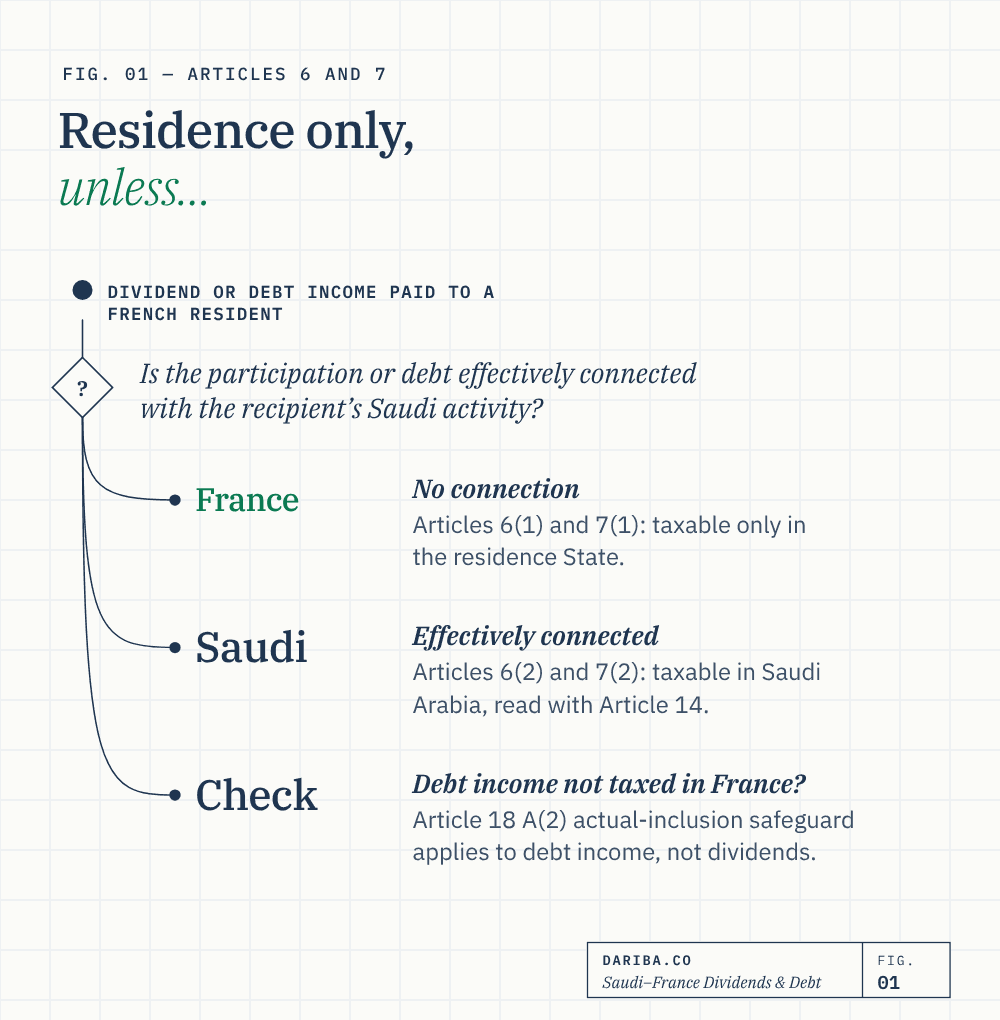
The actual wording concerns that activity and connection. It should not be replaced with a blanket statement that any French recipient with any Saudi presence loses all treaty relief, or that a residence certificate proves there is no relevant connection. Identify who carries on the activity and how the participation is held and used.
The France activity guide explains Article 14’s distinctive framework and identified MFN changes. A generic project or service-presence threshold from another treaty is not the complete France analysis. When paragraph (2) applies, the Article 14 attribution analysis must also be performed; this guide does not turn that exception into an automatic gross-payment rate.
Source: treaty Article 6(2), authentic compilation p. 3, read with Article 14 and the applicable MFN/MLI instruments.
Distinguish debt income from principal and other charges
Article 7(1) generally allocates debt income arising in one State and paid to a resident of the other exclusively to that other State. Paragraph (3) covers debt claims of every kind, with or without mortgage security or a right to participate in the debtor’s profits, and includes the stated government-security and bond income, premiums and prizes.
Dariba analysis: a profit-linked return is not automatically a dividend; the underlying legal claim matters. Conversely, an invoice label such as finance charge does not establish that the payment is remuneration from a debt claim. Separate principal, financing return, service fees, guarantee fees and any default charge, then classify each under the actual contract and applicable provisions.
ZATCA’s January 2025 treaty-withholding circular, section 3.2.9, discusses income classification and states that late-payment penalty charges should not be regarded as debt income for the article it describes. That general guidance should be read with the actual France treaty wording and transaction. A different classification does not automatically mean exemption; it requires the appropriate alternative analysis.
Source: treaty Article 7(1) and (3), authentic compilation p. 4, and ZATCA treaty-withholding circular, section 3.2.9, p. 11.
Apply the debt’s effective-connection exception separately
Article 7(2) permits taxation in the source State where the debt generating the income is effectively connected with industrial or commercial activity carried on there by the recipient, again referring to Article 14. This is a test of the actual claim and activity, not merely the borrower’s location or the existence of a related company.
Dariba recommendation: retain the lending contract, creditor’s rights, funding and payment trail, relevant Saudi activity and attribution analysis. An assertion that the creditor has no separate Saudi company does not answer every activity question. Equally, the Saudi borrower’s own business does not, by itself, establish that the French creditor carries on that same activity.
Protocol paragraph 1 separately addresses the stated debt income paid by a national of either State to a bank or financial institution having the nationality of either State. Its actual persons and terms need checking where that route is relied upon; it should not be rewritten as an exemption for any bank anywhere or every group treasury company.
Source: treaty Article 7(2), authentic compilation p. 4, and Protocol paragraph 1, consolidated p. 20.
Debt income has an actual-inclusion safeguard
Article 18 A(2) addresses double exemption. Notwithstanding the treaty’s other provisions, it permits each State to apply its domestic law to income whose taxation is allocated to the other State when that income is not actually included in that other State’s tax base. The paragraph expressly excludes dividends from the income covered by this safeguard.
It also states exceptions for Saudi citizens, companies whose shares or rights are more than 50% owned directly or indirectly by Saudi citizens, and the specified income temporarily exempt in Saudi Arabia under an official investment-development regime. The ownership test is more than 50%, not exactly 50%, and the temporary-exemption exception has its own wording.
Dariba recommendation: for a debt-income claim, establish the actual tax-base treatment and any claimed exception. A residence certificate does not, alone, establish inclusion of the particular income. The wording concerns actual inclusion in a tax base; do not silently replace it with a universal requirement for positive cash tax on every receipt.
The dividend exclusion belongs to this particular safeguard. It does not remove Article 6(2), the applicable anti-abuse rule, correct classification or the relief procedure. Each condition must keep its own scope.
Source: treaty Article 18 A(2), consolidated p. 16.
Residence-only wording still requires an anti-abuse review
The MLI Article 7(1) principal-purpose test can deny a benefit where, considering all relevant facts and circumstances, obtaining that benefit was one of an arrangement’s or transaction’s principal purposes, unless granting it accords with the relevant provisions’ object and purpose. The French administration’s consolidation displays this rule separately and identifies its MLI basis.
ZATCA’s circular, sections 3.2.8–3.2.9, also discusses beneficial ownership and conduit arrangements in general treaty application. Attribute that guidance accurately: the selected France Articles 6 and 7 use their own resident-recipient wording and do not contain the tiered shareholding tests found in some other treaties. Do not manufacture an additional France article or ignore the actual recipient’s rights and obligations.
Dariba analysis: retain the commercial reasons, recipient’s functions and control over the income, funding, contractual onward-payment duties and arrangement history. A recently inserted intermediary or a declaration without supporting facts does not independently decide the treaty outcome.
Source: MLI Article 7(1), pp. 9–10, French consolidated benefit provision, p. 5, and ZATCA circular, sections 3.2.8–3.2.9, pp. 10–11.
Compare domestic exposure with the conditional treaty result
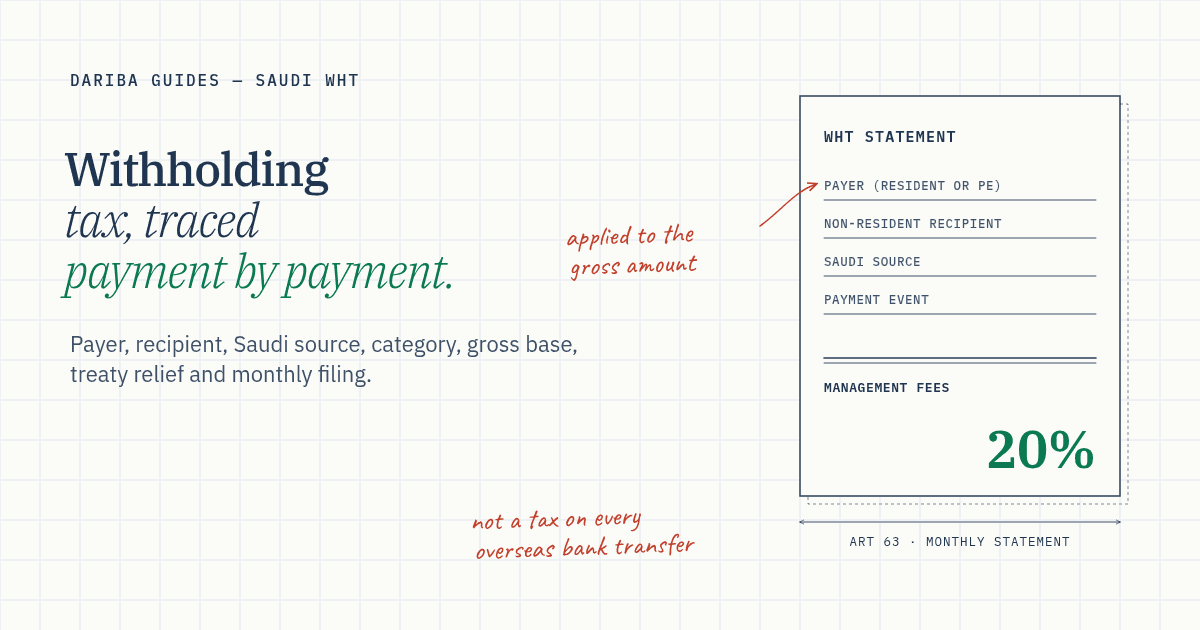
Saudi domestic Regulations Article 63 generally specifies 5% withholding for the stated dividends and loan returns, within its scope and exceptions. The treaty analysis can limit Saudi taxation where its conditions are satisfied. The treaty does not create a domestic tax charge merely because a reader finds a category heading.
| Dariba illustration: original assumptions | Domestic calculation before treaty relief | Conditional treaty analysis |
|---|---|---|
| SAR 1 million qualifying dividend to a French treaty resident | 5% = SAR 50,000 | Article 6(1) gives residence-only taxation, assuming no Article 6(2) connection and all applicable benefit/procedural conditions are met. |
| SAR 200,000 qualifying debt income to a French treaty resident | 5% = SAR 10,000 | Article 7(1) gives residence-only taxation, assuming no Article 7(2) connection, Article 18 A(2) is addressed and the other benefit/procedural conditions are met. |
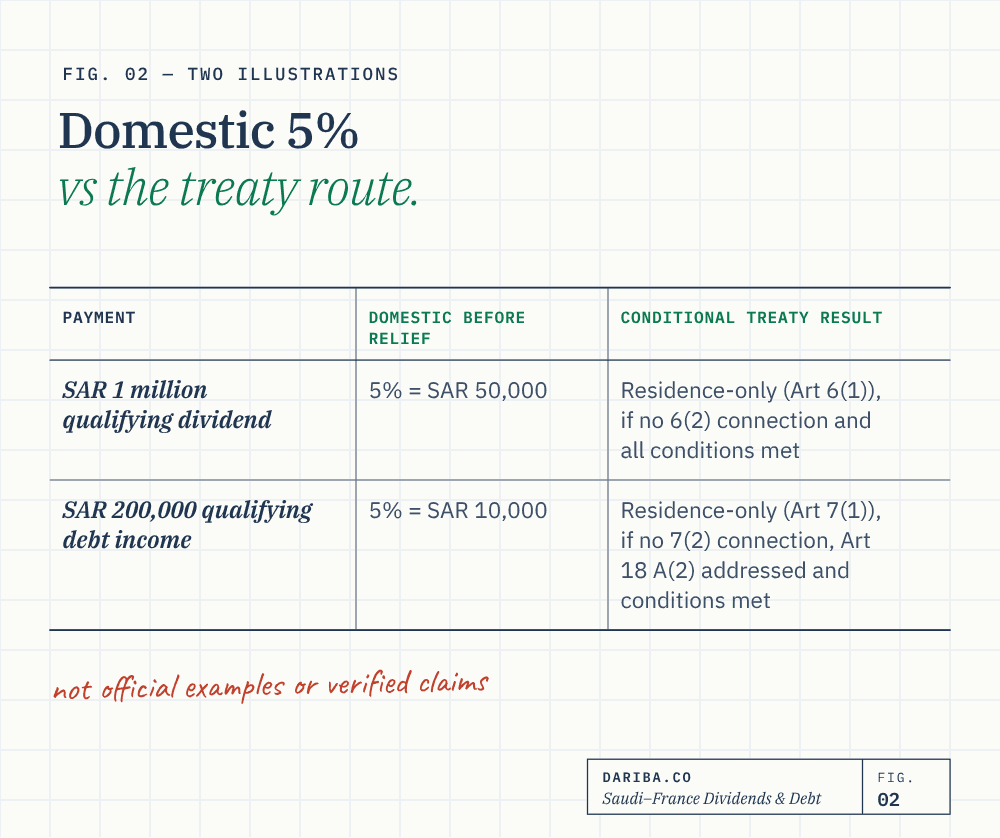
These are isolated illustrations, not official examples or verified taxpayer claims. They do not calculate French tax, gross-up obligations, a branch’s attribution, repayment of principal or the result for another payment category. If a condition fails, reassess the actual domestic liability and applicable treaty provision rather than treating either table row as an unconditional zero-rate instruction.
Source: current Arabic Implementing Regulations, Article 63, pp. 34–35, read with Income Tax Law, Article 68, pp. 29–30, and the treaty provisions cited above.
Complete the relief procedure and retain the payment evidence
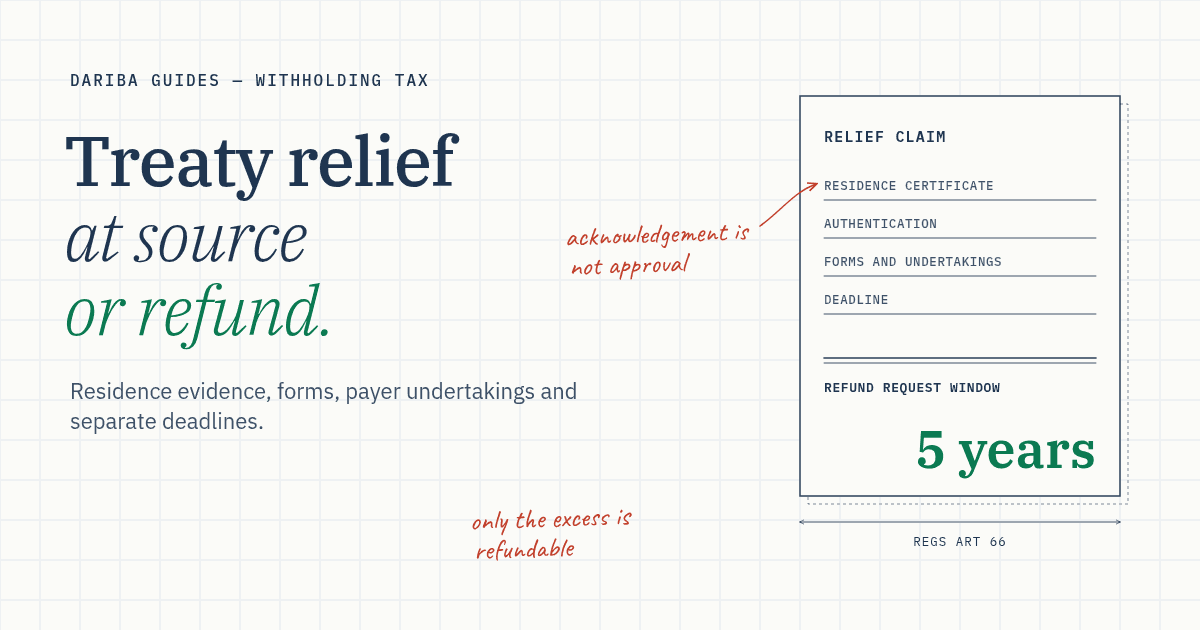
ZATCA’s circular sections 4.1–4.2 distinguishes benefit at source from withholding under domestic law followed by a refund request. The benefit-at-source process includes the treaty-residence certificate, approved request forms, the stated authentication or Apostille route and the resident payer’s undertaking, followed by ZATCA review and approval under the circular’s process.
The refund route requires its own documentation, including the residence evidence, beneficiary authorisation, approved request, authentication requirements, WHT return and remittance receipt, and the stated payer letter concerning prior refund, transfer or set-off. An internally calculated treaty result or submission acknowledgement is not itself proof that the claim has been approved or paid.
The treaty relief and refund guide explains the procedure and limitation-period qualifications. Keep classification, recipient/residence, activity connection, tax-base inclusion where relevant, anti-abuse evidence, approval and actual remittance or refund together. Those records explain why the treatment applies to this payment and period.
Source: ZATCA treaty-withholding circular, sections 4.1–4.2, pp. 15–17.
Key takeaways
- Classify the actual recipient, distribution or debt claim.
- The selected Articles 6 and 7 do not use another treaty’s shareholding-rate tiers.
- Each article has its own effective-connection exception referring to Article 14.
- Article 18 A(2) addresses actual inclusion and expressly excludes dividends.
- The principal-purpose test and actual recipient facts remain relevant.
- Relief at source and a later refund follow different evidence and approval processes.
Sources
- French tax administration: authentic convention compilation before MLI/MFN consolidationArticles 1, 4, 6 and 7: residence, dividends, debt income, definitions and activity-connection exceptions. Selected French wording read at pp. 2–4.
- French tax administration: treaty consolidated for MLI and MFNReading aid, not an authentic replacement: benefit/PPT provision, Articles 1/4/6/7/18 A(2), Protocol paragraph 1 and MLI effect-date note; selected pp. 5–9, 16, 18 and 20.
- ZATCA: Implementation of Withholding Tax under Double Taxation Agreements, January 2025Sections 3.2.8–3.2.9 and 4.1–4.2: general beneficial-owner/debt classification guidance and the separate relief-at-source/refund procedures; actual treaty wording governs.
- Saudi Income Tax Law, current Arabic textArticles 5 and 68: domestic source and withholding framework, separate from treaty allocation and entitlement.
- Saudi Income Tax Implementing Regulations, current Arabic textArticle 63: current domestic categories, 5% dividend/loan-return entries and stated conditions; no blanket rate for every financial remittance.
- OECD: authentic English Multilateral InstrumentArticle 7(1) principal-purpose test and Article 35 effect-date framework, read with the matched treaty positions and consolidated source notes.
- OECD depositary: current MLI signatories and partiesFrance and Saudi entry-into-force dates rechecked; these are distinct from entry into effect for a particular tax.
- OECD depositary: France deposited MLI positionSaudi covered-agreement and relevant Article 7 reservations/notifications read with the Saudi position and consolidated source notes; not an exhaustive certification of later positions.
- OECD depositary: Saudi Arabia deposited MLI positionFrance covered-agreement and relevant Article 7 reservations/notifications read with the French side; unilateral options alone do not establish a modification.
- French official treaty commentary BOI-INT-CVB-SAU, 10 July 2024Paragraph 1 records the December 2023 renewal for five years from 1 January 2024. Official current page rechecked 5 November 2026. This selected guide does not certify all historical amendment dates.
General information from selected official treaty, MLI and Saudi sources reviewed on 5 November 2026. Actual person, residence, payment, activity, period, tax-base treatment and benefit/procedural conditions determine the result. The consolidation is a reading aid; authentic instruments govern. Dariba illustrations are original. No complete France-country schedule or actual taxpayer entitlement is certified.