In brief
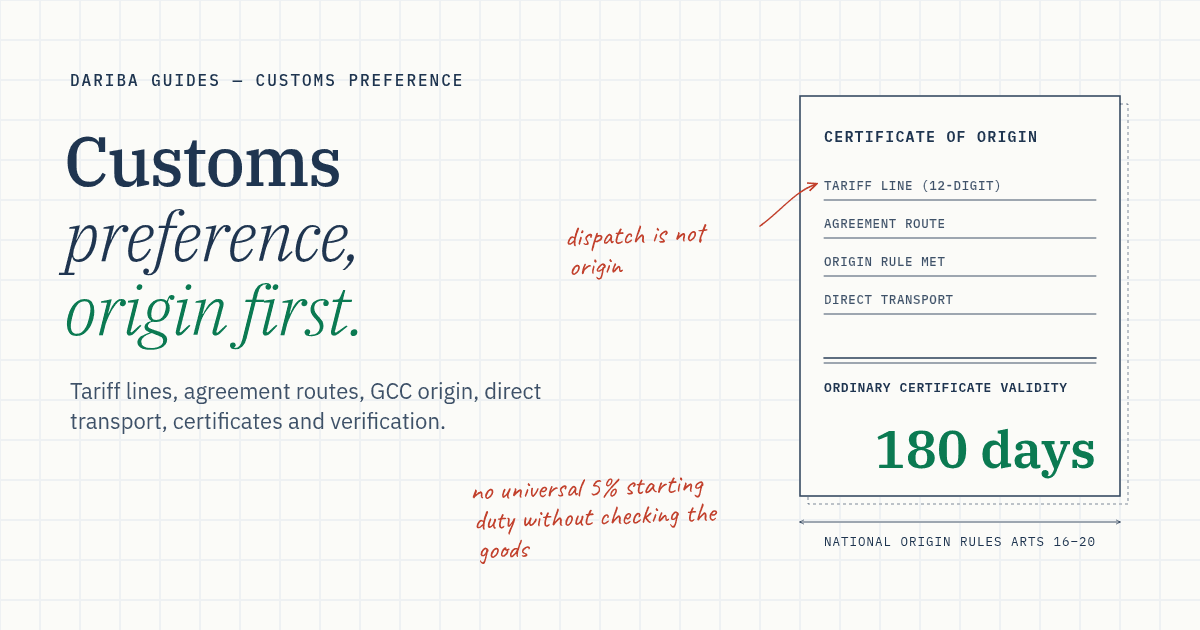
National Origin Rules 16–28 distinguish ordinary validity, retrospective issue, copies, customs-controlled partial certificates, instalment imports and minor errors. A new document does not automatically restart the importer’s separate claim clock.
Begin with the Approved Certificate and Its Actual Issuer
A GCC origin certificate supports a preference claim; it does not independently establish every manufacturing, transport and procedural condition. National Origin Rules Articles 16–18 identify the approved form, competent issuing authority and issuance process. Their requirements should be connected to the actual exporter, producer and goods rather than treated as a document that can be transferred between unrelated shipments.
Article 17 concerns the authorised bodies in GCC states, including notification of issuing authorities and approved stamp specimens and changes. Article 18 addresses the application and supporting production evidence, complete product particulars and the relevant intermediary information where the producer differs from the exporter. A trading invoice and a manufacturing-origin statement answer different questions.
The GCC value-added guide explains the production tests. This article focuses on certificate validity, later issue, copies and consignments. Those procedures do not remove the underlying origin requirements.
The Certificate’s 180 Days Are Not the Importer’s Claim Clock
Article 20(1) ordinarily makes the approved certificate valid for 180 days from issue. Paragraph 2 permits late acceptance where failure to present it on time results from force majeure or compelling circumstances accepted by the importing country’s customs authority. Paragraph 3 separately permits acceptance of other late origin evidence where the goods reached customs before the relevant deadline.
These are qualified acceptance provisions. They do not establish an automatic extension whenever the exporter or importer misses a date. Preserve the actual issue, shipment, arrival and presentation dates and evidence supporting the reason for delay.
The Verification Rules’ ordinary guarantee-refund or bank-guarantee-release application has its own ninety-calendar-day period from clearance. Do not replace that period with the certificate’s 180-day validity or assume that obtaining a new document restarts the importer’s application clock. The customs-preference framework explains the separate guarantee and verification stages.
Retrospective Issue Requires the Article 22 Conditions
Article 22 permits a certificate to be issued after export in its stated cases. One concerns failure to issue at export because of errors, unintended omissions or special circumstances. The other concerns a certificate that was issued but was not accepted at import for technical reasons, supported by evidence of those reasons from the relevant customs or competent authority.
The exporter must identify the place and date of export and explain the application. The issuing authority may issue retrospectively only after checking that the application’s information agrees with the original information held in its file. The certificate must carry the specified retrospective-issue wording in its observations.
This is different from inventing an origin claim after discovering that the actual goods never met the production conditions. Dariba recommends keeping the original shipment and production records, the technical-rejection evidence where relevant, the application and the issuer’s verification together. A later signature does not prove an earlier manufacturing fact or automatically cure every Saudi procedural default.
A Copy Carries the Original Number and Date
Article 23 allows the original issuing authority, on the exporter’s request, to issue a copy. The request must explain the reason for the copy and the party to which it will be submitted. The copy bears the prescribed copy wording in its observations and carries the number and date of the original certificate.
Do not present the copy as an independently dated new certificate with a fresh ordinary validity period. Its connection to the original is part of the provision. Also avoid importing a narrower loss-or-theft-only condition from a different trade agreement: this article requires the stated reason and recipient, and its own wording governs the application.
Keep the copy request and the original certificate reference with the import file. Where several copies or successive submissions exist, reconcile which goods and quantity each document supports rather than treating a duplicate document as permission for a second preference on the same goods.
Partial Certificates Follow Goods Under Customs Control
Article 24 deals with originating products placed under the control of customs authorities in a GCC state where those authorities issue partial certificates based on the earlier original certificate. The process includes attaching a copy of the original certificate with the export declaration and endorsing the relevant copy for the onward movement of some or all of the products to another GCC state, subject to customs knowledge/control of the goods.
The identity of the authority and the relationship to the controlled stock matter. This is not a general permission for a distributor to create its own replacement origin document merely because the goods came from a GCC supplier.
Dariba illustration: a controlled consignment contains 100 identical qualifying units. If a properly supported partial movement covers 40, the remaining stock is 60. A later document covering 70 additional units would exceed that original quantity by 10 unless a separate supported consignment explains the difference. These original numbers illustrate quantity reconciliation, not an official case or a conclusion that partial certification is available for a particular warehouse.
Instalment Imports Have a Different One-Certificate Rule
Article 25 addresses the specified dismantled or unassembled products imported in instalments, at the importer’s request and under the importing customs authority’s conditions. It refers to Harmonized System General Rule 2(a), the stated goods of Sections XVI and XVII, and headings 7308 and 9406. Under that route, a single origin certificate is presented on import of the first consignment.
This is a product-classification and controlled-instalment rule. It should not be expanded into one certificate for every purchase under a long project, or confused with Article 24’s partial certificates for products already under customs control. Equipment, structures and prefabricated buildings still need the correct classification and actual facts.
Dariba recommends reconciling the classification, complete product, instalment plan, authority conditions and first-consignment evidence before relying on the route. An after-the-event spreadsheet combining independent purchases does not itself establish that the goods were one qualifying dismantled product.
Distinguish Minor Discrepancies from Doubt About Origin
Article 27(1) prevents simple discrepancies between origin proof and import documents from automatically making the proof invalid where it is properly established that the documents concern the presented products. Paragraph 2 separately addresses obvious formal or clerical errors that do not create doubt about the correctness of the particulars.
The qualification matters. A harmless typing difference is different from uncertainty about the producer, product, quantity, production process or actual origin. The rule does not guarantee that every inconsistent certificate must be accepted or that substantive gaps can be labelled clerical.
Record the discrepancy, explanation and evidence linking the documents to the goods. Where customs raises an actual origin concern, address that concern through the applicable verification process instead of assuming that the minor-error provision settles the whole claim.
Preserve Supporting Evidence and the Appropriate Exemptions
Articles 19 and 21 address supporting production/origin evidence and retention. The relevant exporter, issuer and customs records are ordinarily retained for at least three years under their stated provisions. A certificate is therefore the visible part of a larger evidence chain involving accounts, production, input origin and the actual shipment.
Article 26 separately addresses its specified personal postal consignments and used personal/household belongings in traveller baggage under the Unified Customs Law. An exemption from origin-proof presentation is not an automatic exemption from every customs duty or an unrestricted commercial-import route.
Article 28 protects confidential origin information, with its stated permission and compulsory judicial-disclosure exception. Apply that customs-origin provision; do not copy a recipient list from the separate VAT or CIT confidentiality rules. For inputs affected by trade-remedy proceedings and earlier certificate calculations, see the trade-remedy and origin guide.
Key takeaways
- Ordinary certificate validity is 180 days from issue; the guarantee claim has a separate ninety-day period from clearance.
- Retrospective issue requires the stated reason, original-file verification and prescribed observations.
- A copy carries the original certificate number and date; its wording does not create a fresh ordinary validity period.
- Partial certificates under Article 24 involve customs-controlled goods and the relevant export declaration.
- Article 25’s one-certificate route concerns its specified classified products and instalment conditions.
- Minor discrepancies and personal origin-proof exemptions do not waive substantive origin or every customs duty.
Sources
- Saudi National Origin Rules, official Arabic publicationArticles 16–28, pp. 11–15: approved form and issuer, supporting evidence, 180-day validity, records, retrospective issue, copies, partial certificates, instalments, personal proof exceptions, minor errors and confidentiality.
- ZATCA Origin Verification Rules, current amended Arabic textDecision 24841, amended by Decision 303-99-1447. Paragraph 4 uses ninety calendar days from clearance for the ordinary guarantee application; evidence and competent-authority agreement conditions remain separate.
General information based on the controlling Arabic sources reviewed on 30 October 2026. Actual product classification, origin, facts, applicable instruments and competent-authority decisions determine treatment. Dariba illustrations use original assumptions. No individual shipment, current trade-remedy schedule, preference approval or independent legal certification is implied.