In brief
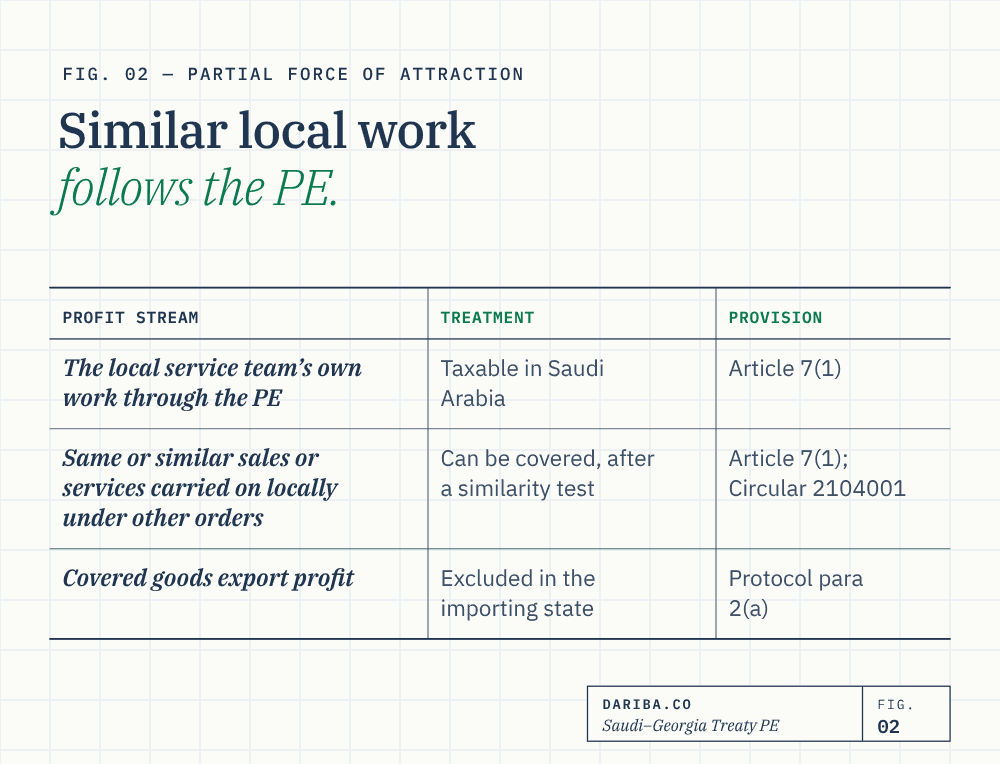
Article 7 includes certain similar local sales and services once a permanent establishment exists. The Protocol separately protects qualifying merchandise export profits from source taxation.
A Georgian supplier with a Saudi service team may earn profit from several activities, including the local team’s own work and similar services carried on locally under other orders. Articles 5 and 7 of the Saudi–Georgia Double Taxation Agreement govern the establishment and the scope of business profits the source state may tax.
| Activity | Treaty provision | Duration test |
|---|---|---|
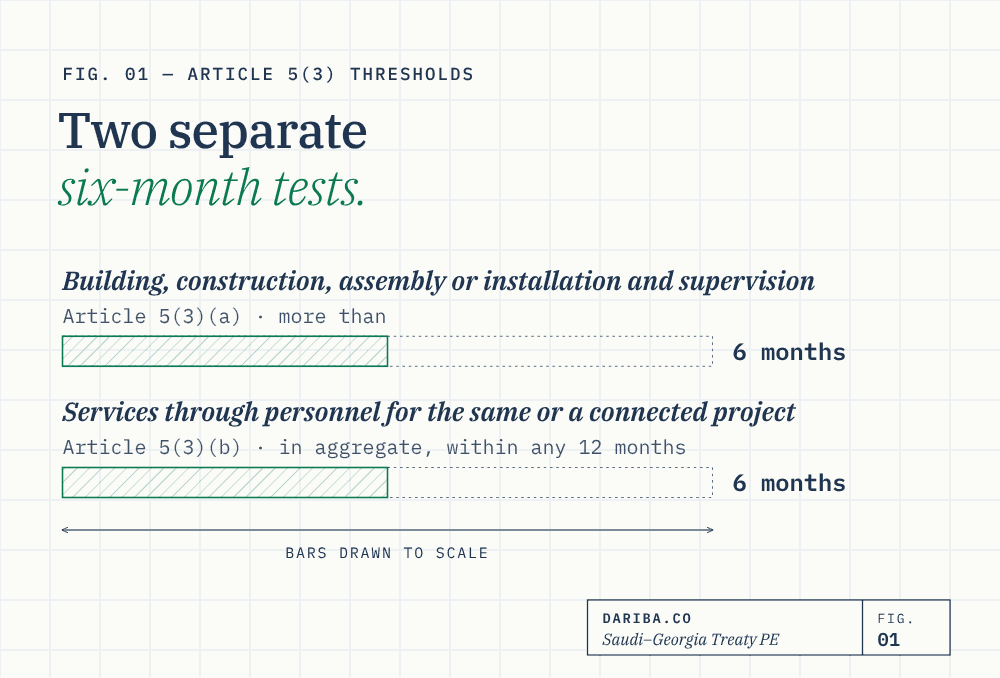
| Listed building, construction, assembly or installation projects and related supervision | Article 5(3)(a) | More than six months |
| Services through personnel, including consultancy, for the same or a connected project | Article 5(3)(b) | More than six months in aggregate within any 12 months |
Review premises and agency alongside the time tests. Article 5(5) includes habitual exercise of authority to conclude contracts for the enterprise and specified regular deliveries from local stock. Georgia’s consolidated Multilateral Instrument position reserves against Articles 12, 13 and 14 on agency, activity exemptions and contract splitting. Review the bilateral tests for those matters.
Test the similarity of local sales and activities
Once business is carried on through a permanent establishment, Article 7(1) covers profit attributable to that establishment and profit from same or similar sales or business activities in the source state. Compare where the goods are sold or work is performed and whether it is of the same or a similar kind to the establishment’s own activities. ZATCA’s Circular 2104001, Force of Attraction Rule in the Context of Permanent Establishment, explains this form of partial force of attraction.
Protocol paragraph 2(a) excludes covered goods export profits from taxation in the importing state. Income from other work under the contract performed through a permanent establishment there may be taxed there. Reconcile the export, local installation and any similar local business to the contract terms and project accounts. For equipment-use and financing payments, check the withholding guide.
Key takeaways
- Article 5(3) provides distinct project and service tests.
- Article 7(1) reaches specified similar sales and activities in the source state.
- Protocol paragraph 2 preserves the treaty treatment of covered merchandise exports.
Sources
- Saudi–Georgia Agreement for the Avoidance of Double Taxation with Respect to Taxes on Income and on Capital and the Prevention of Tax Evasion, with ProtocolArticles 5 and 7 and Protocol paragraph 2.
- Georgia’s Consolidated MLI Reservations and NotificationsListed agreement 49, the 2025 extension and Georgia’s reservations.
- Saudi Arabia’s Deposited MLI Reservations and NotificationsListed agreement 52 and notification under Article 7.
- ZATCA Circular 2104001, Force of Attraction Rule in the Context of Permanent EstablishmentThe similarity test and partial force of attraction.