In brief
Apply Saudi income-tax residence tests, permanent-home conditions, part-days and transit, company principal management and separate treaty certification.
Saudi income-tax residence requires the statutory test for the person concerned. An immigration document, Saudi nationality, a foreign certificate of incorporation or a short visit does not, by itself, answer that question.
Income Tax Law Article 3 and Implementing Regulations Article 3 distinguish natural persons from companies. Ministerial Decision 2194 further explains a company’s principal management. Residence then connects to the separate taxpayer, income-source, permanent-establishment and treaty rules; it is not a complete tax computation.
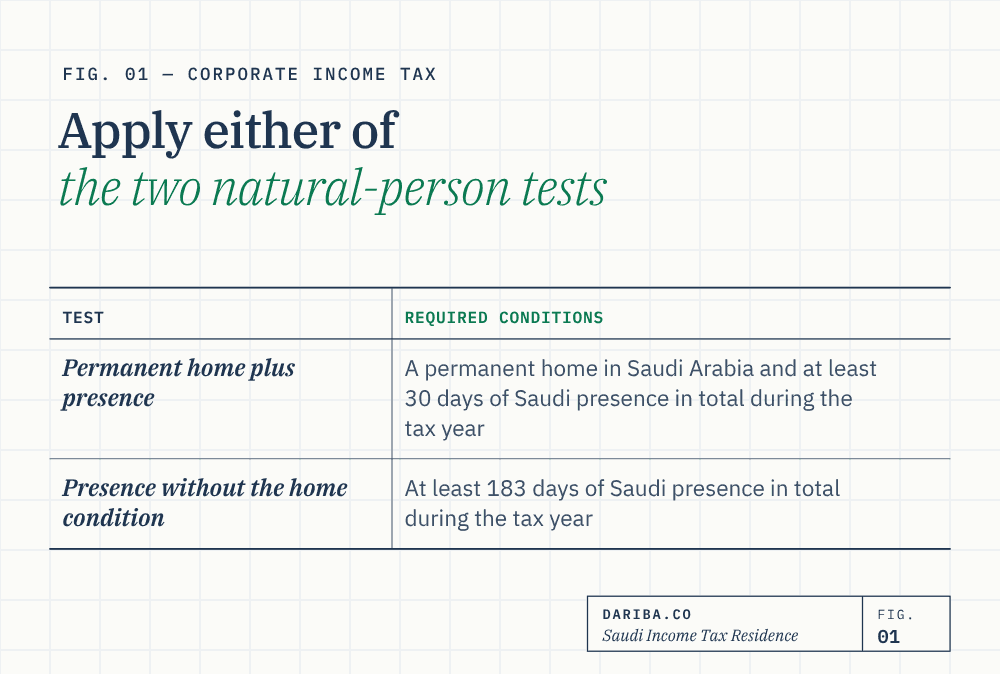
Apply either of the two natural-person tests
Law Article 3(a) treats a natural person as resident in the relevant tax year if either condition is met:
| Test | Required conditions |
|---|---|
| Permanent home plus presence | A permanent home in Saudi Arabia and at least 30 days of Saudi presence in total during the tax year |
| Presence without the home condition | At least 183 days of Saudi presence in total during the tax year |
Regulations Article 3(1) makes clear that the relevant presence may be consecutive or intermittent. The 30-day route is therefore not an exemption for someone who repeatedly leaves before completing a thirty-day visit. Equally, thirty days without the qualifying home does not establish residence through that route.
Dariba original illustration: assume a person has a qualifying Saudi permanent home and spends 12 countable days in Saudi Arabia on one visit and 18 on another in the same tax year. The total is 30 days, satisfying the stated presence limb. Without that qualifying home, the same thirty days do not satisfy the 183-day route.
The thresholds use at least, rather than more than, thirty or 183 days. They apply to the relevant tax year; do not substitute an arbitrary rolling twelve-month window taken from a different treaty or tax rule.
Establish the qualifying permanent home
Regulations Article 3(2) identifies a dwelling owned by the natural person, a dwelling rented under rental agreements during the tax year totalling at least one year, or accommodation provided by another party during the tax year for at least one year.
Ownership is therefore not the only route. Employer-provided accommodation can require consideration under the stated duration condition. Conversely, a hotel booking or short accommodation arrangement should not simply be assumed to satisfy the regulatory definition.
Dariba recommendation: retain the ownership document, actual lease agreements or the accommodation-provision arrangement, and reconcile the relevant dates and availability. Keep the home condition distinct from the presence calculation. If renewal, shared accommodation or overlapping agreements create uncertainty, establish how the actual arrangement meets the wording rather than relying on the description of the property alone.
Count part-days and apply the transit exception
Article 3(a) expressly counts part of a day as a full day. It also excludes a person’s Saudi presence while in transit between two points outside Saudi Arabia. Those are specific statutory directions; a simple sum of twenty-four-hour periods can produce the wrong result.
Dariba original illustration: assume a visit is not qualifying transit. Arrival shortly before midnight on one day and departure shortly after midnight on the next involve presence on two days, even though the elapsed time is much less than forty-eight hours. Apply the actual dates and the part-day rule rather than rounding the elapsed hours down to zero.
Maintain travel records showing entry, departure and any claimed transit. Reconcile those records with the relevant tax year. Where a stop includes business activity or other circumstances that make its character uncertain, examine the actual facts before treating every airport connection as an automatic excluded day.
Dariba analysis: travel-day records and accommodation evidence answer different limbs of the test. A complete passport record can still leave the permanent-home condition unproven; a long lease can still leave the thirty-day presence condition unmet.
Keep nationality and residence separate
Regulations Article 3(3) states that residence is determined by the statutory conditions irrespective of nationality. A Saudi national is not automatically resident under the income-tax residence test solely because of citizenship; a non-Saudi person can meet the domestic residence conditions.
Nationality can still matter elsewhere, including the actual CIT/Zakat taxpayer and ownership rules. Law Article 2(b), for example, separately concerns a resident non-Saudi natural person carrying on activity in Saudi Arabia. Meeting Article 3 does not alone establish the tax treatment of every receipt or employment arrangement.
Read the taxable-activity guide and ownership guide before turning a residence conclusion into a tax percentage. The residence test should identify the relevant category, not replace the rest of the analysis.
Apply the company’s incorporation or principal-management route
Law Article 3(b) treats a company as resident during the tax year if it is formed under the Companies Law or its principal management is in Saudi Arabia. These are alternatives. Foreign incorporation is therefore not sufficient to eliminate the Saudi residence question.
Ministerial Decision 2194, reproduced with Article 3(b)(2) in ZATCA’s current Law compilation, describes principal management as the place where high-level policies and the main management and commercial decisions necessary for the company’s business as a whole are principally made. It identifies Saudi principal management where at least two of the following conditions are met:
- Regular ordinary board meetings at which the principal policies and management decisions are made take place in Saudi Arabia.
- Senior executive decisions concerning management of the company’s functions, such as the chief executive’s and deputies’ decisions, are made in Saudi Arabia.
- Most of the company’s business, generating most of its revenue, is in Saudi Arabia.
Do not reduce the first condition to the location of an isolated ceremonial meeting, or the second to the address printed on an executive’s email. Identify the decisions actually made and where they were made.
Dariba original illustration: assume a foreign-incorporated company’s senior executive decisions are made in Saudi Arabia and most of its business generating most of its revenue is there. Those facts engage two stated management conditions even if its board meets abroad. The conclusion depends on establishing those facts; foreign incorporation alone is not a safe harbour.
Assess the consequences of company residence separately
Decision 2194 also addresses the obligations of a capital company that becomes resident under the management definition, including annual reporting of income from its own and its branches’ operations inside and outside Saudi Arabia. Regulations Article 5(4) contains the related resident-capital-company income rule.
This is a different analysis from identifying only the profits of a non-resident’s Saudi permanent establishment. A business should not assume that registering a local branch necessarily exhausts the residence and reporting consequences of conducting its main management in Saudi Arabia.
Dariba recommendation: review constitutional records, board schedules and minutes, executive authority and decision records, management locations, operations and revenue evidence. Then apply the actual ownership, base, exemption and filing rules. Accounting consolidation and a Saudi management location do not create an automatic group-wide combined return.
Where the enterprise is non-resident, the permanent-establishment guide and Saudi-source withholding or capital-gains rules remain relevant. Failure of the residence test is not a conclusion that all Saudi tax obligations disappear.
Distinguish domestic residence, treaty residence and certification
Domestic residence is the starting point for a treaty analysis, but the actual agreement can contain its own definition, exclusions and dual-residence resolution. Do not assume a certificate decides every treaty tie-breaker or beneficial-ownership requirement. The Saudi–UK guide illustrates an agreement whose non-individual tie-breaker must be checked against the applicable MLI reservations.
ZATCA’s current individual residence application distinguishes a general domestic tax certificate from a certificate based on a double-taxation agreement. It also asks for the tax year and relevant travel, employment and housing information. That distinction supports keeping the domestic and treaty analyses separate.
The statutory thresholds remain the controlling starting point. A shortened service description or an application field’s wording should not silently change Article 3’s at least thirty days into a more-than-thirty-day legal requirement. Where the service does not accommodate the established facts, resolve the application with the authority rather than altering the legal analysis to fit a label.
Maintain a year-specific residence file
For individuals, the working file should connect the relevant year, countable days, transit exclusions and any permanent-home evidence. For companies, it should identify the incorporation route and, where relevant, the principal-management criteria and supporting decisions.
Record the separate conclusions on taxpayer status, source, treaty residence and certification. This produces an advisory answer that can be reviewed when travel, management or ownership changes, rather than a permanent resident/non-resident label copied from the previous year.
Key takeaways
- The home-plus-30-day and 183-day routes are alternatives.
- Part of a day counts, with the statutory transit exception.
- Rented and provided housing have stated duration requirements.
- Nationality alone does not determine income-tax residence.
- Company incorporation and principal management are alternative routes.
- Domestic residence, treaty residence and certification differ.
Sources
- Saudi Income Tax Law, current amended Arabic textArticles 1–3 and 5–6; Article 3(a) part-day/transit rules, Article 3(b) company residence and reproduced Ministerial Decision 2194 principal-management criteria.
- Income Tax Implementing Regulations, current amended Arabic textArticle 3: intermittent presence, permanent-home definition and nationality; Article 5(4): resident-capital-company operations and branches.
- ZATCA current individual tax residence applicationDomestic-versus-treaty certificate choice and year-specific application information. Statutory at-least thresholds remain controlling where a field is abbreviated.
General information only. Actual supplies, facts, applicable periods and controlling Arabic legislation determine the result. Official examples are distinguished from Dariba analysis and original illustrations. Seek advice or clarification where the arrangement or source material leaves a specific issue unresolved.