In brief
Apply Saudi–UK treaty rates, the pension protocol, service and PE rules, MLI anti-abuse changes and the modified MAP deadline.
The Saudi–UK tax treaty can reduce Saudi tax on an eligible payment, but a UK invoice address is not enough. The payer must identify the income, establish the recipient’s entitlement and apply the agreement together with its protocol and the effective Multilateral Instrument (MLI) modifications. The relief procedure then needs its own evidence.
This guide addresses Saudi-source payments to UK treaty residents, principally dividends, debt-claim income, royalties and business services. It does not purport to cover every treaty article or every UK tax consequence.
Use the treaty, protocol and effective MLI modifications together
The Convention was signed on 31 October 2007 and entered into force on 1 January 2009. Article 29 makes its Saudi provisions effective for withholding on amounts paid from 1 January 2010 and for other taxable years beginning from that date.
The original protocol forms an integral part of the agreement. In particular, its pension-scheme dividend exemption must be read alongside Article 10. A rate table derived only from the Convention’s dividend article misses that exemption.
The competent authorities’ joint synthesised text explains their shared understanding of the MLI changes. It is a reading aid; the authentic Convention, protocol and MLI remain controlling. The original protocol is available in ZATCA’s published agreement.
For this treaty, the MLI withholding changes take effect for relevant tax events from 1 January 2021. The Saudi changes for other taxes apply to taxable periods beginning from 1 November 2020. MAP has a separate commencement rule, discussed below. A historical payment needs the rules effective for its own period.
Establish treaty residence and the actual income recipient
Articles 1 and 4 require treaty residence. Incorporation, a bank account, nationality and an administrative contact address are different facts. Article 4 generally looks to liability to tax through the stated residence connections and excludes a person liable there only on income from sources in that state.
The protocol, paragraphs 1(b) and 2, specifically addresses pension schemes. The definition includes an arrangement established in a contracting state that is generally exempt from income tax there and principally administers or provides retirement benefits, or earns income for such arrangements. A pension label on an investment account does not establish those conditions.
For a company or other non-individual resident in both states, Article 4(3) uses place of effective management. Do not automatically substitute the generic MLI competent-authority tie-breaker: Saudi Arabia reserved against MLI Article 4. Individuals have the Convention’s separate sequence of permanent home, personal/economic connections, habitual abode, nationality and, where necessary, competent-authority agreement.
Where the relevant income article requires beneficial ownership, establish that condition separately from residence. ZATCA’s Implementation of Withholding Tax under the Double Taxation Agreement, section 3.2.8, distinguishes an income recipient entitled to use and enjoy dividends from a conduit obliged to pass them on. A residence certificate alone cannot settle that issue.
Read the headline limits with their conditions
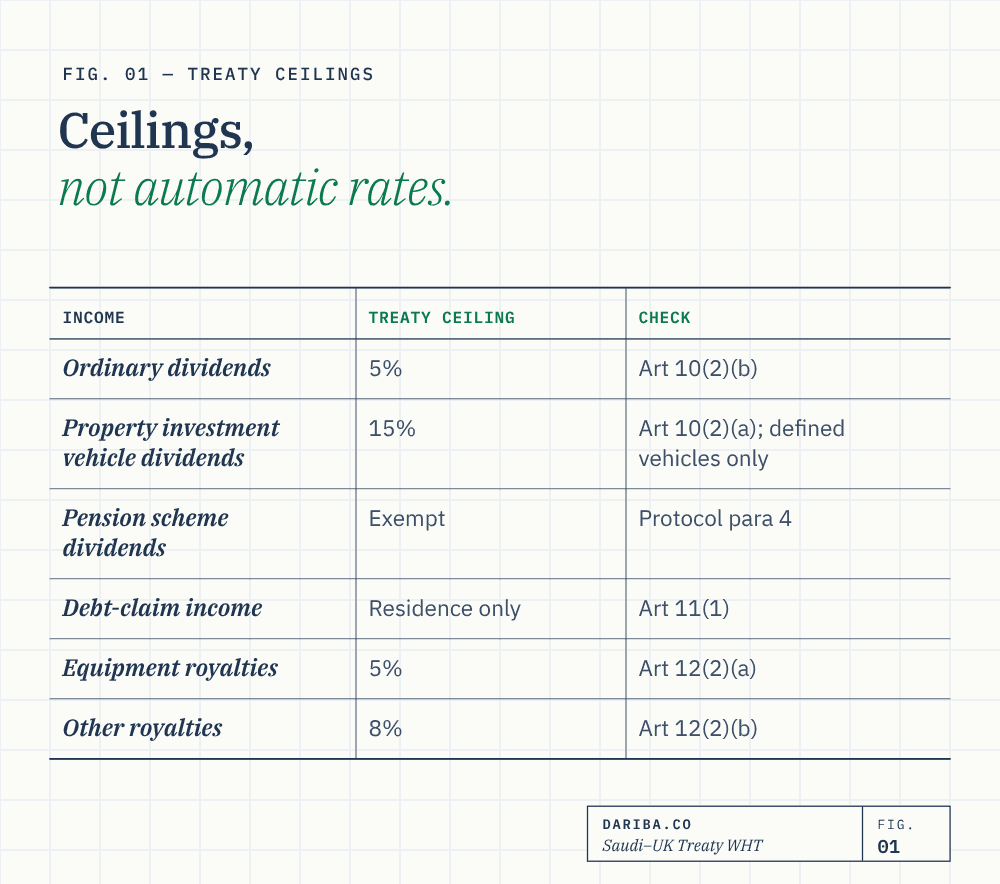
The following table shows treaty source-state limits, rather than a substitute for domestic classification or proof of entitlement. Residence, beneficial ownership where specified, effective connection and anti-abuse requirements remain relevant.
| Income | Treaty treatment relevant to Saudi source tax | Important qualification |
|---|---|---|
| Ordinary dividends | Article 10(2)(b): maximum 5% of gross dividends | Subject to the protocol pension exemption and the effective-connection rule |
| Qualifying dividends paid by a property investment vehicle | Article 10(2)(a): maximum 15% | Protocol paragraph 5 defines the vehicle and qualifying dividend; this is not every property company |
| Dividends beneficially owned by a qualifying pension scheme resident in the other state | Protocol paragraph 4: source-state exemption | Establish the scheme’s treaty residence and qualifying status |
| Income from debt-claims | Article 11(1): taxable only in the beneficial owner’s residence state | Subject to classification, effective connection and the special-relationship excess rule |
| Royalties for industrial, commercial or scientific equipment | Article 12(2)(a): maximum 5% of gross royalties | Establish the actual right to use equipment and its domestic classification |
| Other royalties within Article 12 | Article 12(2)(b): maximum 8% of gross royalties | A service or ordinary software purchase is not automatically a royalty |
| Business profits | Article 7: normally residence-state taxation unless attributable to a Saudi permanent establishment | Specific income articles and the insurance reservation require separate treatment |
Dariba analysis: a treaty ceiling does not create a higher Saudi tax charge. Current Implementing Regulations Article 63 ordinarily charges dividends at 5%. A 15% treaty ceiling therefore does not increase an otherwise applicable 5% domestic charge to 15%. Conversely, exemption may matter where the protocol’s pension conditions are established. Consider any applicable domestic exemption first.
Apply the dividend protocol rather than a single 5% label
Protocol paragraph 5 describes a widely held property investment vehicle distributing most of its income annually, deriving that income from immovable property within Article 6 and exempt from tax on that income. It also defines the qualifying dividend by reference to the vehicle’s distribution. Property ownership alone is insufficient.
Protocol paragraph 4 exempts dividends in the distributing company’s state where the beneficial owner is a pension scheme resident in the other contracting state. The protocol’s definition and residence provision therefore have practical significance, beyond confirming an account’s investment purpose.
Article 10(4) must also be checked where the shareholding is effectively connected with a Saudi permanent establishment or fixed base. In that situation Article 7 or 14, as appropriate, replaces the ordinary Article 10(1)–(2) treatment. Simply having an unrelated Saudi branch does not establish the required connection.
Dariba recommendation: retain the distribution resolution, identity of the beneficial owner, scheme constitution and status where relevant, residence material, property-vehicle analysis where relevant, and evidence addressing effective connection and treaty abuse. An entry in a broker’s dividend report is unlikely to answer all those questions.
Distinguish debt-claim income from dividends and excessive related-party returns
Article 11(1) allocates qualifying debt-claim income exclusively to the state where its beneficial owner is resident. That can remove Saudi source withholding on an eligible UK resident’s income; it is conditional relief rather than a universal exemption for anything called financing.
Article 11(2) covers the specified securities and income from money lent. Protocol paragraph 6 excludes items treated as dividends under Article 10. Article 11(3) directs an effectively connected debt claim to Article 7 or 14. Article 11(4) limits the article’s treatment to the amount independent parties would have agreed where a special relationship causes an excess; the excess requires separate analysis under domestic law and the other treaty provisions.
Official example: ZATCA’s WHT treaty circular, section 3.2.9, considers a resident of a hypothetical State X receiving debt-claim income from Saudi Arabia. Its residence-only outcome assumes the relevant treaty grants that result, the recipient is the beneficial owner and the stated permanent-establishment conditions are met. It is a general illustration, rather than an express ruling on a particular UK loan.
Dariba original illustration: assume SAR 1,000,000 is genuine debt-claim income beneficially owned by an eligible UK treaty resident, with no relevant effective connection, excessive related-party element or anti-abuse failure. At the ordinary 5% domestic loan-return rate, withholding would be SAR 50,000. Article 11 can reduce Saudi source tax to nil, subject to the relief process. This comparison does not determine whether a particular instrument is debt or equity.
Separate equipment royalties, other royalties and services
Article 12 distinguishes equipment royalties at a 5% ceiling from other defined royalties at an 8% ceiling. Its definition covers the stated intellectual-property rights, equipment use and industrial, commercial or scientific know-how. Apply the rights granted and actual obligations, rather than the invoice description alone.
Domestic Regulations Article 63 distinguishes rent at 5% from royalties at 15%. Treaty classification and domestic classification must each be performed. An equipment payment is not necessarily a 15%-to-5% saving: if its proper domestic treatment already produces 5%, the 5% treaty ceiling does not create an additional reduction.
Dariba original illustration: a SAR 1,000,000 trademark royalty properly subject to the domestic 15% royalty rate produces SAR 150,000 before treaty relief. Where all Article 12 conditions are satisfied, the 8% ceiling produces SAR 80,000, a SAR 70,000 difference. These are gross-payment figures; an agreement promising a net receipt requires a separate gross-up calculation.
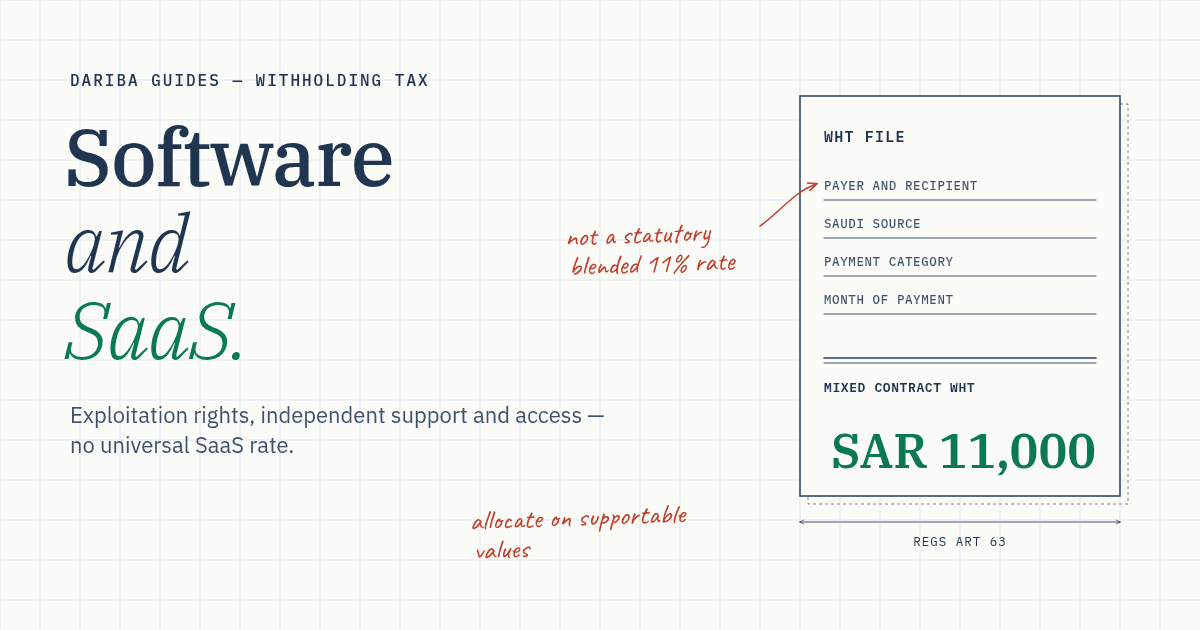
Article 12(4) deals with effectively connected rights/property; Article 12(5) addresses source, including liabilities incurred and borne by a permanent establishment or fixed base; Article 12(6) separates an excessive special-relationship amount. Do not apply 8% mechanically to an entire bundled payment. See the software guide for the distinction between acquiring software, licensing exploitation rights and receiving services.
Test business services against the actual permanent-establishment provisions
Article 7 can protect an eligible UK enterprise’s business profits from Saudi tax where it has no Saudi permanent establishment. Article 7(5), however, preserves the operation of specific income articles. Protocol paragraph 3(b)‘s broad business-profits description does not displace the specific royalty treatment for equipment use. Individual professional services require Article 14 analysis, rather than an automatic corporate-services conclusion.
The Convention contains no separate technical-services fee article equivalent to the generic Article 12A discussed in some model-based explanations. That does not make every technical invoice exempt: first establish whether it is business profits, royalties, an individual’s services or another actual category.
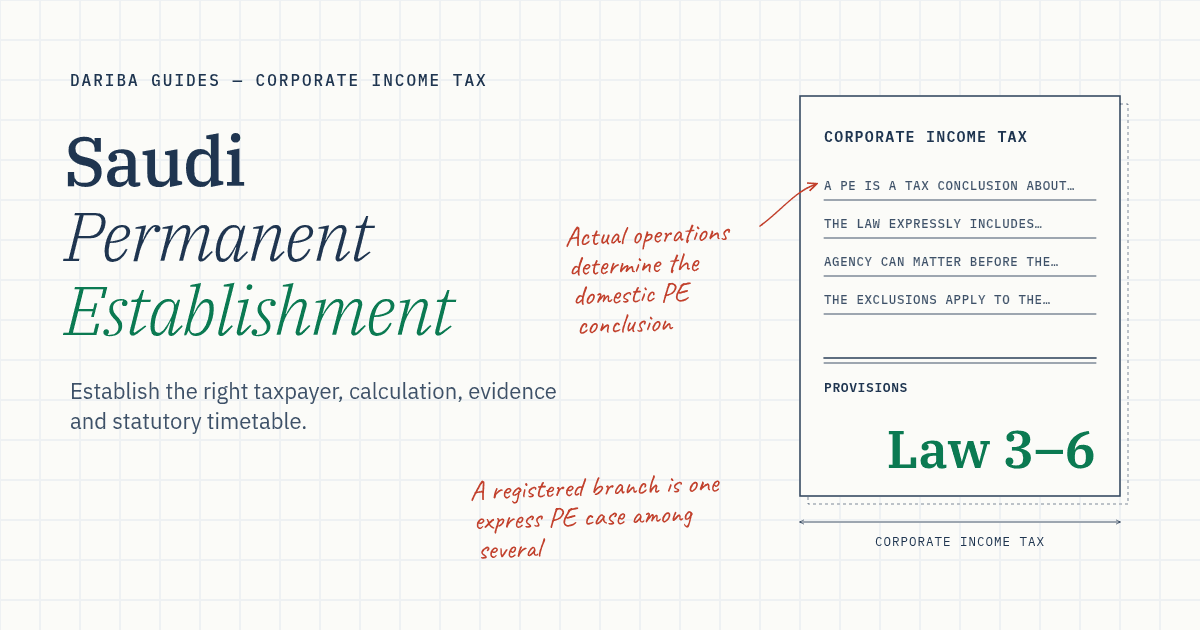
Article 5 includes fixed-place and agency routes, as well as construction, assembly, installation or related supervisory activity lasting more than six months, and services through employees or other personnel for the same or a connected project aggregating more than 183 days within any twelve-month period in the country. The service threshold is not a calendar-year test or a general permission to maintain a Saudi office without a permanent establishment.
The applicable MLI anti-fragmentation provision, Article 13(4), also restricts the specific-activity exceptions where its same/closely related enterprise, complementary-function and cohesive-operation conditions are met. MLI Article 15 supplies the relevant closely related definition, including its more than 50% ownership formulation and factual control test. Do not replace it with a domestic related-party threshold.
The UK reserved against MLI Article 12. Consequently, Saudi Arabia’s adoption of the broader MLI agency provision does not by itself rewrite this treaty’s agent test. The Convention’s habitual exercise of authority to conclude contracts and its independent-agent conditions remain material.
Finally, Article 7(6) preserves the specified operation of domestic laws taxing non-resident insurance profits relating to local risks, subject to its terms. The usual business-services analysis should not be extended into a blanket insurance exemption. See the insurance computation guide and the general permanent-establishment guide for the separate domestic issues.
Address the principal purposes test and the relief process
MLI Article 7(1) replaces the Convention’s original Article 28. It can deny a benefit where, considering all relevant facts, obtaining that benefit was one of an arrangement’s principal purposes, unless granting it accords with the object and purpose of the relevant provisions. It is not confined to the original wording about creating or assigning particular rights.
Dariba recommendation: record the commercial arrangement, functions, decision-making, beneficial ownership, actual payment rights and reasons for the structure. A certificate and a rate calculation do not by themselves answer the principal purposes test.
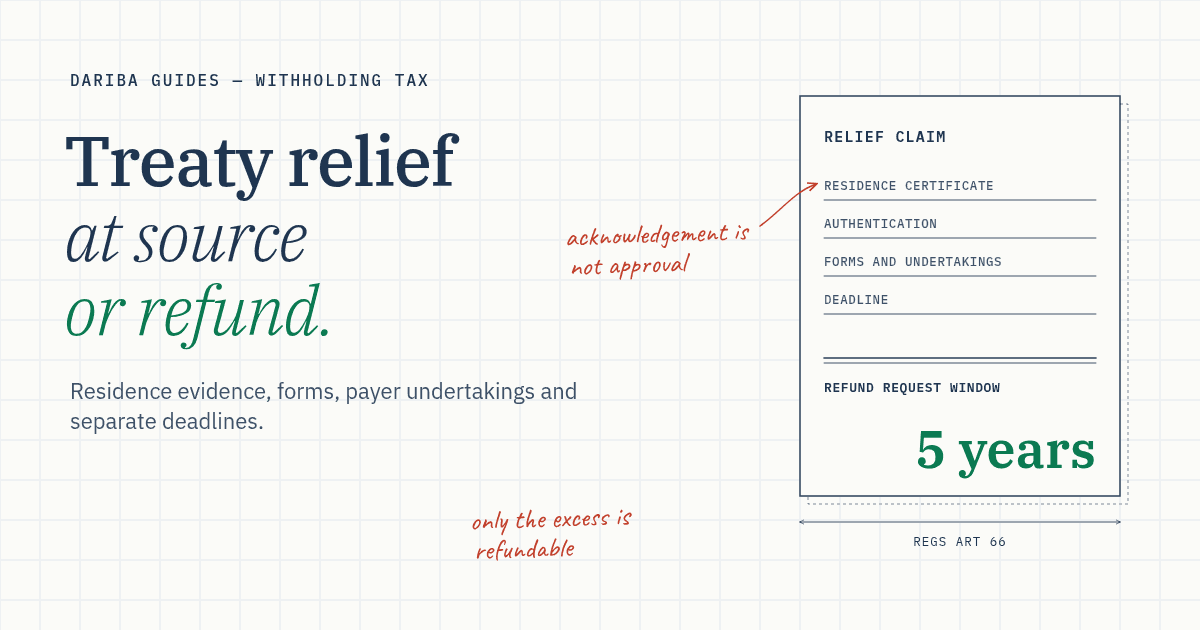
ZATCA’s WHT treaty circular, section 4.2, distinguishes relief at source from withholding followed by a refund application. Each has documentation and procedural requirements. Use the treaty relief and refund guide before implementing a reduced rate. A lodged request or acknowledgement should not be treated as verified entitlement or approval.
Protect the modified MAP deadline separately
For cases within the MLI’s effective MAP provisions, Article 16(1) permits presentation to either state’s competent authority within three years from the first notification of the action producing treaty-inconsistent taxation. It replaces Article 25(1)‘s original two-year period and alternative six-year wording. Do not carry those old periods forward as the current rule.
The MAP modification applies to cases presented on or after 1 May 2020, except cases that were already ineligible on that date under the pre-modification Convention, regardless of the taxable period concerned. It therefore has a different commencement mechanism from the withholding changes.
The applicable MLI Article 16(2) implementation sentence addresses domestic time limits for an agreement reached. It does not make every late application admissible or guarantee that the authorities agree. Preserve domestic objections, refund applications, collection requirements and any requested procedural suspension separately. The MAP guide explains those practical distinctions.
The working file should end with a supported conclusion for the actual recipient, income, amount and period, together with the completed relief steps. That is more useful than a country rate copied into the payment system without its legal conditions.
Key takeaways
- Treaty residence and beneficial ownership require separate evidence.
- The protocol contains a pension-scheme dividend exemption.
- Equipment and other royalties have different treaty ceilings.
- A treaty ceiling cannot increase a lower domestic tax charge.
- Services require the actual category and permanent-establishment analysis.
- MLI anti-abuse and MAP changes have their own conditions and dates.
Sources
- Saudi–UK Double Taxation Convention and original ProtocolConvention signed 31 October 2007; Articles 1, 4–5, 7, 10–12, 25, 28–29 and Protocol paragraphs 1–6, including the pension-scheme dividend exemption.
- Multilateral Convention to Implement Tax Treaty Related Measures to Prevent BEPSArticles 7, 13, 15, 16 and 35; apply subject to the two states’ reservations, notifications and effective dates.
- Saudi Arabia MLI reservations and notifications deposited 23 January 2020Article 4 reservation and relevant treaty notifications; Saudi adoption alone does not establish every bilateral match.
- United Kingdom MLI reservations and notifications deposited 29 June 2018Article 12 reservation and relevant Article 7, 13 and 16 notifications; read with the joint synthesised text.
- Income Tax Implementing Regulations, current amended Arabic textArticle 63: domestic categories, rates, gross base and reporting; Article 66: excess-payment refund period and conditions.
- ZATCA Implementation of Withholding Tax under the Double Taxation Agreement, January 2025Sections 3.2 and 4.2: income classification, official hypothetical examples, benefit-at-source and refund documentation, approval and limitation. English guidance is read subject to the controlling Arabic text.
- Joint UK–Saudi synthesised text published by HMRC, 19 February 2021Joint reading aid for the effective MLI modifications; authentic treaty, protocol and MLI remain controlling.
General information only. Actual supplies, facts, applicable periods and controlling Arabic legislation determine the result. Official examples are distinguished from Dariba analysis and original illustrations. Seek advice or clarification where the arrangement or source material leaves a specific issue unresolved.