In brief
Separate conditional treaty ceilings from lower domestic rates, identify the targeted debt-income exemption and classify services before implementing withholding relief.
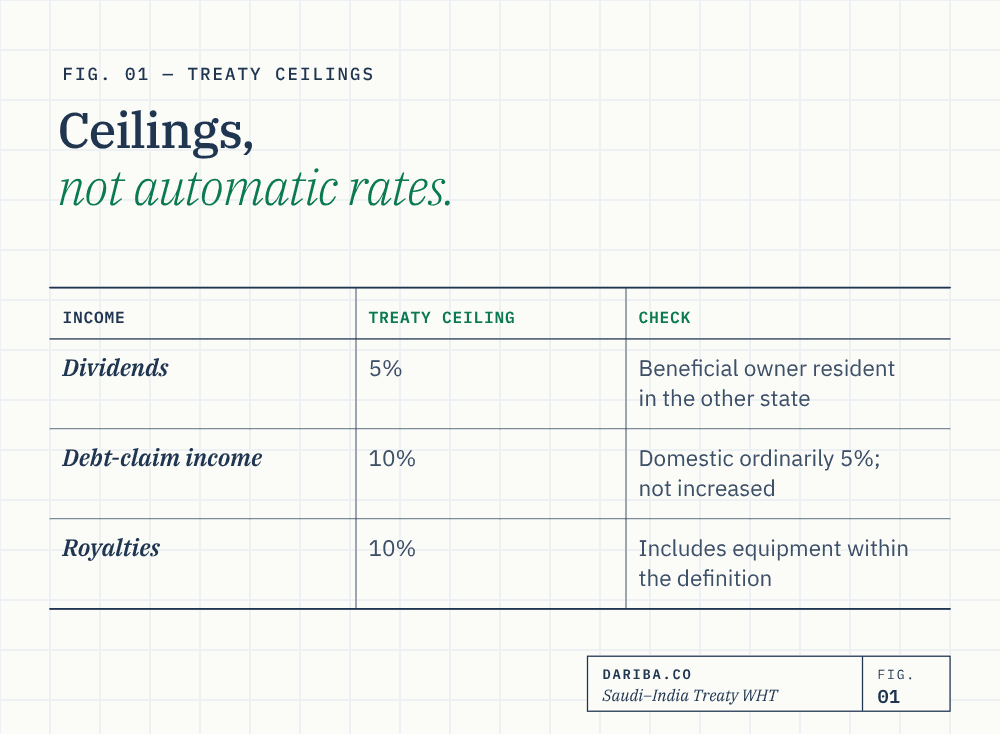
The Saudi–India treaty can protect a payment without producing the same result as another Saudi treaty. Its ordinary dividend ceiling is 5%, its debt-income ceiling is 10%, and its royalty ceiling is 10%. Those figures are conditional limits on source taxation. They do not establish a new domestic charge or increase a lower Saudi domestic rate.
For a Saudi payer, the useful sequence is to establish domestic liability, classify the payment under this particular Convention, test entitlement and effective connection, and then implement the appropriate relief procedure. A rate table is only one part of that analysis.
Establish residence and the applicable treaty period
Article 4(1) generally requires liability to tax by reason of domicile, residence, place of management or a similar criterion. Source-only liability is excluded. The original Protocol extends residence to specified government bodies, certain exempt organisations and pension funds, and an Indian national present in Saudi Arabia for at least 183 days in the fiscal year. That individual residence rule is distinct from the enterprise service-PE test of more than 182 days in any twelve-month period.
For a dual-resident person other than an individual, Article 4(3) uses place of effective management. Saudi Arabia reserves the entirety of MLI Article 4, so the MLI does not automatically replace that rule with a competent-authority agreement requirement. Residence evidence must address the actual recipient and period; a group parent’s certificate does not establish a subsidiary’s entitlement.
The Convention entered into force on 1 November 2006. Article 28 first applies it in Saudi Arabia to amounts paid or credited from 1 January 2007 and to taxable years beginning from that date; the Indian income-period rule starts with fiscal years beginning from 1 April 2007. The relevant MLI changes have their own commencement. For Saudi application, the ordinary Article 35 rules produce withholding commencement on 1 January 2021 and other-tax commencement for taxable periods beginning on or after 1 November 2020. India’s taxable-period election and April fiscal year ordinarily produce application from 1 April 2021. These are period rules, not a statement that every assessment made after those dates is governed by identical wording.
References: Convention Articles 4 and 28; original Protocol 3–4; MLI Articles 4 and 35; deposited Indian and Saudi positions.
Dividends: apply the 5% ceiling without inventing a holding band
Article 10 allows residence-state taxation and permits source-state taxation, limited to 5% of the gross dividend where the beneficial owner is a resident of the other state. It does not introduce a lower participation rate or require a specified ownership percentage. Saudi Arabia’s reservation against MLI Article 8 also prevents importing that article’s 365-day holding condition into this treaty.
The ceiling does not affect taxation of the distributing company’s underlying profits. The dividend definition covers specified share and other corporate rights, excluding debt claims, together with income receiving the same tax treatment under the distributing company’s state law. If the relevant holding is effectively connected with the recipient’s source-state PE or fixed base, Article 10(4) redirects the analysis to Article 7 or 14. Merely finding that the recipient has some local PE is insufficient: the holding’s connection matters.
Article 10(5) separately restricts taxation by the other state of a foreign company’s dividends and undistributed profits, subject to its stated resident-recipient and effectively-connected-holding exceptions. It is not a general exemption for every distribution made through a multinational group.
Reference: Convention Article 10(1)–(5); Saudi deposited reservation under MLI Article 8.
Debt income: distinguish the ordinary ceiling from the targeted exemption
Article 11 ordinarily permits source-state taxation up to 10% of gross debt-claim income, provided the beneficial owner is a resident of the other state. Saudi domestic debt-income withholding is ordinarily 5%. A qualifying treaty ceiling of 10% therefore does not increase that domestic 5% charge or itself create a reduction.
Article 11(3) provides a separate source exemption where income is derived and beneficially owned by the specified other-state government, political subdivision or local authority; named institutions; or another financial institution wholly owned directly and controlled by that other-state government. The named Indian institutions are the Reserve Bank of India, Export-Import Bank of India and National Housing Bank. The signed text names the Saudi Arabian Monetary Agency on the Saudi side.
The recipient qualification is decisive. A government borrower does not make every interest payment exempt. Neither does an indirect government shareholding necessarily satisfy the express direct-ownership condition for the residual financial-institution category. Institutional identity, ownership and control need evidence rather than an inference from a public-sector name.
The definition covers debt claims of every kind and the additional money-lending income described in Article 11(4). Its exclusion of late-payment penalties does not declare those penalties tax-free; another classification must be considered.
Reference: Convention Article 11(1)–(4); Saudi Income Tax Implementing Regulations Article 63.
Apply debt-source, connection and related-party limitations separately
Article 11(5) redirects effectively connected debt claims to Article 7 or 14 where the beneficial owner carries on the relevant business or independent personal services through a PE or fixed base in the source state. The connection concerns the debt claim, not simply the existence of a branch.
Article 11(6) generally locates the debt income by payer residence, with an override where the payer has a PE or fixed base in a contracting state, the indebtedness was incurred in connection with it, and the income is borne by it. Article 11(7) limits the article’s protection to the amount that would have been agreed without the special relationship. The excess remains taxable under each state’s law, with due regard to the Convention’s other provisions.
ZATCA’s Implementation of Withholding Tax under the Double Taxation Agreement, section 3.2.9, gives an example of a beneficial owner receiving debt income where the applicable treaty grants the residence state exclusive taxing rights and there is no relevant PE. That is a generic official example, not an India-specific exemption. The Saudi–India analysis must additionally establish the conditions of its own Article 11, including the targeted recipient exemption where claimed.
References: Convention Article 11(5)–(7); ZATCA withholding-treaty circular, section 3.2.9.
Royalties: the 10% ceiling includes equipment within its definition
Article 12 permits source-state taxation up to 10% of gross royalties where the beneficial owner is a resident of the other state. Its definition includes the specified copyright, patents, trade marks, designs, models, plans, secret formulas or processes, industrial/commercial/scientific equipment, and information concerning industrial, commercial or scientific experience.
The definition does not expressly reproduce the computer-software wording found in the Saudi–Singapore treaty. Nor does it contain a general technical-services limb. That does not settle every software transaction: the rights granted, copyright exploitation, know-how transfer and actual services must be examined. An invoice labelled “subscription” or “consulting” cannot replace that examination.
Article 12(4) addresses effectively connected rights or property; Article 12(5) contains the payer-residence source rule and the PE/fixed-base incurred-and-borne override; Article 12(6) restricts protection of a special-relationship payment to its arm’s-length amount. All three limitations belong in the conclusion.
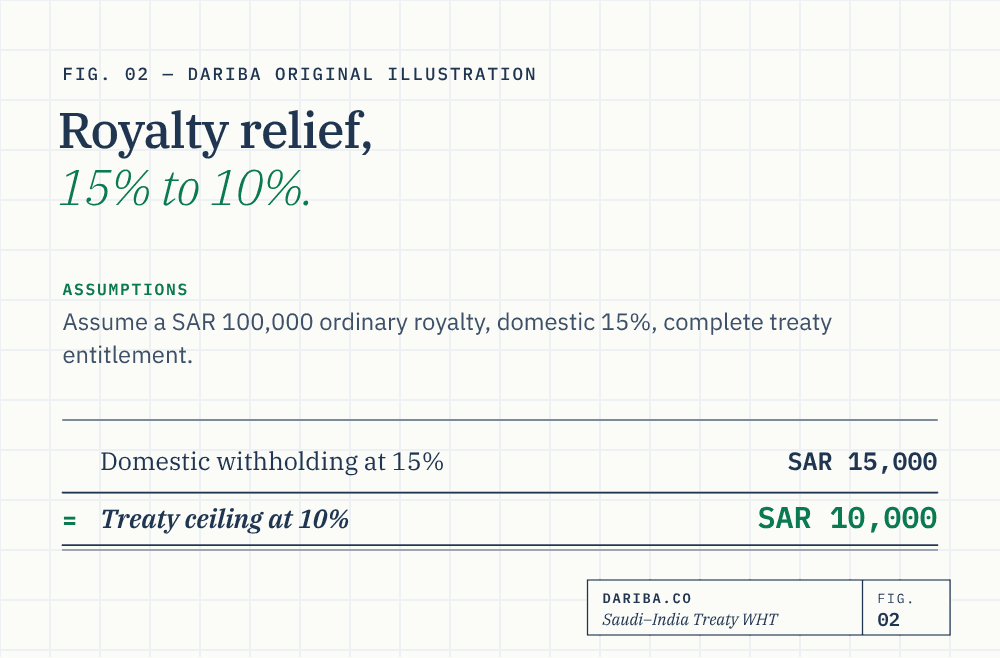
Dariba original illustration: assuming a SAR 100,000 ordinary royalty otherwise subject to Saudi domestic withholding at 15%, complete treaty entitlement and no relevant connection or excess-payment issue, the 10% ceiling reduces withholding from SAR 15,000 to SAR 10,000. A qualifying equipment rental ordinarily charged domestically at 5% is not increased to 10% merely because equipment appears in the treaty royalty definition. These illustrations assume no contractual gross-up.
References: Convention Article 12(1)–(6); Saudi Income Tax Implementing Regulations Article 63; ZATCA circular, section 3.2.10.
Technical services require classification rather than an invented treaty rate
The reviewed Convention has no separate fees-for-technical-services article. Original Protocol 15 requires a review after five years to consider incorporating one. A commitment to review does not itself insert an article, a withholding percentage or a “make available” condition.
Genuine enterprise services therefore require examination under Article 7 and the applicable PE tests, unless another income article governs. This is a conditional analysis: royalties, independent personal services and effectively connected income cannot all be collapsed into a single no-PE service exemption. The India PE and profit guide addresses those enterprise conditions.
ZATCA’s circular, section 3.2.5, illustrates an enterprise providing online consultancy without creating a PE, with the treaty allocating the relevant business profits to its residence state. That official generic example supports the analytical sequence; it does not resolve an Indian supplier’s actual rights, personnel, project connections or agency arrangements. The advisory value is to identify which facts could change the result before payment.
References: Convention Articles 5, 7, 12 and 14; original Protocol 15; ZATCA circular, section 3.2.5.
Document anti-abuse entitlement and implement relief
Apply the effective MLI principal-purpose test: a benefit may be denied where obtaining it was one of the principal purposes of an arrangement or transaction, unless granting it accords with the object and purpose of the relevant treaty provisions. Original Article 26 also addresses domestic anti-evasion rules and entities without bona fide business activities. India’s election for the simplified limitation-on-benefits rule does not, by itself, make that optional rule applicable to Saudi Arabia, which did not make the corresponding choice or consent in the deposited position reviewed.
ZATCA’s circular, section 4, distinguishes benefit at source from refund procedures. Maintain the residence and beneficial-ownership evidence, agreement, payment classification, PE analysis, ownership evidence where required, and the documentation for the selected administrative route. Treaty analysis does not itself complete a withholding return or refund application. See Saudi treaty relief at source and refunds for that process.
Article 24 allows a case to be presented to the competent authority of the taxpayer’s residence state within three years of the first notification of the action producing taxation contrary to the Convention. India reserves the MLI sentence that would ordinarily introduce an either-authority route. Do not assume that route applies here, or that MAP pauses domestic objection deadlines. Article 23 separately provides a credit limited to the residence-state tax attributable to income taxable in the other state; a credit is not necessarily recovery of tax collected beyond the treaty limit.
References: Convention Articles 23, 24 and 26; MLI Articles 7 and 16 and deposited positions; ZATCA circular, section 4.
Key takeaways
- The ordinary dividend ceiling is 5%; the ordinary debt and royalty ceilings are 10%.
- A 10% treaty ceiling does not increase an ordinary lower 5% Saudi domestic debt-income rate.
- The debt exemption depends on the specified beneficial recipient, not merely a government payer.
- Equipment is within the royalty definition, but the treaty does not increase a lower domestic rental charge.
- The Protocol’s five-year technical-services review commitment does not itself create an FTS article.
- Official generic ZATCA examples need this treaty’s actual conditions before application.
- Saudi and Indian MLI commencement follows different withholding and taxable-period rules.
- The original residence-state MAP route is not automatically replaced by an either-authority route.
Sources
- Saudi–India Convention and original Protocol, signed 25 January 2006Articles 4–5, 7, 10–12, 23–24, 26 and 28; original Protocol 3–9 and 15. English prevails on divergence of interpretation.
- India MLI reservations and notifications, deposited 25 June 2019Actual deposited position, not the earlier signature position. Articles 7, 12–13, 16 and 35; Article 12(6) identifies treaty Article 5(7).
- Saudi Arabia MLI reservations and notifications, deposited 23 January 2020Reservations under Articles 4 and 8; Article 12(5) identifies India Article 5(5)(a), while Article 12(6) identifies 5(6), differing from India’s 5(7). Do not silently correct the mismatch.
- Multilateral Convention to Implement Tax Treaty Related Measures to Prevent BEPSArticles 7, 12–16 and 35; notification conditions and reservations govern actual application.
- OECD current list of MLI signatories and partiesIndian entry into force 1 October 2019; Saudi entry into force 1 May 2020. Follow deposited positions rather than signature-stage choices.
- Saudi Income Tax Law, current amended Arabic textDomestic source, liability and withholding framework distinct from treaty limitations.
- Saudi Income Tax Implementing Regulations, current amended Arabic textArticle 63 domestic payment categories and rates, including ordinary debt income, equipment rental and royalties.
- ZATCA Implementation of Withholding Tax under the Double Taxation Agreement, January 2025Sections 3.2.5 and 3.2.9 give generic enterprise-service and debt-income examples, not India-specific rulings. Section 4 addresses benefit-at-source and refund routes.
General information only. Apply actual facts, periods, domestic law and authentic treaty instruments. English prevails on interpretation divergence under the Convention and original Protocol. The independent-agent MLI notification mismatch is expressly qualified. Official generic examples and Dariba original illustrations are distinguished; seek clarification where a material issue remains unresolved.