In brief
Prepare Saudi WHT treaty relief at source or a refund claim, with residence evidence, authentication, forms, payer undertakings and separate deadlines.
A Saudi tax treaty may reduce withholding tax, but establishing the treaty result and obtaining relief are separate tasks. ZATCA’s Implementation of Withholding Tax under the Double Taxation Agreement, version 1, January 2025, section 4.2, describes two routes: benefit at source and withholding followed by a refund request. The payer needs an evidence file and a workable payment process for the chosen route.
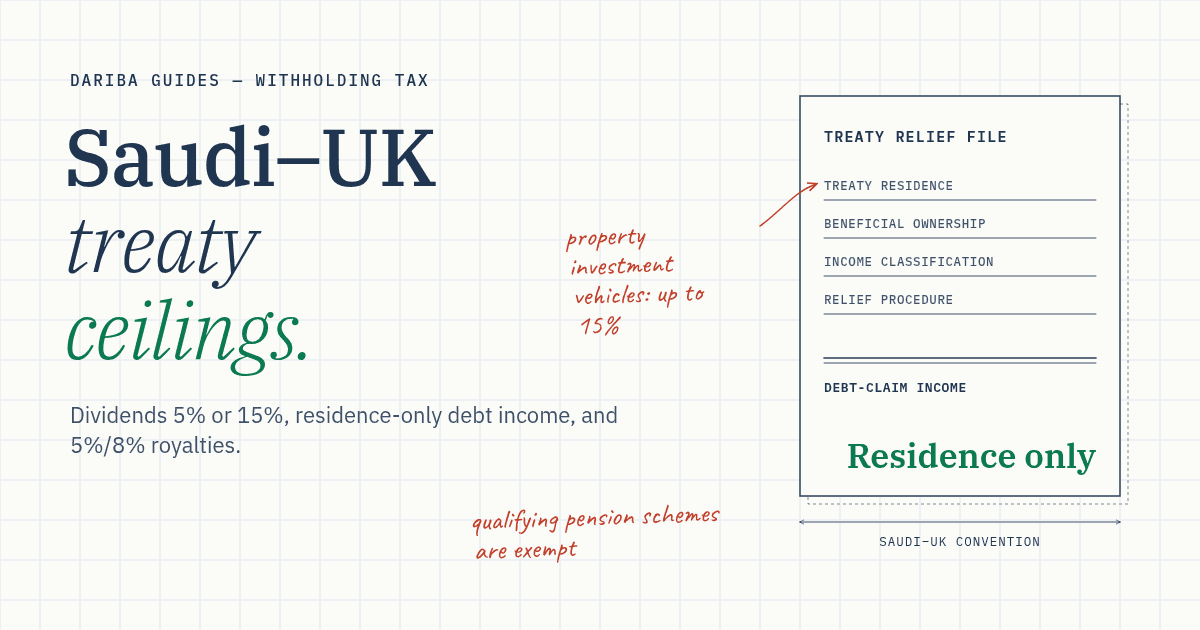
This guide explains that procedure. Rates and entitlement remain specific to the actual agreement, income, recipient and period; the Saudi–UK guide illustrates why a treaty, its protocol and effective MLI changes must be read together.
Determine the domestic liability before claiming treaty relief
Begin with the actual payer, non-resident recipient, source, income category and settlement. Current Income Tax Implementing Regulations Article 63 sets the domestic withholding framework; a foreign remittance is not automatically taxable, and an expense’s deductibility does not establish its withholding treatment.
Then identify the agreement in force for the relevant period, covered person and taxes, residence, income article, permanent-establishment or fixed-base connection, beneficial ownership where required, and applicable anti-abuse provisions. Check effective protocols and MLI modifications rather than importing another country’s rate or a generic model article.
Dariba analysis: the application should explain both the domestic starting point and the treaty change. A form showing only a lower percentage leaves the reviewer unable to see why that percentage applies. Conversely, a treaty ceiling above the applicable domestic rate does not increase the domestic charge.
Use official examples within their actual assumptions
Official example: section 3.2.5 of ZATCA’s WHT treaty circular describes Company A, resident in hypothetical State R, supplying online consultancy to a Saudi resident or permanent establishment. The example assumes those services do not constitute a Saudi permanent establishment and applies the treaty’s business-profits allocation. It does not establish that every remotely delivered service is exempt under every Saudi treaty.
Official example: section 3.2.8 considers dividends paid through a resident of a treaty state that merely passes them to an actual beneficial owner in a different state without a Saudi treaty. The circular explains why the intermediary’s residence does not by itself secure the claimed benefit.
Dariba recommendation: use these examples as questions for the evidence file. Establish what was supplied, which treaty article governs it, who can use and enjoy the income, what further payment obligations exist, and what activities occur in Saudi Arabia. A residence certificate authenticates an important fact; it does not prove every other condition.
Prepare the benefit-at-source application
The circular’s section 4.2, benefit-at-source discussion, states that the person responsible for withholding can request a reduced rate or exemption through ZATCA’s portal. It requires:
- A tax residence certificate from the foreign tax authority. The circular accepts the form issued by that treaty partner’s authority rather than prescribing one universal certificate format.
- The application for the effective treaty under ZATCA’s approved forms.
- Authentication of the specified documents by the Saudi embassy in the non-resident’s state, or the alternative foreign-authority apostille described in the circular.
- The resident taxpayer’s Form Q/7C undertaking concerning tax and penalties resulting from false or incorrect information, calculation error or treaty misinterpretation.
The undertaking is commercially significant. It is not evidence that a supplier’s asserted treaty position has been checked, and it does not transfer the payer’s public-law responsibility to the supplier simply because the contract contains an indemnity.
Dariba recommendation: complete the entitlement review before signing the undertaking. Have the service/right owner, finance team and tax reviewer agree the facts, classification, gross base and requested result. Where a supplier promises to provide evidence later, identify who bears the resulting payment and tax exposure in the meantime.
Distinguish acknowledgement from approval
The circular’s section 4.2.2.2 describes an acknowledgement after the application is lodged, followed by ZATCA’s review and approval once it verifies that the claimed treaty benefits apply. An acknowledgement therefore demonstrates receipt, rather than a decision accepting the tax position.
The current Double Taxation Avoidance Agreements Application service identifies Form Q7B, the relevant applicant categories and the form’s signature/certification steps. Read the live service instructions with the circular, including the applicable authentication route. A short service-duration estimate is not a guarantee of a final substantive relief decision within that time.
Dariba recommendation: retain the submission, attachments, acknowledgement, information requests and actual approval, including its scope. Reconcile the approved person, income, period and amount to the payment being processed. Do not assume that an earlier approval for one contract automatically covers a changed recipient, licence or arrangement.
Use the refund route where the at-source requirements cannot be met
Under the refund discussion in section 4.2, the domestic withholding is first paid to ZATCA and an application then seeks the tax, or difference, recoverable under the treaty. The circular directs resident withholding persons unable to comply with the benefit-at-source route to follow this approach.
The refund documentation includes the foreign tax authority’s residence certificate, the approved treaty application, and the non-resident’s authorisation allowing the resident taxpayer to receive the refund on its behalf. The circular requires the described embassy authentication or apostille for the specified documents.
It also requires a copy of the relevant withholding return and receipt proving payment to ZATCA, plus a resident-taxpayer letter attested by the Chamber of Commerce confirming that the amount claimed has not already been refunded, transferred to another taxpayer or settled against another liability.
Dariba analysis: residence and entitlement explain why the amount should be relieved; the return, receipt and no-duplicate-recovery confirmation explain which paid tax is being recovered. A general ledger provision or a supplier credit note is not the same as evidence that the withholding was remitted.
Reconcile the gross amount, tax paid and actual refund claim
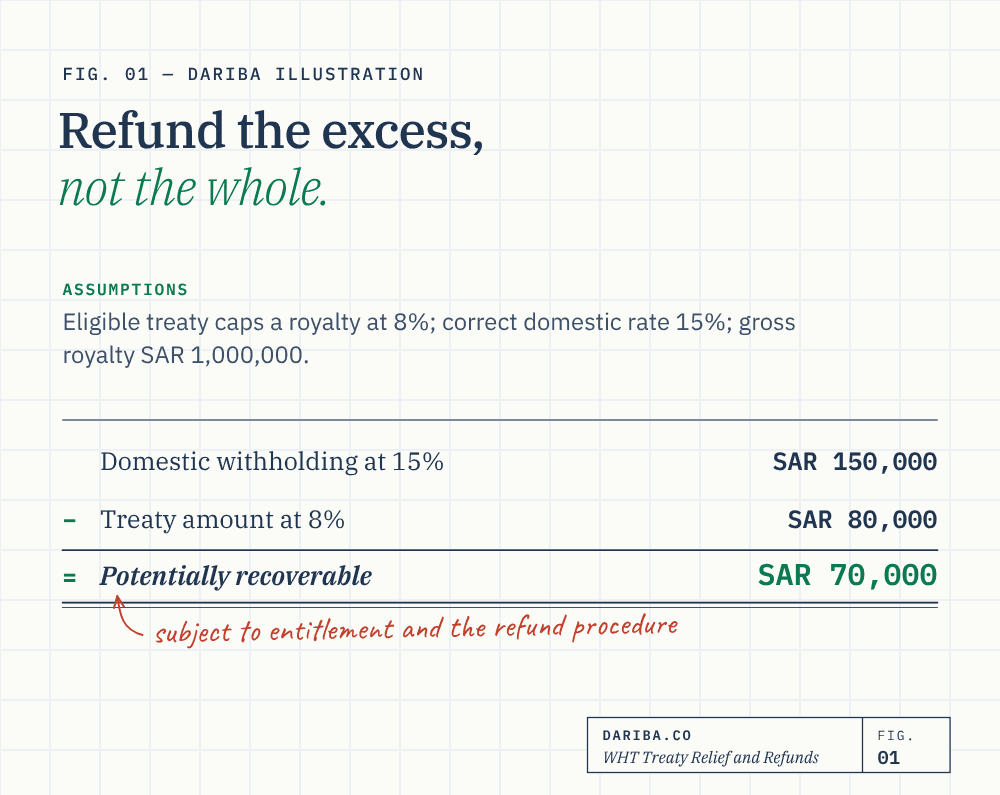
Dariba original illustration: assume an eligible treaty caps a particular royalty at 8%, the correct domestic rate is 15%, and the agreed gross royalty is SAR 1,000,000. Domestic withholding is SAR 150,000. The treaty amount is SAR 80,000, so the difference potentially recoverable is SAR 70,000, subject to entitlement and the refund procedure. The entire SAR 150,000 is not refundable merely because treaty relief is available.
If the contract instead guarantees the supplier a net receipt and the payer bears withholding, first establish the correct gross-up treatment and approved relief position. Do not transplant the gross-payment illustration into a net-price contract without recalculating it. Nor should a payment covering services, equipment use and intellectual-property rights be assigned one royalty rate without analysing the components.
Dariba recommendation: use a transaction schedule tying the contract, invoice, gross consideration, recipient payment, return period, tax payment reference, treaty calculation and requested refund together. Record the authority to receive the refund and the contractual obligation to pass it to the beneficiary where applicable. Track recovery until the actual settlement is reconciled.
Keep refund, MAP and objection deadlines separate
The circular’s section 4.2.2.2 emphasises a five-year application limitation and refers to Implementing Regulations Article 66. Article 66(1) describes an excess-payment refund request within five years of the tax year for which the overpayment was made, submitted by the taxpayer or its formally authorised representative. Do not simply measure every claim as five years from the date someone notices the issue or obtains a certificate.
Article 66 also addresses unfiled returns and amounts under objection or appeal. These conditions require attention where a treaty refund forms part of a disputed liability. Its ordinary overpayment framework should be read with the actual treaty and any effective modifications; a possible treaty issue is not authority to ignore the domestic process.
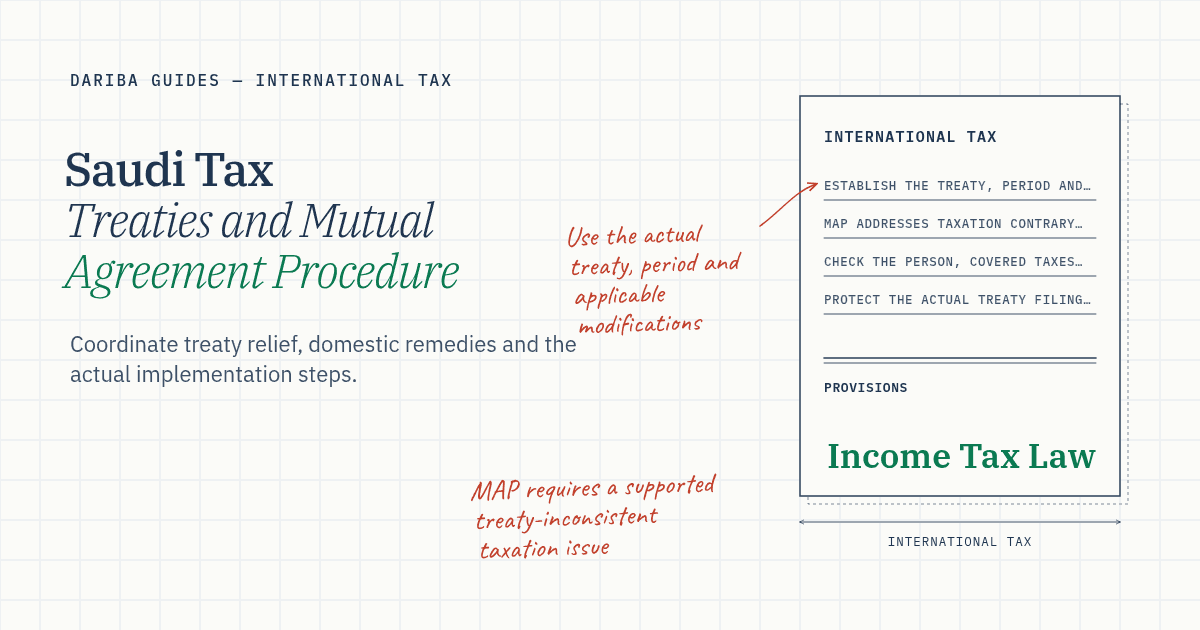
MAP is a separate remedy with the agreement’s own time limits and effective provisions. For example, the modified Saudi–UK treaty uses a three-year first-notification rule for cases within its effective MAP provisions. That does not convert the refund procedure into a three-year process or make a late MAP case admissible merely because a domestic refund period remains open.
Use the MAP guide and CIT refund guide where relevant. Protect the actual domestic objection and committee deadlines separately; an application for treaty relief should not be assumed to suspend another clock.
Maintain withholding compliance while resolving entitlement
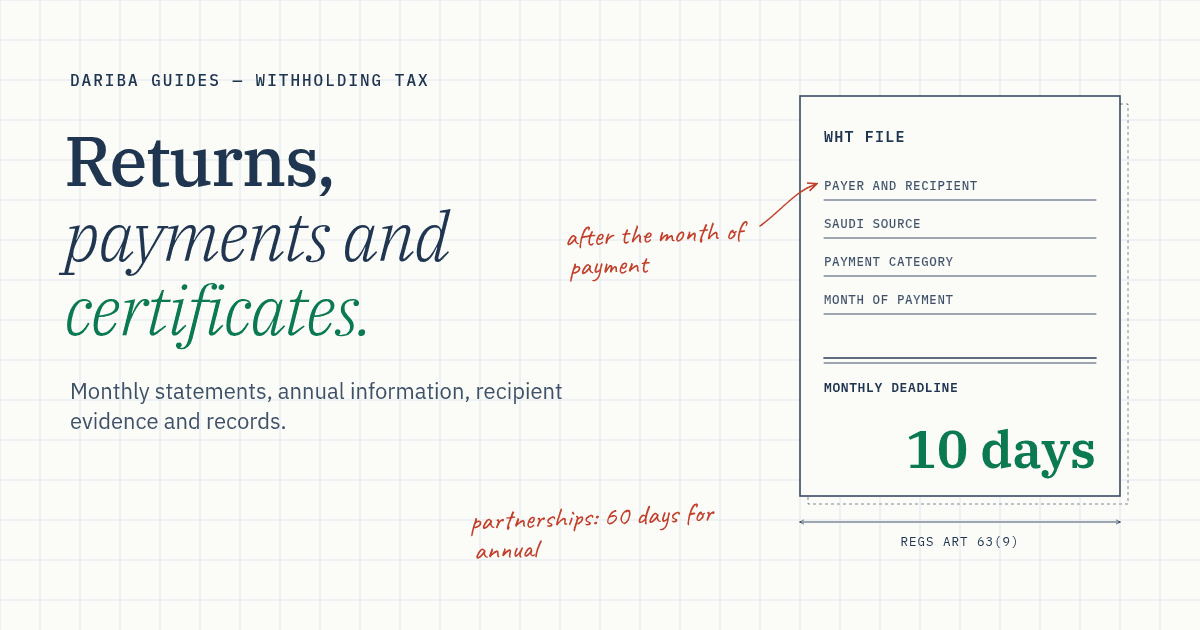
Current Regulations Article 63(9) and ZATCA’s General Withholding Tax Guideline, section 5, address monthly and annual reporting, certificates and records. A pending application should not be assumed to cancel ordinary filing and payment obligations. Establish the applicable reporting treatment for the payment and actual relief approval, rather than deleting the transaction from the withholding reconciliation.
The withholding compliance guide distinguishes payment, monthly filing, annual information and recipient certificates. Preserve the entitlement and procedural file with that compliance evidence, and review whether later changes in residence, ownership, contractual rights or Saudi activities affect the conclusion.
The practical deliverable is a defensible treaty position and a completed relief route, reconciled to the actual payment. A lower rate in a spreadsheet or a submitted form is only one step toward that result.
Key takeaways
- Entitlement and the relief procedure are separate tasks.
- Benefit at source requires the prescribed evidence and undertaking.
- Acknowledgement differs from approval.
- A refund needs evidence of tax paid and authority to receive it.
- Claim only the supported difference and reconcile the gross base.
- Refund, MAP and domestic objection clocks remain separate.
Sources
- ZATCA Implementation of Withholding Tax under the Double Taxation Agreement, January 2025Sections 3.2 and 4.2: income classification, official hypothetical examples, benefit-at-source and refund documentation, approval and limitation. English guidance is read subject to the controlling Arabic text.
- Income Tax Implementing Regulations, current amended Arabic textArticle 63: domestic categories, rates, gross base and reporting; Article 66: excess-payment refund period and conditions.
- ZATCA General Withholding Tax Guideline, second version May 2026Section 5: monthly and annual reporting, certificates and records, separate from treaty entitlement.
- ZATCA Double Taxation Avoidance Agreements Application serviceCurrent Q7B application, applicant categories, signature and certification steps; read alongside the circular’s authentication and undertaking requirements.
General information only. Actual supplies, facts, applicable periods and controlling Arabic legislation determine the result. Official examples are distinguished from Dariba analysis and original illustrations. Seek advice or clarification where the arrangement or source material leaves a specific issue unresolved.