In brief
The 5% dividend and debt ceilings and 8% royalty ceiling are starting points for a conditional analysis of the recipient, payment, government status and relief procedure.
A Saudi payment to a Singapore recipient needs more than a country selection and a rate lookup. The Saudi-Singapore Agreement contains separate rules for ordinary investors, government recipients and trustees. Its royalty definition also expressly mentions computer software and equipment. Those provisions can produce different answers for payments that appear similar on an accounts-payable report.
This guide addresses selected Saudi outbound payments under the Agreement signed on 3 May 2010, its original Protocol and the effective Multilateral Instrument (MLI) modifications. The PE companion explains the connected project, agency and attributable-profit questions.
Establish treaty residence and the relevant period
Articles 1 and 4 require treaty residence. Incorporation, a Singapore bank account or a supplier’s address does not establish every entitlement condition. For a dual-resident entity, Article 4(3) uses the place of effective management. Singapore’s reservation against MLI Article 4 leaves that original rule relevant.
Original Protocol 2 includes specified generally tax-exempt legal persons constituted, established and maintained in the state for the stated religious, charitable, educational, scientific or similar purposes, or to provide employee pensions or similar benefits under a plan. This expands the residence analysis on its actual conditions; it does not exempt every receipt of every exempt entity.
The Agreement entered into force on 1 July 2011. Article 29 makes its Saudi withholding provisions applicable to amounts paid from 1 January 2012 and its other Saudi provisions applicable to taxable years beginning from that date. Singapore’s separate commencement refers to years of assessment beginning from 1 January 2013. The headline effective date should not replace the relevant state’s detailed rule.
For the matched MLI changes, distinguish entry into force from entry into effect. Applying MLI Article 35(1) to the later entry-into-force date of 1 May 2020 gives the Saudi commencement of 1 January 2021 for relevant withholding events and taxable periods beginning on or after 1 November 2020 for other taxes. IRAS’s Annex A separately states Singapore’s commencement conditions. Historic payments require their own period review.
Both Arabic and English texts of this Agreement and original Protocol are authentic. A priority clause found in another country’s treaty cannot be imported here.
Read each ceiling against the domestic payment category
Begin with Saudi source and liability rules, Article 68 of the Income Tax Law and Article 63 of its Implementing Regulations. Then consider the treaty’s classification, recipient conditions and restrictions on source taxation.
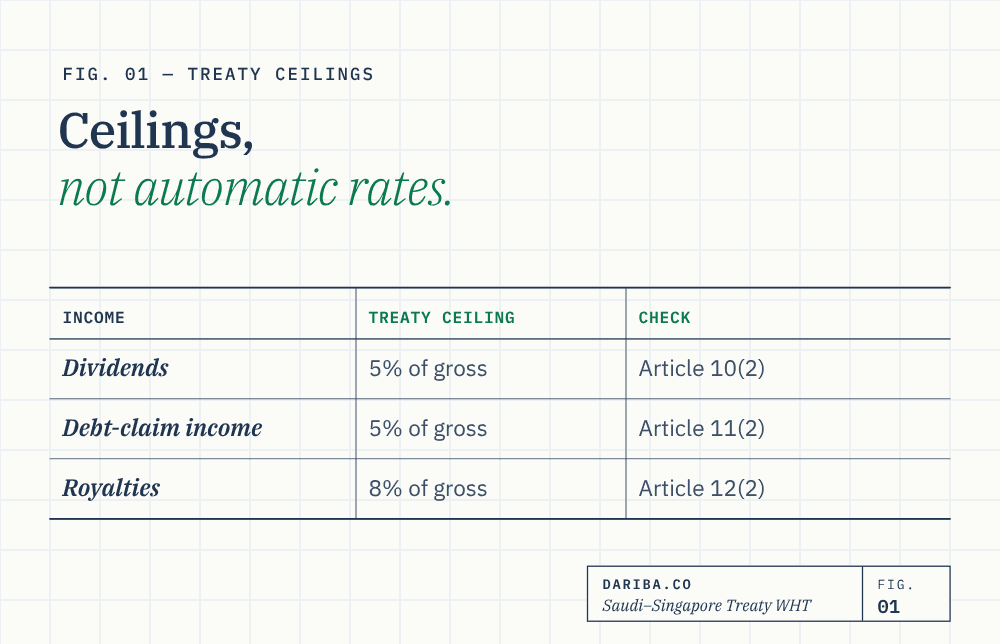
| Receipt, where the relevant conditions are met | Ordinary treaty source-tax ceiling | Provision |
|---|---|---|
| Dividends beneficially owned by a resident of the other state | 5% of gross dividends | Article 10(2) |
| Income from debt-claims beneficially owned by a resident of the other state | 5% of gross income | Article 11(2) |
| Royalties beneficially owned by a resident of the other state | 8% of gross royalties | Article 12(2) |
Article 26 can instead exempt specified government-derived income. Effective connection with a PE or fixed base can move the analysis to another article. A treaty ceiling also does not increase a lower applicable domestic tax charge.
Dariba illustration: assume SAR 100,000 is correctly classified as an ordinary royalty, domestic withholding is 15%, the recipient satisfies treaty entitlement and no overriding provision changes the result. The domestic amount is SAR 15,000 and the treaty ceiling is SAR 8,000, a difference of SAR 7,000. If a separate SAR 100,000 equipment rental instead properly attracts a 5% domestic rate, the 8% treaty ceiling does not increase the SAR 5,000 charge. These are original illustrations, without a contractual gross-up assumption.
Dividends: 5% without an imported participation band
Article 10(2) does not express its 5% ceiling as a two-tier participation schedule. It does not itself require a particular ownership percentage or holding period. Singapore’s reservation against MLI Article 8 also means that a 365-day rule from that provision should not be added mechanically.
Beneficial ownership and treaty residence remain necessary. Paragraph 3 defines dividends by the relevant corporate rights and source-state treatment; a payment called a distribution is not sufficient without examining the underlying right. Paragraph 2 does not reduce the distributing company’s tax on its own profits.
Paragraph 4 addresses a holding effectively connected with a PE or fixed base, directing the analysis to Article 7 or 14 as appropriate. Paragraph 5 separately limits taxation of a foreign company’s distributions and undistributed profits, subject to its resident-recipient and effective-connection exceptions. Neither paragraph establishes a general exemption for every branch remittance or group payment.
Debt income: distinguish the 5% limit from excluded late charges
Article 11(3) covers debt-claims of every kind, including the specified government securities, bonds, debentures, premiums and prizes. Security over an asset and participation in the debtor’s profits do not by themselves take a debt-claim outside that definition.
Penalty charges for late payment are excluded from the article’s definition. The consequence is a classification question under the remaining treaty and domestic rules, rather than an automatic tax exemption.
For an ordinary qualifying lender, Article 11(2) permits source taxation up to 5% of gross debt income. The fact that the borrower is a government body does not by itself establish the government-recipient exemption in Article 26. This is a material distinction from treaty provisions that expressly exempt particular government payers.
Government income: apply Article 26 to the actual recipient
Article 26(1) exempts in the other state the Article 10 and 11 income derived there by the government of a contracting state. It also covers the specified gains from disposing of shares, debt-claims or rights that yield that income. It does not extend its exemption to royalties merely because they are paid to a public-sector recipient.
Paragraph 2 expressly includes the Saudi Arabian Monetary Agency and Public Investment Fund on the Saudi side, and the Monetary Authority of Singapore and Government of Singapore Investment Corporation Pte Ltd on the Singapore side, using the names in the signed text.
The residual limb covers other wholly government-owned statutory bodies or governmental institutions other than corporations. The expressly named corporation and the qualified residual category must be read separately. A company cannot establish eligibility solely by showing government ownership. Protocol 1 also defines a statutory body by its legal constitution, autonomy and governmental functions.
Dariba recommendation: retain the recipient’s exact legal identity, constituting instrument, ownership and functions, together with the provision relied upon. Where a renamed or restructured entity claims the position of a named body, establish the legal continuity and treaty treatment rather than assume it from branding.
Royalties: software, equipment and know-how require a contract review
Article 12(3) expressly includes consideration for the use of, or right to use, computer software, the listed intellectual property, industrial, commercial or scientific equipment, and information concerning industrial, commercial or scientific experience.
That wording makes software rights and equipment important classification questions. It does not justify treating every cloud subscription, hosting arrangement, implementation fee or outright transfer as identical. Examine what the customer actually acquires: access to a supplier’s service, a software-use right, specified exploitation rights, equipment use, know-how, or separately identifiable components. Where the contract and official material do not resolve a material distinction, identify that uncertainty and seek clarification.
Unlike the Saudi-Malaysia treaty, this definition does not expressly include technical services or assistance as a separate category. A genuine enterprise service may therefore require Article 7 analysis, but a technical label does not prevent a payment from being a royalty where the underlying rights satisfy Article 12. Article 7(6) preserves the separately applicable income articles.
The 8% ceiling in Article 12(2) applies to qualifying royalties; it is not a universal rate for every Singapore invoice. The Malaysia guide explains why copying classifications across treaties can misstate the result.
Use the official examples within their stated assumptions
ZATCA’s January 2025 Implementation of Withholding Tax under the Double Taxation Agreement, section 3.2.5, gives an online-consultancy example: Company A, resident in treaty State R, supplies a Saudi resident or PE without creating a PE. Under the assumed business-profits rule, the residence state retains the taxing right.
This is an official generic example, not a Singapore-specific ruling. Dariba analysis: it supports reviewing genuine enterprise consultancy under Article 7 after checking rights transferred, PE exposure and any specific treaty provision. It does not establish an exemption for software rights or every payment described as consultancy. Protocol 4 also preserves domestic treatment of insurance activities.
Section 3.2.8 gives a separate dividend-conduit example involving State X and an actual beneficiary in State Y. It illustrates why receiving a payment and passing it onward may fail beneficial ownership. A residence certificate alone does not answer that question.
Trustees have a specific Protocol rule
Original Protocol 7 deems a resident trustee receiving dividends, debt-claim income or royalties from the other state to be the beneficial owner as long as the trustee is subject to tax on that trust income in the first state.
This provision deserves a separate review before applying a generic intermediary analysis. Establish the trustee’s residence, legal capacity, income received and tax treatment. The rule is not an unconditional exemption for trusts, a deeming rule for every custodian, or a replacement for the remaining income-article and anti-abuse conditions.
Keep source, connection and related-party excess in the conclusion
Articles 11(5) and 12(5) generally locate the income by the payer’s residence, but address a liability incurred in connection with, and borne by, a PE or fixed base in a contracting state. The payer’s address is therefore not the only source fact.
Articles 10(4), 11(4) and 12(4) require an effective connection between the relevant holding, debt-claim, right or property and the PE or fixed base. Merely having some Saudi PE does not establish that every investment receipt is connected with it.
Articles 11(6) and 12(6) limit their treatment to the amount that would have been agreed without the relevant special relationship. The excess remains subject to domestic law with due regard to the treaty’s other provisions. Neither the invoice total nor a group transfer-pricing policy automatically places all consideration within the ceiling.
The matched MLI principal-purpose test, shown as Article 28A in IRAS’s Annex A, also applies on its terms. It addresses benefits that were one of an arrangement’s principal purposes, while retaining the exception where granting the benefit accords with the relevant provisions’ object and purpose. Article 28 separately preserves its specified domestic anti-avoidance treatment concerning expenses and deductions.
Turn the conclusion into a defensible relief file
Record the domestic category, treaty article, residence, beneficial-ownership or trustee analysis, government status where relevant, PE connection, source, amount and anti-abuse conclusion. Match the agreements and invoices to the rights or services actually supplied.
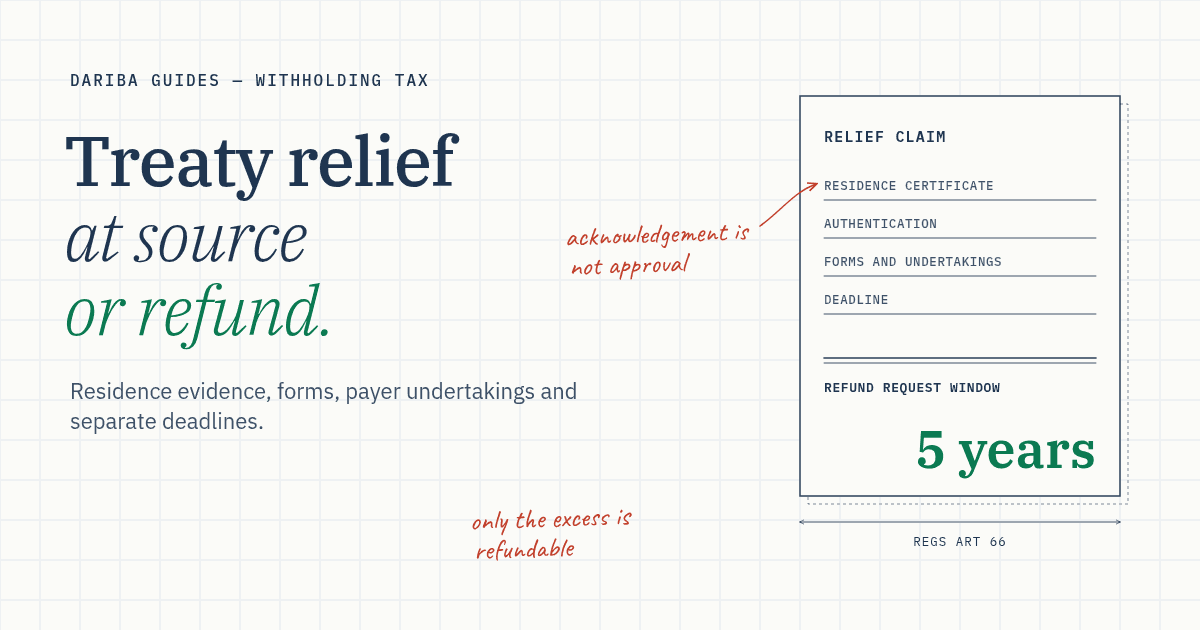
ZATCA’s circular, section 4, distinguishes benefit at source from withholding under domestic law followed by a refund claim. Follow the applicable documentation and approval process; substantive eligibility alone does not complete it. The relief guide explains those steps.
Article 24(1) permits presentation to the competent authority of the state of residence within three years of the first notification of the disputed treaty-inconsistent taxation. Singapore’s MLI Article 16(5)(a) reservation means that the broader either-state submission route should not simply be imported from another treaty. Domestic objection periods and payment obligations require separate attention. The competent authorities endeavour to resolve a justified case; the procedure is not a guarantee of a particular result.
Key takeaways
- Ordinary qualifying dividends and debt-claim income have a 5% gross source-tax ceiling.
- Article 12 expressly includes computer software and industrial, commercial or scientific equipment.
- The royalty definition does not expressly absorb technical services as the Malaysia treaty does.
- Article 26 government-recipient exemptions do not cover every state-owned corporation.
- Protocol 7 has a specific beneficial-ownership rule for a resident trustee taxed on trust income.
- Effective connection, source and special-relationship excess can change a rate-table answer.
- A lower domestic rate remains relevant; a treaty ceiling does not increase it.
- The residence-state MAP route and the separate withholding-relief procedure need their own attention.
Sources
- Saudi-Singapore Double Taxation Agreement and original Protocol, signed 3 May 2010Articles 1, 4, 5, 7, 10-12, 24, 26 and 29; Protocol 1-4 and 7. Both Arabic and English texts are authentic; no English-priority clause imported from a different treaty.
- IRAS Saudi-Singapore Agreement with Annex A on the effects of the MLIOriginal agreement and Protocol, pp.2-22; Annex A, pp.23-24, revised preamble and principal-purpose test. Annex A commencement wording expressly addresses Singapore.
- Singapore MLI reservations and notifications, deposited 21 December 2018Articles 4 and 8 reserved; Article 12 reserved; Article 13 Option B and reservation against 13(4); Articles 14-15 reservations; Article 16(5)(a) reservation preserves the residence-state MAP route.
- Saudi Arabia MLI reservations and notifications, deposited 23 January 2020Covered agreement and matched elections, including Article 13 Option A, which does not match Singapore’s Option B.
- Multilateral Convention to Implement Tax Treaty Related Measures to Prevent BEPSArticles 7, 12-16, 34 and 35; match both states’ positions before applying optional provisions or effective dates.
- Saudi Income Tax Law, current amended Arabic textDomestic source and withholding framework, particularly Article 68, remains distinct from treaty entitlement.
- Saudi Income Tax Implementing Regulations, current amended Arabic textArticle 63 domestic withholding categories and rates; actual classification and related-party conditions remain necessary.
- ZATCA Implementation of Withholding Tax under the Double Taxation Agreement, January 2025Sections 3.2.5, 3.2.8, 3.2.10 and 4: generic online-consultancy and conduit-dividend examples, classification and the separate relief process. These are not Singapore-specific official examples.
General information only. Apply the actual facts, period, Saudi domestic law and authentic treaty instruments. This agreement and original Protocol have equally authentic Arabic and English texts. MLI matching, payment classification and entitlement require their own evidence. Official examples are distinguished from Dariba analysis and original illustrations. Seek clarification where a material issue remains unresolved.