In brief
Classify the receipt before applying the 5% dividend and debt limits or the 8% royalty ceiling; technical services fall within this treaty’s royalty definition.
A Saudi payment to a Malaysian supplier needs an income-classification review before a treaty rate is selected. This agreement is particularly important for technical work: Article 12(3) includes technical services or assistance within its royalty definition. A no-PE declaration alone therefore does not settle the withholding position.
The Saudi-Malaysia Agreement, its original Protocol and the effective Multilateral Instrument (MLI) modifications must be read together. This guide addresses selected Saudi outbound payments; it is not a rate table for every receipt, entity or historic period.
Establish residence and the applicable treaty period
Articles 1 and 4 determine who can claim treaty treatment. A Malaysian incorporation certificate or bank account is not a complete residence analysis. For a dual-resident entity, Article 4(3) uses effective management; original Protocol 1 explains the actual management, control and highest-level policy decision connection. The applicable MLI reservations leave this treaty provision relevant.
Original Protocol 3 also includes specified tax-exempt charitable, educational and similar legal persons and qualifying pension arrangements in the residence definition. It does not exempt every payment to them or remove the separate conditions of an income article.
The Inland Revenue Board of Malaysia’s synthesised text is a useful official reading aid. It gives the general MLI effective dates as 1 January 2022 for relevant withholding events and taxable periods beginning on or after 1 December 2021 for other taxes. The original agreement has separate commencement provisions under Article 27. Identify the actual period before applying a later modification.
The agreement and original Protocol each expressly state that English prevails if their authentic language texts diverge. That specific language clause matters when resolving a discrepancy; the synthesised text itself does not replace the authentic instruments.
Read the treaty ceiling alongside domestic withholding
A treaty generally limits the source-state tax permitted by domestic law; its ceiling does not create a higher charge where the applicable domestic rate is lower. Start with Saudi source and liability rules and Article 63 of the Income Tax Implementing Regulations, then establish treaty classification and entitlement.
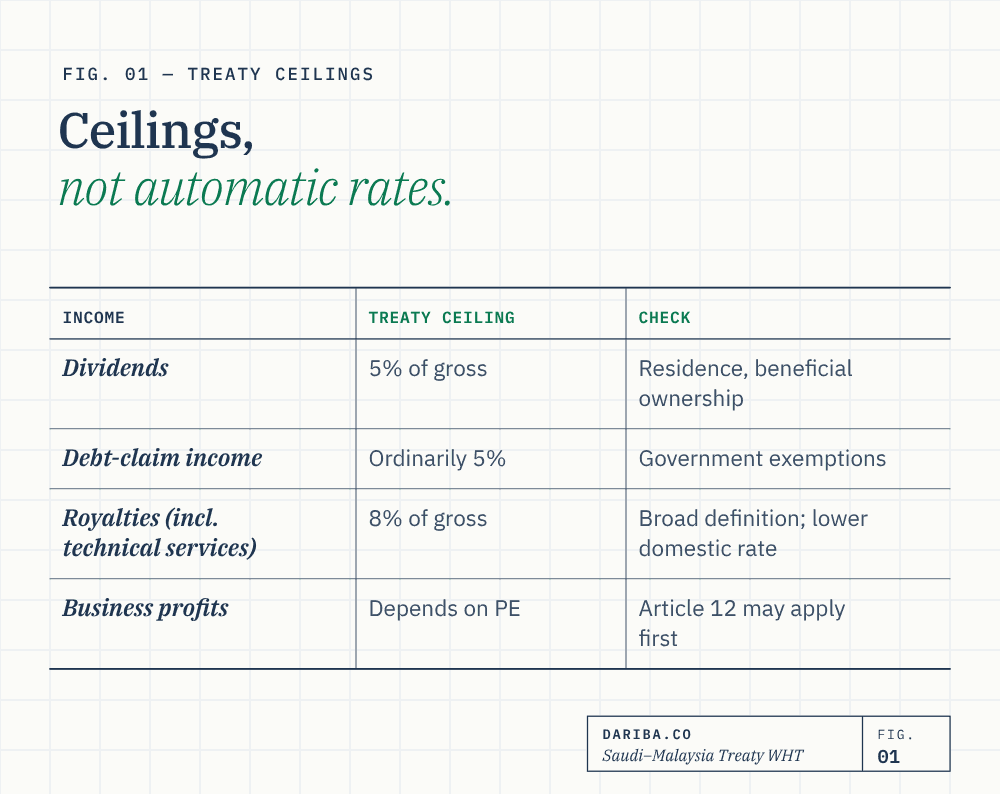
| Receipt meeting the relevant conditions | Treaty source-tax position | Decision that still needs evidence |
|---|---|---|
| Dividends under Article 10 | 5% of the gross dividend | Treaty residence, beneficial ownership and any effective connection |
| Debt-claim income under Article 11 | Ordinarily 5% of the gross income | Government exemption, source, effective connection and any excess |
| Royalties under Article 12 | 8% of the gross royalty | The broad definition, lower domestic rate, effective connection and any excess |
| Enterprise business profits under Article 7 | Source taxation depends on the PE and attribution provisions | Whether another income article applies first, particularly Article 12 |
Dariba recommendation: record the domestic category, treaty article, domestic rate, treaty ceiling and reason for the final rate separately. A spreadsheet showing only “Malaysia: 5%” loses the distinction between dividends, technical work, equipment and ordinary business profits.
Dividends have a 5% ceiling without an imported participation test
Article 10(2) limits source-state dividend tax to 5% of the gross amount where the beneficial owner is resident in the other contracting state. This agreement does not attach a lower participation-based dividend band or a 365-day holding condition to that paragraph. Conditions from another Saudi treaty should not be carried across.
Article 10(3) defines the covered corporate participation income. The paragraph 2 ceiling does not remove tax on the company’s underlying profits. Under paragraph 4, a holding effectively connected with the recipient’s source-state PE or fixed base moves the analysis to Article 7 or 14, as applicable.
Paragraph 5 separately restricts the other state’s taxation of dividends paid by a foreign company and its undistributed profits, with its stated resident-recipient and effective-connection exceptions. It is not a general exemption for all income earned abroad or a replacement for the relevant Saudi branch rules.
Dariba illustration — original assumptions: an eligible Malaysian beneficial owner receives a gross Saudi dividend of SAR 200,000. Applying a 5% rate gives SAR 10,000. This assumes the actual domestic charge and treaty conditions support that treatment; it is not an example published by ZATCA.
Debt income has targeted government exemptions
Article 11(2) ordinarily provides a 5% gross ceiling for an eligible beneficial owner. Paragraph 3 separately exempts source-state debt income where the payer is that state’s government, political subdivision, statutory body or local authority. It also addresses payment to the other state’s government and specified public bodies, including the stated wholly owned institutions, agencies or instrumentalities.
The two limbs are different. The recipient limb’s wholly owned wording should not be converted into an exemption for every commercial payer with state ownership. Establish the legal identity, ownership and exact limb relied upon. A label such as “government related” is insufficient by itself.
Article 11(4) includes the specified debt claims, government securities, bonds, debentures and related premiums. Its exclusion of late-payment penalties from this article’s debt-income definition does not establish that those penalties are exempt from every other applicable tax rule.
Paragraphs 5-7 address effective connection with a PE or fixed base, the source rule including qualifying PE-borne debt, and amounts exceeding an arm’s-length amount because of a special relationship. The ceiling protects the qualifying amount, not an unlimited related-party excess.
Technical services fall within the royalty definition
Article 12(3) covers relevant intellectual-property rights, know-how, industrial, commercial or scientific equipment, and services or assistance of a technical nature. The final category is express treaty wording. There is no need to invent a separate fees-for-technical-services article to recognise it.
Dariba analysis: determine what the supplier actually supplies. A genuine technical-service receipt can fall within Article 12 even where the enterprise has no Saudi PE. Article 7(6) preserves the separately classified income articles. A conclusion that “all consultancy is exempt without a PE” would overlook this agreement’s wording.
The text does not provide an exhaustive modern classification of every software subscription, digital implementation, mixed consulting package or service described as technical. Review the deliverables, rights, know-how, equipment and nature of the assistance. A contract heading or supplier’s no-PE declaration is not enough to resolve a material classification doubt.
The 8% ceiling is also not automatically the final Saudi rate on every technical service. Where the actual Saudi domestic category carries a lower rate, the treaty ceiling does not raise it. Related-party categories, mixed supplies and other domestic rules need their own analysis before selecting that lower rate.
Equipment and ordinary royalties can produce different final rates
Equipment consideration can fall within Article 12’s definition, whose ceiling is 8%; this treaty does not provide a separate 5% equipment ceiling. Saudi domestic equipment rental can nevertheless carry a lower applicable rate under Article 63.
Dariba illustration — original assumptions: a gross SAR 100,000 payment is correctly classified as an ordinary Saudi domestic royalty at 15%, and the eligible beneficial owner meets Article 12’s conditions. Domestic withholding would be SAR 15,000; an applicable 8% treaty ceiling gives SAR 8,000, a difference of SAR 7,000, subject to the relief procedure.
In a separate case, assume a SAR 100,000 payment is correctly classified as equipment rental carrying a 5% Saudi domestic rate and the same 8% treaty ceiling. The applicable 5% charge is SAR 5,000; the ceiling does not increase it to SAR 8,000. These are Dariba’s original illustrations, not official guideline examples. Both assume a gross fee without a contractual net-of-tax gross-up.
Check connection, source and related-party excess
Article 12(4) moves an effectively connected right or property to the applicable PE or fixed-base article. The mere existence of a Saudi PE does not establish that every receipt is connected with it. Document the connection for the actual right or property and receipt.
Paragraph 5 addresses residence-based source and the qualifying PE or fixed-base liability and expense-bearing case. Paragraph 6 limits the article’s protection where a special relationship produces an excessive amount. An 8% calculation on an invoice does not resolve either source or arm’s-length pricing.
The corresponding Article 10 and 11 exceptions are not identical in all their wording. Apply the provision for the actual income rather than using a single generic “PE exception” for every payment.
Treat anti-abuse, relief procedure and MAP as separate steps
The matched MLI principal-purpose test can deny a benefit where its conditions are met, subject to the stated object-and-purpose exception. Residence and beneficial ownership evidence do not remove that separate review. Equally, a cross-border group structure alone is not a complete application of the test.
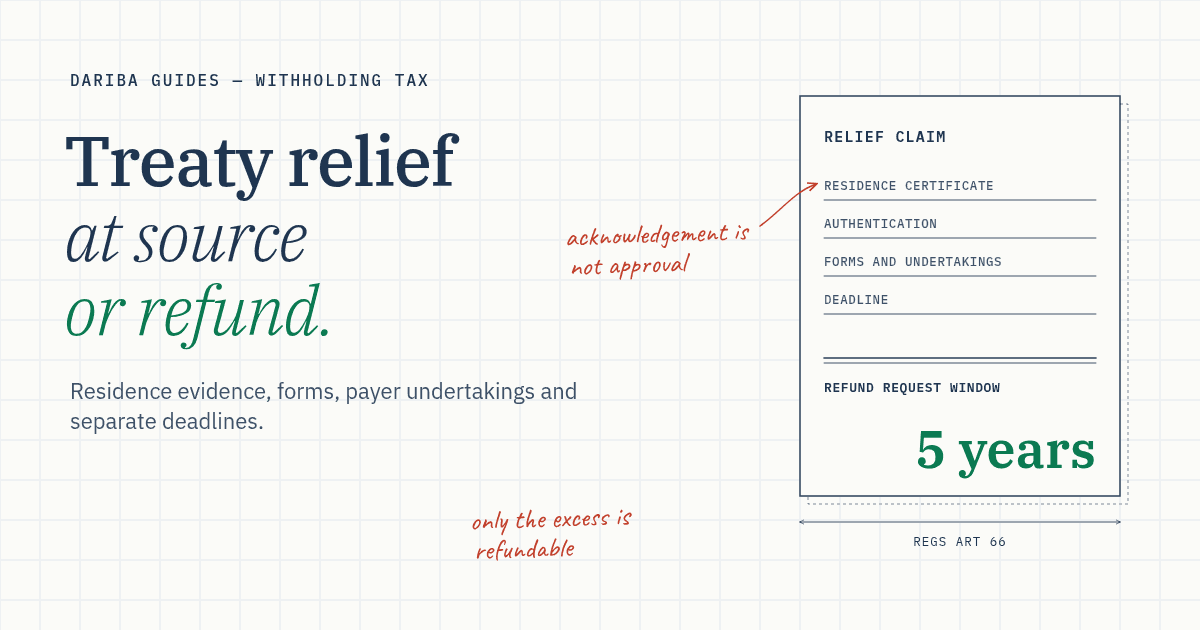
ZATCA’s January 2025 Implementation of Withholding Tax under the Double Taxation Agreement circular addresses the separate classification and treaty-relief process. Use the relief-at-source and refund guide to connect the treaty conclusion to the documents and actual claim route. A rate ceiling does not itself authorise an unsupported reduction or late filing.
Article 24, as modified by MLI Article 16, permits presentation of an eligible treaty case to either competent authority. Its three-year period runs from the first notification of the action producing non-conforming taxation. An agreement reached has the stated implementation protection against domestic time limits. Preserve domestic objection and refund deadlines separately; presenting a MAP case is not proof that every other deadline or collection step has stopped.
The Malaysia PE companion addresses the enterprise-presence and attributable-profit questions. The final payment file should connect the actual income, source, recipient, beneficial ownership, applicable period, rate and claim evidence in one supported conclusion.
Key takeaways
- Treaty residence, beneficial ownership and the effective anti-abuse rules require evidence.
- Eligible dividends and ordinary debt-claim income have a 5% gross source-tax ceiling.
- Article 11(3) provides specific government-payer or government-recipient debt exemptions.
- The 8% royalty ceiling includes the treaty’s technical-service and equipment categories.
- A treaty ceiling does not increase a lower applicable Saudi domestic rate.
- No Saudi PE does not automatically exempt a technical-service payment under Article 12.
- Effective connection, source rules and related-party excess can change the conclusion.
- Tax entitlement, withholding administration and a refund claim are separate steps.
Sources
- Saudi-Malaysia Double Taxation Agreement and original Protocol, signed 31 January 2006Articles 1, 4, 5, 7, 10-12, 24 and 27; original Protocol 1, 3-5. Article 12(3) expressly includes technical services or assistance. The agreement and Protocol state that English prevails on divergence.
- Inland Revenue Board of Malaysia, synthesised Saudi-Malaysia agreement incorporating the MLICommencement, p.3; Article 5 with MLI 12, 13 Option A and anti-fragmentation, and 15, pp.7-10; Articles 7 and 10-12, pp.11-16; MAP and PPT, pp.21-22. Reading aid, not a replacement for the authentic instruments.
- Malaysia consolidated MLI reservations and notifications, November 2022Article 4 reservation; Article 12 Saudi notifications; Article 13 Option A and Saudi notification; reservation against the entirety of Article 14. Later Ukraine notification does not by itself change Saudi matching.
- Saudi Arabia MLI reservations and notifications, deposited 23 January 2020Bilateral matching for the covered agreement, PE provisions, treaty abuse and dispute procedure. An election by one state alone is insufficient.
- Multilateral Convention to Implement Tax Treaty Related Measures to Prevent BEPSArticles 7, 12-16 and 35, subject to actual reservations, notifications and effective dates.
- Saudi Income Tax Law, current amended Arabic textDomestic source, liability and withholding framework remain distinct from treaty limits.
- Saudi Income Tax Implementing Regulations, current amended Arabic textArticle 63 domestic withholding categories and rates, including ordinary royalties, equipment rental, dividends, loan returns and technical/consulting services; apply actual classification and related-party rules.
- ZATCA Implementation of Withholding Tax under the Double Taxation Agreement, January 2025Classification, residence and the separate relief-at-source/refund process. Generic circular examples are not presented as official Malaysia examples.
General information only. Apply the actual facts, period, Saudi domestic law and authentic treaty instruments. This agreement and its original Protocol expressly give English priority if their authentic language texts diverge. MLI matching and entitlement require separate review. Dariba analysis and original illustrations are identified; seek clarification where the sources leave a material issue unresolved.