In brief
Read the months-based project tests, matched MLI agency rules and original Protocol before deciding whether a Malaysian enterprise has a Saudi PE and what profit is taxable.
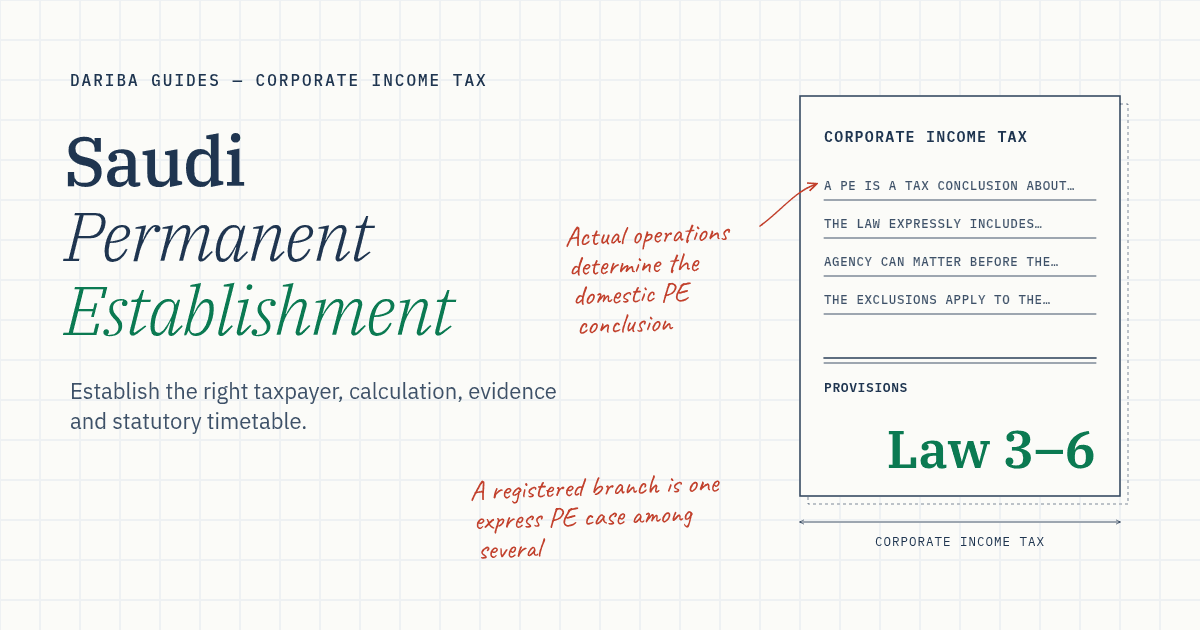
A Malaysian enterprise’s Saudi project requires several distinct permanent-establishment tests. This treaty uses more than six months for its construction and service thresholds, while its effective MLI provisions also address broader agency arrangements and activity exemptions. A days-only checklist misses material parts of the agreement.
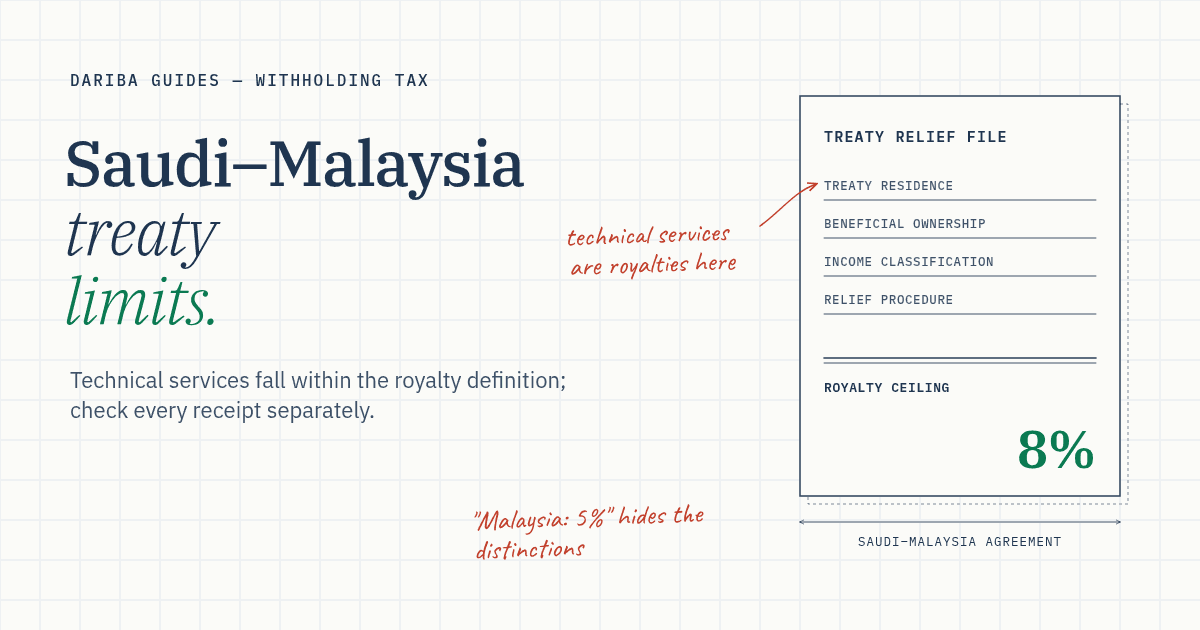
Even a sound no-PE conclusion does not resolve every payment. Article 12 expressly includes technical services or assistance in the royalty definition. Use this guide with the Malaysia withholding analysis and distinguish enterprise presence from the classification of each receipt.
Identify the resident enterprise and applicable period
Apply Articles 1 and 4 before relying on treaty protection. A dual-resident entity’s effective-management test and original Protocol 1 require actual management and control facts. Specified exempt organisations and pension arrangements have their own residence provision in Protocol 3; it does not create a blanket income exemption.
The official Malaysian synthesised text identifies the matched MLI provisions and gives the general effective dates: relevant withholding events from 1 January 2022 and other taxes for taxable periods beginning on or after 1 December 2021. The original agreement has separate Article 27 commencement rules. A historic project needs its actual period assessed.
Read the synthesised text alongside the authentic agreement, original Protocol and MLI positions. The agreement and Protocol expressly give English priority if their authentic texts diverge. This is a specific treaty language clause, not a general conclusion about every Saudi treaty.
Keep the fixed-place route separate from project duration
Article 5(1) addresses a fixed business place through which the enterprise carries on all or part of its business. Paragraph 2 includes a management place, branch, office, factory, workshop and natural-resource extraction place.
Construction and service thresholds do not provide a universal safe harbour for an actual office or another fixed place. Establish the enterprise’s use of the premises, activities and applicable exception. A customer address or occasional visit alone is also insufficient to replace that analysis.
Dariba recommendation: map the actual Saudi functions, premises, staff, decisions and customer interactions. Compare these with the contractual operating model before concluding that the presence is merely representative or auxiliary.
Construction and related supervision use a strict months threshold
Article 5(3)(a) covers a building site, construction, assembly or installation project, or connected supervisory activities, continuing for more than six months. It is not a twelve-month construction threshold and does not state a 183-day substitute.
Exactly six months does not exceed this particular threshold. That observation does not rule out another PE route, an incorrectly measured project period or the effective anti-abuse rules. Preserve evidence of mobilisation, work, interruptions, supervision and completion; the final invoice date alone does not establish the duration.
Malaysia reserves against the entirety of MLI Article 14 on contract splitting. Do not import that article’s mechanical aggregation provisions into this agreement. The reservation does not approve artificial splitting; actual project facts and the applicable principal-purpose test remain relevant.
Services use more than six months within any twelve-month period
Article 5(3)(b) addresses services, including consultancy, supplied through employees or other personnel engaged by the enterprise. Qualifying activities for the same or a connected project must continue within the country for periods aggregating more than six months within any twelve-month period.
The wording requires the enterprise, personnel, activity location, project connection and relevant periods to be established. It does not give each employee a fresh six-month allowance or reset the test on 1 January. Changing the team or contract number does not itself establish a new, unconnected project.
Dariba analysis: use a project timeline and identify overlapping activities and connected contracts. Keep the treaty’s months-based language in the conclusion. An unsupported conversion to 183 days can change a boundary result; seek clarification where interruptions, partial months or overlapping work create a material counting uncertainty.
An individual professional’s Article 14 and an employee’s Article 15 are separate provisions. This enterprise service-PE test should not be substituted for either individual’s actual income article.
Matched Option A changes the activity exemptions
The effective MLI Article 13(2) Option A replaces Article 5(4), as shown in the official synthesised text. It addresses sole-purpose storage, display, delivery, processing by another enterprise, purchasing and information collection; it also covers other activities and qualifying combinations. The stated preparatory-or-auxiliary condition applies to the activity or the overall combined activity, as relevant.
An operating warehouse or local purchasing function is therefore not exempt simply because its label appears in the original list. Establish the actual function and whether the applicable preparatory-or-auxiliary condition is met. This matched modification differs from the UK treaty’s modification and should be analysed on its own text.
MLI Article 13(4) also addresses fragmentation: the exemption can be unavailable where the enterprise or a closely related enterprise carries on business at the same or another place in that state, the specified PE or combined non-auxiliary condition is met, and the activities form complementary functions of a cohesive business operation. Common ownership alone does not establish every element.
MLI Article 15(1) uses actual control and specified ownership or common-control cases. Its numerical ownership limb is more than 50%, not 50% or more. Exactly 50% does not meet that numerical limb by itself, although the actual-control test can still matter.
Original Protocol 4 separately says that selling goods displayed at the end of a trade exhibition or conference does not, by itself, create a PE. Retain the actual event and activity limits; that narrow statement is not a general exemption for continuing local sales operations.
Agency analysis includes a habitual principal role
The matched MLI Article 12(1) replaces Article 5(5)(a). It reaches a person acting for the enterprise who habitually concludes the specified contracts or habitually plays the principal role leading to contracts routinely concluded without material modification. The covered contracts concern the enterprise’s name, relevant property rights or its services, subject to the actual exceptions.
Dariba analysis: moving formal signature offshore does not alone answer this test. Review who develops and settles the commercial arrangement, whether approvals materially change it and what the parties habitually do. One isolated introduction is not, by itself, proof of every required element.
Article 5(5)(b) separately retains the specified habitual stock-and-order/delivery agency route without contract-concluding authority. Do not omit that limb because the MLI modifies paragraph 5(a).
MLI Article 12(2) replaces paragraph 6’s independent-agent wording. Independence and ordinary business matter; acting exclusively or almost exclusively for closely related enterprises excludes the stated independent-agent treatment for those enterprises. Article 5(7) still prevents ownership or control between companies alone from automatically creating a PE, without excluding a PE established by their actual activities.
Attribute profit using Article 7 and the original Protocol
Article 7(1)-(2) separates the existence of a PE from its profit. Source-state taxation concerns attributable profit, assessed on the treaty’s distinct-and-separate-enterprise basis and subject to paragraph 3. A PE finding does not make the entire foreign enterprise’s revenue taxable profit.
Original Protocol 5(i) is particularly relevant to merchandise contracts: export business profits are not taxed in the importing contracting state, while the Saudi qualification preserves taxation of income from other activities included in export contracts and carried out in Saudi Arabia.
Dariba recommendation: support the distinction between actual merchandise export and Saudi activities with deliverables, functions, locations, pricing and cost evidence. Neither a single invoice labelled “export” nor a Saudi activity’s existence justifies treating all receipts identically. Apply the actual income articles and attributable-profit rules to the identified components.
Protocol 5(iv) preserves the specified domestic discretion or estimate where the authority lacks sufficient PE-profit information. It expressly retains Article 7 principles so far as the available information permits. That is neither immunity from an estimate nor permission to disregard those principles whenever records are incomplete.
Apply the expense limits and preserve the other income articles
Article 7(3) permits qualifying PE-purpose expenses, including executive and general administration expenses incurred locally or elsewhere. It restricts the specified internal royalties, rights fees, service or management commissions and non-bank financing amounts, apart from actual-expense reimbursements. It also addresses corresponding internal charges made by the PE to other parts of the enterprise.
The actual-expense and banking qualifications need their own evidence. A head-office allocation is not automatically deductible because an invoice exists, while the restrictions do not establish that every supported third-party cost is disallowed. The head-office deduction guide addresses the connected domestic and evidence questions.
Paragraph 4 prevents attribution merely from purchasing goods for the enterprise. Paragraph 5 requires a consistent attribution method year by year unless a good and sufficient reason supports change. Paragraph 6 preserves the other treaty income articles, including Article 12’s technical-service wording.
Original Protocol 5(iii) separately preserves the stated Saudi non-resident insurance treatment, with its consultation qualification if the relevant law changes beyond the specified minor changes. It is not an unrestricted statement about every future insurance rule.
Document the conclusion and its remaining dependencies
The matched MLI principal-purpose test applies on its actual conditions, including its object-and-purpose exception. A short contract, separate group company or residence certificate does not alone establish that all treaty benefits are available.
Retain the residence analysis, project timeline, connected-project evidence, facility functions, agency practices, original Protocol analysis, profit bridge and supported costs. Identify the PE route considered and the facts supporting each conclusion. Where the counting method or income classification is unresolved, explain the point and obtain clarification rather than present an unsupported certainty.
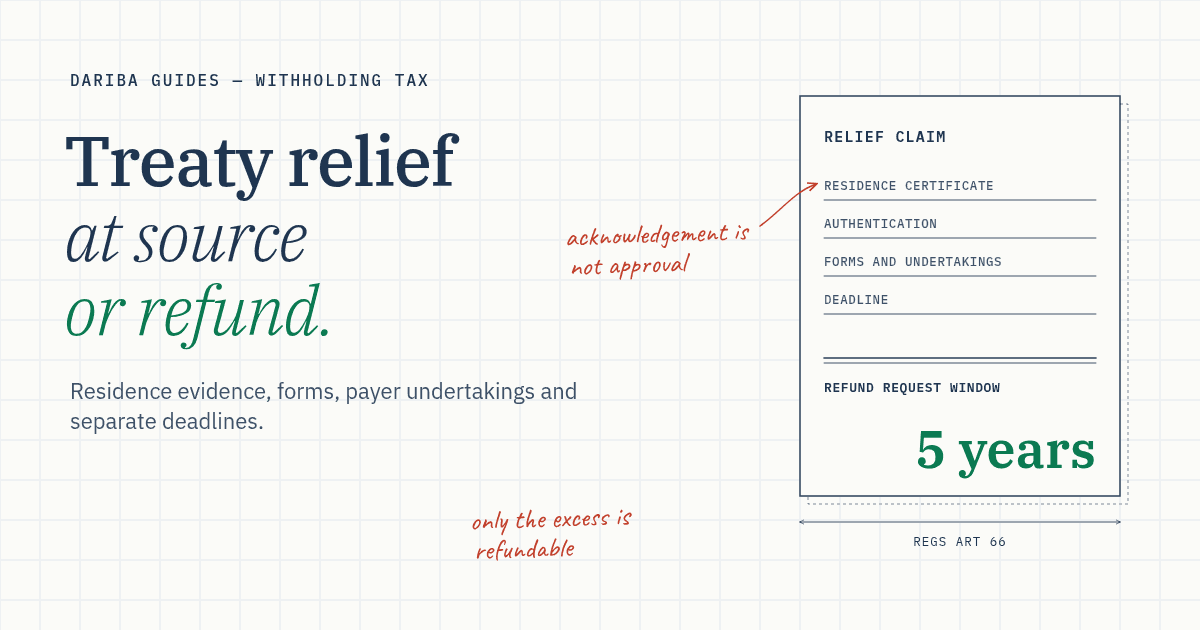
Treaty PE, VAT establishment, withholding, registration, filing and deduction are separate decisions. ZATCA’s January 2025 treaty-withholding circular addresses the relief process; it does not supply an official Malaysia PE worked example. The withholding companion explains the rate, technical-service, government-debt exemption and MAP questions that must be connected to the payment file.
Key takeaways
- Fixed-place, construction, service and agency PE routes require separate analysis.
- Construction and related supervision use more than six months.
- Services use more than six months for the same or connected project within any twelve-month period.
- Matched MLI Article 12 extends agency analysis to specified habitual principal-role arrangements.
- Matched Option A requires the relevant excluded activity to be preparatory or auxiliary.
- Anti-fragmentation and the strict more-than-50% closely-related ownership limb need their actual conditions.
- Protocol 5 distinguishes merchandise exports from other activities performed in Saudi Arabia.
- A PE finding does not convert all contract revenue into taxable profit or settle technical-service withholding.
Sources
- Saudi-Malaysia Double Taxation Agreement and original Protocol, signed 31 January 2006Articles 1, 4, 5, 7, 10-12, 24 and 27; original Protocol 1, 3-5. Article 12(3) expressly includes technical services or assistance. The agreement and Protocol state that English prevails on divergence.
- Inland Revenue Board of Malaysia, synthesised Saudi-Malaysia agreement incorporating the MLICommencement, p.3; Article 5 with MLI 12, 13 Option A and anti-fragmentation, and 15, pp.7-10; Articles 7 and 10-12, pp.11-16; MAP and PPT, pp.21-22. Reading aid, not a replacement for the authentic instruments.
- Malaysia consolidated MLI reservations and notifications, November 2022Article 4 reservation; Article 12 Saudi notifications; Article 13 Option A and Saudi notification; reservation against the entirety of Article 14. Later Ukraine notification does not by itself change Saudi matching.
- Saudi Arabia MLI reservations and notifications, deposited 23 January 2020Bilateral matching for the covered agreement, PE provisions, treaty abuse and dispute procedure. An election by one state alone is insufficient.
- Multilateral Convention to Implement Tax Treaty Related Measures to Prevent BEPSArticles 7, 12-16 and 35, subject to actual reservations, notifications and effective dates.
- Saudi Income Tax Law, current amended Arabic textDomestic source, liability and withholding framework remain distinct from treaty limits.
- Saudi Income Tax Implementing Regulations, current amended Arabic textArticle 63 domestic withholding categories and rates, including ordinary royalties, equipment rental, dividends, loan returns and technical/consulting services; apply actual classification and related-party rules.
- ZATCA Implementation of Withholding Tax under the Double Taxation Agreement, January 2025Classification, residence and the separate relief-at-source/refund process. Generic circular examples are not presented as official Malaysia examples.
General information only. Apply the actual facts, period, Saudi domestic law and authentic treaty instruments. This agreement and its original Protocol expressly give English priority if their authentic language texts diverge. MLI matching and entitlement require separate review. Dariba analysis and original illustrations are identified; seek clarification where the sources leave a material issue unresolved.