In brief
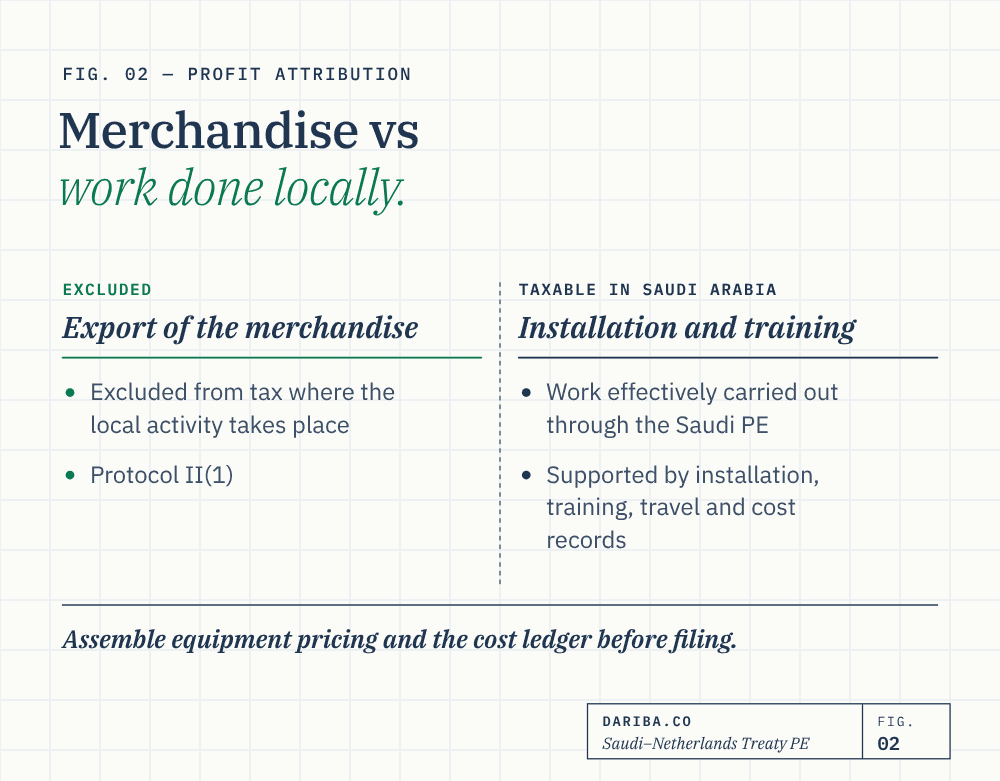
A Dutch exporter’s substantial local installation, maintenance or training can create a Saudi permanent establishment under the Protocol. The profit analysis then distinguishes the exported merchandise and the work effectively carried out through the Saudi establishment.
A Dutch supplier sells a production line to a Saudi customer and agrees to install it and train operators. The installation team stays for four months. Under the Saudi–Netherlands Double Taxation Convention, the time spent on site is only one part of the analysis. Protocol II(1) has a separate rule for substantial local activities included in an export contract.
Check the Article 5 thresholds and the Protocol separately
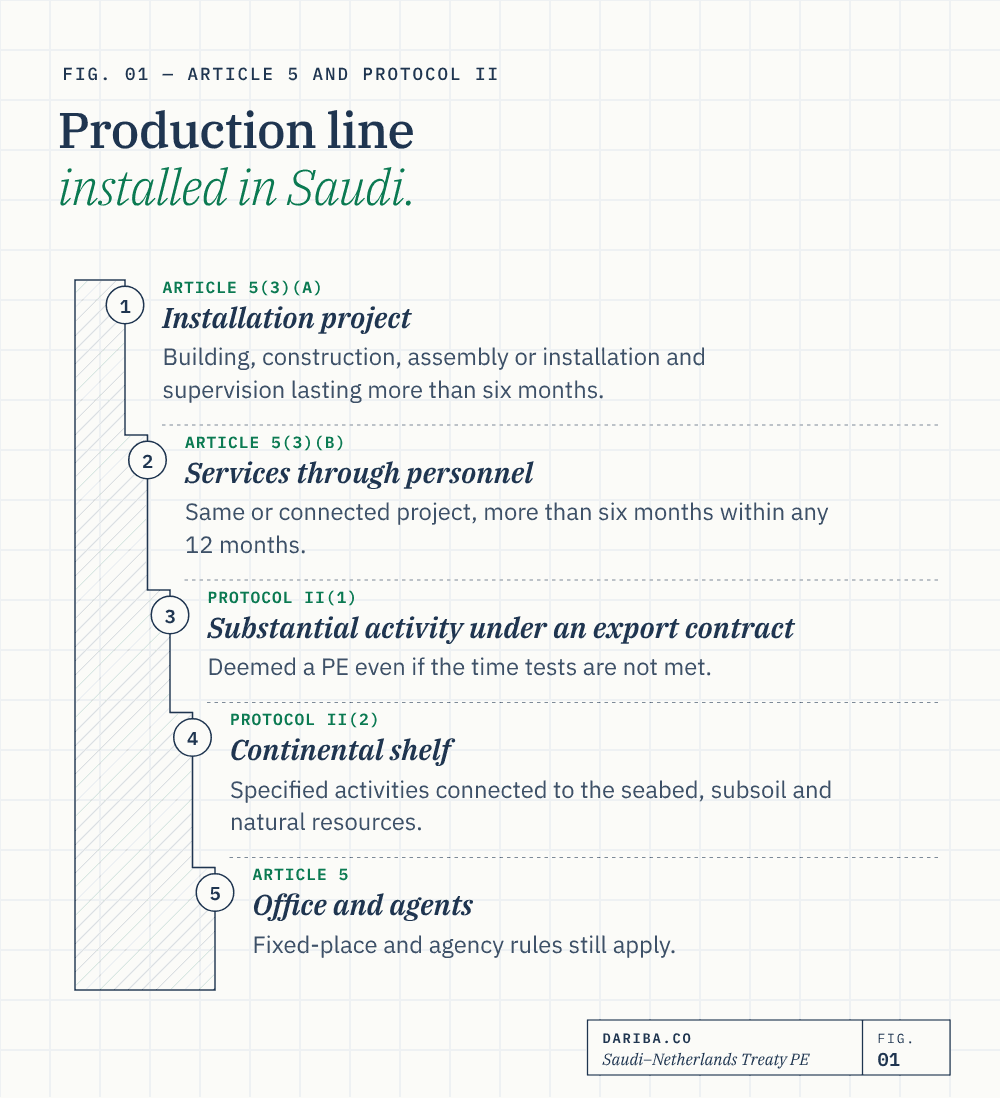
Article 5(3)(a) applies to specified building, construction, assembly or installation projects and associated supervision lasting more than six months. Article 5(3)(b) applies to enterprise services, including consultancy, carried out through personnel on the same or a connected project for periods aggregating more than six months within any 12 months. Keep the project and work-order chronology in the units the treaty uses.
Protocol II(1) deems substantial activity carried out in a contracting state under a goods export contract to be a permanent establishment (PE). The Protocol gives maintenance, training and installation as examples. In the four-month illustration, review the substance of the Saudi work and its place in the export contract before concluding that the supplier has no PE. Document the scope, personnel, work performed and acceptance terms.
Protocol II(2) separately covers specified activities on the continental shelf connected to the seabed, subsoil and their natural resources. Protocol II(3) covers specified exploration, extraction and exploitation rights, including rights to interests or benefits in the resulting assets. Review the rights and the activities under the actual arrangement.
Review the local office and the people who conclude contracts
Article 5 also provides fixed-place and agency rules. Establish where the enterprise operates, who can conclude contracts and what the local representatives actually do. Before relying on an agency or activity exception, check the matched Multilateral Instrument provisions and effective dates for the period. The deposited positions of both states identify which treaty provisions they notified.
Attribute the Saudi profit using the work actually performed
Protocol II(1) excludes the profit from exporting the merchandise from tax in the state where the covered local activity takes place. Protocol III(1) addresses surveying, construction, supply and installation contracts. It measures the attribution basis by the work effectively carried out by the PE in its state and excludes portions executed outside that state.
For the production-line contract, assemble the equipment pricing, on-site installation and training records, travel and cost ledger. Reconcile the commercial allocation with Article 7’s separate-enterprise approach and the functions performed. The local work can have a taxable profit even where the merchandise export profit falls outside that charge.
Identify the taxpayer and income category
Check Article 14 separately for independent personal services, including the fixed-base and at-least-183-days limbs. If the contract grants equipment use or intellectual property rights, test Article 12, including its effective-connection rule. This review informs the payer’s withholding and refund analysis and the enterprise’s PE reporting.
Key takeaways
- Article 5(3)(a) uses more than six months for specified sites and projects.
- Article 5(3)(b) uses more than six months within any 12 months for enterprise services on the same or a connected project.
- Protocol II separately addresses substantial activities under export contracts, offshore activities and resource rights.
- Protocol III(1) limits the attribution basis on specified contracts to the part effectively carried out by the local establishment.
Sources
- Saudi–Netherlands Convention for the Avoidance of Double Taxation and the Prevention of Tax Evasion with Respect to Taxes on Income, with ProtocolArticles 5, 7 and 14 and Protocol II–III. Apply any relevant MLI modification for the period.
- Saudi Arabia’s Deposited MLI Reservations and NotificationsListed agreement 29 and Saudi choices for permanent-establishment provisions.
- Netherlands’ Deposited MLI Reservations and NotificationsListed agreement 60. Read both countries’ positions for activity exemptions, agency and any contract splitting.