In brief
German businesses outside the bilateral air transport agreement should test their Saudi offices, sites, sales agents and connected income under domestic law.
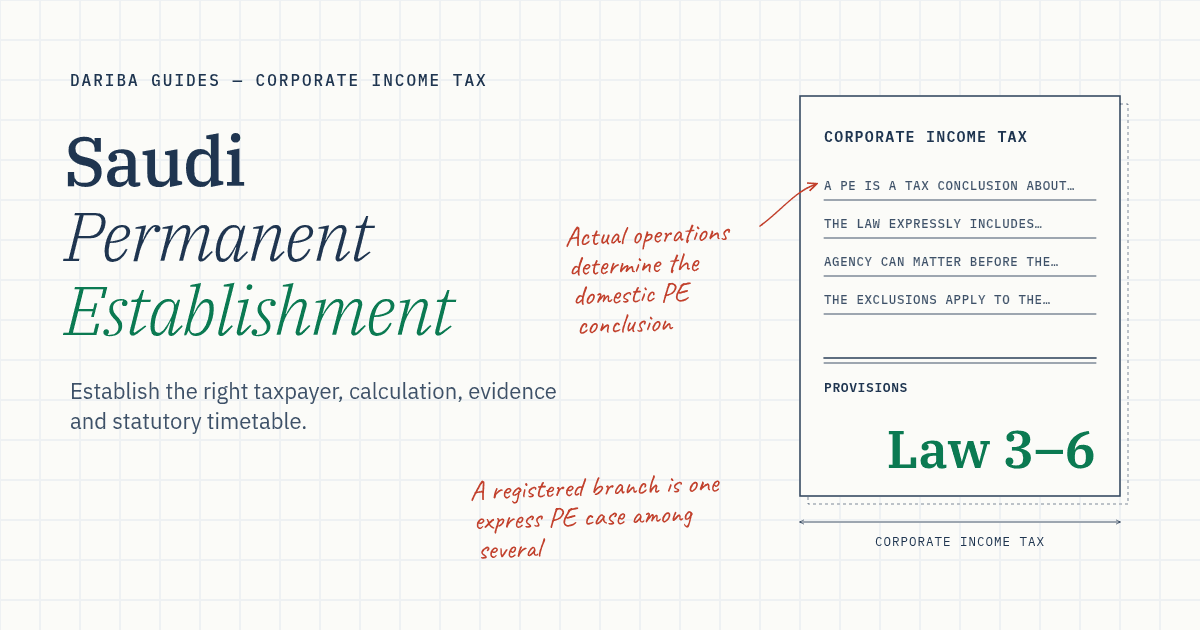
A German industrial supplier may send engineers to a Saudi customer while a local representative negotiates orders and arranges delivery. Evaluate those activities under Article 4 of the Saudi Income Tax Law. The Saudi–Germany bilateral tax agreement addresses specified aviation activities. A German industrial project should be assessed under the Saudi domestic permanent establishment (PE) rules.
Identify the site, premises and agent
Article 4(a) addresses a fixed place through which the non-resident conducts business wholly or partly, and Article 4(b) lists examples including construction sites, assembly facilities and related supervision. Record site access, equipment and people, what work they perform and whether the company conducts part of its business there. Saudi domestic law does not supply a universal six-month threshold for such a project.
Article 4 of the Implementing Regulations also addresses specified dependent-agent activities. A representative may negotiate for the non-resident, conclude its contracts or maintain Saudi stock and regularly fulfil orders from it. Determine what the agent is authorised to do and what it actually does. Consider whether any premises are used solely for an Article 4(c) excluded activity in the Income Tax Law.
Connect the income and any withholding to the PE
For example, a German supplier may use a Saudi workshop to commission machinery and also take direct Saudi orders for similar equipment. If it has a PE, review the connected tax base under Article 6(c) and the specific same-or-similar Saudi sales and activities rule in Article 5(a)(10). Keep a reconciliation between the workshop or agent functions, Saudi sales and the revenue and allowable costs reported.
Under Article 68(f), amounts directly connected with the PE’s business enter the non-resident’s tax base. Article 68(g) addresses the credit for tax withheld on a payment included in that base. Other payments to a non-resident can still attract withholding if they are Saudi-source and fall within the domestic rules. Tie each payment to the actual activities before processing it. For designated airline income, review the separate air transport agreement.
Sources
- Saudi Income Tax LawArticles 4–6, 60 and 68.
- Saudi Income Tax Implementing Regulations, amended Arabic textArticles 4 and 63.
- Saudi–Germany Agreement for the Avoidance of Double Taxation on the Income and Capital of Air Transport Enterprises and the Remuneration of Their EmployeesArticles 1 and 3 on the aviation scope.