In brief
Original donor controls require six cumulative conditions, approved public-benefit donation projects and no ordinary or overlapping special VAT recovery. The February 2025 circular’s minimum and timetable differ from current Article 70 and require resolution.
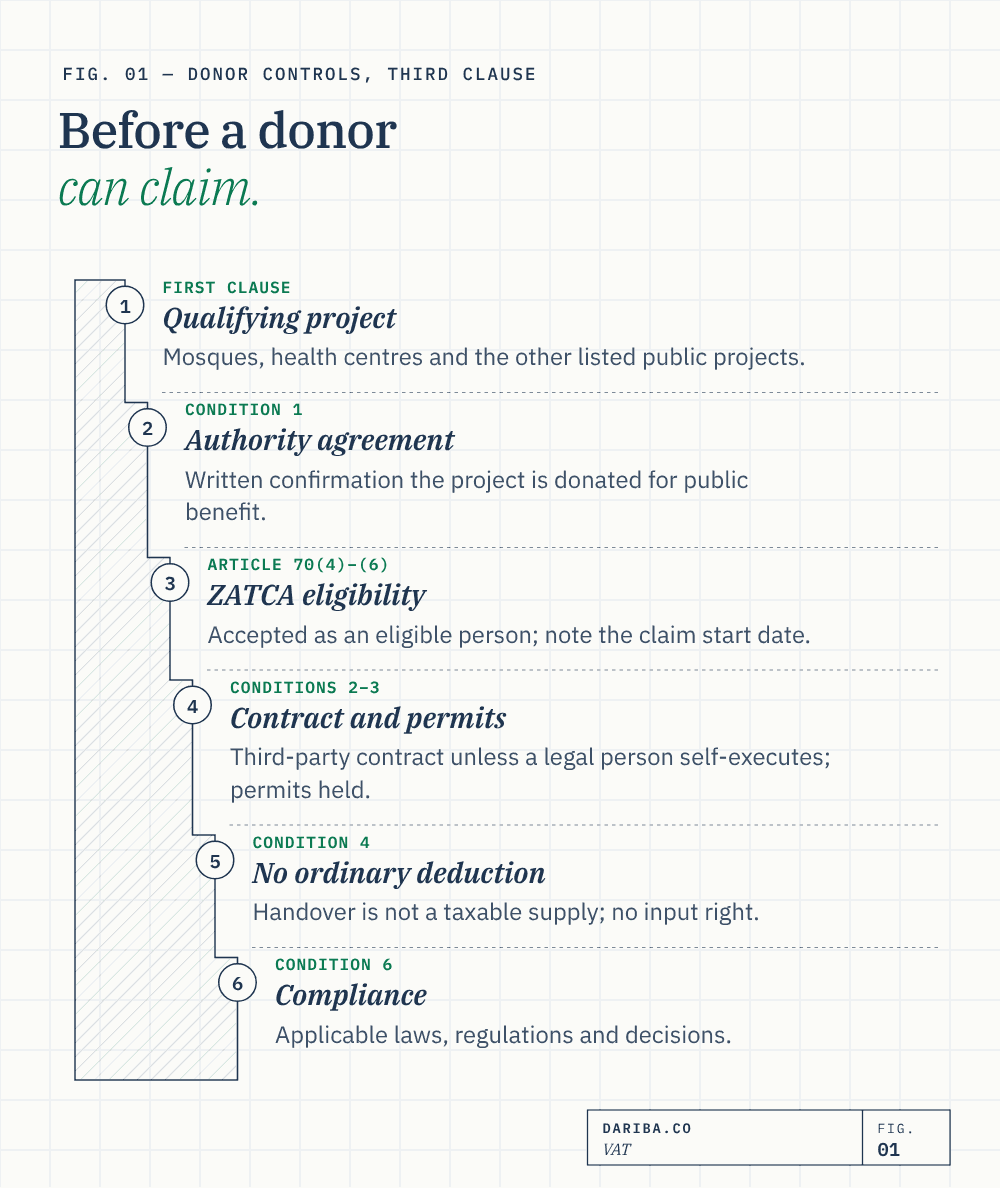
A person funding a public building does not automatically acquire a Saudi VAT refund. The published donor controls issued under Governor Decision 26097, dated 10 Jumada I 1445H, require an approved donation project, actual eligible-person registration and all the specified project and recovery conditions.
ZATCA’s February 2025 public-benefit-project circular explains those conditions and gives examples. Some of its filing detail differs from the current Arabic VAT Regulations. Establish the project and claimant first, then resolve the actual applicable filing requirements rather than treating the circular as an amendment of Article 70.
Identify the donated project and competent recipient
The controls’ First clause concerns the stated construction, building, demolition/reconstruction, restoration and expansion projects: mosques, health centres, educational facilities and other public-benefit buildings. They are intended for handover on completion to the competent government authority in its public-authority capacity.
The donor can be a natural or legal person undertaking or contributing to implementation. The donation definition excludes consideration or compensation received by the donor at or after handover from the competent authority or another person. The circular section 5(4) also addresses monetary or in-kind compensation.
A project does not meet this definition merely because it is described as charitable or ESG spending. A paid construction contract, operating concession, commercial facility or cash donation needs its actual legal treatment. This guide does not convert every socially useful expense into the specified building-project route.
Sources: published controls, First–Second clauses; Arabic circular sections 4–5. The charities and fee-earning activities guide addresses a different, broader activity analysis.
Obtain the competent authority’s written project approval
Under Third clause, condition 1, provide the contract or agreement with the competent authority confirming that the project is donated for public benefit, with the parties’ and project’s required details. An informal expectation of eventual government use is not the written approval described by the control.
The competent authority is the government beneficiary responsible for receiving the project in its public capacity. Keep the actual project identity, agreed scope, donor, recipient and handover basis connected to that approval. A contractor’s licence alone is not the beneficiary authority’s donation agreement.
The donor must then obtain ZATCA’s acceptance as an eligible person. The controls define that status by approval; submitting an application or paying supplier VAT is not the approval itself. Article 70(4)–(6) also distinguishes the identification number, registration date and date from which qualifying tax may be claimed.
Sources: controls, First and Third clauses; circular section 5(1); Regulations Article 70(4)–(6).
Distinguish third-party construction from legal-person self-execution
Third clause, condition 2 requires the donor’s project implementation contract with the third party, unless the donor is a legal person executing the project itself. The exception concerns that implementation contract; it does not remove the government agreement, permits or other eligibility conditions.
Official examples: circular section 5(2), Examples 1–2, contrasts an individual arranging mosque construction through a licensed contractor with a licensed construction/restoration legal person carrying out a healthcare-facility restoration itself. The individual provides the third-party contract. The self-executing legal person need not contract with itself, but still meets all other requirements.
The circular requires the self-executing donor to analyse and support its project costs. Do not equate an internal project budget or management recharge with evidence of VAT actually borne and paid. Nor should the exception be extended to every individual who arranges work personally.
Sources: controls, Third(2); Arabic circular section 5(2), Examples 1–2; English guidance, same examples.
Retain all required permits and comply with the governing rules
Third clause, condition 3 requires the relevant construction permits. Circular section 5(3) discusses building, demolition, restoration and correction permits; a project may require more than one authority’s permission. Identify the actual works and competent regulators rather than assuming one document covers the whole project.
Condition 6 independently requires compliance with the Kingdom’s applicable laws, regulations, decisions and equivalent enforceable provisions. VAT refund eligibility is not a substitute for project, land or construction compliance.
Dariba recommendation: reconcile the donation agreement, land/title information, permissions, implementation contract and changes in scope throughout the project. Preserve completion and handover evidence. These are practical controls supporting the statutory conditions, not a promise that a particular authority will approve a project.
Sources: controls, Third(3)/(6); circular section 5(3)/(6).
Establish the absence of ordinary deduction or another recovery route
Third clause, condition 4 requires that handover not constitute a taxable supply and that the donor have no ordinary input-deduction right for the project in its taxable-person capacity. Condition 5 separately excludes VAT recoverable through eligible-developer or another eligible-person status. Merely choosing not to exercise an available deduction does not establish this route.
The circular’s section 5(4) school-construction example distinguishes the VAT-registered donor’s ordinary economic activity from its stated free donated-school activity, subject to all remaining conditions. Section 5(5) separately discusses a developer and the prohibition on overlapping recovery. Neither example grants every registered business a second refund.
| Question | Evidence needed for the actual project |
|---|---|
| Is handover genuinely a qualifying donation? | Agreement, consideration analysis and actual implementation |
| Is ordinary deduction available? | Actual supply/use, VAT status and entitlement analysis |
| Is another special recovery route available? | Applicable category, approval and project VAT position |
| Has the amount already been recovered? | Invoice-level return/claim and credit-note reconciliation |
Dariba analysis: keep entitlement and prior use separate. A ledger showing that VAT has not yet been claimed does not prove that ordinary or other recovery is legally unavailable. An uncertain overlap should be resolved in the eligibility determination, rather than by changing the label on the claim.
Sources: controls, Third(4)–(5); circular section 5(4)–(5); Article 70(9).
Connect paid invoices and each purchase to the approved project
Circular section 6 includes qualifying construction/material and consultant/engineer costs, subject to actual project connection and statutory requirements. The supplier must correctly charge VAT. Retain compliant tax invoices or appropriate customs/payment evidence and satisfy the applicable e-invoicing requirements. The route does not reimburse VAT that was not actually incurred and paid.
Section 7.3 requires a project schedule containing name, estimated cost, start/completion dates and completion percentage, with the stated building permit, title deed, contract and bill of quantities. The purchases schedule links each supplier/TIN, invoice date/number/total, VAT amount and goods/services to the project. Retain invoices issued to the eligible donor and payment evidence; an invoice issued to an unrelated sponsor cannot simply be relabelled.
Fourth clause permits more than one project subject to compliance for each project and the exclusive project-refund requirements. Maintain separate project attribution and prevent duplicated invoices across projects or claims. Use the issued identification number and approved bank details.
Sources: controls, Fourth clause; circular sections 6 and 7.3; Article 70(12)–(13).
Resolve the circular’s threshold and timetable against Article 70
The February 2025 circular sections 7.1–7.3 state a SAR 1,000 minimum and a filing limit measured six months from the calendar year’s end, including for its quarterly periods. Current Arabic Article 70(11) instead prohibits a claim below SAR 5,000, while Article 70(8) measures six months from the relevant refund period’s end and restricts amendments and multiple claims.
The downloaded original controls’ Fourth clause refers the refund procedure to Article 70; it does not itself set a SAR 1,000 override or a later quarterly deadline. This review has not established a separate current operative decision authorising those differences. Do not treat the older circular’s more favourable terms as a confirmed current filing entitlement.
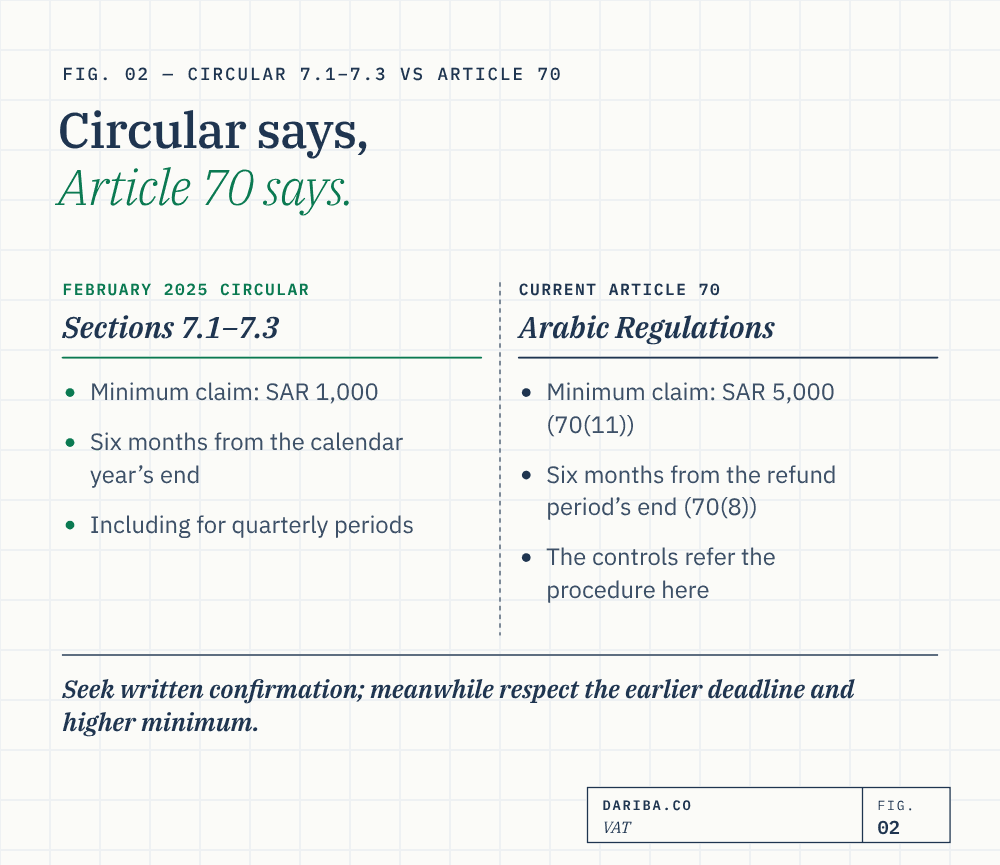
Dariba recommendation: seek written confirmation of the applicable donor procedure and approval notice promptly, organise a filing timetable that respects the current regulation, and avoid waiting for the later year-end-based date while the issue is unresolved. This identifies a material source conflict; it does not decide that every historical donor claim used the wrong rules.
Section 7.1 also describes a limited historical route for VAT incurred on or after 1 January 2018, included in specified claims for periods beginning after 30 May 2024, up to the final refund period of 2025. That wording does not establish an open-ended November 2026 amnesty or reopen an expired claim. The actual enabling decision, period and approval must be established before relying on retrospective relief.
Sources: Arabic circular sections 7.1–7.3; controls, Fourth clause; current Article 70(7)–(8), (11). The general designated-person guide explains the current parent framework.
Correct erroneous refunds and keep the decision trail
The controls’ Fifth clause requires immediate voluntary repayment on discovering an erroneous or unentitled refund and permits ZATCA’s assessment of improperly recovered amounts. Current Article 70(17) also requires immediate voluntary notification of the error and repayment under its procedures. A bank receipt is not permanent permission to retain an incorrect amount.
Retain eligible-person approval and effective dates, project agreements, permits, cost schedules, invoices/payments, other-route reconciliation, the actual claim and all notices/responses. Information requests, objection rights and payment of an approved amount need their own applicable deadlines; neither project approval nor initial submission guarantees payment.
This guide addresses the published original donor controls and selected circular conditions. Full retrospective-decision history, any donor-specific procedural override, actual land/project compliance, Zakat or income-tax deductions and an individual claim outcome remain separate matters. No RETT conclusion follows from these VAT controls.
Sources: controls, Fifth clause; Article 70(15)–(18).
Key takeaways
- The published controls concern the stated public-benefit building projects donated to the competent government authority.
- Actual ZATCA eligible-person approval and its effective date remain essential.
- The self-executing legal-person exception concerns the third-party contract, not all conditions.
- Permits, lawful implementation and project-specific invoice/payment evidence must be retained.
- Ordinary deduction and another special refund must not overlap this route.
- The circular’s SAR 1,000 and year-end filing terms differ from current Article 70; no operative override or continuing historical window is certified.
Sources
- ZATCA: original published donor controls under Governor Decision 2609710 Jumada I 1445H. First definitions, Third six cumulative registration conditions, Fourth Article 70 procedure and Fifth erroneous recovery. Original three-page scan visually read.
- ZATCA: Public-Benefit Projects VAT Recovery circular, ArabicIssue 1 February 2025, sections 4–7.3, official examples under 5(2)/(4)/(5). SAR 1,000/year-end timetable differs from current Article 70; no procedural override certified.
- ZATCA: Public-Benefit Projects VAT Recovery circular, English guidanceIssue 1 February 2025; Arabic and controlling regulation govern. Original cases distinguished from Dariba recommendations.
- Saudi VAT Implementing Regulations, controlling Arabic compilationArticle 70 eligibility/start dates, period/one-claim rules, SAR 5,000 minimum, documents, response, payment and error notification/repayment.
General source-based information reviewed 6 November 2026. Actual donor, project, competent authority, entitlement, approvals, periods and operative decisions control. Official examples are identified separately from Dariba recommendations. Conflicting filing guidance is expressly unresolved; full historical chains, procedural overrides and individual entitlement are not certified.