In brief
Article 73 covers qualifying tourists and goods carried out of Saudi Arabia through an approved-provider mechanism. Personal eligibility, exclusions, commissions and delegated operating requirements limit the result.
The Legal Framework Is More Specific Than a General Tourist Refund
VAT Implementing Regulations Article 73 provides a framework for refunding VAT to qualifying tourists on eligible goods paid for in Saudi Arabia and carried with them when leaving. It also provides for approved service providers and additional implementation requirements. VAT Law Article 33(2) is the separate statutory provision for tourist refund conditions.
This framework should not be described as a refund of every expense incurred during a visit. Tourist status, goods eligibility, supplier approval, the authorised provider and the applicable implementation mechanism each matter.
This guide explains the current compiled regulatory provisions. It does not confirm a current approved-provider list, participating retailer, airport counter, minimum purchase amount or rollout date. Those operational matters require the applicable ZATCA requirements and actual provider approval; the presence of Article 73 alone does not establish them.
Establish Who Qualifies as a Tourist
Article 73(3) defines the tourist as a natural person satisfying its conditions. The ordinary residence condition excludes a person with a permanent place of residence in Saudi Arabia or a GCC state applying VAT. The person must not be a crew member of a departing flight, aircraft, vessel or other means of transport. Additional conditions may be issued under paragraph 12.
The test is not simply possession of a foreign passport or a particular visa label. A visitor should establish the relevant residence facts and applicable additional requirements. A business company making purchases has a different question from a natural person acquiring eligible goods for personal use.
Paragraph 11 qualifies the GCC residence condition: tourists from GCC states are treated like tourists from outside the GCC until operation of the electronic-services system referred to in Article 79. Preserve that condition rather than asserting either permanent exclusion of every GCC resident or unconditional eligibility for every GCC visitor. The applicable system status and implementation requirements must be checked for the actual case.
Goods Must Meet the Positive Conditions and Avoid the Exclusions
Article 73(4) concerns goods bought for personal use from an approved supplier. Paragraph 1 also requires the eligible goods to be carried with the tourist on departure. Those conditions are separate from paying VAT on the purchase.
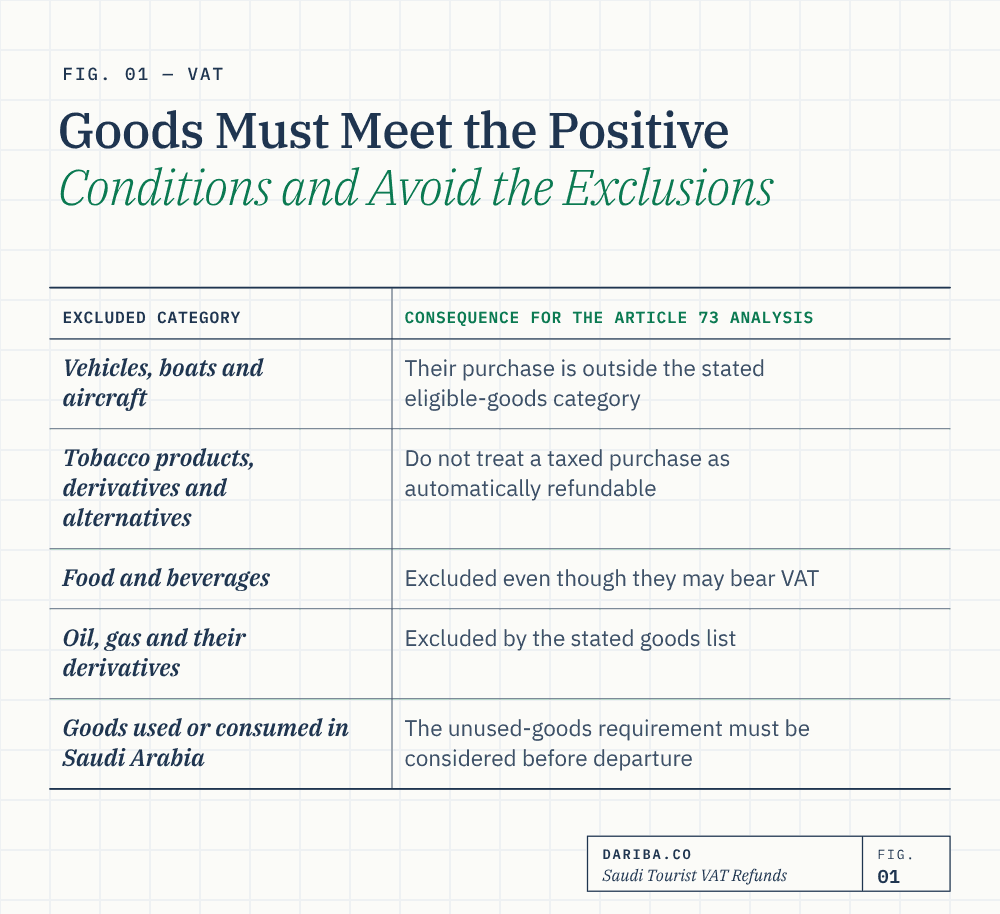
The provision expressly excludes the following:
| Excluded category | Consequence for the Article 73 analysis |
|---|---|
| Vehicles, boats and aircraft | Their purchase is outside the stated eligible-goods category |
| Tobacco products, derivatives and alternatives | Do not treat a taxed purchase as automatically refundable |
| Food and beverages | Excluded even though they may bear VAT |
| Oil, gas and their derivatives | Excluded by the stated goods list |
| Goods used or consumed in Saudi Arabia | The unused-goods requirement must be considered before departure |
Further goods or conditions may be specified under paragraph 12. Hotel accommodation, restaurant consumption and other services should not be presented as eligible carried-out goods merely because the customer is a visitor. A commercial export or a foreign business refund claim also follows its own provisions.
Dariba illustration: a visitor buys an otherwise qualifying unused personal item and also pays for a restaurant meal. Carrying the item on departure does not convert the meal into eligible goods. The item still needs the approved-supplier, tourist and operating-scheme conditions to be met. This is our illustration of the statutory distinction, not an official example or confirmation of any retailer’s approval.
Use the Approved Provider While Still in the Kingdom
Under Article 73(2), ZATCA may authorise one or more providers to facilitate tourist refunds and determines which providers are approved. Paragraph 5 requires the tourist to submit the refund request while in Saudi Arabia through the approved provider, acting on the tourist’s behalf.
The provider must verify that the request meets Article 73’s requirements and pays the tourist the amount satisfying those requirements under paragraph 6. The provider’s role therefore includes eligibility checks; an invoice or a shop’s promotional statement is not itself confirmation of approval.
Before relying on a refund in a purchase decision, obtain confirmation of the supplier’s and provider’s actual approved status, applicable goods and evidence requirements, submission procedure and departure checks. This is a practical recommendation to verify the operative scheme, not a new application deadline or a claim that one specific private company is authorised.
Distinguish Gross VAT from the Amount Paid to the Tourist
Article 73(6) permits the approved provider, in agreement with ZATCA, to deduct a percentage commission and impose other administrative charges for facilitating the refund. The regulation does not establish one universal commission percentage or cash payout in the reviewed text.
Dariba arithmetic illustration: assume an otherwise eligible purchase price is SAR 1,150 inclusive of VAT at 15%. The VAT component is SAR 150: SAR 1,150 × 15/115. It is not SAR 172.50 calculated as 15% of the VAT-inclusive price. Any permitted commission or administrative charge affects the amount ultimately received. This illustration assumes eligibility and does not quote an actual provider’s charges or guarantee recovery.
Article 33(3) separately zero-rates the qualifying refund-related services supplied by the tourist refund service provider under Article 73, as an exception to the specified exported-service restrictions. That provision concerns the provider’s facilitation service. It is not a general rule that all shopping, accommodation and other services supplied to tourists become zero-rated at the point of sale.
ZATCA Reviews the Provider’s Claim Separately
Article 73(7) permits ZATCA to verify the provider’s claims and compliance and request additional documents. Under paragraph 8, ZATCA may reject a claim in whole or part if requirements are not met. Where it approves a claim, it pays the approved refund amount to the provider.
Do not merge that Authority-to-provider settlement with the provider’s payment to the tourist. The provision describes different parties and steps; it does not promise that a tourist will receive every amount invoiced as VAT without verification.
Paragraph 8 also prevents issuance or amendment of an assessment relating to these refund claims after five years from the end of the calendar year in which ZATCA received the claim. This is a specific assessment limitation. It should not be rewritten as a five-year tourist application period measured from the shopping date, departure or the provider’s initial payment.
Providers Must Preserve Records and Can Be Jointly Liable
Article 73(9) requires the approved provider to keep the relevant paper or electronic records for the period specified by Article 66. The provider should preserve the chain between the purchase, tourist evidence, request, verification and payment rather than retain only a bank transfer total.
Under paragraph 10, the approved provider is jointly liable with the tourist for repayment of amounts shown to have been refunded contrary to the relevant procedures, Article 73 or ZATCA’s tourist-refund decisions. The provision does not remove the tourist’s responsibility merely because a provider processed the claim.
Dariba recommends that a provider’s procedures identify validation responsibility, exceptions, evidence retention and correction of an improper refund. These are implementation controls supporting the regulatory duties; this guide does not certify a particular provider’s process.
Confirm the Delegated Operating Requirements
Article 73(12) authorises the Governor to issue the necessary requirements. It identifies five areas: implementation requirements and phases; additional tourist and goods conditions; minimum eligible goods value; supplier approval; and refund application requirements.
Those matters must be established from the applicable official instruments and approvals. A threshold or deadline from another country, an old consultation or a general travel article is not a Saudi operating requirement. In this review, a complete current set of those delegated requirements and approvals was not verified; no specific provider, minimum or airport procedure is asserted here.
For other refund routes, use the eligible-person framework and ordinary VAT credits and refunds. The legal route should follow the claimant and transaction, rather than the common use of the word “refund”.
Key takeaways
- Article 73 concerns eligible goods paid for in the Kingdom and carried on departure, not every visitor expense.
- Natural-person residence and crew conditions are qualified by the stated GCC transition provision.
- Excluded goods include vehicles, tobacco, food and beverages, oil/gas products and goods used in the Kingdom.
- The tourist applies while in Saudi Arabia through an approved provider.
- Provider commissions and administrative fees can affect the payout; its facilitation service has a separate zero-rate rule.
- No particular approved provider, minimum purchase value, airport process or rollout date is verified by this guide.
Sources
- Saudi VAT Law, controlling Arabic textArticle 33(2): statutory delegation for the tourist refund framework.
- Saudi VAT Implementing Regulations, current Arabic compilationArticle 73(1)–(12): tourists, goods, approved providers, payments, review, five-year assessment limitation, records, joint liability and delegated requirements. Article 33(3) separately concerns provider facilitation services; Article 79 transition cross-reference retained.
General information based on the current compiled Arabic provisions reviewed on 29 October 2026. Actual eligibility, approvals and delegated implementation requirements determine availability. This guide does not verify an approved-provider list, purchase minimum, airport process or rollout date. Dariba illustrations are labelled and do not guarantee a refund.