In brief
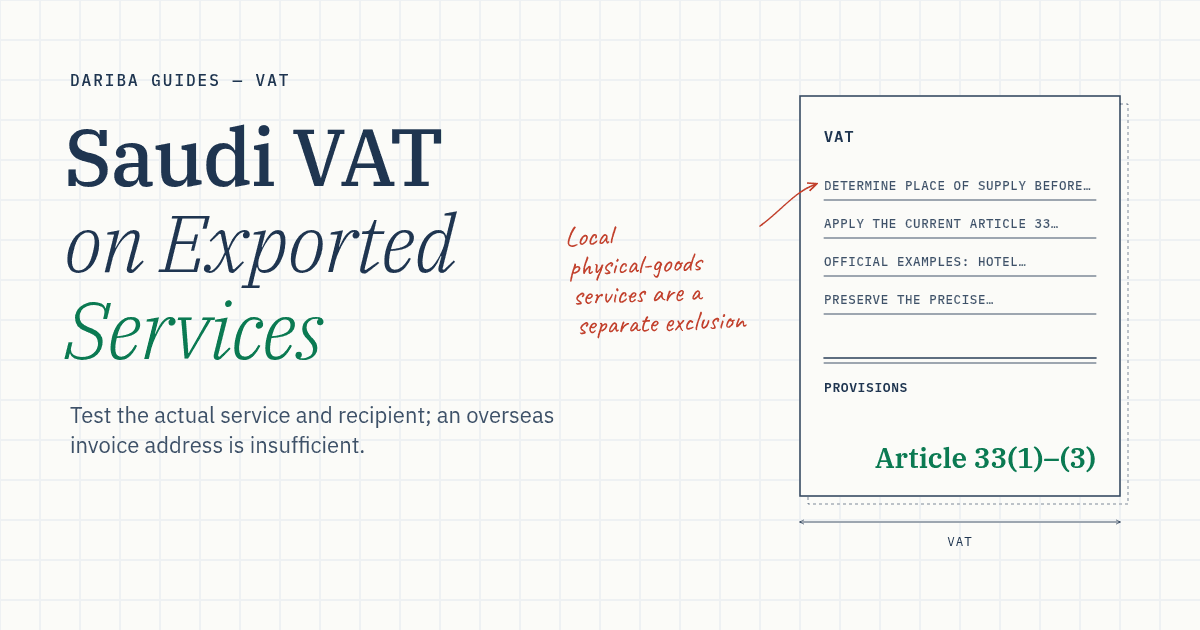
Export zero-rating requires a qualifying supply and documented foreign movement. Article 32 requires evidence within 90 days; customer non-residence alone cannot replace customs, commercial and transport support.
Zero-rating an export requires an actual qualifying export supply and evidence of the goods’ movement. An overseas customer, foreign-currency invoice or promise to collect from a Saudi warehouse is insufficient on its own. Article 32 places the evidence responsibility on the supplier applying the zero rate.
Establish which supply involves the export movement
Article 27(1) addresses an agreement between supplier and customer that transport results from the supply. Paragraph (2) identifies the relevant transported supply in a chain involving direct movement between countries and several sales of the same goods. Do not assume every invoice in a chain automatically has the same treatment.
ZATCA’s Imports and Exports guideline, second edition May 2026, section 7.1, pp. 34–35, connects the export declaration and actual transport. Commercial delivery terms help identify transport, risk and responsibilities but are not conclusive by themselves.
Confirm the destination, movement, ownership and customs sequence for the actual contract. Goods already abroad and sold there raise a place-of-supply question; that is different from a Saudi supply supported as a zero-rated export.
Direct and indirect exports require their actual conditions
Section 7.2, p. 35, describes a direct export where the supplier arranges transport outside the relevant territory and completes export clearance. In an indirect export, section 7.3, pp. 35–37, requires additional scrutiny because the customer arranges transport.
The guideline distinguishes transfer of ownership after the supplier’s export clearance from transfer before clearance to a non-resident customer required to export as a result of the supply. The supplier must support that actual arrangement and export, rather than merely obtain an overseas address.
Dariba recommendation: agree who will provide the export declaration, transport and foreign delivery evidence before releasing goods. A contractual promise helps control the risk, but it does not replace the documents or make an unsupported zero rate defensible.
Official example: warehouse collection without proof
Section 7.3, Example 8, p. 36, describes a Jeddah factory selling 1,000 plastic panels for SAR 30,000 to an Egyptian trader. Collection is from the factory warehouse; shipment is not specified and the customer does not provide evidence that the goods left the relevant territory as a result of that supply.
On those facts, the guideline requires the standard rate. The customer’s non-residence does not cure the missing export arrangement and evidence. The example is useful precisely because the customer could plausibly export later, yet the supplier lacks support for its own zero-rated position.
Dariba illustration — original price assumption: if the SAR 30,000 were expressly exclusive of VAT and the supply is standard-rated at 15%, VAT would be SAR 4,500. If a contract fixes an inclusive amount, the calculation differs. This assumed pricing basis is not added to the official example as an established fact.
Obtain the Article 32 evidence within 90 days
Article 32(1)–(3), p. 29, requires evidence within 90 days from the date of supply that the goods moved outside the relevant territory. The minimum includes official export-clearance documents for the supplier/customer concerning that supply, commercial documents identifying the customer and delivery place, and transport documents showing foreign delivery or receipt.
Section 7.4, p. 38, explains contracts/invoices and carrier documents. A customs clearance entry does not by itself prove the required delivery/receipt, and a customer email does not automatically replace the other statutory categories.
The guideline permits initial zero-rating where timely evidence is expected. If the required evidence is absent after the period, Article 32(2) does not permit the supplier to continue treating the supply as an export merely because it has chased the customer repeatedly. Track the date of supply and evidence deadline separately from the invoice payment date.
Respond to missing, rejected or later evidence
Article 32(4) allows ZATCA to reject insufficient documents and treat the supply as not exported until evidence is later provided. Retain a coherent link between the order, invoice, customs entry, shipment and delivery; individually authentic documents can still fail to prove they concern the same goods/supply.
Where evidence arrives later, establish the actual correction/adjustment route, documents and applicable time limits. The provision does not justify silently changing a closed return or assuming an unlimited right to recover tax from the customer.
The credit/debit-note guide addresses documentation. Dariba recommends an evidence register that distinguishes pending proof, insufficient proof, tax charged and subsequent accepted support. This is a practical control, not a prescribed statutory software format.
Supplies after export clearance retain conditions
Article 32(5), p. 30, addresses supplies after completion of export procedures, subject to commercial/transport evidence and the paragraph (1) period. Guideline section 7.5, Example 10, pp. 39–40, describes a Saudi hydrocarbon export followed by the Italian customer’s resale of the same goods to a Swiss trader after export clearance and loading.
The example illustrates qualifying subsequent zero-rated supplies supported by the export movement. It does not establish that every later sale is exempt from invoicing, registration or evidence analysis. Identify the goods and timing for each supplier.
The example’s named destination wording is not needed to apply the principle; the relevant fact is the documented foreign destination and movement. Avoid making an incidental location description the legal test.
Own-goods transfers, re-exports and suspension differ
Section 7.6, p. 40, explains that moving one’s own goods can involve an export customs procedure without a sale to another customer. A customs export does not automatically create commercial consideration or an ordinary customer invoice. Assess the actual supply/nominal-supply and reporting rules.
Article 32(6) retains the evidence conditions for re-exports of movable goods temporarily imported for repair, transformation or modification. Current Article 32 bis separately governs qualifying suspension transactions and added services. The guideline’s old reference to deleted Article 32(7) should be read with the current Arabic framework.
The import-relief guide explains these conditions. Do not assume permanent exemption from the initial import charge or an automatic refund simply because a later export declaration exists.
Apply the GCC transition and retain input entitlement evidence
Article 79(6)–(8), pp. 81–82, and guideline section 9, pp. 52–55, explain the transitional treatment pending the relevant electronic-services arrangements and formal commencement. During the described goods transition, supplies involving movement to another GCC state are treated as exports, with the same export-evidence requirements.
Do not substitute the ordinary intra-GCC evidence period for Article 32’s 90-day export requirement where transitional export treatment applies. Verify the actual period and any later official commencement decision before relying on a historic example.
A zero-rated export is a taxable supply; input entitlement still requires actual business use, recipient status, evidence and restrictions under Articles 49–51. The input recovery guide explains why neither a foreign customer nor a 0% output rate proves that every related cost is deductible.
Key takeaways
- Identify which supply involves the export movement.
- Direct and indirect export arrangements need their actual conditions.
- Obtain customs, commercial and transport evidence within 90 days.
- Missing or rejected evidence cannot support indefinite zero-rating.
- Later supplies and re-exports retain their specific evidence requirements.
- GCC transitional exports and input recovery need separate analysis.
Sources
- Controlling Arabic VAT Implementing RegulationsCurrent Arabic provisions, p. 27: 26; 32: 29-30; 79: 81-82. Conditions and actual period control.
- Official Arabic GCC VAT AgreementPlace of supply, import valuation, export zero-rating, import relief and suspension read with current Saudi implementing provisions.
- ZATCA Imports and Exports guidelineSecond edition May 2026, pp. 34–41; 52-55. Official examples distinguished from Dariba assumptions; stale references and inconsistent figures qualified.
- ZATCA Input Tax Deduction guidelineThird edition May 2026. Actual recipient, taxable use, evidence and restrictions remain separate from output classification or cash-flow facilities.
General information only. Actual supplies, facts, applicable periods and controlling Arabic legislation determine the result. Official examples are distinguished from Dariba analysis and original illustrations. Seek advice or clarification where the arrangement or source material leaves a specific issue unresolved.