In brief
SILZ’s goods rules depend on actual customs suspension and licensed use. Services, utilities, mainland release, importer liability and recovery require separate analysis.
A SILZ transaction needs more than the label tax-free zone. Import VAT suspension, a supply of goods while suspended, release to the mainland and a separate service are different events. Apply the current Arabic Article 32 bis, the zone’s statutory framework and ZATCA’s General Guideline for Zakat, Tax and Customs Regulations on SILZ, second edition May 2026, to the actual goods and parties.
Separate a goods movement from the supplier’s transaction
The Special Tax Rules, Article 8(B), treats the zone as part of Saudi territory for VAT while providing special treatment for specified customs-suspended goods movements and transactions. The Statute’s Articles 7–8 also address customs and VAT suspension. These provisions do not create a general offshore territory in which every service or expense is outside Saudi VAT.
For each transaction, identify the supplier and customer, ownership or supply event, goods location, physical movement and actual customs procedure. A sale while goods remain stored, the original import and later mainland release can require different entries and evidence even when they concern the same stock.
Dariba recommendation: map the physical and contractual flows together. A commercial invoice alone does not prove entry into a customs-suspension procedure, and a customs storage record does not itself identify every service supplied alongside the goods.
Meet all special-zone conditions in Article 32 bis
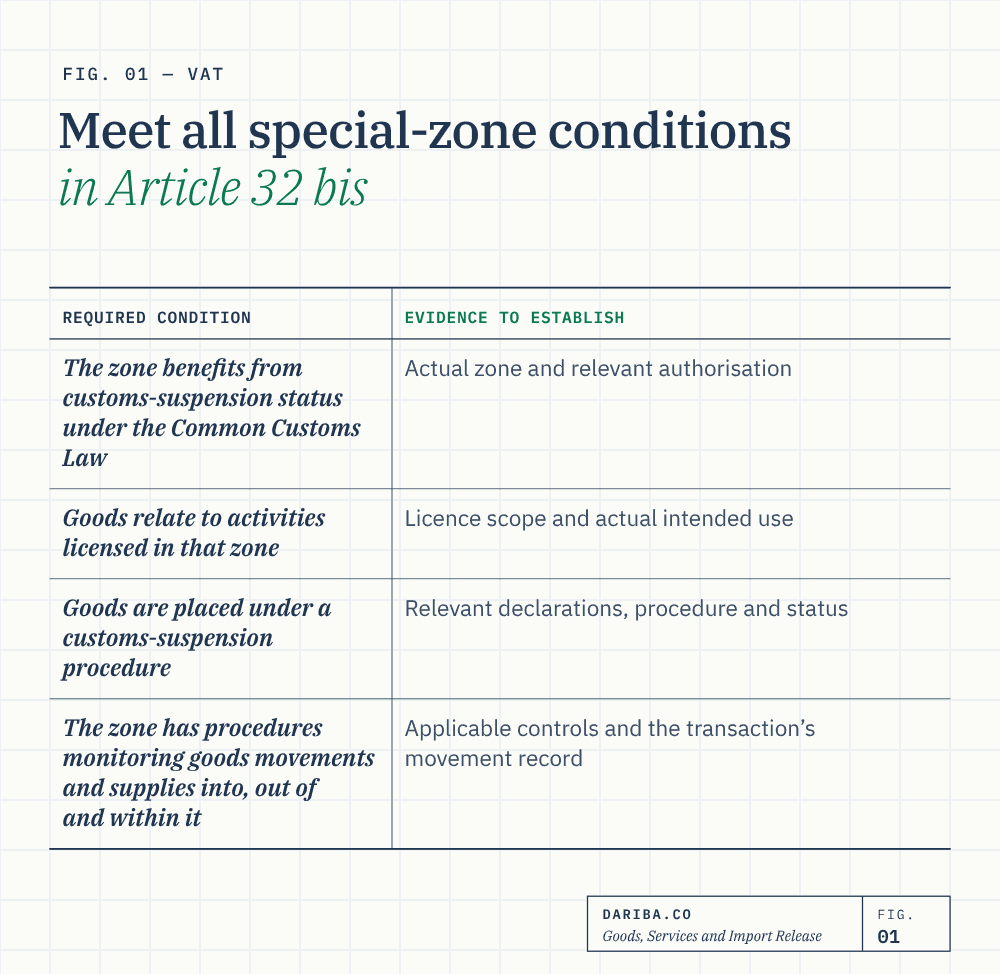
Paragraph (5) applies the specified treatment to zone imports, supplies into or within zones, movements between zones and exits, according to the nature of the transaction, without prejudice to other applicable provisions. All its conditions must be met:
| Required condition | Evidence to establish |
|---|---|
| The zone benefits from customs-suspension status under the Common Customs Law | Actual zone and relevant authorisation |
| Goods relate to activities licensed in that zone | Licence scope and actual intended use |
| Goods are placed under a customs-suspension procedure | Relevant declarations, procedure and status |
| The zone has procedures monitoring goods movements and supplies into, out of and within it | Applicable controls and the transaction’s movement record |
An address in a zone, a logistics activity or the customer’s claim to an incentive is insufficient alone. Paragraphs (6)–(7) additionally require invoices and relevant records, including evidence of location at supply and movements into, within or out of suspension, especially customs documents.
Distinguish import suspension from zero-rated goods supplies
Article 32 bis(3) suspends VAT due on an import placed under a qualifying customs-suspension procedure, with tax becoming due when goods leave that status under the applicable cases and procedures. Paragraph (1) separately zero-rates the relevant supplies into or within qualifying suspension procedures.
ZATCA’s SILZ guideline, section 4.3 and section 6.2.2, expressly explains zero-rate treatment for its qualifying goods supplies where the supplier is taxable and VAT registered. Its goods discussion also uses outside-scope wording for the suspension framework. Read the actual transaction, supplier status and current Article 32 bis together; do not apply a single outside-scope label to every registered-supplier sale and then assume it has the same return or recovery consequences.
Dariba analysis: the key distinction is between suspended import liability and the treatment of an actual supply. For a material arrangement that falls outside the guideline’s clear registered-supplier facts, obtain clarification rather than infer entitlement from a storage location alone. Registration obligations also need to be considered on their actual facts.
Mainland release creates a separate import event
Under Article 32 bis(3) and the relevant zone provisions, release from customs suspension requires the applicable import treatment. The SILZ guideline’s section 6.2.2, discussion of goods supplied from the zone to the mainland, treats exit for free circulation as importation and places liability on the importer identified in the customs declaration, usually the customer on its stated facts.
The supplier’s treatment and the importer’s liability should therefore be reconciled rather than treated as duplicate tax on one unchanged event. Identify the named importer, actual release date, classification, relevant VAT rate and correctly determined customs VAT base.
Dariba original illustration: assume an ordinary standard-rated release with a correctly determined import VAT base of SAR 200,000. VAT at 15% is SAR 30,000. The assumed base is not necessarily the commercial invoice value: the applicable valuation rules and any amounts included in that base must first be established. This illustration does not calculate a customs-duty tariff or certify an exemption.
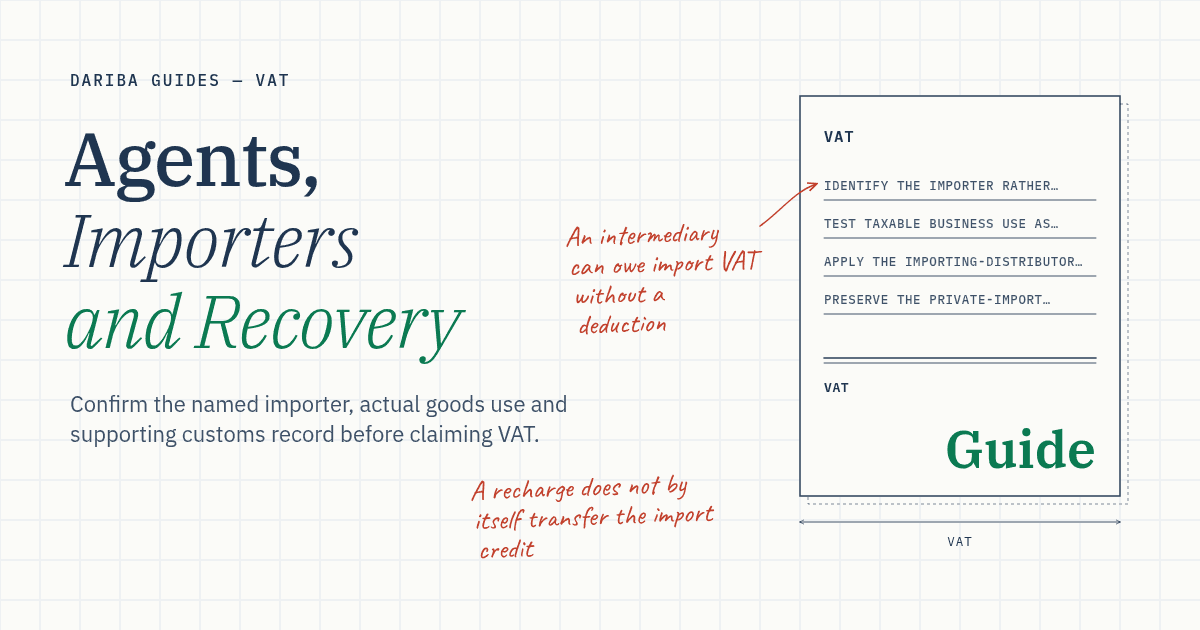
The import-agent guide explains why liability as the named importer and entitlement to deduct import VAT remain separate questions. Paying the customs amount does not alone prove taxable business use or transfer the credit to another entity.
Services do not automatically inherit the goods treatment
Section 6.2.2 distinguishes goods under the special framework from services supplied to or by zone entities. Ordinary service rules still apply to actual mainland-to-zone, within-zone or zone-to-mainland services. An overseas service recipient requires its own place and Article 33 analysis, rather than automatic zero-rating because the supplier is in SILZ.
The guideline also addresses goods and services sold together: identify separately supplied services and their value, while respecting the actual single-supply facts it describes, including its basic-warranty example. Do not strip an arbitrary service percentage from every goods invoice or assume every separately described service shares the goods’ treatment.
Dariba original illustration: assume a separate ordinary Saudi standard-rated advisory service to a zone entity for SAR 10,000 exclusive of VAT. VAT is SAR 1,500 and the total SAR 11,500. These are assumed facts; they do not decide the place or rate of every logistics, repair, transport or foreign-facing service.
Utilities are expressly outside Article 32 bis’s scope
Paragraph (8) excludes the specified water and forms of energy not covered by customs-suspension procedures, including electricity, gas, lighting, heating, cooling and air conditioning. They should not simply be treated as qualifying suspended stock because they are delivered to a zone building.
This exclusion requires the ordinary VAT treatment to be established; it is not itself a separate universal rate for every utility-related contract. Distinguish the actual goods or services, the supplier and consideration, and any genuinely separate transaction.
The same discipline applies to goods consumed or used for non-licensed purposes. The guideline does not extend the licensed-activity goods treatment to every item purchased by an established entity.
Temporary movements and onward exports require their own controls
Article 32 bis(2) addresses qualifying re-export of movable goods temporarily imported for repair, refurbishment, transformation or processing, with associated added services and the required customs conditions. Paragraph (4) applies the relevant export treatment to goods leaving suspension for outside GCC territory. The actual destination and applicable transitional rules still need consideration.
The SILZ guideline, section 6.2.2, separately discusses temporary mainland-to-zone repair movements, re-importation and onward export documentation. A temporary movement is not automatically a permanent tax-free disposal. Establish the procedure, identity of the goods, permitted period, work performed and actual discharge or re-entry conditions; do not infer that all repair value or every later mainland release is exempt.
For movements to another special zone, the guideline requires the destination’s own suspension conditions and actual procedures to be satisfied. Merely moving goods between two locations marketed as economic zones does not establish that status.
Input deduction and refunds require an actual route
The guideline’s deduction discussion and section 6.3.1 distinguish VAT-registered persons’ input deduction and credit-balance refunds from separate designated-person arrangements. Eligible input supporting taxable supplies, including zero-rated supplies, remains subject to Articles 49–51 and supporting evidence. It is not a promise to recover every zone cost.
A mainland importer’s correctly paid import VAT also requires its own use, evidence and entitlement assessment. An actual Article 44 authorisation for import-tax accounting through returns is a separate matter; no such authorisation arises merely from buying from SILZ.
Ordinary credit refunds follow Article 69. A person seeking a different designated-person route must meet the actual Article 70 eligibility, registration or approval and claim conditions. Do not duplicate recovery or treat the special rules’ provision for a refund framework as automatic approval of an individual claim. See the refund guide and designated-person guide.
Reconcile status, invoices and customs evidence
Dariba recommends one transaction record linking the licence, goods description, location at supply, customs status, movement or exit evidence, supplier invoice, customer and named importer, VAT treatment and relevant return entry. For services, retain the actual scope, recipient and place analysis separately.
The SILZ direct-tax guide deals with eligible-income and withholding relief. Those conclusions do not settle VAT, and this goods/VAT guide does not certify every customs authorisation, tariff, valuation or licensing condition. Identify which conditions are supported and resolve any material uncertainty before applying suspension or zero-rating to a different arrangement.
Key takeaways
- An import under suspension and a supply of goods are distinct tax events.
- Article 32 bis requires actual zone, goods, licensed-use and monitoring conditions.
- ZATCA’s guideline expressly gives qualifying registered-supplier goods cases zero-rate treatment.
- Mainland release creates the relevant import VAT event for the named importer.
- Services and excluded utilities do not inherit a blanket goods suspension.
- Input recovery and ordinary or designated refunds have their own conditions.
Sources
- VAT Implementing Regulations, current amended Arabic textArticle 32 bis(1)–(8): supplies, import suspension, zone conditions, records and utility exclusions. Articles 33, 49–51, 69–70: actual service and recovery rules. Arabic controls.
- ZATCA General Guideline for Zakat, Tax and Customs Regulations on SILZ, second edition May 2026Section 4.3 and section 6.2.2: goods movement, qualified registered supplies, services, mainland import release, temporary repair movements and recovery; section 6.3.1 distinguishes actual VAT refund routes.
- GACA Special Tax Rules for the Special Integrated Logistics Zone, official English textArticle 8(B): zone within Saudi VAT territory, specified goods/customs-suspension treatment and provision for a refund framework; read with current Implementing Regulations and ZATCA guidance.
- ZATCA Input Tax Deduction guideline, third version May 2026Taxable use, actual evidence, restricted inputs and attribution remain conditional. No automatic importer credit or all-cost recovery.
- Statute of the Special Integrated Logistics Zone, Royal Order A/17Official Arabic Statute, Articles 7–8: customs and VAT suspension and specified temporary movements; actual procedures and current implementing provisions must be considered.
General information only. Actual supplies, facts, applicable periods and controlling Arabic legislation determine the result. Official examples are distinguished from Dariba analysis and original illustrations. Seek advice or clarification where the arrangement or source material leaves a specific issue unresolved.