In brief
SILZ has its own eligible-income and payment-category relief. Mixed activities, related recipients, mainland-funded payments, relocated businesses and annual compliance require separate evidence.
The Special Integrated Logistics Zone has its own direct-tax rules. Its 0% eligible-income treatment and specified withholding relief should not be borrowed from another Saudi zone or treated as an exemption for every transaction involving a SILZ address. Establish the licensed entity, prescribed activities, actual income or payment, relief period and anti-avoidance position first.
Start with the established entity and prescribed activities
The Special Tax Rules for the Special Integrated Logistics Zone, Article 1, defines eligible income by reference to prescribed activities of an established entity that would otherwise be taxable under the Income Tax Law. Article 2 preserves ordinary Saudi tax laws unless an express special exclusion applies.
The underlying Statute, Royal Order A/17, Article 6, lists activities permitted with the competent authority’s required licences and approvals. They include specified goods maintenance, repair, processing, assembly and storage; sorting, packaging, trading and distribution; import, export and re-export; value-added, logistics and after-sales services; and waste or electronic-waste recycling.
ZATCA’s General Guideline for Zakat, Tax and Customs Regulations on SILZ, second edition May 2026, section 3.1, explains the licensed-activity framework. An activity appearing in the broad statutory list does not prove that a particular entity has the required licence or that its entire income arises from the prescribed activity.
Apply zero rate to eligible income during the actual period
Special Tax Rules Article 3(A) gives the stated 0% income-tax rate to eligible income during the relief period, subject to compliance. Paragraph (E) preserves ordinary treatment for other income. Guideline section 4.1 describes eligible income separately from non-eligible activity income, for which it describes the ordinary 20% CIT treatment where applicable.
Dariba analysis: distinguish the activity, income and relevant costs. Do not convert every dividend, service fee, investment return or mainland business receipt into eligible income merely because the entity holds a zone licence. The applicable ordinary CIT or Zakat position must also be identified rather than assumed from a commercial label.
Article 4 starts the period on the date the entity obtains its trading licence for prescribed activities. It ends on the earlier of fifty years or the entity ceasing to be an established entity in the zone. The guideline includes cancellation or suspension of the licence in its earlier-ending discussion. This is not an unconditional fifty-year guarantee for every projected receipt.
Maintain separate activity accounts before using a fallback ratio
Article 6(C) requires separate accounts for non-prescribed activities in its stated circumstances and allocation to prescribed activities as though independent, under the arm’s-length principle. Paragraph (D) requires accounts for each tax year, including a partial year beginning with the trading licence where applicable.
Guideline section 6.2.1 requires eligible and ineligible activity income and associated costs to be calculated separately. Where profits are not separated, it gives the following calculation: established-entity tax base multiplied by ineligible income divided by total income.
Dariba original illustration of that stated formula: assume an applicable total tax base of SAR 4 million, total income of SAR 10 million and ineligible income of SAR 2 million. The ratio is 20% and the calculated non-eligible base SAR 800,000. Assuming the ordinary 20% CIT rate applies to that base, tax is SAR 160,000. These figures are Dariba assumptions, not an official worked example or confirmation of the underlying base.
The fallback is not an election to dispense with separate records or a universal allocation of all costs by revenue. Different profitability, pricing or functions can make the actual separate computations materially different. Document the basis and obtain clarification where application to the facts is uncertain.
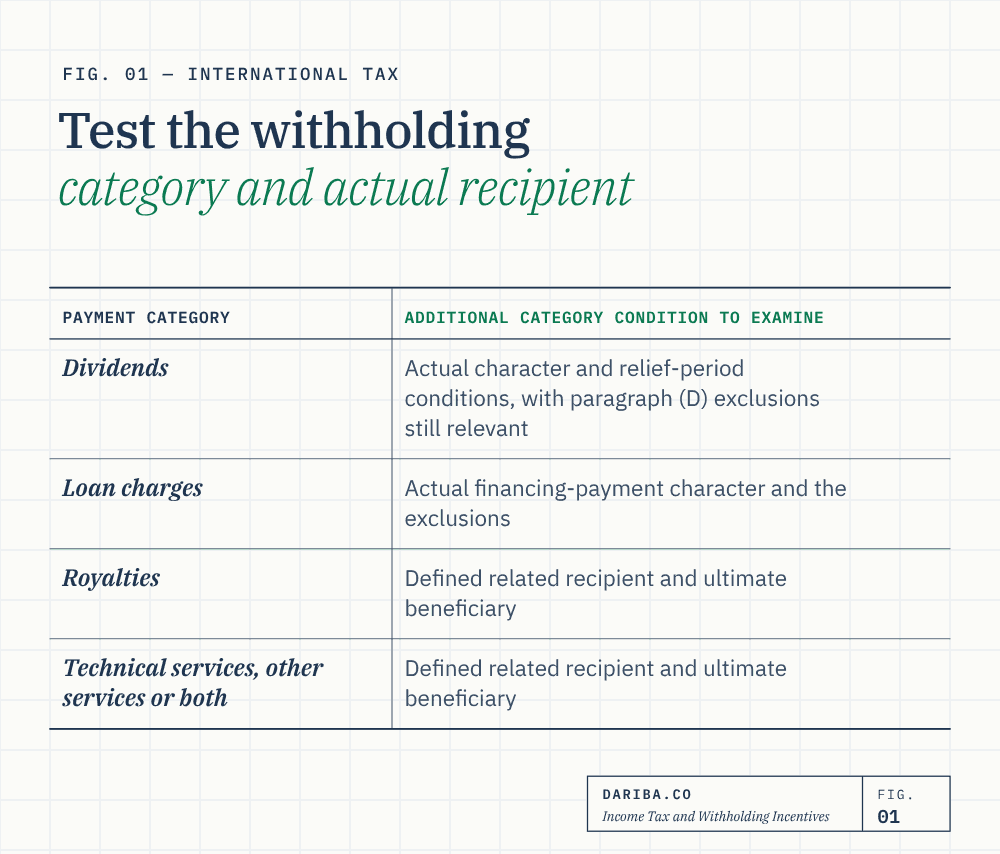
Test the withholding category and actual recipient
Article 3(B) lists relief for specified payments to non-residents during the period. It distinguishes dividends and loan charges from royalties and technical or other services, for which the recipient must be a related person. Article 3(C) uses the ultimate beneficiary for the latter recipient conditions.
| Payment category | Additional category condition to examine |
|---|---|
| Dividends | Actual character and relief-period conditions, with paragraph (D) exclusions still relevant |
| Loan charges | Actual financing-payment character and the exclusions |
| Royalties | Defined related recipient and ultimate beneficiary |
| Technical services, other services or both | Defined related recipient and ultimate beneficiary |
For the special rules, Article 1(A)(14)’s defined related person cross-refers to the Transfer Pricing Bylaws and amendments. Do not substitute an informal affiliate label or an assumed ownership percentage without applying the actual definition. The related-person guide explains the wider control analysis.
An unrelated foreign service provider should not be promised the same exemption merely because its invoice supports the zone business. Conversely, a payment meeting the related-recipient limb still needs the exclusions and actual facts tested. The ordinary withholding guide applies where special relief is unavailable, together with any actual treaty entitlement.
Preserve the exclusions for non-prescribed and mainland-related payments
Article 3(D) excludes payments relating to non-prescribed activities and addresses payments sourced, or to be sourced, from related persons conducting mainland activity in connection with the relevant exempt payment categories. It also preserves Article 5’s avoidance cases. Guideline section 4.2 sets out these exceptions alongside the payment list.
Dariba recommendation: trace the obligation, economic beneficiary, funding and connection to activities. A payment routed through the zone entity is not necessarily the zone entity’s qualifying payment. Likewise, a bank transfer from a zone account does not answer whether the amount is connected with related mainland payments.
The special definition of payment also includes specified non-cash consideration, settlement, set-off, book adjustments and due and payable liabilities. Review the actual transaction rather than restricting the evidence file to outward bank remittances. This does not replace the applicable ordinary rules for identifying the relevant withholding event.
Do not treat relocation disclosure as automatic clearance
Article 5(A) sets out non-eligibility where an entity or related person carries on prescribed activities on the mainland, those activities cease or are substantially reduced, and the stated subsequent zone activity or transfer arrangements occur. Paragraphs (B)–(C) separately address facilitating non-resident payments for persons ineligible for relief, intentional false information and misuse of incentives, with denial, revocation and applicable penalties.
Guideline section 5 discusses disclosure of transferred mainland activities at fair market value and provision of information on existing and new profits. Its disclosure discussion must be reconciled with the published special rule’s relocation restrictions; it should not be read as an automatic safe harbour curing every Article 5(A) case.
Dariba analysis: before modelling 0% on a relocated business, identify the historic activity, entities, functions, reduction or cessation on the mainland, assets or contracts transferred, valuation and actual reporting. Obtain a confirmed application of the rules to a material relocation rather than assume that filing a transfer-pricing disclosure alone establishes entitlement.
This distinction is commercially significant: a genuine new licensed activity and a rearrangement of an existing mainland business can have different facts. A new legal entity or zone address does not by itself resolve that boundary.
The non-resident goods rule has a physical-presence condition
The Statute’s Article 9 addresses a non-resident’s directly goods-related zone activities under the special framework. Special Tax Rules Article 3(F) makes its PE exclusion subject to the non-resident having no physical presence in Saudi Arabia.
Do not present this as a blanket PE exemption for every foreign group company, personnel arrangement or mainland operation. Identify the actual activities, people, presence and relevant ordinary law or treaty questions. The zone entity’s own relief and a non-resident supplier’s or affiliate’s Saudi exposure are different analyses.
Article 8(A) also treats the zone as part of Saudi Arabia for international agreements and links the entity’s residence to satisfaction of the Income Tax Law requirements. A licence is not a substitute for every domestic or treaty-residence condition.
Registration and annual compliance continue
Article 6(A) requires annual confirmation of compliance with the special rules through the stated declaration framework. Article 7 preserves ZATCA’s information, assessment, examination and audit powers and permits a request for interpretation. A zero eligible-income tax result does not remove those powers.
Guideline sections 6.1–6.2.1 explain tax registration, the separate zone/mainland branch identities described there, annual income-tax reporting and separate ineligible-activity calculations. It states a 120-day annual CIT filing framework and continued withholding declarations, including incentive-covered payments under the relevant reporting rules. Review the actual registration, form, period and due dates.
Dariba recommendation: keep the licence, activity and income map, accounts, costs, related-recipient and beneficial-owner evidence, funding trail, relocation analysis, returns and annual confirmation together. Reassess the position when activities, contracts or licence status change, rather than renew the same conclusion solely because last year’s return showed no tax.
Keep other taxes and the wider zone comparison separate
Guideline section 4.4 expressly preserves ordinary Zakat and other tax rules. No blanket Zakat exemption should be inferred from the eligible-income CIT incentive. VAT and customs have separate goods, suspension, services and recovery provisions; the direct-tax analysis above does not determine those results.
The Saudi zone comparison distinguishes SILZ from KAEC, Ras Al-Khair, Jazan and Cloud Computing. This guide addresses direct-tax eligibility and payment controls. It does not certify every delegated licensing condition, VAT/customs procedure or case-specific relocation outcome. The useful conclusion identifies which relief is supported and which factual or interpretive boundary still needs resolution.
Key takeaways
- Only eligible income of an established entity receives the stated 0% rate during the relief period.
- The fifty-year period starts with the trading licence and can end earlier.
- Royalty and service-payment relief requires the defined related recipient; not every foreign supplier qualifies.
- Mainland-related funding and non-prescribed activities are express withholding exclusions.
- Relocation disclosure and valuation should not be treated as automatic clearance of Article5.
- Separate accounts, actual reporting and ordinary Zakat and other tax rules remain relevant.
Sources
- GACA Special Tax Rules for the Special Integrated Logistics Zone, official English textArticles 1–7 and 8(A): definitions, eligible income, withholding categories/exclusions, period, anti-avoidance, accounts, administration and treaty residence. Article 5 relocation wording must be reconciled with current guidance before a case-specific relief conclusion.
- ZATCA General Guideline for Zakat, Tax and Customs Regulations on SILZ, second edition May 2026Sections 3.1, 4.1–4.2, 4.4, 5 and 6.1–6.2.1: licensed activities, eligible and other income, payment categories, ordinary Zakat, relocation/disclosure, registration and mixed-base calculation. Full VAT/customs procedure is a separate review.
- Statute of the Special Integrated Logistics Zone, Royal Order A/17Official Arabic Statute, particularly Articles 6, 9 and 10: licensed activities, non-resident goods-related PE framework and authority for special income-tax rules.
General information only. Actual supplies, facts, applicable periods and controlling Arabic legislation determine the result. Official examples are distinguished from Dariba analysis and original illustrations. Seek advice or clarification where the arrangement or source material leaves a specific issue unresolved.