In brief
Article 64 sets ordinary notice, stated exceptions, record access and document procedures. Article 56 supplies separate information powers. Reconciliations and official evidence guidance support a response without proving an unpublished audit-selection policy.
A Saudi VAT examination requires both cooperation and attention to the limits and procedures in the Regulations. Article 64 governs notice, access, transferred documents and electronic records; Article 56 separately addresses information. Preparing a traceable explanation of the return is more useful than guessing ZATCA’s unpublished selection criteria or assuming every data difference proves an error.
Ordinary notice and the stated exceptions
Article 64(6)(a) provides for examination at the taxable person’s business premises or ZATCA’s premises on notice issued at least twenty days before the examination date. The text says days, not twenty business days. The ordinary notice provision is not limited to on-site examinations.
Paragraph (6)(b) permits examination without prior notice where ZATCA has reasonable grounds to suspect a violation of the Law or Regulations, or where the taxable person has refused, or is likely to refuse, cooperation. These are statutory grounds, not a general preference for unannounced visits.
ZATCA’s dedicated Examination, Assessment, Correction and Objection guideline, version 3 May 2026, sections 6.1-6.2, p. 35, describes on-site/off-site work and advance notices identifying requested records and, where applicable, the periods. It also distinguishes requests outside a formal examination. The ordinary examination notice period should not be assumed to govern every separate information request.
If a visit is unannounced, Dariba recommends recording the officers’ identification, stated purpose, periods and basis while arranging the required access. Seek prompt advice on a disputed procedure. Raising a legal question should not become obstruction or concealment. Conversely, the cooperation obligation should not be represented as proof that the taxpayer agreed to every distinct post-limitation examination under Article 64(10).
What records and premises can be examined?
Under Article 64(6)(c), examination at the business takes place during its usual official working hours. Access must be allowed to the books, records, invoices and accounting documents retained under the Law and Regulations; examination of those documents may occur on or off the premises. Paragraph (7) permits visits to premises belonging to the taxable person to verify compliance.
Where records are electronic, paragraph (8) requires paper copies or electronic files containing the requested information during examination. A summary spreadsheet is not automatically a substitute for the underlying records. Retain a record of each request, the files supplied and explanations of any extraction limitations, rather than silently omitting difficult transactions.
The record-keeping guide distinguishes ordinary six-year retention, longer asset-related requirements, Arabic records and the conditions surrounding electronic access. Neither “all records are always six years” nor “a login alone validates any overseas storage arrangement” is a reliable audit preparation rule.
Removal, return and additional evidence powers
If ZATCA transfers books or documents off-site, Article 64(6)(d) requires a receipt. Paragraph (6)(e) requires transferred documents to be returned within twenty days from the examination’s completion; ZATCA may retain copies where it considers necessary. The return clock is not twenty days from the date documents were first collected.
Dariba recommends maintaining an inventory identifying each transferred item, date, receipt and return status. This is an evidence-management practice, not an additional statutory form prescribed by paragraph (6).
Article 64(9) addresses additional measures where requested information is not provided through cooperation. It includes temporary holding of documents where concealment, destruction or tampering is indicated, and search/evidence collection in suspected violation cases. These conditional powers should not be reduced to an unlimited routine right to seize anything in every examination.
Third-party information is a separate power
Article 56(1) requires persons to provide information requested to establish their tax obligations. Paragraphs (2)-(4) address direct and continuous access to information directly related to tax held by the specified third parties, including government bodies, banks and regulated financial institutions, and their obligation to provide it.
Dariba analysis: bank movements are relevant evidence, but they are not themselves the legal definition of taxable consideration. Loans, capital contributions, transfers between accounts and customer receipts can have different meanings. Prepare a bridge from financial movements to actual supplies, tax points and returns. Do not respond to an unexplained difference by mechanically charging VAT on every deposit.
The guideline section 7.1.2, p. 40, says ZATCA generally allows twenty days for requested information, but a shorter period may be required in exceptional circumstances such as suspected fraud or risks to documents. This is qualified guidance, not an unconditional twenty-day extension of every actual notice or an exemption from its deadline.
This is a practical consequence of the information power. It is not a claim that ZATCA uses a particular unpublished scoring model, audits a sector at a verified frequency, or has already matched every bank entry to an invoice.
An official example on imperfect evidence
ZATCA’s Input Tax Deduction guideline, third version May 2026, section 8.1, Example 22, pp. 35–36, describes Tariq’s SAR 3,000 purchase from a small local supplier. The invoice shows the supplier’s tax number and relevant supply information but omits Tariq’s address and the quantity of parts. His accountant unsuccessfully seeks an updated invoice. ZATCA exercises discretion to accept alternative evidence, together with evidence of VAT payment.
The example does not give a taxpayer a general right to deduct against any incomplete receipt. Dariba analysis: an examination file should show efforts to obtain compliant documentation, actual supply and use, the VAT incurred, payment evidence and the basis for any alternative-evidence treatment under Article 49(7). The original facts and exercised discretion matter. A missing document should be investigated, rather than automatically accepted or assumed incurable.
Build a reconciliation around explanations
The following are Dariba’s preparation priorities, not published ZATCA audit-selection criteria:
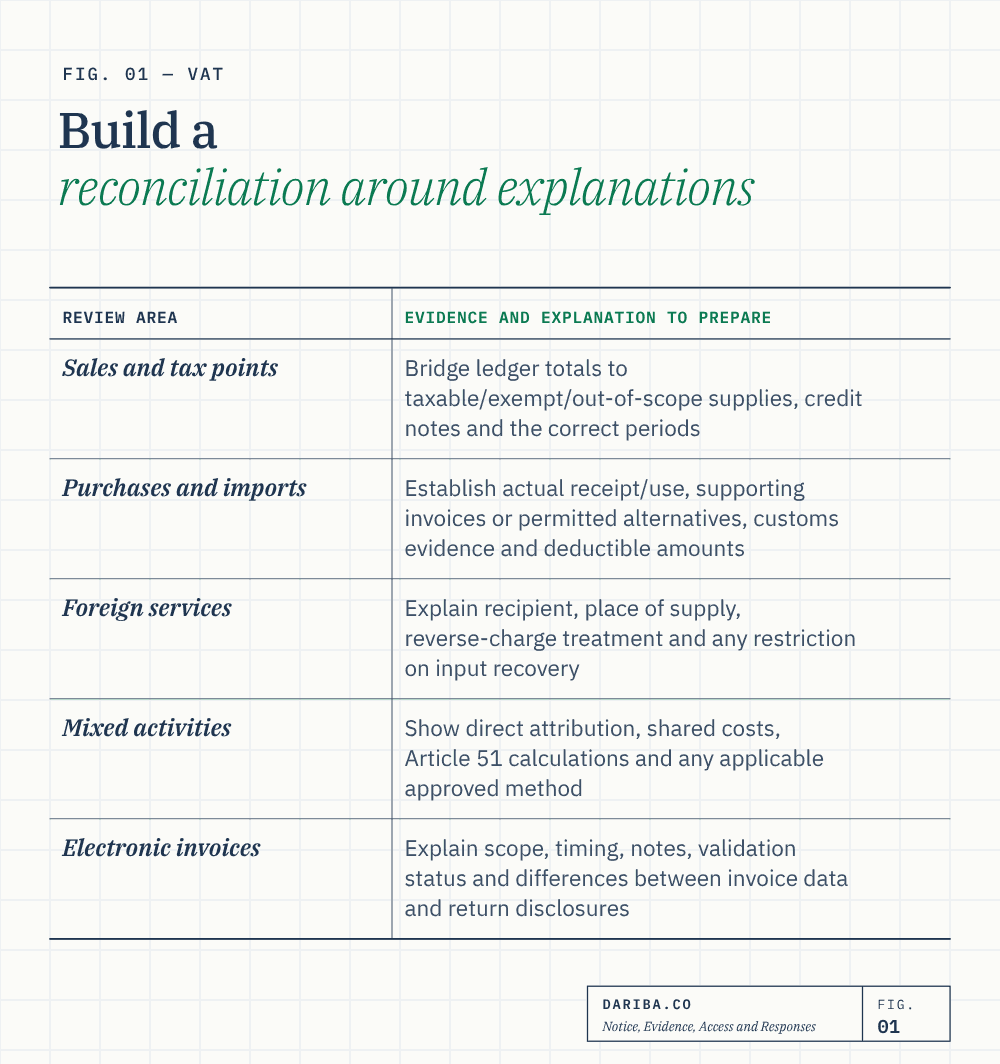
| Review area | Evidence and explanation to prepare |
|---|---|
| Sales and tax points | Bridge ledger totals to taxable/exempt/out-of-scope supplies, credit notes and the correct periods |
| Purchases and imports | Establish actual receipt/use, supporting invoices or permitted alternatives, customs evidence and deductible amounts |
| Foreign services | Explain recipient, place of supply, reverse-charge treatment and any restriction on input recovery |
| Mixed activities | Show direct attribution, shared costs, Article 51 calculations and any applicable approved method |
| Electronic invoices | Explain scope, timing, notes, validation status and differences between invoice data and return disclosures |
An invoice dataset and a return need not have identical totals without adjustments: tax timing, notes, excluded populations and reverse-charge disclosures can require explanation. This is not permission to leave unexplained mismatches. It is a reason to prepare a documented bridge rather than an unsupported equality check.
Refunds, limitation and correction need their own analysis
Article 69(7) permits examination of refund-request periods within one calendar year from request submission, without prejudice to Article 64(3) and (4). It does not mean every credit return causes an audit, that all refund examinations finish within a year, or that the ordinary assessment period disappears.
Article 64(3) ordinarily restricts assessments after five years from the relevant calendar-year end; paragraph (4) provides the specified twenty-year cases. Paragraph (10) separately requires agreement for its examination/assessment route after the paragraph (3) period. Preserve the distinction between information requests, examination, assessment and the basis relied on for an older period.
Known return errors should be evaluated promptly under Article 63. An examination does not create a universal permission to defer correction until its conclusion. Equally, voluntary correction is not, merely because it is voluntary, a guaranteed penalty waiver. Any relief programme or penalty treatment needs its actual conditions and dates checked. See the correction guide.
Close the process with a decision and account reconciliation
The dedicated guideline section 6.3, pp. 37-39, identifies several possible outcomes: assessment, a penalty, a direction for future treatment, registration/cancellation action, or completion without further formal action. An examination does not necessarily produce additional tax. Record the actual conclusion and any continuing directions.
Article 64(1)-(2) requires assessment notification and the specified information, including calculation basis and appeal rights. Compare any assessment to the evidence and explanation actually supplied; identify agreed and disputed adjustments and their periods.
Maintain a clear record of receipt and notification dates and verify the governing objection requirements under Article 68 and the Committees’ Work Rules. A clarification request or continuing dialogue should not be assumed to suspend a deadline or collection. A well-managed examination ends with an understood legal and accounting position, not merely confirmation that the last spreadsheet was uploaded.
Key takeaways
- Ordinary examination notice is at least twenty days, subject to the specified no-notice grounds.
- Removed documents require a receipt and are ordinarily returned within twenty days after examination completion; necessary copies may be retained.
- Electronic record production and third-party information powers have their own statutory basis.
- Official Example 22 accepts imperfect invoice evidence through exercised discretion, not a general waiver of documentation.
- Preparation priorities are Dariba recommendations; no unpublished sector ranking or automatic penalty relief is asserted.
Sources
- Controlling Arabic VAT Implementing RegulationsTenth edition April 2025. Articles 56,64,68-70; pp. 60,64-74. Arabic controls; applicable conditions and separate deadlines remain.
- ZATCA Input Tax Deduction guidelineThird version May 2026. Section 8.1 Example 22, pp. 35-36; alternative evidence involves exercised discretion.
- ZATCA Tax Invoicing and Records guidelineVersion 3 May 2026. Sections 8-9, pp. 40-47, retention and evidence; statutory distinctions control.
- ZATCA Examination, Assessment, Correction and Objection guidelineVersion3 May2026. Sections 4.3-4.4.1, Examples 2-3, document pages20-24; sections6-7 pages35-40. Examples preserve actual agreed withdrawal, historic facts and ordinary-limit assumptions.
General information only. Actual supplies, facts, applicable periods and controlling Arabic legislation determine the result. Official examples are distinguished from Dariba analysis and original illustrations. Seek advice or clarification where the arrangement or source material leaves a specific issue unresolved.