In brief
Regulations Article 18 separates legal-person self supplies, actual VAT-group supplies and specified cross-border establishment services. All three paragraph (3) conditions, special place rules and separate valuation/liability analysis matter.
Saudi VAT does not treat every internal allocation, foreign invoice or group recharge alike. Regulations Article 18 distinguishes a legal person’s self supplies, supplies within an actual VAT group and specified services between establishments of the same person across a border. The identity of the person, the establishments and the service must be established before selecting a liability or claiming that nothing is taxable.
Start with the legal person and the actual transaction
A branch of a company and a separately incorporated subsidiary are different arrangements. Common ownership does not merge separate companies into one person for every VAT purpose. Conversely, a management-account entry between branches does not by itself establish that one independent company has sold a service to another.
Identify the legal entity, registration, actual establishments, contractual service and recipient. Keep the internal service, an external customer sale and the allocation of costs distinct. The ledger label alone cannot decide all three.
This guide concerns the selected Article 18 framework. It does not determine whether a particular branch, office or arrangement has the necessary substance or whether an actual charge represents a service.
Article 18(1) preserves other supply rules
Paragraph(1) generally places goods and services supplied by a legal person to itself outside VAT scope, without prejudice to Article 16 and nominal-supply cases. Those qualifications matter. A same-owner stock movement or use change cannot be cleared by an unrestricted statement that self supplies never matter for VAT.
Article 16 has its own conditions for specified own-goods movements and the relevant evidence and transition. Article 15 addresses nominal supplies, including retained goods on cessation and relevant free/private-use events. Neither should be replaced by an internal accounting classification.
Record what actually moved or changed use, the relevant destination and period, and any input history before selecting the rule. See own-goods movements and nominal supplies for those separate conditions.
Actual VAT-group membership is a separate route
Article 18(2) concerns supplies from one VAT-group member to another member of that group. An ownership chart, consolidated financial statement or pending group application is not itself proof of effective membership.
Establish the members and applicable dates. ZATCA’s Tax Groups guideline, sections 6.1–6.3, pages 20–22, distinguishes the group’s activity, external supplies, imports, output/input amounts and membership-period joint obligations. Section 6.2 expressly disregards supplies between actual members, including for the stated taxable/exempt revenue calculation. Then separately analyse supplies to outsiders and input recovery. Internal outside-scope treatment does not give every member or every cost unrestricted deduction, and it does not automatically include an overseas establishment in the group.
The VAT-group guide explains eligibility, approval, changes, recovery and exit. The same-person rule and the VAT-group rule should not be conflated simply because management calls both arrangements intragroup.
Article 18(3) has three cumulative conditions
Paragraph (3) treats services supplied by a non-resident supplier to a legal person established inside Saudi Arabia as supplies when all its stated conditions apply. The legal person must be established in Saudi Arabia and in more than one country; the services must be supplied by its non-resident establishment outside Saudi Arabia and received by an establishment of the same person inside Saudi Arabia; and the service must not occur outside Saudi Arabia under an Agreement special place-of-supply rule.
Do not omit the final condition or assume that a foreign head office makes every receipt outside scope. Equally, do not treat a Saudi subsidiary as the same person’s establishment merely because its parent is abroad. Classify the actual arrangement before deciding which received-supply provisions apply.
The provision addresses when services are treated as supplies. Liability, taxable nature, value, tax point and any deductible input require their own applicable rules; Article 18 alone is not a complete return calculation.
Residence follows the relevant establishment
Agreement Article 1 distinguishes place of business from a fixed establishment with permanent human and technical resources enabling supplies or receipts. Where a person has residence in more than one state, the place most closely connected with the supply matters.
In ZATCA’s Imports and Exports guideline, second edition May 2026, section 6.1, Example 3, page 30, a Saudi machinery company’s Bahrain branch maintains a customer’s vehicle there. The guideline regards that branch as the supplier on those facts and places the service outside Saudi VAT.
This is an external customer-service example. It is not a calculation of an internal head-office recharge or proof that every service involving the same company has the Bahrain result.
Read the Saudi-branch example within its facts
Example 4 on page 30 concerns a UAE security company with a registered Riyadh branch. A Riyadh bank contracts with UAE representatives and the people and equipment providing remote monitoring are in the UAE. The guideline directs reporting by the Saudi branch and distinguishes a separately incorporated Saudi subsidiary.
That example makes actual identity and establishment analysis important. It does not expressly give an internal head-office-to-branch consideration, deductible proportion or a worked Article 18(3) calculation. Do not invent those facts or turn its branch-reporting statement into a universal rule for all foreign contracts.
The imported-services guide explains these examples alongside ordinary RCM compliance. A focused Article 18 analysis should identify the internal service separately from the company’s customer sale.
Special service-place rules still matter
Agreement Articles 17–21 contain specific rules for the identified hire, transport, property, telecommunications/electronic and performance-based services. Apply the actual category before relying on ordinary residence rules.
The guideline’s section 6.2, Example 5, page 31, locates an Amman hotel service outside Saudi Arabia on its facts. It is an external received-service example, illustrating the place distinction rather than a worked internal establishment charge. A Saudi payer alone does not replace the relevant special-place test.
Preserve the evidence identifying the service and the establishment connected with it. Then assess any output liability and permitted input separately. Neither a cost allocation nor an equal accounting debit and credit demonstrates automatic VAT neutrality.
Keep the liability, value and deduction decisions separate
Article 18 identifies the relevant supply treatment; it does not state one universal value for every internal cost allocation. Establish the actual supply and applicable valuation route before treating salary allocations, a transfer-pricing mark-up, purchase cost or market value as the VAT base. Article 38 concerns its cumulative related-person conditions; Article 39(1) has a purchase/cost rule and market-value fallback for the nominal supplies within its scope. Do not import either mechanically into every branch ledger entry.
Where a received supply falls within the Agreement’s customer-liability provisions, Regulations Article 47(1) requires the relevant output tax and any input deductible to the extent permitted. That conditional rule does not make every foreign cost an imported taxable service or guarantee an equal input claim. The actual use, evidence and restrictions in Articles 49–51 still matter. A taxable customer and a partly exempt business each need supply-specific analysis.
Dariba recommendation: document supply identity first, then place and liable person, value, tax point, reporting and recovery. If the internal service or appropriate valuation cannot be established from the facts and applicable sources, seek a transaction-specific conclusion rather than applying 15% to all head-office expenditure. This focused guide does not resolve a universal internal-services valuation method or every cross-border VAT-group arrangement.
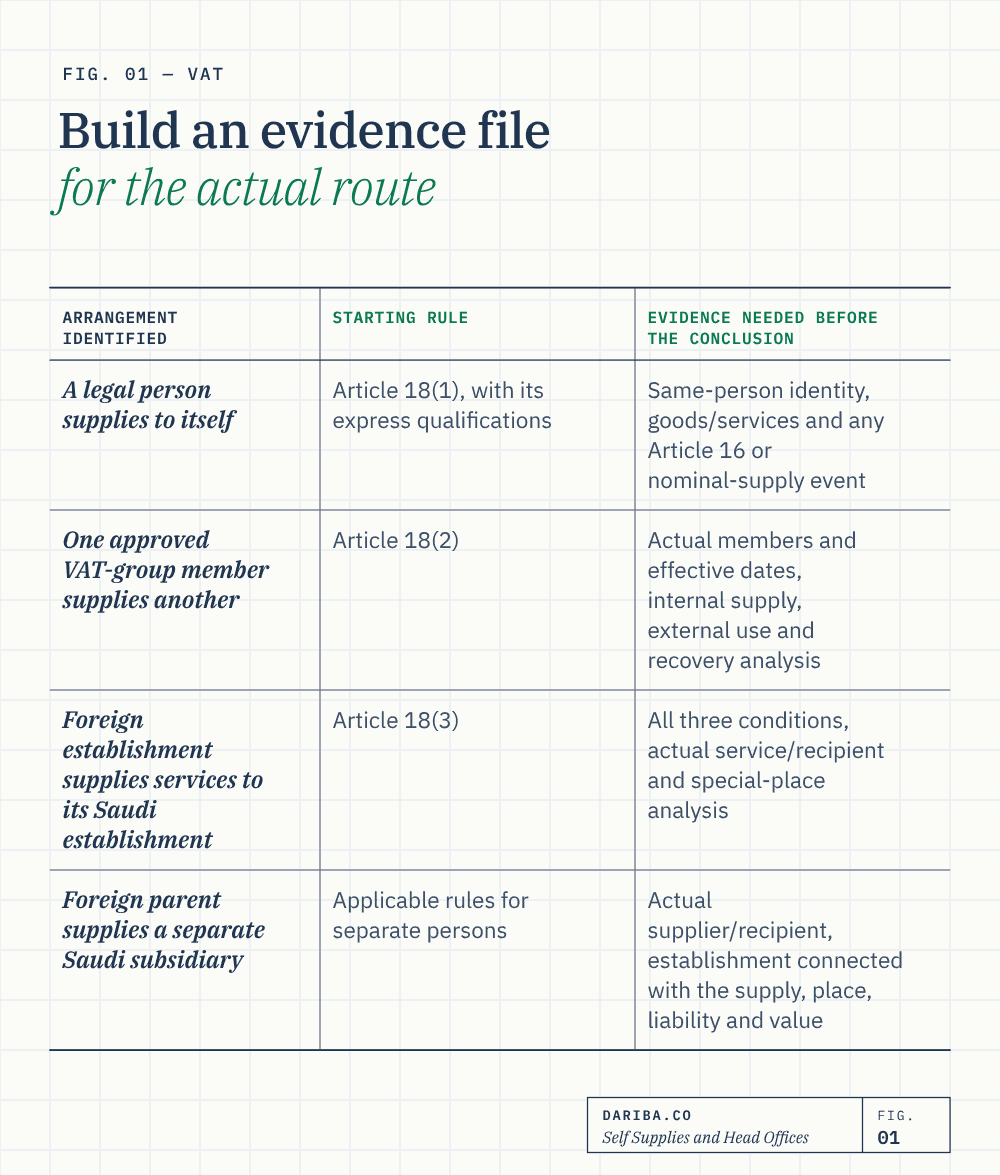
Build an evidence file for the actual route
The following is a Dariba review aid, not an official worked example or a determination of tax on a particular arrangement.
| Arrangement identified | Starting rule | Evidence needed before the conclusion |
|---|---|---|
| A legal person supplies to itself | Article 18(1), with its express qualifications | Same-person identity, goods/services and any Article 16 or nominal-supply event |
| One approved VAT-group member supplies another | Article 18(2) | Actual members and effective dates, internal supply, external use and recovery analysis |
| Foreign establishment supplies services to its Saudi establishment | Article 18(3) | All three conditions, actual service/recipient and special-place analysis |
| Foreign parent supplies a separate Saudi subsidiary | Applicable rules for separate persons | Actual supplier/recipient, establishment connected with the supply, place, liability and value |
Retain legal-entity and registration records, the actual service description, people/resources connected with delivery, establishment evidence, allocation support and applicable group approvals. Record why an official example is comparable and which facts differ. A cost-centre code, foreign address or group chart can support the file but cannot substitute for the statutory analysis.
Where goods rather than services move, return to the goods rules. Where the issue is an external customer contract, identify the external supplier rather than treating the customer’s payment as an internal head-office charge. Keeping those events distinct makes the return position explainable and prevents the same facts being used to justify incompatible VAT treatments.
Key takeaways
- A branch of the same person differs from a separately incorporated subsidiary.
- Article 18(1) preserves Article 16 and nominal-supply cases.
- Article 18(2) concerns supplies between actual members of an effective VAT group.
- Article 18(3) requires all its same-person, establishment/service and special-place conditions.
- The Bahrain maintenance and UAE security examples concern their actual external customer supplies; they do not provide an invented internal recharge calculation.
- The VAT supply, liable person, value, tax point and deductible input need separate analysis.
- This focused review does not prescribe one valuation formula for all head-office costs or determine every cross-border group arrangement.
Sources
- Saudi VAT Implementing Regulations, controlling Arabic textTenth edition April 2025. Article 18 p.21;21(4) p.23;38–39 pp.36–37;47(1) p.44. Distinct self/group/cross-establishment supplies, relevant residence and conditional liability/valuation. Articles 49–51 retain normal recovery conditions.
- Official Arabic GCC VAT AgreementArticle 1 definitions pp.3–4; ordinary/special service place Articles 15–21 pp.9–10. Actual residence, establishment and special-place conditions, read with Saudi implementation and relevant period.
- ZATCA Imports and Exports guidelineSecond edition May 2026. Sections 6.1–6.3 pp.29–32; Examples 3–4 p.30 and 5 p.31. Branch/subsidiary, supplier identity, special place and separate recovery; no invented internal-service value.
- ZATCA Tax Groups guidelineSections 6.1–6.3 pp.20–22: group attribution, internal supplies, recovery distinction and membership-period liability. Current Arabic Article 18(2) controls the incorrect Article 18(8) footnote28 reference.
General information only. Actual supplies, facts, applicable periods and controlling Arabic legislation determine the result. Official examples are distinguished from Dariba analysis and original illustrations. Seek advice or clarification where the arrangement or source material leaves a specific issue unresolved.