In brief
Article 14 treats transactions other than supplies of goods as services and gives non-exhaustive examples. A right, waiver or undertaking can be a service; a compensation label does not decide whether a supply exists.
A Saudi VAT review should begin with what is supplied, rather than the name given to the payment. Article 14(2) of the VAT Implementing Regulations treats a transaction that is not a supply of goods as a supply of services and gives a non-exhaustive list. Rights, permissions and undertakings can therefore matter even when no physical product changes hands.
This classification question comes before the rate, place of supply, tax point and input deduction. A conclusion that a transaction is a service does not establish that every receipt is subject to 15% VAT, or that every amount described as compensation falls outside VAT.
Start with the supply and its consideration
Article 14(1) addresses taxable supplies in the Kingdom in the course of economic activity, including relevant reverse-charge receipts and imports. Read it with the Agreement’s definitions and the rules applying to the actual supplier and customer. A contractual receipt must be connected with the transaction being analysed; the presence of money alone does not identify a service.
Dariba recommends recording four matters before selecting a tax code: the parties, the right or obligation, what the payer receives and how the payment relates to it. Read the original contract, amendments and settlement together. A short ledger description such as compensation, licence, reimbursement or exit fee cannot answer those questions on its own.
Map the six categories in Article 14
Article 14(2)(a)-(f) includes the following categories. These are classification prompts, rather than six automatic standard-rating rules.
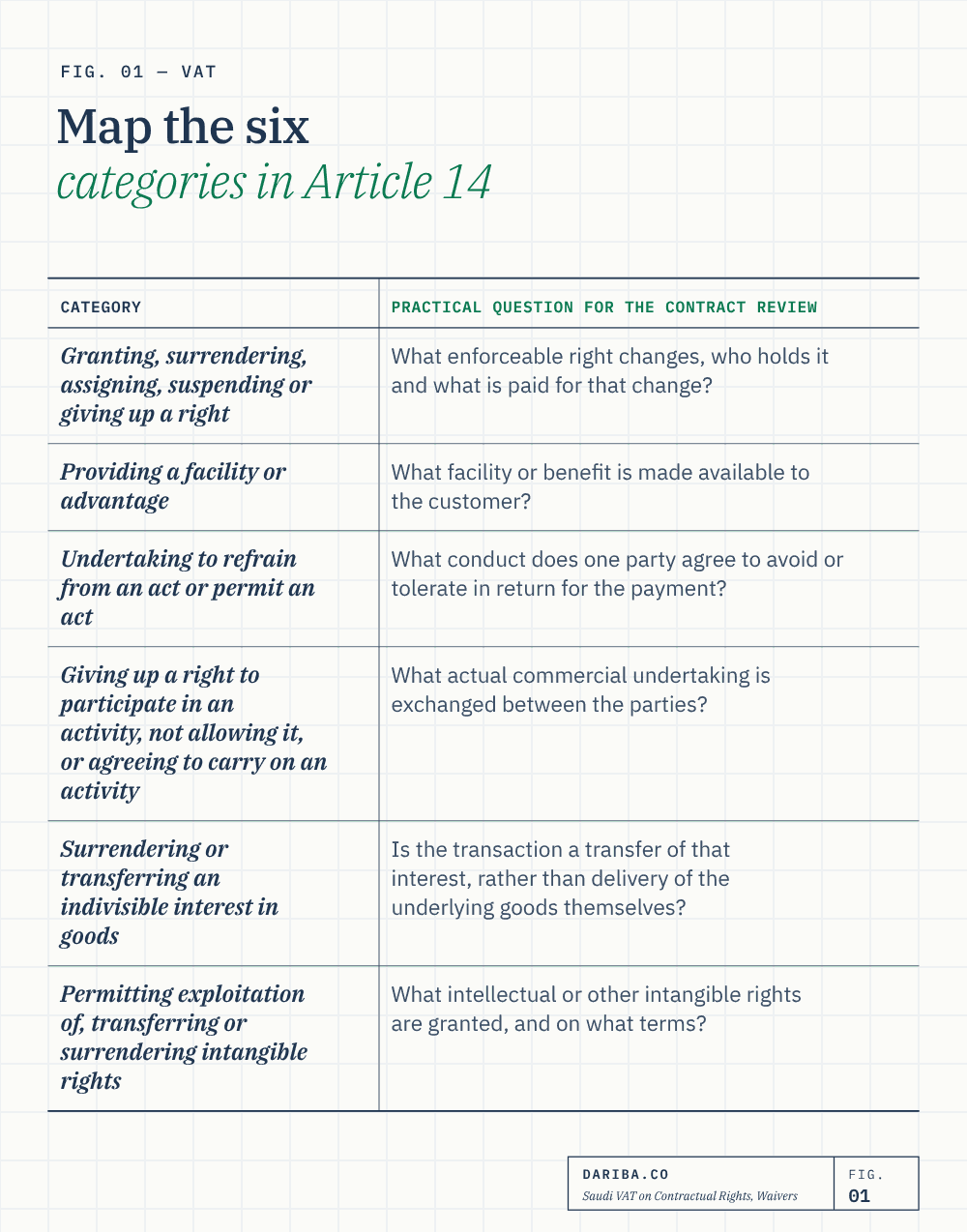
| Category | Practical question for the contract review |
|---|---|
| Granting, surrendering, assigning, suspending or giving up a right | What enforceable right changes, who holds it and what is paid for that change? |
| Providing a facility or advantage | What facility or benefit is made available to the customer? |
| Undertaking to refrain from an act or permit an act | What conduct does one party agree to avoid or tolerate in return for the payment? |
| Giving up a right to participate in an activity, not allowing it, or agreeing to carry on an activity | What actual commercial undertaking is exchanged between the parties? |
| Surrendering or transferring an indivisible interest in goods | Is the transaction a transfer of that interest, rather than delivery of the underlying goods themselves? |
| Permitting exploitation of, transferring or surrendering intangible rights | What intellectual or other intangible rights are granted, and on what terms? |
The final category expressly includes rights of authors, inventors and artists, trademarks and similar rights recognised by Saudi law. Identify the actual licence or transfer. Delivery of a physical item containing intellectual property does not, by itself, resolve whether the contract supplies goods, rights or more than one element.
A paid waiver can be a service
Dariba illustration — original assumptions: a Saudi VAT-registered business grants another Saudi business a defined commercial licence for SAR 80,000, expressly exclusive of VAT. Assume it is an actual domestic standard-rated service, with no applicable exemption, zero rate or special treatment. VAT is SAR 12,000 and the total SAR 92,000.
The calculation follows the stated classification and price assumptions. It does not establish that every licence, transfer of rights or royalty has the same treatment. A foreign customer, financial instrument, property-related right or package containing other supplies needs its own applicable rules considered.
A paid agreement to refrain from competing is another arrangement requiring Article 14 analysis. Identify whether there is an actual undertaking given in return for the payment. Do not treat the words non-compete as proof that all conditions for a taxable Saudi service are satisfied, or assume that a payment is outside scope simply because no positive physical work is performed.
Distinguish compensation from the price of a right
ZATCA’s Financial Services Sector Guideline, Arabic second edition May 2026, section 4.3.1, p. 36, addresses compensation for damage or penalties unconnected with any supply made by the financial-services provider. On those facts, the amounts fall outside VAT. The absence of a connection with a supply is essential to that explanation.
That is different from a payment whose actual commercial purpose is to buy a right, obtain a release or secure an undertaking. Article 14 requires the transaction to be examined. The guideline’s financial-sector explanation should not be expanded into a ruling that every damages clause, termination amount or court settlement has one treatment.
Dariba analysis: ask what would have happened without the payment. Does it compensate for an established loss without buying a supply, settle an existing price obligation, or secure something newly agreed by the recipient? This is a diagnostic question, not a statutory test or a substitute for reading the complete agreement. Where a settlement combines these matters, examine each actual component rather than selecting a single treatment from the heading.
Review termination and settlement documents as a whole
A contract termination may involve unpaid consideration for services already performed, a refund, a paid surrender of rights and a disputed damages amount. Those components can require different analyses. A settlement signed after the original transaction does not necessarily create a new supply for every amount it records, nor does it erase an existing taxable supply.
Check the obligations being released, the service history, original invoices, payment conditions and any separately supported allocation. A commercial allocation is useful evidence; it does not bind the VAT result merely because the parties have agreed a label. Seek transaction-specific clarification where the documents do not explain the relationship between payment and supply.
Where the actual consideration for a previously taxable supply changes, apply the relevant adjustment and documentary rules. The credit and debit note guide explains that separate process. An internal settlement spreadsheet is not automatically the required adjustment document.
Apply place, rate and timing after identifying the service
Article 14 answers a classification question within the wider VAT framework. The place-of-supply guide addresses the actual supplier, recipient, establishments and special rules. A customer outside Saudi Arabia does not, by itself, establish zero-rating of every contractual right.
Similarly, a financial service or property-related transaction needs its specific classification considered. Do not use Article 14’s broad service categories to override a relevant exemption, special place rule or another regime’s actual requirements. The consideration guide addresses what forms part of the tax base once the transaction is identified.
Apply the ordinary or relevant special tax-point rules to the actual service, invoice and payment. Signing a settlement, recording income and collecting cash can occur on different dates. None should be adopted as the universal VAT date for all rights and waivers.
Keep the evidence needed to explain the conclusion
Retain the complete agreement, the original right, the agreed change, evidence of performance or loss, the payment calculation and the relevant invoices or adjustment notes. Record the period and establishments involved. For mixed settlements, explain why each component has the treatment adopted and how the figures reconcile to the total paid.
The useful advisory conclusion is specific: identify what is supplied, why the payment is connected with it, which rule governs its location and classification, and what evidence supports the treatment. Where the available facts do not settle the distinction between compensation and consideration, preserve that question explicitly rather than creating certainty from the payment’s description.
Key takeaways
- Article 14(2) lists service categories; it does not impose one rate on every contractual receipt.
- A paid waiver or undertaking requires the actual rights, obligations and consideration to be identified.
- Rights over goods and the goods themselves can have different classifications.
- ZATCA distinguishes financial-provider compensation unconnected with a supply from consideration for a service.
- Settlement payments may contain different components; their documentation must support the actual treatment.
- Dariba illustrations use explicit assumptions and do not establish a safe harbour for termination payments.
Sources
- VAT Implementing Regulations, current amended Arabic textArticles 14(1)-(2), 18(1)-(3), 21-25, 29, 33, 49-51 and 79. Article 14 categories and Article 18 cumulative conditions are distinct from a universal rate, tax point or recovery rule.
- Unified GCC VAT Agreement, official Arabic textArticle 1 definitions of supply, consideration and input tax; Articles 5-8 distinguish goods, services, own movements and deemed supplies. Domestic and transitional rules must also be applied.
- ZATCA Financial Services Sector Guideline, Arabic second edition, May 2026Section 4.3.1, p.36: compensation unconnected with a supply by the financial provider; sections 8.2-8.3, pp.52-54: same-person branches and actual receipt of third-party services. Arabic Examples 21 and 22 correspond to English Examples 20 and 21.
- ZATCA Tax Invoicing and Records Guideline, third version, May 2026Actual taxable supplies, tax invoices, adjustment notes and records; a settlement description or internal allocation is not sufficient evidence of classification.
- Saudi VAT Law, official Arabic textArticles 2 and 25: domestic imposition/rate and the prescribed tax calculation framework, read with the Agreement and Implementing Regulations.
General information only. Actual supplies, facts, applicable periods and controlling Arabic legislation determine the result. Official examples are distinguished from Dariba analysis and original illustrations. Seek advice or clarification where the arrangement or source material leaves a specific issue unresolved.