In brief
Article 38 requires related parties, a below-market value and incomplete customer input entitlement on that specific supply. Comparability, fallback evidence and commercial payment obligations remain distinct.
Related parties do not automatically use market value for every Saudi VAT transaction. Article 38 substitutes fair market value only when its cumulative conditions are met: the parties are related, the agreed supply value is below fair market value, and the customer cannot deduct or recover all input VAT on that particular supply. Each condition needs its own evidence.
Establish the relationship under Article 37
Article 37 supplements the Agreement’s relationship principles. It addresses specified family relationships up to the fourth degree, employer/employee and partnership relationships, relevant natural-person roles or ownership/control of a legal person, common control and the stated bankruptcy/endowment/beneficiary relationships.
Its ownership/control limbs use more than 50% in the stated cases, not the same wording as Article 10’s VAT-group eligibility threshold of at least 50%. Exactly 50% does not satisfy a more-than-50% limb simply by rounding; another relationship or control basis can still matter.
Check the actual direct/indirect chain and applicable limb rather than using one company’s related-party accounting list as the complete statutory test. A party can be related through employment or another stated relationship without satisfying a shareholding percentage.
Apply all three Article 38 conditions
| Condition | Question to answer |
|---|---|
| Relationship | Are the actual supplier/customer related under the applicable provisions? |
| Below-market supply value | Is the relevant agreed value lower than a supported fair market value? |
| Incomplete input entitlement | Is the customer unable to recover all VAT on this specific received supply? |
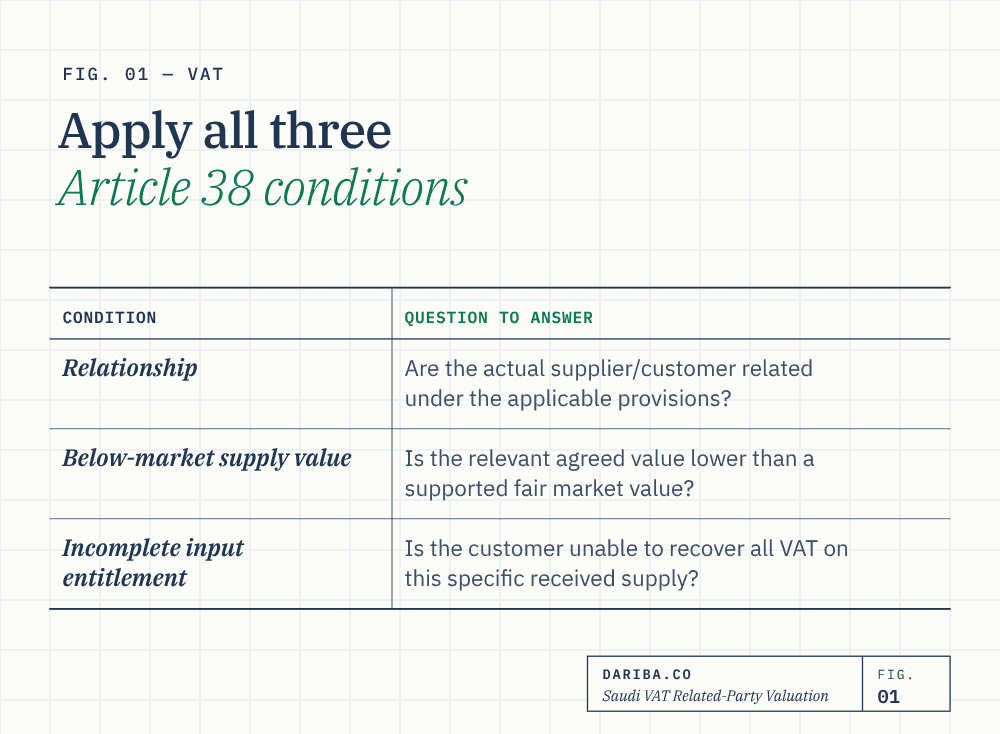
If one condition is absent, this particular substitution rule does not establish a market-value uplift. Other provisions may still apply, including correct consideration, non-cash valuation, nominal supplies or actual exemptions.
The third condition is supply-specific. A customer with both taxable and exempt activities may still fully deduct VAT on a cost directly attributable to taxable activity. Conversely, a generally taxable company can incur restricted or non-economic expenditure that is not fully deductible.
Official example: the same finance company receives different services
ZATCA’s Promotional Offers guideline, second edition May 2026, section 4.5.1, Example 12, p. 23, describes Al-Qemma International Finance’s taxable advisory activity and exempt finance margins. A related office-services company discounts two invoices.
The advisory-report cost relates directly to taxable advisory supplies, with full input entitlement. The market-value substitution is not required under Article 38 even though relationship and below-market pricing are present. The general website/design cost is overhead supporting the mixed business; it is not fully deductible, so the related supplier must apply market value on the stated facts.
Dariba analysis: the customer’s overall exempt-income percentage does not answer the third condition for every invoice. Obtain actual intended/use attribution for the received service. A supplier cannot safely assume full entitlement from a VAT certificate alone, while a mixed customer should not automatically have every discounted cost uplifted.
Use a similar and simultaneous comparison
Article 38(2)–(3) concerns comparable supplies between unrelated persons. Relevant features include the goods/services, characteristics, quality, quantity, place/date of supply and supplier reputation. A price from a materially different time or commercial setting may be unsuitable even if the product description looks similar.
Section 4.5.2, Example 13, p. 24, describes a suit advertised at SAR 2,500 including VAT, sold to an employee for SAR 1,500. The contemporaneous public discount produces SAR 2,000 including VAT as the relevant comparison. A SAR 1,200 clearance offer earlier in the year is not the simultaneous comparator on those facts.
The guideline reports market value of SAR 1,739.13 excluding VAT and output VAT SAR 260.87. The employee remains liable for the agreed SAR 1,500; the example does not give the employer a universal contractual right to recover additional cash from the employee.
A Dariba calculation showing the actual tax difference
Original assumptions: related persons agree SAR 10,000 exclusive of VAT for an ordinary standard-rated service. A properly supported comparable value is SAR 15,000 exclusive, and the recipient cannot fully deduct VAT on this service. All Article 38 conditions are satisfied.
Output VAT is therefore SAR 2,250 on SAR 15,000, compared with SAR 1,500 on the agreed net price: an additional SAR 750. Establish the contractual amount payable separately; the statutory valuation uplift is not proof that the customer agreed to pay SAR 15,000 or that the supplier may unilaterally change the commercial contract.
If the same service were wholly eligible direct taxable-use expenditure for that recipient, the incomplete-recovery condition would fail on the assumed facts. Do not uplift the base under Article 38 solely because the supplier regards the discount as generous. These alternatives are Dariba illustrations, not additional facts attributed to Example 12.
When a direct comparator cannot be established
Article 38(4) provides the alternative valuation framework where a similar/simultaneous supply cannot be verified. It refers to similar transactions or the supplier’s incurred cost, whichever is greater, with ZATCA’s decision prevailing on disagreement.
Do not reduce this to an unrestricted choice of any low cost-plus figure or a blanket permission to use historic book value. Explain why a direct comparable is unavailable, what alternative evidence supports the measure and how the statutory comparison is applied.
A transfer-pricing study can supply useful evidence, but transfer-pricing methods, annual profit adjustments and VAT valuation are not automatically identical. Establish whether the actual VAT supply value changes, whether Article 38 applies and what invoicing/period consequences follow. No universal VAT treatment for every year-end transfer-pricing adjustment is established by these provisions alone.
Separate VAT groups, nominal gifts and genuine discounts
An actual supply between effective members of an approved VAT group is treated under Article 18(2); that is different from an external related-party supply requiring Article 38 analysis. Common ownership alone does not make all transactions intra-group for VAT.
An independent gift can instead engage Article 15 and Article 39’s purchase/cost valuation and exceptions. A genuine discounted sale to an unrelated customer ordinarily requires its actual consideration considered. Avoid applying the employee-suit example indiscriminately to public discounts, internal branch allocations, free gifts and group supplies.
The group guide, deemed-supply guide and consideration guide explain those separate routes.
Retain the supplier’s valuation file and the customer’s evidence
Keep the relationship basis, commercial agreement, actual received service/use, recipient entitlement evidence, comparison date/terms, chosen valuation, invoice and return calculation. If facts change or a value was originally wrong, identify whether a later adjustment or correction is required under the applicable rules.
Dariba recommends agreeing an evidence process with related customers before invoicing recurring discounted services. This is an operating recommendation, not a statutory requirement for one prescribed certificate in every Article 38 case. A defensible position explains all three conditions and the selected measure rather than relying on either “related means market value” or “the customer has a VAT number”.
Key takeaways
- Article 37 relationship tests are distinct from VAT group eligibility and financial reporting lists.
- Article 38 substitutes market value only if all three statutory conditions apply.
- A mixed business can fully recover VAT on a particular directly taxable-use cost.
- Comparable supplies must reflect the actual characteristics, terms and time.
- The fallback is not permission to choose any low cost-plus figure.
- VAT valuation does not itself amend the commercial contract or settle transfer-pricing adjustments.
Sources
- Controlling Arabic VAT Implementing RegulationsArticles 37-38, pp. 35–36; relationship, cumulative conditions and comparable/fallback value.
- Official Arabic GCC VAT AgreementArticles 25-26, pp. 11–12: advertised prices, value, non-cash payments, expenses and actual reductions; current Saudi standard rate read with domestic law.
- ZATCA Promotional Offers guidelineSecond edition May2026 section4.5, Examples 12-13, pp. 22–24: specific customer entitlement and contemporaneous employee pricing.
- ZATCA Tax Invoicing and Records guidelineVersion3 May2026. Actual invoice and credit/debit-note requirements are distinct from commercial pricing.
General information only. Actual supplies, facts, applicable periods and controlling Arabic legislation determine the result. Official examples are distinguished from Dariba analysis and original illustrations. Seek advice or clarification where the arrangement or source material leaves a specific issue unresolved.