In brief
A platform responsible to the passenger can supply transport as principal while the independent driver supplies the platform. Full-fare output VAT and conditional driver input are separate.
A transport application may retain a percentage of the fare without making only a commission service for VAT. The decisive question is who undertakes the passenger’s transport contract. ZATCA’s Guideline for Agents under VAT Provisions, second version May 2026, section 9.2, Example 15, treats its Go! Transport platform as principal, with a separate driver-to-platform supply.
Start with the passenger contract and service obligation
In section 9.2, the passenger or corporate customer has an account with the transport company, requests transport through it and pays through it. Example 15 further explains that the company contracts with the customer and is obliged to provide the service, using independent drivers to perform it. Those facts support principal treatment.
Dariba analysis: inspect the terms actually accepted by the passenger, the obligation to provide a vehicle and journey, and the driver arrangement. Payment collection is relevant in the stated model; it is not a universal standalone test for every application. A different contractual model requires its own analysis rather than automatic adoption of the Go! result.
VAT Law Article 9 also treats supplies made or received in a person’s own name on another’s behalf as made or received by that person. The agency and principal guide explains why an intermediary can have two VAT supply legs even where its accounting reports only a retained amount.
Preserve the official example’s historical rate
Example 15 expressly occurs in 2019, when the applicable standard rate was 5%. Rami orders a journey from central Riyadh to King Khalid International Airport through Go! Transport for SAR 84 including VAT. The company retains 25% of the collected fare and pays the independent driver SAR 63, being 75%.
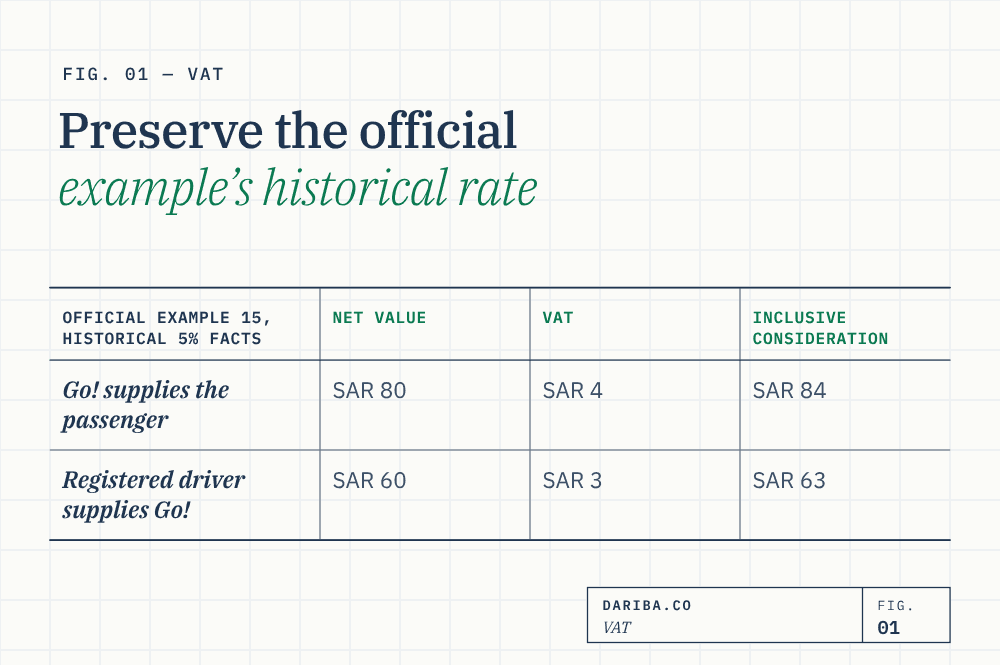
On those stated facts, the platform makes the passenger supply. Its net value is SAR 80 and output VAT SAR 4. If the driver is VAT registered, the driver’s SAR 63 inclusive consideration comprises SAR 60 plus SAR 3 VAT, with a tax invoice issued to the platform.
| Official Example 15, historical 5% facts | Net value | VAT | Inclusive consideration |
|---|---|---|---|
| Go! supplies the passenger | SAR 80 | SAR 4 | SAR 84 |
| Registered driver supplies Go! | SAR 60 | SAR 3 | SAR 63 |
These are the guideline’s historical amounts. They are not presented as today’s standard rate, and the driver’s registration is a condition of the stated driver VAT result. The company’s SAR 21 retained cash is not the whole consideration for its passenger transport supply.
Calculate full-fare output separately from the driver supply
Dariba original illustration at the current 15% standard rate: assume an ordinary taxable domestic journey with a SAR 115 VAT-inclusive passenger fare, the same 75% gross driver allocation and a VAT-registered driver whose own supply is standard-rated. The platform’s net passenger value is SAR 100, with SAR 15 output VAT. The driver receives SAR 86.25, comprising SAR 75 plus SAR 11.25 VAT.
The retained gross amount is SAR 28.75. It is a settlement difference in this assumed principal model, not a basis for ignoring the SAR 115 passenger supply. Do not multiply only the retained gross amount by 15% and treat the result as the platform’s full output liability.
The current-rate numbers are Dariba assumptions, not an amended ZATCA example. Confirm whether actual amounts are inclusive or exclusive, how discounts or additional fees operate, and who supplies any separately charged service before applying the arithmetic to a real settlement.
Driver registration changes the evidence for input VAT
The official example says that a registered driver accounts for VAT and invoices the platform. It does not say that every independent driver must register solely because a trip is ordered through an application. Determine the driver’s actual taxable activity and registration position under the relevant rules.
If the driver is not VAT registered and charges no VAT on its supply, the platform cannot create a deduction by extracting a notional VAT amount from the payment. A contractual deduction described as commission is not a supplier tax invoice.
Where the driver correctly charges VAT, the platform’s entitlement remains subject to Articles 49–51, including taxable use, evidence and relevant restrictions. In the Dariba illustration, SAR 11.25 is the driver’s charged VAT under the assumptions; it is not an unconditional recovery promise. Other platform costs must be tested separately.
A domestic airport trip remains a separate journey
The official journey is between central Riyadh and a Saudi airport. It is not international passenger transport merely because the customer may next board an overseas flight. The transport actually supplied must satisfy the relevant place and Article 34 conditions.
The international transport guide distinguishes one international service from an independent domestic leg and covers connected services. A taxi ordered separately to reach the airport should not be zero-rated simply by attaching the passenger’s airline booking.
Conversely, qualifying international transport and a separate agency booking service can have different VAT treatments. Identify the actual journey and supplier of each service; a travel-related commercial label does not supply the answer.
Reconcile the passenger, driver and settlement records
Dariba recommends keeping passenger fares, output VAT, driver consideration, actual driver invoices and settlement deductions in a reconciled record. A platform fee or retained amount should agree with the contract and ledger without replacing the full supply reported to the passenger.
Confirm who issues the passenger document under the applicable invoicing rules and whose details identify the supplier. Where a third party issues an invoice, the actual permitted invoicing arrangement and supplier responsibility still matter. The platform’s collection report is useful evidence of cash movement, but it does not by itself establish every invoicing or input condition.
Before changing the reporting model, reconcile both sides of the supply chain. The conclusion should explain why the company is principal or agent, what each person supplies, which amounts include VAT and which inputs are actually supported. This makes the analysis usable when contracts, driver populations or pricing change.
Key takeaways
- ZATCA’s Example 15 makes the platform principal on its actual contract and service facts.
- The platform accounts on the full passenger supply, rather than only its retained amount.
- An independent registered driver makes a separate supply to the platform.
- An unregistered driver does not issue deductible VAT merely because the platform withholds a share.
- The official 2019 example uses 5%; current-rate illustrations are Dariba’s own.
- A domestic airport trip is not international transport just because a flight follows.
Sources
- ZATCA Guideline for Agents under VAT Provisions, second version May 2026Section 9.1: travel agent capacity and separate commission; section 9.2, Example 15: 2019 platform facts at historical 5%; sections 9.4.1–9.4.3, Examples 17–18: hotel suppliers. Current-rate figures are separately labelled Dariba assumptions.
- Saudi VAT Law, official amended Arabic textArticle 9: supplies made or received in the intermediary’s own name on another’s behalf are treated as its own; current standard rate is distinguished from the historical example.
- VAT Implementing Regulations, current amended Arabic textArticles 30 and 34: actual accommodation and transport rules; Articles 49–53: conditional recovery and invoices. Existing relevant scope retained; Arabic controls.
General information only. Actual supplies, facts, applicable periods and controlling Arabic legislation determine the result. Official examples are distinguished from Dariba analysis and original illustrations. Seek advice or clarification where the arrangement or source material leaves a specific issue unresolved.