In brief
Calculate Saudi deemed Zakat using the prescribed sales inputs, highest alternative criterion, capital floor and SAR 500 minimum, with checked examples.
Build the calculation in the right order
Article 89 of the Zakat Collection Regulations, 1445H, starts with an estimate of capital appropriate to the size of the activity: sales divided by eight, plus 15% of sales. Article 84 then applies the specific 2.5% rate. The documented-capital floor and Article 86 minimum must also be tested.
This calculation assumes the taxpayer belongs within the deemed framework. The scope and transition guide explains that threshold question and the short opening or closing-period exclusion. A formula or minimum charge should not be applied before establishing the relevant status and period.
Establish sales from the prescribed tax information
Article 89(2) provides that sales used must not be below the sales disclosed in VAT returns, including zero-rated and exempt sales, together with the relevant economic-activity real-estate transaction data. It uses the nearest disclosed period or tax year corresponding to the Zakat year under assessment.
The VAT taxable rate is not the criterion for excluding a sale from this calculation. Conversely, a tax-data amount from another period should not be inserted without explaining the statutory period relationship.
Dariba recommendation: retain a schedule of the returns and periods used, including any final adjustments. Reconcile the data to the activity and relevant identifier. If information appears duplicated or attributed to the wrong taxpayer, investigate and document the issue rather than unilaterally omitting an input or simply accepting an unexplained system total.
If VAT has no recorded sales, compare the alternative criteria
Article 89(3) uses the highest result from the relevant alternatives when no sales are recorded in VAT. It does not direct the taxpayer to add all four alternative estimates together.
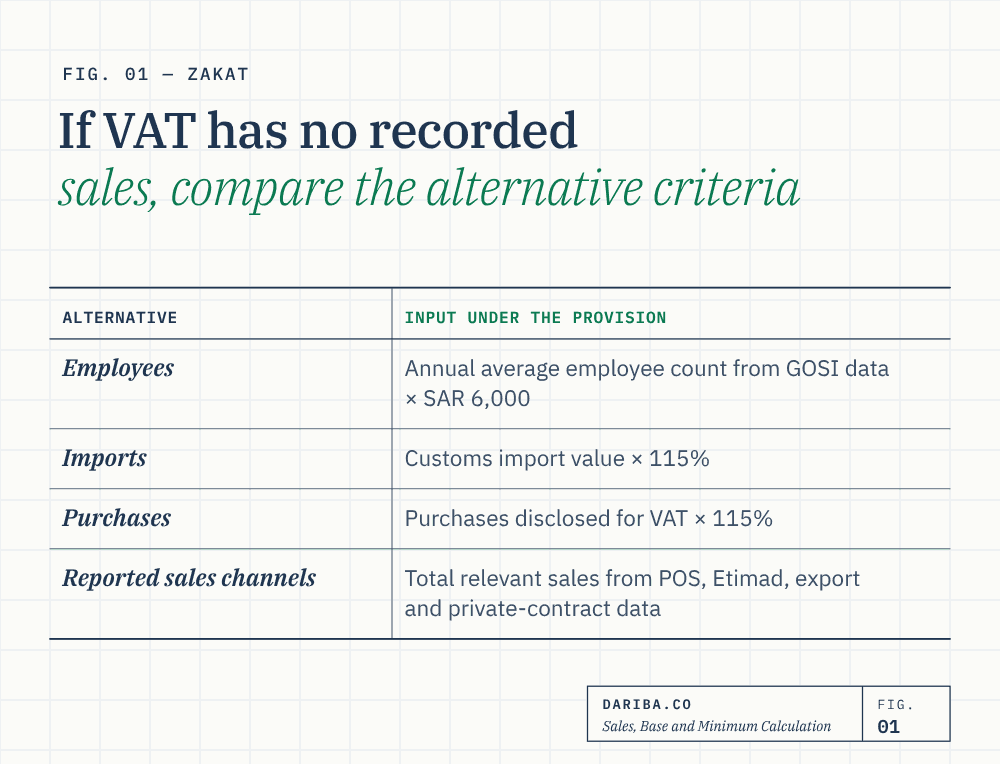
| Alternative | Input under the provision |
|---|---|
| Employees | Annual average employee count from GOSI data × SAR 6,000 |
| Imports | Customs import value × 115% |
| Purchases | Purchases disclosed for VAT × 115% |
| Reported sales channels | Total relevant sales from POS, Etimad, export and private-contract data |
The employee input is the annual average, including the relevant Saudi and non-Saudi employees under the guideline. The SAR 6,000 factor is not a monthly amount to multiply again by 12. The sales-channel alternative can itself include multiple channels: the guideline’s Example 16 combines its stated Etimad and POS sales, rather than selecting only the larger channel.
Check the selected criterion against the official illustrations
Official example: section 9.2, Example 11, of ZATCA’s Guideline for Estimated Zakat Payers, September 2024, compares SAR 160,000 POS sales with 24 average employees × SAR 6,000, or SAR 144,000. It selects SAR 160,000. The resulting base is SAR 44,000 and the charge SAR 1,100, subject to the example’s assumptions.
Official example: Example 15 compares a SAR 360,000 Etimad amount with 65 employees × SAR 6,000, or SAR 390,000. It selects the latter. Applying the formula gives SAR 107,250 and SAR 2,681.25 before whole-riyal rounding.
Dariba analysis: compare the statutory outputs, not whichever raw input looks largest. A customs value must first receive its 115% factor, while an employee count needs its own conversion. Preserve the assumptions and relevant additional capital-floor test.
Apply the formula without confusing the base with the Zakat rate
Official example: section 9.1, Example 9, uses SAR 3 million sales and SAR 500,000 documented capital. Sales divided by eight are SAR 375,000; 15% of sales is SAR 450,000. The resulting base is SAR 825,000, above the stated capital, and Zakat is SAR 20,625.
The formula’s two components total 27.5% of the relevant sales. That percentage is an estimated base factor, not a 27.5% Zakat rate. Multiplying it by 2.5% produces 0.6875% of sales only before considering the capital floor, minimum and other applicable conditions.
Dariba recommendation: show the two components and the final checks separately. The simplified turnover factor can be a useful arithmetic check, but it should not conceal a capital amount or minimum that determines the actual liability.
Test documented capital and the SAR 500 minimum separately
Article 89(6) uses the capital established from the commercial registrations, activity licences or other relevant evidence where it exceeds the formula result. This is a comparison of the resulting base with capital, not an additional instruction to add that capital again.
Official example: Example 19 uses SAR 350,000 sales, producing a SAR 96,250 formula base. Documented capital of SAR 100,000 becomes the base instead; Zakat is SAR 2,500.
Official example: Example 18 uses a continuing taxpayer with no activity, no registered employees and SAR 10,000 capital. The initial 2.5% amount is SAR 250, so the example applies the SAR 500 minimum. The short-period exclusion and unique-number assessment unit still need their own provisions; this example does not justify charging a minimum separately for every licence.
Final data changes can increase or decrease the assessment
Article 89(5) links the deemed Zakat result to final VAT or relevant real-estate transaction data adjustments, whether the change increases or reduces it. A downward final change should not be treated as legally irrelevant simply because the initial estimate has already been issued.
Official illustration: section 7, Example 6, moves from SAR 1 million to SAR 1.4 million sales. Under its assumptions, the base changes from SAR 275,000 to SAR 385,000 and Zakat from SAR 6,875 to SAR 9,625: an increase of SAR 2,750.
Dariba recommendation: retain the final source-tax decision and identify the affected assessment and period. A proposed or pending VAT amendment is not automatically the same as a final change. Equally, the regulation’s linkage does not establish that every system record has already been corrected without a reconciliation.
Review ZATCA’s powers and the calculation evidence
Article 89(4) permits criteria reflecting actual sales and recalculation where higher sales become apparent, within the relevant Article 106 periods. Article 89(7) also provides for changes to the calculation method according to market conditions and taxpayer behaviour. Do not treat the currently published formula as a guarantee that no other authorised assessment can arise on the actual facts.
Article 90 permits an increase where the taxpayer finds more Zakat due. Article 91 makes the estimate an assessment governed by the applicable framework. Obtain the calculation details and identify the actual correction or objection procedure rather than relying on an informal discussion to protect a deadline.
Dariba analysis: numerical inconsistencies in an illustrative table do not amend the statutory formula. Recalculate from the source inputs, retain precision until the appropriate rounding and explain any difference. A defensible review connects the status, period, sales evidence, selected criterion, base, capital and minimum in one reproducible calculation.
Key takeaways
- Establish status and the relevant period before calculating.
- VAT zero-rated and exempt sales can remain relevant inputs.
- Compare alternative estimates rather than adding them all.
- The employee factor is SAR 6,000 times the annual average count.
- Compare the formula base with documented capital.
- Final source-tax changes can increase or decrease Zakat.
Sources
- Implementing Regulations for Zakat Collection, 1445H, current Arabic textDefinition and Articles 82–91. Exact conditions, boundaries, formula and assessment provisions identified in the analysis.
- ZATCA Guideline for Estimated Zakat Payers, September 2024Specific sections and examples cited in the analysis. Illustration dates and numerical translation issues do not override the current Arabic rules.
- Implementing Regulations for Zakat Collection, English referenceTranslation only; the current Arabic wording governs.
General information only. Actual supplies, facts, applicable periods and controlling Arabic legislation determine the result. Official examples are distinguished from Dariba analysis and original illustrations. Seek advice or clarification where the arrangement or source material leaves a specific issue unresolved.