In brief
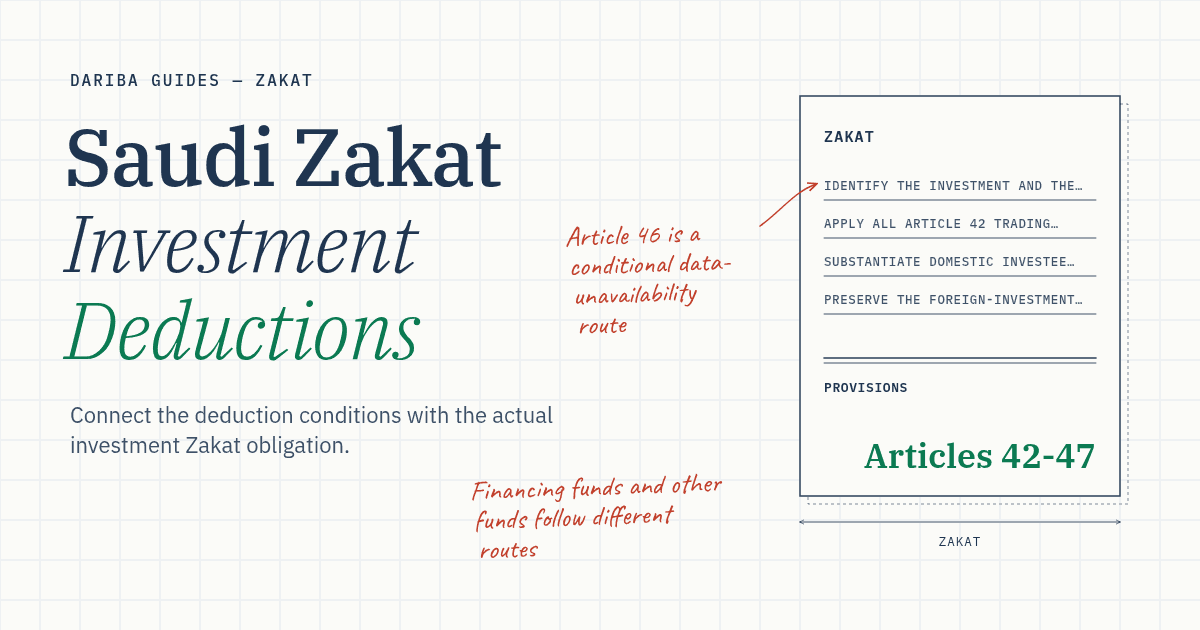
Apply foreign-investment deduction, separate Zakat certification and payment, and the conditional Article 46 route where detailed investee data is unavailable.
A foreign investment can qualify for deduction from the investor’s ordinary Zakat base while requiring a separate investment-Zakat calculation and payment to ZATCA. Article 44 does not grant a deduction merely because capital is deployed abroad or the investee pays foreign income tax. Article 46’s data-unavailability route is also conditional, rather than an elective shortcut for every minority holding.
Establish the ordinary foreign-investment route
Current amended Arabic Zakat Implementing Regulations Article 44, p. 25, is subject to Article 42’s investment controls. It requires non-current classification and non-trading purpose, together with the stated separate calculation, certificate and payment conditions.
The Zakat General Guideline, first version October 2024, section 5.3.3.2, pp. 221–222, explains that the investor accounts for the investment’s Zakat, contrasting the ordinary registered domestic-investee route.
Dariba recommends first identifying the actual legal investee and ownership. A branch, fund unit, shareholder loan or partly owned company should not be presumed to share one route merely because it appears under overseas investments in a management report.
Preserve the separate calculation, certificate and payment
Article 44(3) requires payment of the investment’s Zakat to ZATCA within the return, calculated independently of the payer’s base under a certificate prepared according to the regulations and approved by a chartered accountant licensed in Saudi Arabia.
Deducting the carrying amount is therefore only one part of the analysis. It does not mean the investment has escaped Zakat or that an unspecified foreign tax payment satisfies the required ZATCA payment.
Dariba recommends agreeing the information and certificate scope early, reconciling the relevant ownership share and separate result with the return. A foreign financial statement or auditor’s report alone is not automatically the specific investment-Zakat certificate required here.
Retain the minimum-base rule whether profits are paid or retained
Article 44(4) requires the investment minimum base under Article 27 whether profits are distributed or not. The minimum/maximum guide explains why Article 27 is a conditional alternative with its actual comparison, rather than a universal assertion that adjusted profit always determines every base.
Dividend retention does not remove the express Article 44 condition. Nor should a distribution be assumed to eliminate the separately calculated investment obligation.
Dariba analysis: forecast both the ordinary investor calculation and the investment calculation before describing a restructuring or distribution as a saving. The certificate must reflect the applicable regulatory computation and actual facts.
Use ZATCA’s non-payment example accurately
Official General Guideline Example 79, p. 222: an SAR 9 million foreign-company investment is non-current, but the investor does not intend to pay its share of the investment’s Zakat. The guide does not permit the deduction on those facts.
The reason is not simply that every foreign investment is non-deductible. Conversely, non-trading intent and non-current presentation do not overcome the missing payment condition.
Dariba recommends using this example as a completeness check: is the separate calculation, required certificate and actual Zakat payment supported, or does the file stop after confirming the investment’s accounting classification?
Apply every condition before using Article 46
Article 46, Arabic text, p. 26, permits the stated approach when inability to calculate foreign-investment Zakat is supported by reasons acceptable to ZATCA. It requires ownership of less than 50%, inability to calculate under the regulations, inability to obtain the necessary detailed data and inability to provide that data to the chartered accountant.
All those conditions matter. A 49% interest alone is insufficient, and an interest of exactly 50% does not satisfy a less-than-50% threshold. The current Arabic page states the numeric threshold; it is not inferred from unreliable text extraction.
Keep the data requests, responses, access limitations and explanation of inability. These are Dariba’s practical evidence recommendations, not a statement that sending one unanswered email automatically establishes reasons acceptable to ZATCA.
Use the correct asset-minus-liability calculation
For current/non-current presentation, Article 46(1)(a) deducts current liabilities from current assets. For liquidity presentation, paragraph (b), read with Article 19, uses short-term liabilities and short-term assets, including the stated debts due within one year or less and the specified asset examples.
Do not substitute all liabilities, book equity or a percentage of gross investment cost for the stated measure. Reconcile the presentation and underlying data actually available.
Dariba original arithmetic only: assumed relevant current assets of SAR 12 million less relevant current liabilities of SAR 7 million produce SAR 5 million before any applicable ownership allocation, rate or other conditions. This is not a ZATCA example, an approval of Article 46 eligibility, or a complete Zakat assessment.
Check whether another express investment route applies
Article 47(2), Arabic text, p. 27, treats an investment in a foreign company wholly owned by payers subject to ZATCA Zakat collection as domestic under Article 43. Confirm the complete ownership and subjection before applying that express rule.
Article 47(1) separately addresses investments in non-subject companies with its actual conditions. Fund investments have the Article 45 and Articles 77–79 framework; do not extend Article 46 by analogy without the relevant express route and facts.
The investment overview connects these categories. A useful analysis states which route applies and why, rather than simply choosing the calculation with the lowest apparent result.
Make the return reconciliation reviewable
Retain the investment value/classification, Article 42 review, ownership, investee data, separate computation, certificate, payment and the evidence supporting any Article 46 inability position. Connect the deducted amount and separate Zakat in the return.
Where the facts do not establish a condition or the available source leaves an actual issue unresolved, identify the missing point and obtain appropriate clarification rather than treating uncertainty as an exemption.
Dariba recommends presenting management with the ordinary route, the conditions for any alternative, the outstanding evidence and the resulting combined obligation. That explains the economic consequence of the deduction while preserving the limits of what the regulation and guidance establish.
Key takeaways
- Foreign income tax does not replace the required investment Zakat.
- The ordinary route includes independent calculation, certificate and payment.
- Article 27 applies as stated whether profits are distributed or retained.
- Less than 50% ownership alone does not qualify for Article 46.
- Use the prescribed current or short-term asset-minus-liability measure.
- Document the inability reasons and the complete return reconciliation.
Sources
- Controlling Arabic Zakat Implementing Regulations, 1445HArticles 42-47, pp. 24–27; Article 55 p. 29 and fund routes77-79 pp. 40–42. Current amended Arabic controls.
- Official English Zakat regulations, read with current ArabicArticles 42-47 pp. 28–31;55 p. 34;77-79 pp. 48–50. Translation assists; Arabic conditions control.
- ZATCA General Guideline, first version October 2024Section 5.3.3, pp. 215–230; Examples 77-82 pp. 219–220,222,224,226-227. Exact facts and conditions retained.
General information only. Actual supplies, facts, applicable periods and controlling Arabic legislation determine the result. Official examples are distinguished from Dariba analysis and original illustrations. Seek advice or clarification where the arrangement or source material leaves a specific issue unresolved.