In brief
Apply amended Article 73 project cost tests and the licensed off-plan deduction formula, with current-asset corrections and clearly labelled examples.
Real-estate Zakat treatment depends on the actual project and purpose. Operational property, construction for sale and licensed off-plan sales have different routes. Current amended Article 73 must be read directly: an older guideline’s description cannot replace its project-by-project tests, off-plan formula or corresponding current-liability consequences.
Identify the purpose and current governing text
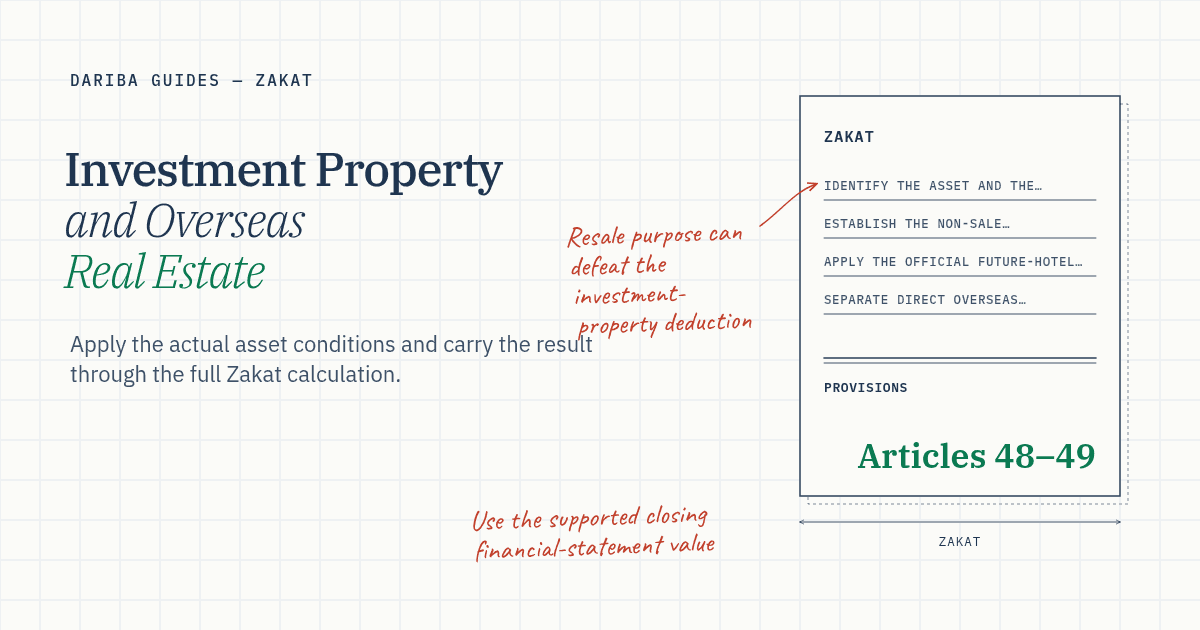
Current amended Arabic Zakat Implementing Regulations Article 49, pp. 27–28, addresses own-use construction, non-current investment property not prepared for sale and operational raw land not prepared for sale. Article 73, pp. 37–38, separately addresses construction for sale and off-plan projects.
The compilation identifies Article 73 as amended by Decision 1248 dated 11/10/1446H. The Guideline for Deduction Items from the Zakat Base, first edition July 2025, section 3.6.2, explains both the construction-for-sale and amended licensed off-plan routes. The older Zakat General Guideline, first version October 2024, remains useful for its separately identified examples but predates the amendment.
Dariba recommends recording the applicable period, actual licence, project purpose and current paragraph. This article addresses Zakat; it does not decide the separate VAT or RETT treatment of a property transaction.
Distinguish own-use construction and non-sale property
Article 49 includes capital construction/projects created for use in the payer’s activity rather than sale, together with the stated non-sale investment property and operational land. Read the relevant Article 48 recognition, net-value and other controls.
Official General Guideline Example 75, p. 213: property/equipment SAR 100,000, non-sale rental investment property SAR 120,000 and own-use headquarters construction SAR 70,000 produce SAR 290,000 deductions on those facts. Prepaid expenses of SAR 30,000 are not included in that result.
The example does not make every landholding or development deductible. Actual operational use, sale purpose and the correct project route remain necessary.
Apply the Article 73(1) construction-for-sale conditions
Article 73(1)(a) concerns real estate under construction prepared for sale after completion. It excludes the stated case offered for sale in its current condition or where the cost-of-sales ratio exceeds 25%, with its classification and calculation controls.
The ratio is tested separately for each project using cost, under the stated formula: cost of disposals/sales divided by opening balance plus additions during the year. ZATCA retains the stated power to review and adjust the percentage according to market conditions.
Do not replace cost of sales with selling price, group-wide cash receipts or an average across unrelated projects. The exact applicable rule and evidence must support the numerator, denominator and project boundary.
Use the official cost-ratio example within its limits
ZATCA’s Guideline for Deduction Items from the Zakat Base, first edition July 2025, section 3.6.2, addresses amended Article 73 directly.
Official Example 33: Project One’s SAR 10,700,000 cost of sales over SAR 20,200,000 opening balance plus SAR 15,100,000 additions produces approximately 30.31%, and it is not deducted. Project Two’s SAR 10,100,000 over SAR 50,000,000 plus SAR 20,200,000 produces approximately 14.39%, qualifying on the stated facts with the required current-asset correction. The two projects are tested separately.
Official Example 34: no project sales produces a 0% ratio, but the project has been completed and a building-completion certificate obtained. The guide treats that as offering the project for sale in its current condition and does not permit the deduction. Passing the percentage test therefore does not replace the other conditions.
Dariba analysis: retain completion/marketing evidence as well as the cost ratio. A low or zero sales ratio cannot, by itself, establish that a completed or presently offered project remains within the construction deduction.
Preserve current-asset classification and liability consequences
Article 73(1)(b) addresses qualifying construction-for-sale property classified as inventory/current assets under the applicable accounting standards. It permits the stated deduction when paragraph (a)‘s controls hold, with addition from current liabilities under Article 25.
The current classification therefore does not automatically defeat this express route. Nor does the exception remove the purpose, sale-status or project-ratio tests.
Dariba analysis: present the asset deduction and its liability correction together. A SAR 4 million gross deduction does not itself establish a SAR 4 million reduction in the final Zakat base or a particular cash saving.
Apply the licensed off-plan project formula separately
Article 73(2)(a) provides an exception to Article 17 for off-plan sales projects licensed by the competent authority under the applicable Saudi laws. Where positive, the deduction is the project balance at year-end minus additions to the project during the year. The formula is applied separately to each project.
Official Deduction Items Guideline Example 36, section 3.6.2: Project A has SAR 31,200,111 closing balance and SAR 4,800,000 additions, producing SAR 26,400,111 deduction. Project B has SAR 6,078,000 closing balance and SAR 19,500,000 additions; its negative formula result gives no deduction. The guide preserves the corresponding liability treatment for undeducted non-current amounts.
Dariba analysis: do not deduct all closing costs, substitute customer collections for project additions, or treat the negative project as a negative deduction offsetting another project’s positive amount. Establish the licence and project-specific balances first.
Allocate the off-plan deduction and include funding correctly
Article 73(2)(c) requires the resulting deduction to start with the project’s non-current portion and then use any remaining deduction against its current portion. Paragraphs (d)–(e) preserve the applicable funding additions and Article 25.
Official Deduction Items Guideline Example 37, section 3.6.2: Project B’s current SAR 48,550,170 plus non-current SAR 13,179,041, less SAR 45,000,000 additions, produces SAR 16,729,211 deduction. The guide takes SAR 13,179,041 from the non-current portion and SAR 3,550,170 from the current portion, with the corresponding current-asset correction.
The same example explains that the Zakat provision is excluded from the relevant current-liability denominator because it has been reclassified as equity equivalents. The aggregate liability cap and other conditions still apply; a displayed intermediate correction is not a substitute for the final permitted addition.
Dariba analysis: reconcile the project formula, allocation, revised liability categories and final cap in one schedule. A licensed off-plan deduction does not eliminate the requirement to classify and add the actual funding sources correctly.
Keep a project-specific evidence and reconciliation file
Retain licences, purpose and sale-status evidence, project opening/addition/disposal/closing ledgers, cost-of-sales calculations, financial-statement classification, formula allocation, funding and Article 25 corrections.
The deductions overview and apportionment guide connect the project result to the full base. A financial-statement heading or an old sector-guideline conclusion should not bypass the current amended conditions.
Dariba recommends a separate conclusion for each project and paragraph: why it qualifies, the supported amount, the corresponding additions/corrections and any unresolved issue. That makes the analysis useful without promising that every property developer, construction cost or customer advance receives one universal treatment.
Key takeaways
- Classify own-use property, construction for sale and off-plan projects separately.
- Current Article 73 is amended by Decision 1248.
- Test cost-of-sales ratios separately for each project.
- The off-plan formula requires a competent-authority licence and positive result.
- Allocate the off-plan deduction to non-current assets first.
- Funding additions and Article 25 corrections remain relevant.
Sources
- Current amended Arabic Zakat Implementing Regulations, 1445HArticles 25–26, 35, 48–56 and amended 73 as relevant. Detailed conditions, special payer provisions and controlling Arabic text apply.
- Official English Zakat regulations, read with current ArabicTranslation assists navigation; actual Arabic categories, conditions and amended provisions control.
- ZATCA Zakat General Guideline, first version October 2024General asset and correction framework; older examples are separately identified from the July 2025 dedicated guideline.
- ZATCA Guideline for Deduction Items from the Zakat Base, first edition July 2025Sections 2.3, 3.3 and 3.6; precise official examples identified by number in each analysis.
General information only. Actual supplies, facts, applicable periods and controlling Arabic legislation determine the result. Official examples are distinguished from Dariba analysis and original illustrations. Seek advice or clarification where the arrangement or source material leaves a specific issue unresolved.