In brief
Advance payments depend on current revenue and the statutory prior-year formula. The SAR 500,000 threshold applies to each calculated instalment; treasury planning must also preserve annual settlement and evidence.
A Saudi corporate-income-tax cash plan should not start by reserving three instalments for every profitable company. First apply the advance-payment formula and its statutory threshold. Only then schedule the payments, consider a supported reduction request and reconcile them with the annual return. The annual tax obligation can remain substantial even where no advance is required.
This guide turns the rules into a treasury workflow. The advance-payment legal guide provides the connected provision analysis.
Test the SAR 500,000 instalment threshold first
Income Tax Law Article 70(a) requires qualifying taxpayers earning revenue in the tax year to make three payments on account. Each calculated payment is 25% × (A − B), where A is the prior year’s tax according to the taxpayer’s return and B is the prior year’s tax paid through withholding under Article 68.
Crucially, Article 70(b) removes the ordinary advance-payment obligation where that formula result does not reach SAR 500,000. The test is each calculated payment, not the aggregate of the three payments and not the prior-year gross tax figure. Exactly SAR 500,000 reaches the threshold.
Dariba original threshold illustration: A of SAR 1,200,000 and B of SAR 100,000 gives a net formula input of SAR 1,100,000 and a calculated instalment of SAR 275,000. That is below the threshold, so these assumptions do not produce an ordinary Article 70 advance obligation. It would be incorrect to budget three legally required SAR 275,000 instalments from those figures alone. This does not exempt the current year’s final tax.
For comparison, A of SAR 2,000,000 and B of nil gives exactly SAR 500,000 per payment. Document the equality boundary instead of using “above SAR 500,000” as the test.
Validate the prior-year inputs and withholding credit
Regulations Article 64(1)(b) clarifies that B concerns withholding from the taxpayer’s own activity at source. It is not the withholding that the company deducted from payments to overseas suppliers on those suppliers’ income. Keep the company’s withholding-agent liabilities separate from its own tax credits.
Tie A to the relevant prior-year return and B to the taxpayer’s own credit evidence. Record any amended-return or assessment issue that affects the amount being used. A bank debit described as “tax” is not enough to establish the correct tax type, year, taxpayer and credit.
A newly commenced business without the relevant prior-year base, a prior-loss year or a short tax period must be reviewed on its actual facts. Do not convert a nil or below-threshold result into a negative advance, or assume that a corporate reorganisation necessarily gives an existing activity a fresh first-year exemption. Article 64(4) also preserves particular arrangements for oil and hydrocarbon production companies; the ordinary schedule is not a substitute for reviewing those arrangements.
Build the calendar from the actual tax year
Article 70(a) and Regulations Article 64(1)(c) identify three dates: on or before the last day of the sixth, ninth and twelfth months of the tax year. For an ordinary calendar year, these are 30 June, 30 September and 31 December. There are three advances; calling the system “quarterly” should not create a fourth payment.
Use the actual approved tax year for a non-calendar taxpayer. Short periods and year changes need their own timing review. Do not assume that a banking cut-off, an internal payment approval or a pending request changes the statutory due date.
For each due date, retain the computation, responsible approver, payment reference, bank confirmation and tax-account allocation. This is Dariba’s control recommendation: distinguish a payment scheduled in treasury software from one actually settled and credited to the correct obligation.
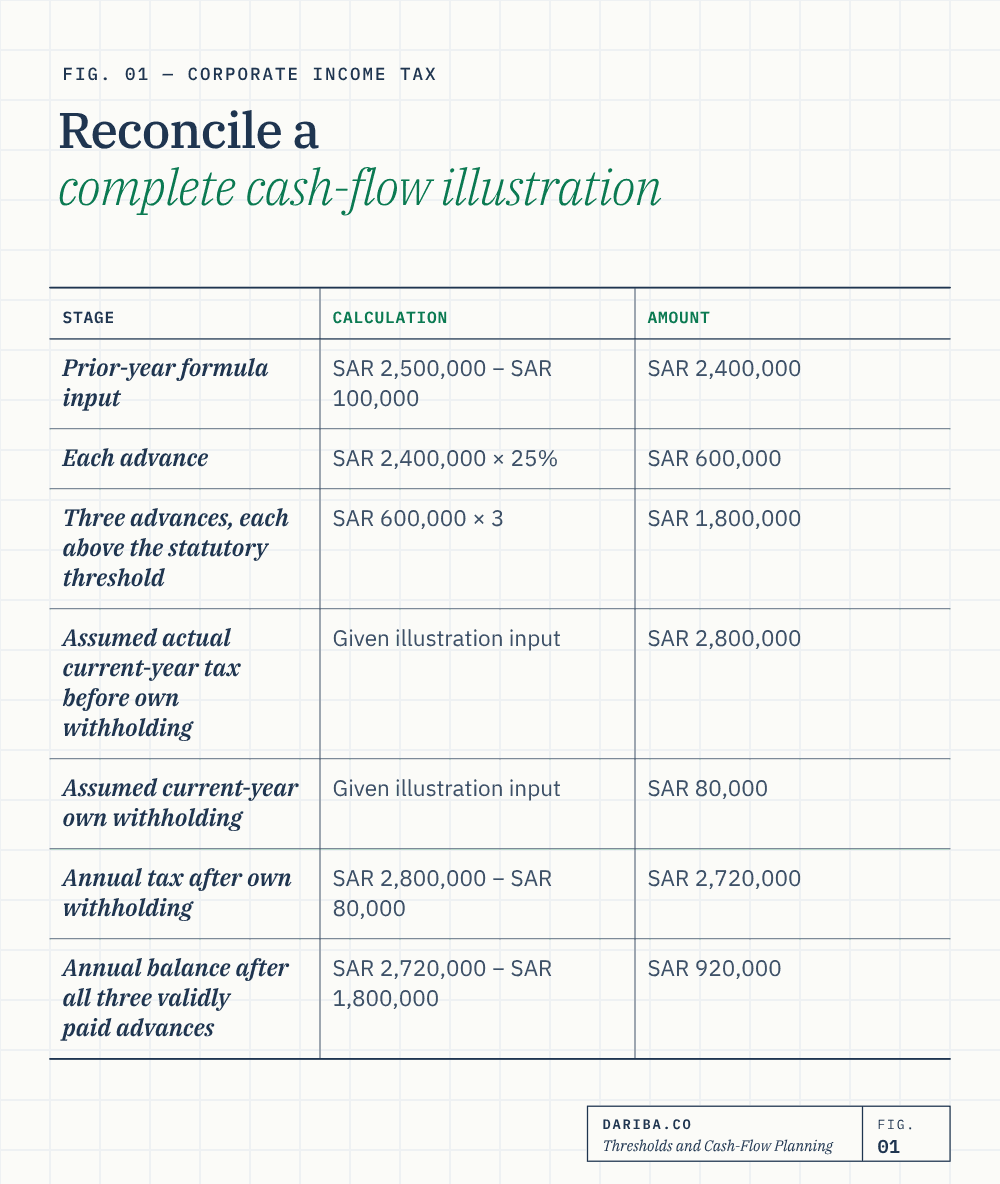
Reconcile a complete cash-flow illustration
Dariba original illustration: assume an ordinary calendar-year taxpayer has current-year revenue and no special arrangement. Its prior-year return tax is SAR 2,500,000 and eligible withholding on its own prior-year income is SAR 100,000.
| Stage | Calculation | Amount |
|---|---|---|
| Prior-year formula input | SAR 2,500,000 − SAR 100,000 | SAR 2,400,000 |
| Each advance | SAR 2,400,000 × 25% | SAR 600,000 |
| Three advances, each above the statutory threshold | SAR 600,000 × 3 | SAR 1,800,000 |
| Assumed actual current-year tax before own withholding | Given illustration input | SAR 2,800,000 |
| Assumed current-year own withholding | Given illustration input | SAR 80,000 |
| Annual tax after own withholding | SAR 2,800,000 − SAR 80,000 | SAR 2,720,000 |
| Annual balance after all three validly paid advances | SAR 2,720,000 − SAR 1,800,000 | SAR 920,000 |
Each SAR 600,000 advance is scheduled for the relevant month-end. The SAR 920,000 is an annual balance, not another advance. Law Articles 69 and 70(d) require the annual payment and recognise the advances on account of that year’s tax. Calculate the 120-day settlement period from the actual year-end rather than hardcoding 30 April for every year or taxpayer.
The example assumes all credits are eligible and all advances were correctly paid and allocated. It does not model penalties, assessments, disputed credits or a reduction. ZATCA’s Simplified Guideline for Income Tax, sections 5–6, explains the ordinary filing process; these numbers are Dariba’s own and are not attributed to an official worked example.
Prepare an evidenced reduction request before relying on relief
Law Article 70(c) allows a reduction where ZATCA is satisfied that the relevant current-year income will be substantially lower, with its stated exclusion for income subject to source withholding. Regulations Article 64(2) specifies a decline of at least 30% in the relevant comparison and proportionate reduction.
Article 64(3) requires the first payment in full by its due date, then a written request explaining the grounds and supported by evidence for reducing later payments. It gives ZATCA 30 working days from receipt to decide. The provision should not be converted into an automatic approval merely because the company has submitted a request or its forecast shows a decline.
Connect the forecast to management accounts, contracts, exceptional items and the relevant income measure. A general cash shortage, a percentage fall in accounting cash receipts or an unsupported expectation of lower tax does not automatically establish the statutory comparison. Maintain the application receipt and actual decision, and keep funding the legally due amounts while the request is unresolved.
Distinguish late advances from approved instalment plans
Article 70(e) applies collection procedures to advances. Regulations Articles 64(1)(d) and 68 address 1% of unpaid tax for each completed 30-day delay period; Article 68(2) states that this specific charge is not calculated if 30 days of delay have not been completed. That does not move the payment deadline or remove other applicable collection consequences.
Do not describe this rule as automatic daily compounding. Determine the overdue tax, due date, completed periods and actual payments. Any current penalty-relief initiative has separate eligibility and timing; no waiver is assumed in this illustration.
An instalment plan for an existing debt under Law Article 71 and Regulations Article 65 is different from reducing future advances. Article 65 requires a written, supported payment proposal, contains duration and cancellation conditions, and excludes the specified amounts withheld at source for payment to the Treasury. Its payment arrangement does not itself waive the delay charge. The CIT instalment and collection guide explains those conditions.
Close the year with a payment and evidence reconciliation
Before filing, reconcile the actual tax computation, the taxpayer’s own eligible withholding, advances actually paid, approved reductions and tax-account postings. Law Article 70(d)’s credit is tied to payments for that year; a forecast or an unallocated transfer should not be assumed to settle the return balance.
If the reconciliation gives an overpayment, use the applicable credit or refund procedure rather than treating the excess as an automatic cash repayment or investment return. The refund guide explains the statutory conditions and compensation framework.
The practical objective is a cash schedule that follows the legal threshold, reflects decisions actually obtained and ends in a fully supported annual balance. This also makes the below-threshold case visible: no ordinary advances can still mean a large amount payable within the annual settlement period.
Key takeaways
- Apply Law Article 70’s threshold before treating three advances as due.
- Each formula result is 25% of prior-year tax less the taxpayer’s own withholding.
- A result below SAR 500,000 is exempt from the ordinary advance obligation; exact equality reaches the threshold.
- Three payments fall in months 6, 9 and 12 of the actual tax year.
- A reduction request requires evidence and does not itself approve a lower payment.
- Advance credits and annual tax are reconciled using actual paid amounts.
Sources
- Saudi Income Tax Law, current amended Arabic textArticle 70(a)–(e): formula, SAR 500,000 per-payment threshold, reduction, credit and collection. Articles 68(g), 69 and 71 distinguish own withholding credits, annual settlement and instalment plans.
- Income Tax Implementing Regulations, current amended Arabic textArticle 64: implementation and 30-working-day reduction decision period; Article 65: separate instalment-plan conditions; Article 68: completed 30-day late-payment rule.
- ZATCA Simplified Guideline for Income Tax, second version May 2026Sections 5–6 give ordinary filing/compliance context. The detailed advance threshold and reduction conditions follow the Law and Regulations; no numbered official advance-payment calculation is attributed.
General information only. Actual supplies, facts, applicable periods and controlling Arabic legislation determine the result. Official examples are distinguished from Dariba analysis and original illustrations. Seek advice or clarification where the arrangement or source material leaves a specific issue unresolved.