In brief
Test the five alternative finance-lease criteria and preserve their exact thresholds. Article 14(6) separately explains the lease-to-own asset purchase financed by the lessor; principal, return, depreciation and transfer consequences need one reconciled analysis.
Determine the tax lease before deducting the instalment
Regulations Article 14 addresses finance leasing and lease-to-own arrangements. Where its conditions apply, the lessee is treated as owner for tax purposes and rental instalments are treated as repayment of a loan. The commercial description “rent” therefore does not establish that the entire payment is a deductible operating expense.
Review the actual agreement, asset, economic terms and statutory criteria. An accounting right-of-use asset or lease classification is useful evidence of the arrangement, but does not replace the Article 14 test. Likewise, an agreement labelled an operating lease should not be accepted as outside the tax rule without reviewing its terms.
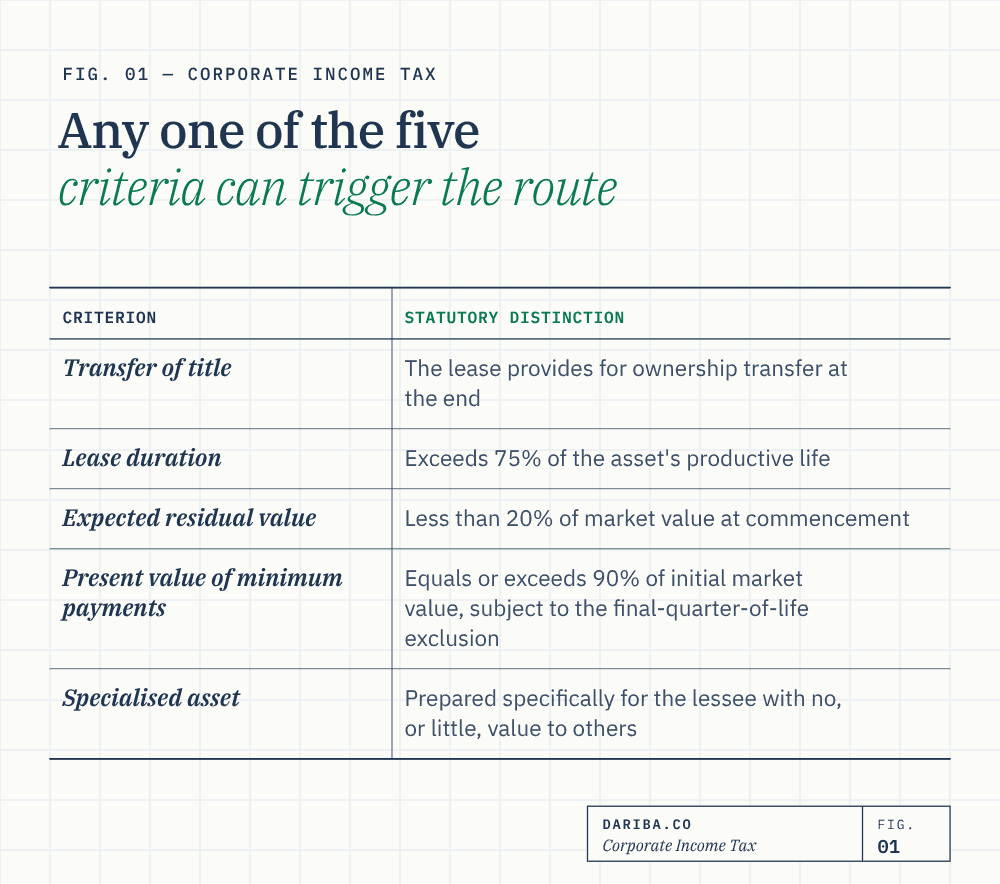
Any one of the five criteria can trigger the route
Article 14(2) treats the arrangement as finance leasing where any of the specified conditions is met:
| Criterion | Statutory distinction |
|---|---|
| Transfer of title | The lease provides for ownership transfer at the end |
| Lease duration | Exceeds 75% of the asset’s productive life |
| Expected residual value | Less than 20% of market value at commencement |
| Present value of minimum payments | Equals or exceeds 90% of initial market value, subject to the final-quarter-of-life exclusion |
| Specialised asset | Prepared specifically for the lessee with no, or little, value to others |
These are alternative criteria. A company should not require all five to be met, nor conclude that failure of one numerical criterion resolves the classification.
Preserve the exact percentage boundaries
“Exceeds 75%” differs from “75% or more”. “Less than 20%” differs from “20% or less”. The present-value criterion, in contrast, includes equality at 90%. Article 14(4) includes a renewable additional period in the lease duration. Assess the actual terms rather than omitting renewals merely to reduce the percentage.
Dariba illustration: an eight-year term for an asset with a ten-year productive life is 80%, exceeding 75%. A 7.5-year term is exactly 75% and does not, by itself, satisfy that duration criterion. It could still qualify under another criterion. These are original numerical illustrations of the boundary, not a ZATCA ruling on a lease’s life or renewal terms.
Apply the present-value test with its stated qualifications
Article 14(3) refers to the discount rate determined according to the Saudi Central Bank basis identified in the provision. Do not simply insert an accounting incremental borrowing rate without establishing that it is appropriate for this tax test. Document the actual rate, payment schedule, valuation and commencement facts.
For illustration, a qualifying present value of SAR 900,000 against an initial market value of SAR 1 million reaches 90%. That illustrates the numerical threshold only. Article 14(2)(d) excludes leases beginning in the final quarter of the asset’s productive life from this particular test; it does not remove the other alternative criteria.
A lease-to-own purchase has a stated financing treatment
Article 14(6) expressly treats a lease-to-own contract as a purchase of the asset by the lessee, financed through a loan from the lessor. For tax purposes, the rental instalments are treated as repayments of that loan. This paragraph should be read alongside the finance-lease criteria in Article 14(2), rather than omitted from the analysis because the agreement uses the word “lease”.
Dariba recommendation: establish who purchases the asset, how the lessor provides the financing, the transfer of ownership and the principal and return embedded in the payment schedule. Then apply Article 14(7)‘s consequences to the actual arrangement. The payment label alone does not turn the principal into a deductible rental expense.
Three related provisions answer different questions:
| Provision | Question addressed |
|---|---|
| Article 14(5) | Where the lessor owned the asset before the finance lease, the financing treatment also involves a sale by the lessor and purchase by the lessee. |
| Article 14(6) | The lease-to-own contract is treated as the lessee’s asset purchase financed by a loan from the lessor; instalments are treated as loan repayments. |
| Article 14(7) | The stated ownership, depreciation, principal and financing-return consequences apply, including paragraph (d)‘s separate sale-and-purchase consequences where the lessor previously owned the asset. |
Dariba analysis: do not record the same asset purchase or debt twice because more than one paragraph describes a consequence. Reconcile the actual asset, transfer, financing and payment schedule once, then identify the applicable tax adjustments. This CIT treatment does not itself decide the classification under VAT, Zakat, withholding or another separately governed regime.
Source: current Arabic Income Tax Implementing Regulations, Article 14(5)–(7), p. 13.
Split principal and financing returns
Article 14(7) divides instalments into principal and loan charges. The initial principal is the present value of minimum payments under the contract. The principal part is a repayment of the borrowing and is not a deductible cost for the lessee; the financing return is treated as income for the lessor and an expense for the lessee, subject to applicable rules.
Dariba illustration: if an otherwise correctly determined payment comprises SAR 100,000 principal and SAR 20,000 financing return, SAR 120,000 is the cash payment. The principal is not an expense deduction under this rule. The SAR 20,000 must still be tested under the relevant expense and financing conditions. The example assumes the split; it does not calculate an effective interest schedule.
Depreciation follows the tax ownership conclusion
Article 14(7)(a) prevents the lessor deducting depreciation where that right belongs to the lessee under this route. The lessee’s depreciation remains subject to the applicable asset rules, rather than being set equal to principal repayments or total instalments. Keep the tax asset and debt schedules reconciled over the contract.
Read the depreciation guide with the loan-charge guide. An accounting lease expense cannot be added to both tax depreciation and loan charges without the necessary reconciliation. That would count the same economic cost more than once.
The asset transfer can have a separate tax effect
Article 14(5) and (7)(d) address the case where the lessor owned the asset before the lease: in addition to financing treatment, the arrangement is regarded as a sale by the lessor and purchase by the lessee, with the resulting tax consequences for each. Do not analyse only the monthly instalments while overlooking the initial transfer.
The statutory rule does not independently determine VAT, RETT, Zakat or every withholding issue. Those depend on the asset, persons, supply and applicable provisions. A related-party transaction also requires the appropriate pricing analysis. This guide explains the CIT lease route; it does not treat that route as a universal classification for other regimes.
Build one contract file with linked schedules
Retain the executed agreement and renewals, ownership terms, productive-life support, initial market value, residual forecast, discount-rate basis, minimum-payment schedule, classification conclusion, tax depreciation and principal/return split. Reconcile those schedules when the contract is amended, settled early or the asset is replaced.
ZATCA’s May 2026 Guideline on the Conditions of Deductible Expenses, section 2.1, supplies the general deduction conditions; the particular lease criteria and consequences above are drawn from Regulations Article 14. No official numbered lease example is attributed to that guideline. The practical value is a supported tax treatment from commencement through settlement, rather than a year-end adjustment inferred from the payment label.
Key takeaways
- Tax lease classification follows the actual Article 14 criteria.
- Any one of the five stated criteria can establish finance leasing.
- The 75%, 20% and 90% boundaries have different wording.
- Principal repayment differs from financing expense.
- Tax depreciation follows the tax ownership conclusion.
- Initial asset-transfer effects and other taxes require separate review.
- Article14(6) treats a lease-to-own contract as the lessee’s purchase financed through a loan from the lessor.
Sources
- Saudi Income Tax Law, current amended Arabic textRelevant Articles 7, 9, 17–23 and 43. The current amended Law governs over older translations or inconsistent subordinate summaries.
- Income Tax Implementing Regulations, current amended Arabic textArticle 14(1)–(7), pp.12–13: five alternative criteria, exact thresholds, discount rate, renewal, financed purchase, principal/return and ownership consequences.
- ZATCA Guideline on the Conditions of Deductible Expenses, second version May 2026General section 2.1 and relevant financing/head-office examples. Original Dariba calculations are distinguished from official examples.
General information only. Actual supplies, facts, applicable periods and controlling Arabic legislation determine the result. Official examples are distinguished from Dariba analysis and original illustrations. Seek advice or clarification where the arrangement or source material leaves a specific issue unresolved.