In brief
Article 61 requires the SAMA daily rate on the relevant tax point. That date can arise from an advance payment or earlier invoice; it is not invariably the delivery date.
Saudi VAT amounts expressed in a foreign currency must be converted to Saudi riyals using the SAMA daily rate for the date the relevant tax becomes due. The practical task is to establish that tax point first, then select the rate. Payment can determine the tax point where the applicable timing rules make it relevant.
This guide addresses the conversion rule in Article 61. It assumes that the transaction has already been classified for Saudi VAT purposes; currency conversion does not determine whether a supply is taxable, exempt or outside scope.
What Article 61 requires
Article 61 applies where a relevant amount under the VAT Implementing Regulations is expressed in a currency other than riyals. It requires conversion using the daily rate prescribed by the Saudi Central Bank, commonly called SAMA, on the date the relevant tax becomes due under the Agreement and Law.
There are three decisions to document: the foreign-currency amount, the legally applicable tax point and the SAMA rate for that date. A bank’s settlement rate or the finance team’s monthly reporting rate does not satisfy Article 61 merely because it is used elsewhere in the accounts. If it produces the same number, retain evidence that the VAT calculation nevertheless uses the prescribed source and date.
Source: VAT Implementing Regulations, Article 61, Arabic consolidated text, printed page 56.
Establish the tax point before choosing the exchange rate
For an ordinary supply, the general timing rule considers the supply, issue of the tax invoice and receipt of consideration, taking the earliest relevant event. A payment received before delivery can therefore create a tax point for the amount received. An invoice issued before delivery can also bring the tax point forward.
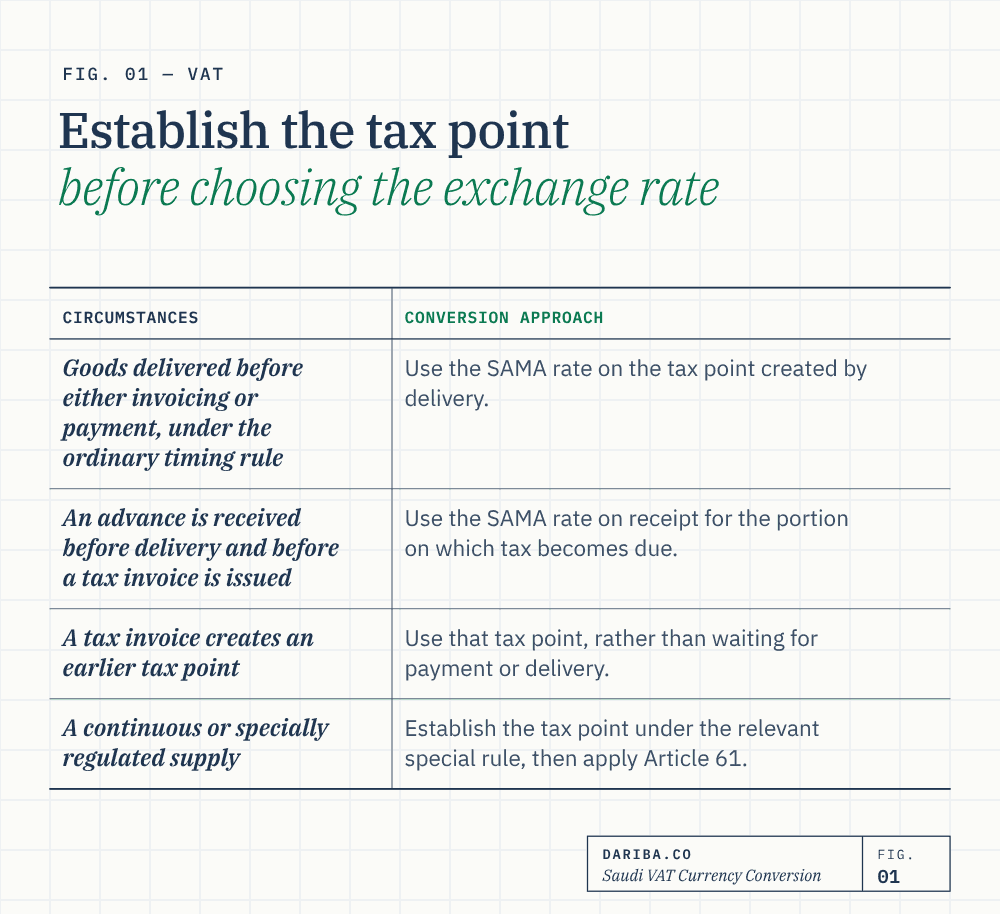
The physical delivery or completion date, invoice date and payment date should not be used interchangeably. For continuous supplies and other special cases, apply the particular timing provision first. A return payment deadline is a different date again.
| Circumstances | Conversion approach |
|---|---|
| Goods delivered before either invoicing or payment, under the ordinary timing rule | Use the SAMA rate on the tax point created by delivery. |
| An advance is received before delivery and before a tax invoice is issued | Use the SAMA rate on receipt for the portion on which tax becomes due. |
| A tax invoice creates an earlier tax point | Use that tax point, rather than waiting for payment or delivery. |
| A continuous or specially regulated supply | Establish the tax point under the relevant special rule, then apply Article 61. |
ZATCA explains ordinary and advance-payment timing in section 4.5.1, and continuous supplies in section 4.5.2, of its Tax Invoicing and Records Guideline, May 2026, pages 26-27.
ZATCA’s example: a dollar-denominated sale
In Example 3, section 4.2.2 of the Tax Invoicing and Records Guideline (version 3, May 2026, pages 17-18), Al-Madinah Chemical Products Company supplies chemicals to Al-Safa Plastics Factory under dollar pricing. The goods and invoice fall in March 2021, with no advance receipt. ZATCA describes converting the invoice VAT to riyals using the SAMA rate on the invoice issuance date. This is a paraphrase of ZATCA’s example; the company facts have not been adapted. Read the official example.
The example confirms that commercial pricing can remain in dollars while the VAT figure is expressed in riyals. Its reference to the invoice date must be read alongside Article 61 and the timing rules: the example does not establish that every invoice date overrides an earlier tax point. It also does not give exact separate delivery and invoicing days from which to resolve every possible timing question.
Dariba’s analysis. For a business with foreign-currency contracts, the key control is the connection between the contract, tax point and riyal VAT amount. A correct SAMA rate applied to the wrong date can still give the wrong result. Where advances, earlier invoices or special supply rules change the tax point, extend the analysis from those rules rather than assuming the short official example covers those facts. The following original illustration shows that extension; its figures and additional facts are Dariba’s, not ZATCA’s.
Dariba illustration: an advance changes the relevant date
Assume a VAT-registered Saudi supplier agrees an ordinary taxable supply for EUR 10,000, exclusive of VAT at 15%. There are no special timing rules. No tax invoice has been issued when the customer pays an advance comprising EUR 3,000 of net consideration plus the associated VAT on 5 March. The remaining EUR 7,000 of net consideration becomes taxable on delivery on 20 March, before any further payment or earlier invoice.
The following exchange rates are invented solely to illustrate the calculation; they are not historical SAMA rates.
| Tax point | Amount | Illustrative SAR per EUR | SAR taxable value | VAT at 15% |
|---|---|---|---|---|
| 5 March: advance received | EUR 3,000 | 4.00 | SAR 12,000 | SAR 1,800 |
| 20 March: remaining amount on delivery | EUR 7,000 | 4.10 | SAR 28,700 | SAR 4,305 |
| Total | EUR 10,000 | Two tax points | SAR 40,700 | SAR 6,105 |
Converting the entire contract at the delivery-date rate would overlook the advance-payment tax point. Conversely, a later payment of the outstanding balance does not, by itself, reset the rate for tax that already became due. A later contractual price adjustment requires its own analysis.
What must appear on the invoice
ZATCA’s invoicing guideline permits invoice monetary values in a foreign currency, while requiring the tax charged to be stated in Saudi riyals. Section 4.2.2 connects that SAR figure to the Article 61 conversion rule. The invoice and supporting calculation should therefore reconcile even where the commercial contract is denominated in euros or dollars.
A foreign supplier’s invoice requires a separate classification check. Do not assume that it must charge Saudi VAT: the reverse charge can place the accounting obligation on the Saudi customer. Equally, foreign VAT does not become Saudi deductible input tax simply because the amount is translated into riyals. See the Input Tax Deduction Guideline, sections 4.3 and 11.2.
A practical control for the finance team
For management, this creates a decision about how the system records tax points, not just where it obtains exchange rates. If the VAT process automatically uses the bank settlement date or the date accounts payable enters the invoice, test whether that date matches the legally relevant event. Prioritise transactions with advances and multiple billing milestones, where one commercial contract can produce more than one relevant conversion date. This is a recommended review approach, not a prediction that every such transaction contains an error.
Keep a calculation schedule identifying the transaction, tax-point rule, relevant dates, foreign-currency amount, SAMA rate and resulting SAR VAT. Reconcile advances separately from final invoices so the same consideration is not taxed twice. These are recommended controls for demonstrating the calculation, rather than a separate statutory requirement for a particular spreadsheet format.
If the required rate cannot be identified, resolve the treatment before relying on an internal substitute. For a material historical error, establish the affected periods and apply the return-correction rules; selecting a new rate in the current return does not itself correct an earlier declaration.
For the broader document requirements, continue to VAT invoicing in Saudi Arabia.
Key takeaways
- Establish the tax point before choosing the exchange rate.
- An advance payment can create a tax point for the amount received.
- Separate VAT conversion from accounting and bank-settlement rates.
- A foreign-currency tax invoice must show the Saudi VAT charged in riyals.
- Assess reverse-charge obligations separately from supplier-issued Saudi VAT invoices.
Sources
- ZATCA - VAT Implementing Regulations, Arabic consolidated edition (April 2025)Controlling Arabic text; check the cited article and applicable transaction period.
- ZATCA - Tax Invoicing and Records Guideline, version 3, May 2026Section 4.2.2, Example 3, pages 17-18; sections 4.5.1-4.5.2, pages 26-27.
- ZATCA - Input Tax Deduction Guideline, third version, May 2026Sections 4.3 and 11.2: reverse charge and foreign VAT.
General information only. Actual supplies, facts, applicable periods and controlling Arabic legislation determine the result. Official examples are distinguished from Dariba analysis and original illustrations. Seek advice or clarification where the arrangement or source material leaves a specific issue unresolved.