In brief
Article 49(8) permits an eligible deduction in a later tax period, but not one falling more than five calendar years after the supply year. The final eligible period and its filing date are different.
Article 49(8) allows an eligible input-tax deduction to be taken in a later VAT period, but limits how late that period can be. The restriction is measured by reference to the calendar year of supply. It should not be reduced to a rolling five-year period from an invoice date, or confused with the filing date of the return for the final eligible period.
This guide concerns an ordinary delayed deduction under Article 49(8). Refund applications, corrections of earlier returns and capital-asset adjustments have their own provisions and must be assessed separately.
Read the permission and the limitation together
Article 49(8) permits deduction in a tax period after the period containing the supply date, provided the taxable person remains entitled to the deduction under the other rules. It then excludes deduction in a period falling more than five calendar years after the calendar year of supply.
Being within the time window is therefore necessary, but does not establish entitlement. The customer must still check the nature and use of the expenditure, applicable restrictions, supporting evidence and whether the tax has already been claimed.
Sources: VAT Implementing Regulations, Article 49(8), Arabic consolidated text, printed page 43; Input Tax Deduction Guideline, sections 9.1-9.2, May 2026, pages 38-39.
Calculate the last eligible tax-period year
First establish the legally relevant supply date. The invoice date can be relevant to that analysis, but should not be substituted automatically for the supply date. Then add five to the calendar year in which that supply falls.
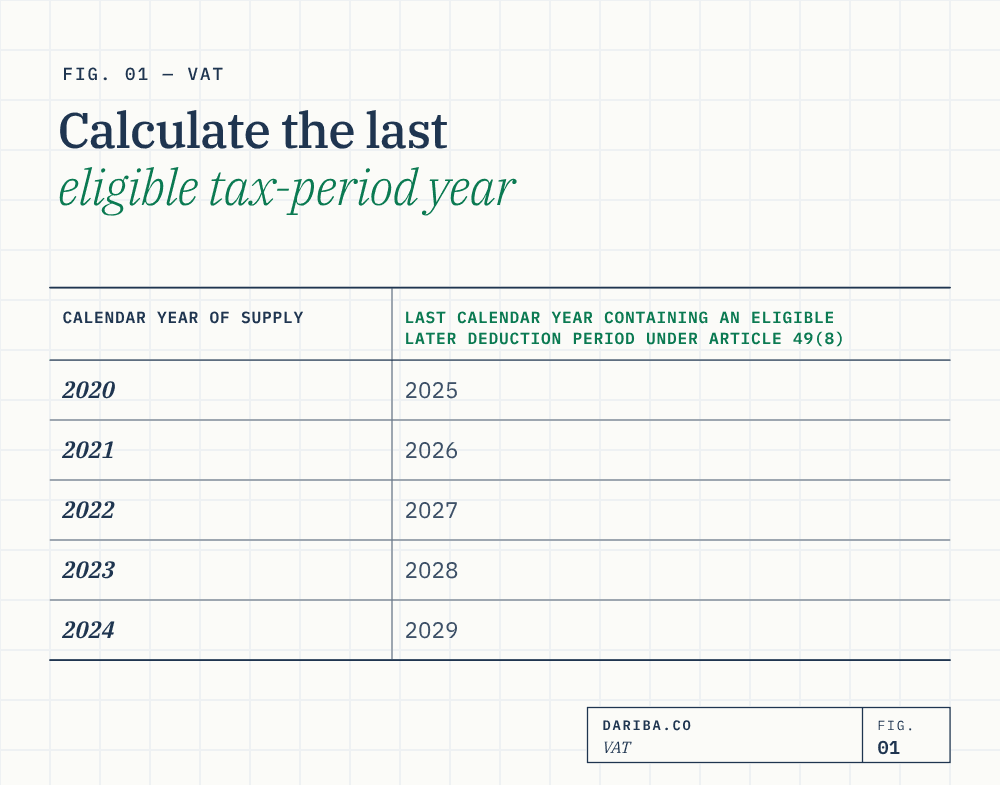
| Calendar year of supply | Last calendar year containing an eligible later deduction period under Article 49(8) |
|---|---|
| 2020 | 2025 |
| 2021 | 2026 |
| 2022 | 2027 |
| 2023 | 2028 |
| 2024 | 2029 |
This is a year-based rule. A supply in January 2021 and one in December 2021 lead to the same last eligible year, 2026. It is consequently inaccurate to describe the rule as exactly 60 months from each invoice date.
The eligible period is different from the return submission date
For a supply in 2021, December 2026 can be the last eligible monthly period; for a quarterly filer, it can be the quarter ending 31 December 2026. The return for that period is normally filed in the following month under Article 62(1).
An otherwise valid deduction in that return is not a deduction in a January 2027 period merely because the return is submitted in January. Conversely, placing the amount in a January 2027 period or the first quarter of 2027 would be outside the ordinary Article 49(8) window for a 2021 supply.
This distinction does not establish an unrestricted right to submit or amend earlier-period returns at any later date. Filing, correction, assessment and refund procedures must be considered on their own terms.
ZATCA’s example: an invoice reaches finance after the original return
In Example 25, section 9.2 of the Input Tax Deduction Guideline (third version, May 2026, page 39), Al Faris Co receives legal services in March 2018. Its commercial manager delays sending the invoice to finance until the first-quarter return has been filed. ZATCA permits deduction in the second-quarter return, rather than requiring amendment of the first-quarter return. This is a paraphrase of the official example. Read the example in section 9.2.
This supports a specific distinction: an eligible input-tax deduction omitted from the original period can be exercised in a subsequent eligible period under Article 49(8). It does not establish that every type of return error can be moved to a later period, or that an ineligible deduction becomes recoverable because an invoice was processed late.
Dariba’s analysis. The finance team’s first task is to identify the nature of the omission. If it is a first claim for otherwise deductible input tax, the later-period mechanism may be relevant. If tax was already claimed, an adjustment was made, or the error concerns a different part of the return, the analysis changes. Treating all historical items as an undifferentiated backlog risks selecting the wrong procedure.
ZATCA’s example concerns a delay between quarters in the same year. Applying Article 49(8) near the end of the five-year window requires the statutory year calculation as well; that longer delay is not a fact stated in Example 25. The following Dariba illustration develops that separate issue while retaining explicit assumptions about entitlement and evidence.
Dariba illustration: an omission identified near the final eligible year
Assume a VAT-registered business uses ordinary invoice accounting. It receives a fully deductible supply in July 2021, holds the required evidence and has never deducted the VAT. Its finance team identifies the omission in November 2026.
Subject to confirming continuing eligibility and the return treatment, the business can include the delayed deduction in an eligible 2026 period. For a quarterly filer, the quarter ending December 2026 remains within the year-based limitation.
Change one fact: the business identifies the invoice in February 2027 and proposes to deduct it in its current first-quarter 2027 return. Article 49(8) does not permit that current-period claim for a 2021 supply. Any possible earlier-period correction or other remedy requires a separate assessment; it should not be assumed from the permission to deduct in a later period.
Rules that need a separate analysis
| Issue | Why Article 49(8) alone is insufficient |
|---|---|
| Cash accounting | Section 9.1 of the guideline explains that deduction depends on payment to the relevant extent. |
| Unpaid supplier invoices | Article 40 contains the reduction and subsequent payment rules. Distinguish reinstatement following an adjustment from a first deduction of previously unclaimed tax. |
| Capital assets and changes of use | Article 52 governs adjustments. An adjustment period does not automatically extend the ordinary delayed-deduction window. |
| Missing or defective evidence | Article 49(7) and guideline section 8 address supporting evidence and possible alternatives. A claim within time still needs support. |
| A credit balance or refund request | Article 69 and the relevant refund provisions concern a different procedural step. |
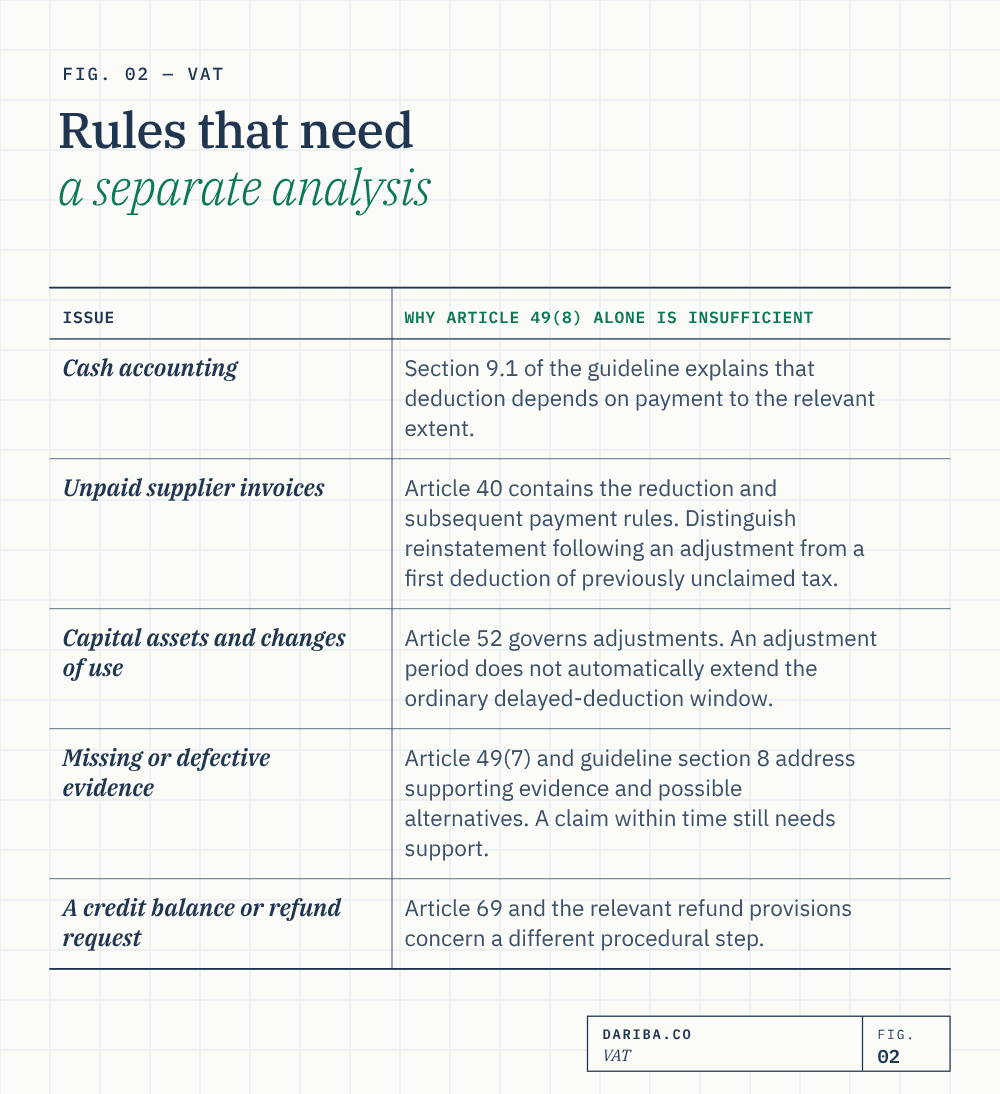
These interactions are particularly important for older disputes, financing arrangements, property expenditure and reorganisations. The appropriate route depends on what happened to the original deduction, not simply on the age of the invoice.
A practical review of historical invoices
For management, the useful output is an assessed schedule of potential claims, not simply the total VAT on old invoices. Separate amounts that appear eligible, amounts requiring better evidence, duplicates and items requiring a different procedural analysis. That makes it possible to prioritise the oldest eligible years while directing unresolved items to the right review. These categories are Dariba’s recommended working method, not a prescribed ZATCA classification.
Build a schedule by supply year, rather than only by invoice receipt date. For each item, record the customer entity, supply date, evidence held, VAT amount, original treatment, any adjustment and the proposed deduction period. Check expenditure restrictions and duplicate claims before calculating the amount to recover.
Prioritise the oldest eligible supply years and resolve uncertain items before the final eligible period is prepared. This is a recommended finance control. It does not create an extension or a different statutory deadline.
For the underlying entitlement tests, see input VAT recovery.
Key takeaways
- Measure the Article 49(8) window from the calendar year of supply, rather than automatically from the invoice date.
- A 2021 supply has 2026 as the last eligible tax-period year under the ordinary later-period rule.
- The return for the final eligible 2026 period can normally be filed in the following month; that does not turn it into a 2027-period deduction.
- Continuing entitlement, supporting evidence and duplicate-claim checks remain necessary.
- Assess corrections, refunds, cash accounting, unpaid invoices and capital-asset adjustments under their own provisions.
Sources
- ZATCA - VAT Implementing Regulations, Arabic consolidated edition (April 2025)Controlling Arabic text; check the cited article and applicable transaction period.
- ZATCA - Input Tax Deduction Guideline, third version, May 2026Sections 8, 9.1-9.2 and 10, pages 34-43; section 9.2, Example 25, on page 39.
General information only. Actual supplies, facts, applicable periods and controlling Arabic legislation determine the result. Official examples are distinguished from Dariba analysis and original illustrations. Seek advice or clarification where the arrangement or source material leaves a specific issue unresolved.