In brief
The rules permit valid simplified invoices in defined cases, including domestic supplies to non-taxable natural persons regardless of value. Correctly issued simplified invoices can support an otherwise eligible input claim; conditional fields and electronic requirements still apply.
Saudi VAT invoicing starts with three decisions: who supplies what, which invoice type is permitted, and when the document must be issued. A correctly designed template helps, but it cannot resolve a misclassified supply, the wrong recipient or an incorrect tax point.
Article 53 governs tax invoices, alongside the applicable electronic invoicing rules. Article 49 governs the customer’s entitlement to deduct input VAT. The two interact, but a tax invoice does not itself establish that every amount charged is deductible.
Choose the invoice type from the transaction and customer
A standard tax invoice is ordinarily required for taxable supplies to another taxable person, a non-taxable legal person and the other businesses/entities identified in Article 53(1). Advances for those supplies are included. Goods exports and the applicable cross-border categories need their specific rules; an exempt supply does not become zero-rated simply because the supplier issues an invoice.
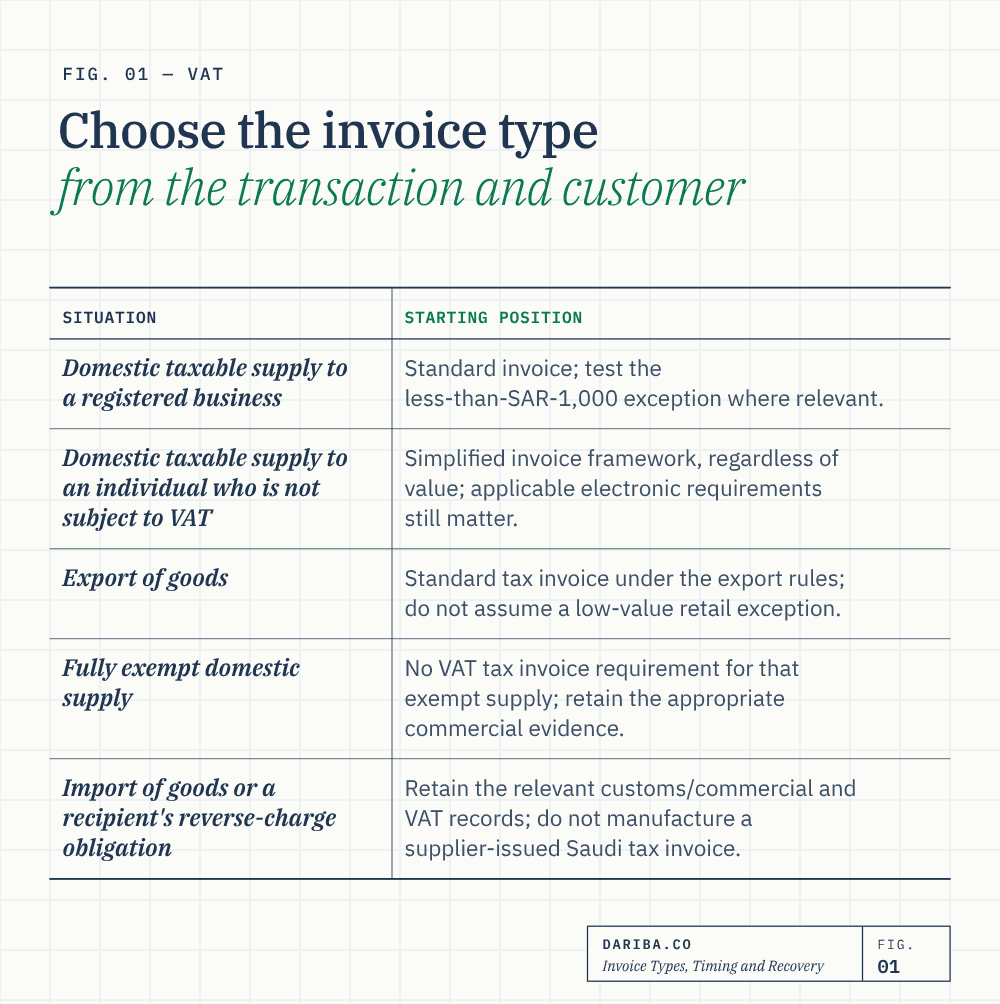
The low-value exception in Article 53(1)(c) uses less than SAR 1,000. It is not a general permission at SAR 1,000 exactly. Domestic supplies to a natural person who is not subject to VAT fall under the simplified-invoice framework irrespective of value, subject to the applicable special rules. A high consumer purchase price alone therefore does not establish a standard-invoice requirement.
| Situation | Starting position |
|---|---|
| Domestic taxable supply to a registered business | Standard invoice; test the less-than-SAR-1,000 exception where relevant. |
| Domestic taxable supply to an individual who is not subject to VAT | Simplified invoice framework, regardless of value; applicable electronic requirements still matter. |
| Export of goods | Standard tax invoice under the export rules; do not assume a low-value retail exception. |
| Fully exempt domestic supply | No VAT tax invoice requirement for that exempt supply; retain the appropriate commercial evidence. |
| Import of goods or a recipient’s reverse-charge obligation | Retain the relevant customs/commercial and VAT records; do not manufacture a supplier-issued Saudi tax invoice. |
Sources: Article 53, Arabic Regulations, pp. 55–58; Tax Invoicing and Records Guideline, version 3, May 2026, sections 4.1.2 and 4.3, pages 13–15 and 23–24.
The guideline’s short introductory description on page 12 suggests a broad SAR 1,000 dividing line. Its detailed table and section 4.3 explain the natural-person rule. Read those passages with the legislation rather than applying the introductory sentence as an exception-free rule.
Build standard invoice content with its conditions
Article 53(5) includes the issue date, uniquely identifying sequential number, supplier tax identification, party names and addresses, description/quantity or scope, relevant supply date, values, discounts, rate and SAR tax. It also contains conditional information: a different supply date, the customer’s self-accounting identification/statement, non-standard treatment and the eligible used-goods margin-method reference must be addressed where applicable.
It is misleading to treat every conditional item as mandatory on every transaction. It is equally unsafe to use the legislative list as the entire electronic invoice specification. ZATCA’s section 4.2.3, pp. 18–20, sets out the current standard-invoice data, including the customer’s registration or other relevant identification and additional electronic information. Supplier and customer identifiers must reflect their actual roles. Implement the applicable data fields, not a fixed promise that any twelve boxes will suffice.
Invoices must include the required Arabic information; additional languages may accompany it. Section 4.2.1 explains permitted numerals, currency symbols and Latin proper names. That guidance does not make an English-only invoice compliant. Foreign-currency commercial values may be used, but Saudi VAT must be expressed in riyals under Article 61. See the currency-conversion analysis.
Source: Invoicing guideline, sections 4.2.1–4.2.3, pages 16–20.
ZATCA’s example: a simplified retail invoice
In Example 7, section 4.3.2 of the May 2026 invoicing guideline, p. 24, Al-Hadiqah Al-Khadhraa Markets sells food products for SAR 90 plus SAR 13.50 VAT. ZATCA permits the simplified invoice to show that VAT amount or the SAR 103.50 total with a clear indication that it includes VAT at 15%. These are the official example’s facts and figures. Read Example 7.
Article 53(8)‘s baseline includes the issue date, supplier’s name/address/tax identification, supply description, consideration, and tax or the permitted VAT-inclusive statement. Applicable electronic invoice requirements add to that baseline. The example is not permission to omit electronic fields that apply to the supplier.
Dariba’s analysis. Document type should be selected from the customer and transaction facts at checkout. A blanket rule based only on receipt value will misclassify some transactions. Capture the relevant business/customer status and route exceptions deliberately; these are recommended process controls rather than a prescribed software design.
A valid simplified invoice can support an input claim
Article 49(7)(a) expressly recognises a correctly issued simplified tax invoice as supporting evidence. The earlier proposition that a business can never deduct VAT from a simplified invoice is therefore too broad. The invoice must be permitted and correctly issued, and the customer must meet the separate entitlement, use and restriction tests.
Dariba illustration. A registered business buys a fully taxable-use input for SAR 500 plus SAR 75 VAT, a SAR 575 total. Assume a simplified invoice is permitted for that transaction, is correctly issued under the applicable electronic rules, and the business holds it and satisfies all other deduction conditions. Simplified form alone does not prevent the SAR 75 deduction. This is an original illustration of Article 49(7), not an additional ZATCA example or a promise for any retail receipt.
An incomplete document is a different issue. ZATCA may accept alternative evidence at its discretion under Article 49(7); a claimant should not assume acceptance or state that every defect permanently extinguishes the substantive entitlement. See input VAT entitlement.
Source: Article 49(7), p. 49; invoicing guideline section 9.5, pages 46–47.
Separate issuance deadlines from the tax point
For Article 53(1) standard invoices, the ordinary issuance deadline is the fifteenth day of the following month. A simplified invoice is generally issued on supply or earlier receipt of consideration, to the relevant extent. Article 53(7)(c) provides a qualified later-invoicing exception for specified licensed financial-service supplies and any other supplies designated by decision. The exception includes additional customer/supply information; it is not a general extension for every business or fee.
The deadline for issuing a document does not postpone VAT that already became due. Ordinary supply, advance-payment and earlier-invoice rules must be distinguished from continuous-supply rules. For instalment arrangements, contractual due dates can also matter. See the guideline’s sections 4.5–4.5.2, pages 25–27 and the controlling timing provisions for the particular supply.
ZATCA’s example: a monthly summary invoice
Example 8, section 4.4, p. 25, describes Gulf Arab Equipment Company’s separate equipment and service supplies to Al-Bayt Al-Amer during September 2022. ZATCA permits a summary invoice showing the individual supply dates. Article 53(4) limits the covered period to one calendar month and requires issuance by the fifteenth day of the following month. Read Example 8.
The useful extension is a reconciliation control: preserve each supply and its date within the summary, then reconcile the monthly document to the source transactions. Do not issue duplicate individual tax invoices for supplies already covered, or assume that summary billing changes their tax points. A qualified simplified-summary route exists for persons meeting Article 53(7)(d)‘s exception; it is not the general standard-summary rule.
Self-billing, corrections and electronic records
Customer-issued invoices require Article 53(2)‘s approval, prior agreement, registration and acceptance arrangements. Section 5.1 explains notification requirements. A commercial agreement alone is insufficient. Third-party issuance under Article 53(3) is a separate arrangement; the supplier retains responsibility. Continue to the self-billing guide.
Where tax or consideration changes, Articles 40 and 54 govern the appropriate adjustment and credit/debit note. Article 54(3) also addresses correcting party data. Retain the original invoice and the linked correction documents; do not silently overwrite the historical document. The exact correction procedure depends on the error and applicable electronic requirements. Article 54, p. 58 supplies the legislative starting point.
Electronic invoicing requirements depend on the applicable phase and notified integration obligations. The published implementation resolution distinguishes clearance and reporting and adds invoice-format, identification and storage requirements. Retain the required electronic record and audit trail; a printout alone should not be treated as proof that those requirements are met. This overview does not certify software or determine an individual taxpayer’s integration date. Consult ZATCA’s current regulations and implementation resolution when implementing the workflow.
For management, the review should connect supply classification, invoice type, statutory timing, electronic validation, customer evidence and return reporting. Test these together on actual transactions. A visually complete invoice can still contain the wrong tax; an eligible cost can still require better evidence before deduction.
Key takeaways
- Domestic supplies to natural persons who are not subject to VAT fall under the simplified framework regardless of value, subject to applicable special rules.
- The low-value exception uses less than SAR 1,000; it is not a general permission at exactly SAR 1,000.
- Article 49(7)(a) recognises a correctly issued simplified invoice as evidence; separate entitlement and restriction tests remain.
- Standard invoice fields include conditional items, while electronic requirements add data beyond a fixed twelve-field checklist.
- Ordinary standard-invoice issuance by the following month’s fifteenth does not defer a tax point that has already arisen.
- ZATCA Examples 7 and 8 explain a retail simplified invoice and monthly summary billing on their stated facts.
- Self-billing requires the applicable approval and notification framework; corrections and electronic retention need their own compliant workflows.
Sources
- ZATCA - VAT Implementing Regulations, Arabic tenth edition, April 2025Article 49(7) p49; Article 53 pp55-58; Article 54 p58; Article 61 p62.
- ZATCA - Tax Invoicing and Records Guideline, version 3, May 2026Detailed invoice types pp13-15,23-24; fields pp16-20; Examples 7-8 pp24-25; timing pp25-27; alternative evidence pp46-47.
- ZATCA - E-Invoicing Implementation Resolution, published May 2023, English translationCurrent official legislation page links this resolution; clearance/reporting and record specifications are additional. Arabic version prevails.
General information only. Actual supplies, facts, applicable periods and controlling Arabic legislation determine the result. Official examples are distinguished from Dariba analysis and original illustrations. Seek advice or clarification where the arrangement or source material leaves a specific issue unresolved.