In brief
Identify when profits from similar Saudi sales or services can enter a foreign enterprise’s Saudi tax base.
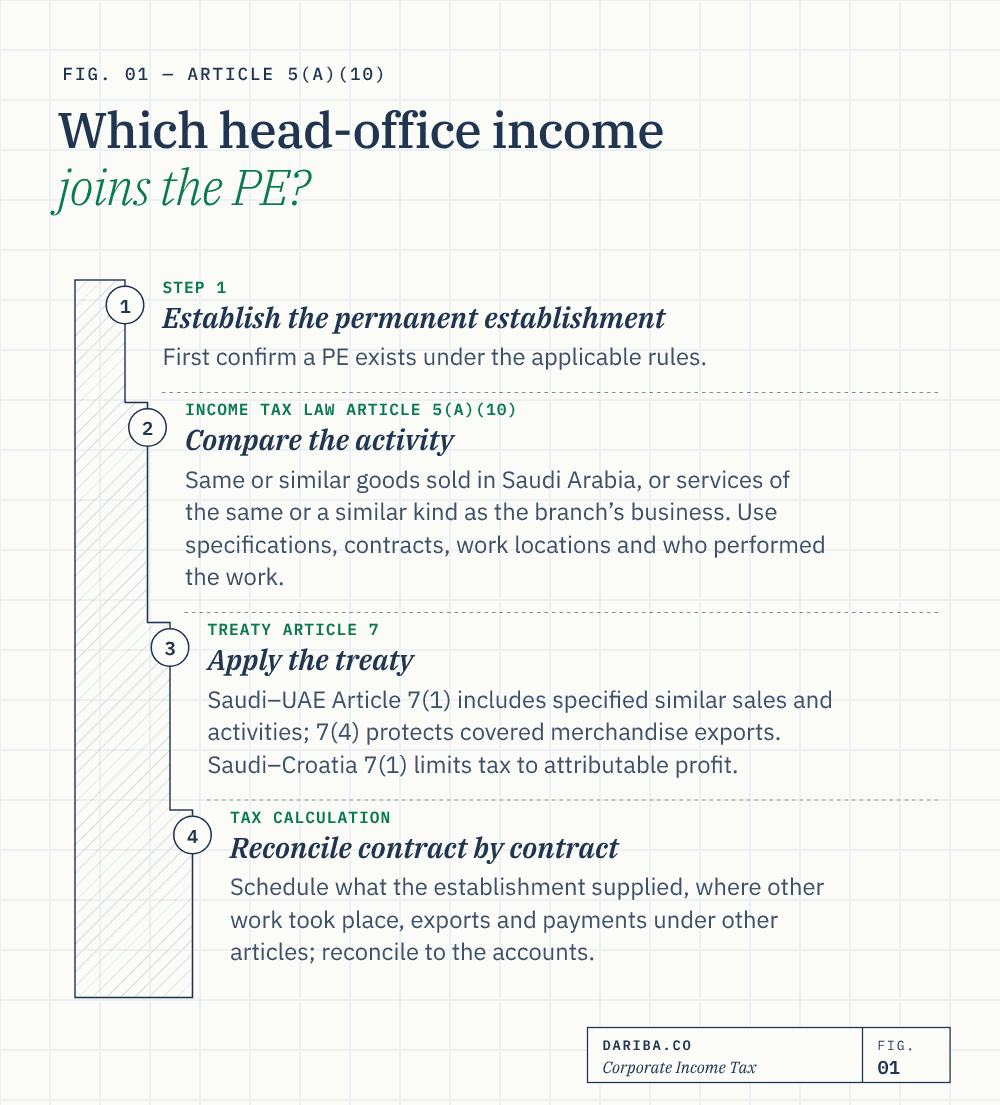
A foreign company with a Saudi branch may also make sales or supply services through its head office. Saudi Income Tax Law Article 5(a)(10) can bring in income from Saudi sales of the same or similar goods and from services or other activities in Saudi Arabia of the same or a similar kind as the branch’s business. ZATCA’s Circular 2104001, Force of Attraction Rule in the Context of Permanent Establishment, calls this partial force of attraction.
Identify the treaty and compare the activities
First establish whether the enterprise has a permanent establishment under the applicable rules. Then compare each Saudi sale or service with what the establishment actually does. Use product specifications, customer contracts, work locations and who performed the work. The head office’s invoice and the location of the signing team are evidence to consider alongside the underlying business activity.
Both the treaty’s profit rule and its exceptions matter. Article 7(1) of the Saudi–UAE agreement includes specified similar local sales and activities. Article 7(4) protects covered merchandise export profits and permits source taxation of other work under the export contract performed through a local establishment. Article 7(1) of the Saudi–Croatia agreement limits source taxation under that article to profits attributable to the establishment.
Reconcile the transactions to the tax calculation
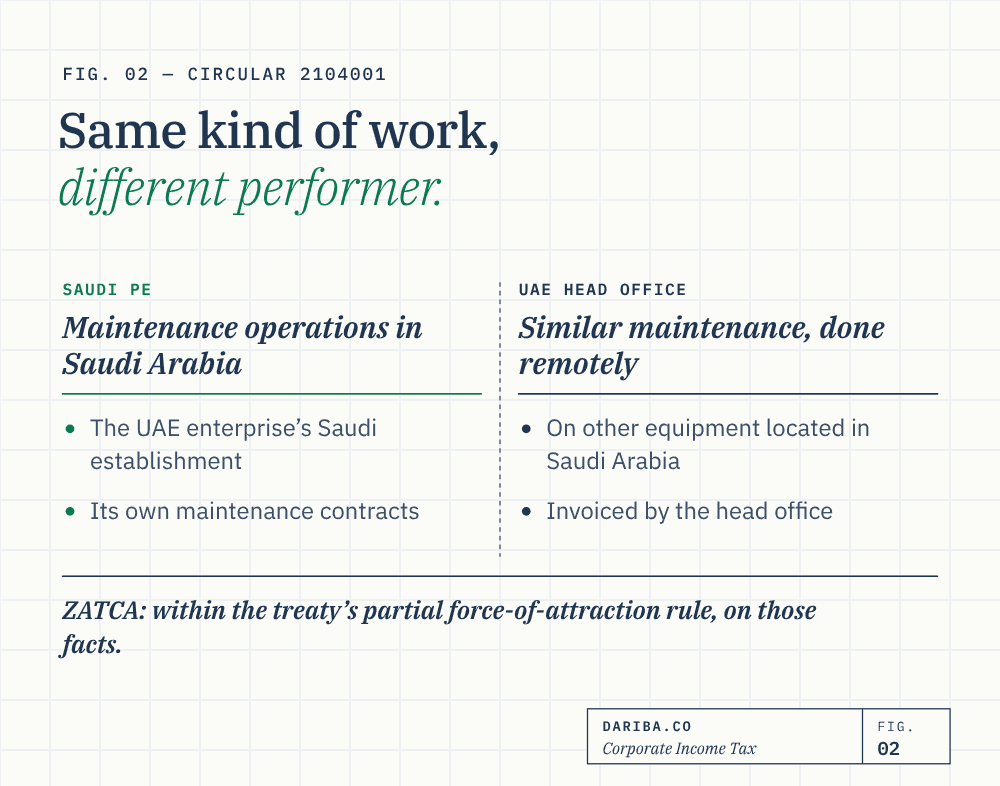
ZATCA’s Circular 2104001 illustrates a UAE enterprise with Saudi maintenance operations whose head office also provides similar maintenance remotely on other equipment in Saudi Arabia. ZATCA treats the additional activity as within the treaty’s partial force-of-attraction rule on those facts.
Use a contract-by-contract schedule showing what the Saudi establishment supplied, where other activities took place and how they compare. Identify any covered merchandise exports and payments governed by separate treaty articles. Reconcile the in-scope revenue and applicable deductions to the accounts. The Saudi domestic permanent establishment guide explains the starting point for identifying the establishment and its income.
Key takeaways
- Saudi Income Tax Law Article 5(a)(10) addresses same or similar sales, services and activities.
- Treaty business-profits provisions can change the treatment.
- Some agreements protect covered merchandise exports and tax profits from other local work under the same contract.
Sources
- ZATCA Circular 2104001, Force of Attraction Rule in the Context of Permanent EstablishmentDomestic and treaty treatment, including the UAE maintenance example.
- Saudi–UAE Agreement for the Avoidance of Double Taxation with Respect to Taxes on Income and on Capital and the Prevention of Tax EvasionArticles 5, 7, 14 and 29.
- Saudi–Croatia Agreement for the Avoidance of Double Taxation with Respect to Taxes on Income and on Capital and the Prevention of Tax Evasion and AvoidanceArticle 7(1), which uses attributable profits.