In brief
The ownership-law fee and RETT have separate charging and relief conditions. Assess the actual non-Saudi disposer, property and transaction before combining their amounts.
Saudi Arabia’s rules for non-Saudi property ownership include a separate disposal fee collected by the Real Estate General Authority (REGA). The current Regulations prescribe 2% in the listed locations, with ten zero-fee cases. This charge needs its own analysis alongside ZATCA’s Real Estate Transaction Tax (RETT).
For a property transaction, establish who disposes of which right, where the property is located and whether a fee condition applies. Then assess RETT independently. Neither paying one charge nor qualifying for relief from it settles the other.
What creates the fee?
Article 9 of the Law of Real Estate Ownership by Non-Saudis, Royal Decree No. M/14 imposes a REGA-collected fee on the value of a non-Saudi’s disposal of real rights in Saudi property. The Law sets a 5% ceiling, without prejudice to other lawful taxes or fees.
The actual prescribed rate comes from Article 9 of the Implementing Regulations for that Law. Its schedule specifies 2%, across the stated real rights and uses, in these locations:
| Location in the fee schedule | Prescribed rate before a zero-fee case applies |
|---|---|
| Riyadh city | 2% |
| Makkah city | 2% |
| Madinah city | 2% |
| Jeddah Governorate | 2% |
The schedule’s rights, uses and rate cells span all four locations. Do not read the first printed 2% cell as applying only to Riyadh, or replace “Jeddah Governorate” with an assumed nationwide boundary rule.
The 5% statutory maximum, 2% prescribed fee and 5% standard RETT rate are three different references. The ownership-law fee is not an amendment raising RETT’s rate.
Whose status matters?
The fee concerns the relevant non-Saudi disposer. A foreign buyer alone is not the charging test.
Ownership Law Article 1 distinguishes a natural person without Saudi nationality, a foreign company, a foreign non-profit entity and another foreign legal-person category designated by the Council of Ministers. The Law separately addresses Saudi companies with non-Saudi participation and regulated capital-market vehicles.
Identify the actual legal owner and capacity. Do not classify a Saudi-established company as a foreign disposer solely from its shareholder nationality, or treat a foreign fund investor as the direct owner disposing of the fund’s underlying property. Those structures require their actual statutory route and transaction facts.
The ownership-law guide explains the applicant and vehicle distinctions. The geographic guide explains why ownership permission and fee geography need separate checks.
The ten zero-fee cases
Ownership Regulations Article 10 makes the relevant disposal subject to the fee at zero in the following cases. “Zero fee” here refers to this ownership-law charge.
| Paragraph | Case and the condition to establish |
|---|---|
| 10(1) | Disposal outside the Article 9 fee schedule. This geographic outcome does not itself establish permission to own or exemption from RETT. |
| 10(2) | A disposal occurring in the division of a deceased estate. Distinguish that division from a later independent sale by an heir. |
| 10(3) | Disposal implemented under a final judicial judgment or an order issued by a competent judicial authority. Establish the instrument and the transaction it actually implements. |
| 10(4) | Disposal resulting from expropriation for the public interest under the applicable laws and instructions. |
| 10(5) | Disposal without consideration to a waqf or to a public legal person. An ordinary private non-profit is not automatically either category. |
| 10(6) | Return to the previous non-Saudi owner within 180 days from notarization of the original disposal, with no change in the property description or the agreed financial consideration for the disposal being reversed. |
| 10(7) | Partition of co-owned property between its owners, without increasing any owner’s share. |
| 10(8) | Disposal where the owner is an accredited diplomatic representation or an international or regional body, subject to reciprocity. |
| 10(9) | Transfer by a natural person to a company or investment fund established in Saudi Arabia, where that person directly or indirectly owns all its shares, interests or units. |
| 10(10) | Sale of units developed by a non-Saudi who acquired the land: development must finish within the period specified in the development licence, and sale must occur no later than one year from the licence’s expiry. |
A broad label such as “restructuring”, “court transfer” or “developer sale” does not establish these facts. Retain the particular instrument, ownership chain, licence, dates, consideration and property-right evidence relevant to the paragraph used.
Why similar RETT relief can produce a different answer
The two frameworks sometimes address similar events, but their wording and conditions differ.
Returning a property: 180 days is not RETT’s cancellation window
Ownership Regulations Article 10(6) has the 180-day fee condition described above.
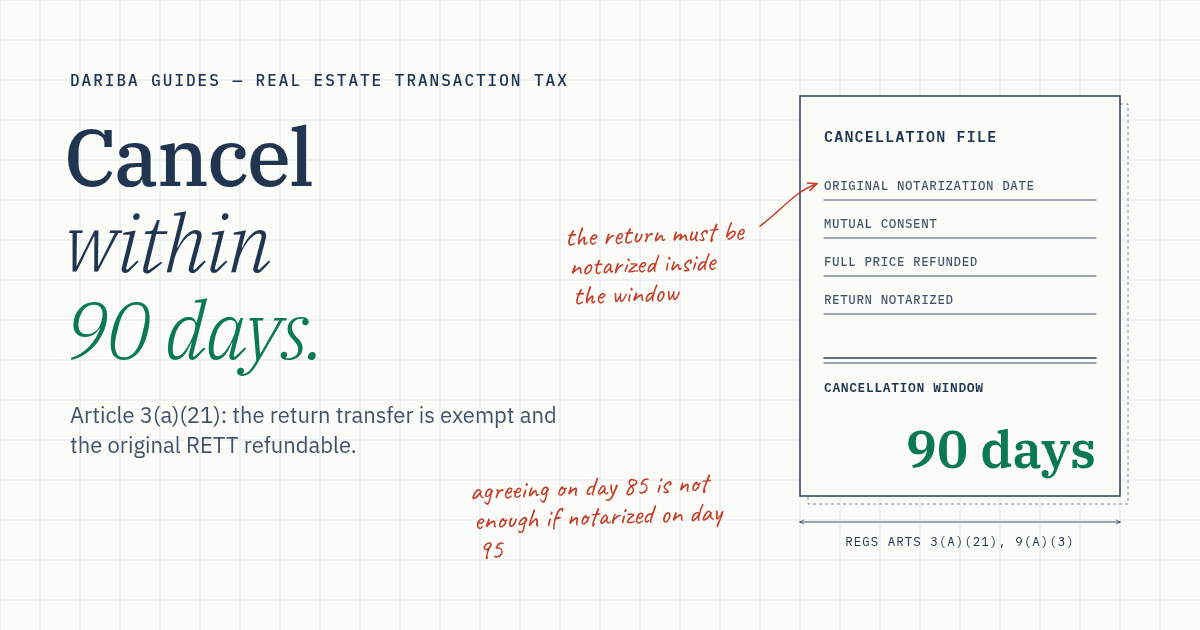
RETT Regulations Article 3(a)(21) separately addresses a qualifying consensual cancellation within 90 days, with its own unchanged-description and full-value-return conditions. Article 9(a)(3) supplies the associated refund conditions, including the required return notarization. See the 90-day cancellation guide and refund guide.
A return after 120 elapsed days could satisfy the ownership fee’s time limb while failing the RETT cancellation route’s 90-day limb. That comparison assumes the remaining relevant conditions; it does not itself establish the fee outcome, another RETT relief or a right to repayment.
Do not turn a zero-fee return into an automatic refund of the original disposal’s fee. Establish the actual disposal being reviewed and the applicable administrative basis separately.
A court order: identify the RETT route too
The ownership fee’s Article 10(3) refers to a final judgment or a competent judicial authority’s order.
RETT Regulations Article 3(a)(15) instead has a particular court-ordered forced-sale exemption in liquidation and administrative liquidation under the Bankruptcy Law and its Regulations. A judicial order alone does not satisfy every condition of that exemption. Other RETT outcomes require their own ground. See the court-ordered transfers guide.
Partition: check actual rights, deeds and consideration
The fee condition in Article 10(7) is not a substitute for RETT Regulations Article 2(k). The latter excludes a qualifying partition from the real estate transaction definition and requires the prescribed deed, reflection of the rights under the original single deed, and no consideration due between the owners.
Equal area alone may not establish reflected rights. A balancing payment also needs analysis; it does not automatically become the only taxable base. See the partition guide.
A transfer to a wholly owned vehicle: keep the conditions separate
The fee’s Article 10(9) specifies the natural person, Saudi-established transferee and complete direct or indirect ownership. It does not itself state the five-year percentage condition found in RETT Regulations Article 3(a)(17).
For RETT, apply that condition and any actual permitted changes under Article 3(c). Neither import it into the fee paragraph as if expressly written there, nor remove it from RETT because the fee paragraph lacks it. See the individual-to-wholly-owned-vehicle guide.
Development: a unit sale differs from a land transfer to a developer
Fee Article 10(10) concerns the specified developed-unit sale and its licence-related completion and sale periods.
RETT Regulations Article 3(a)(19) concerns a qualifying transfer to a licensed off-plan developer for the specified project, with its own developer/project licence and tax-or-guarantee requirements where applicable. It does not exempt every later unit sale because the developer met the ownership fee’s conditions. See the developer-transfer guide.
Dariba calculations: conditional totals
Example 1 — both charges apply. Assume a relevant non-Saudi disposal in Riyadh, no applicable relief, and independently proper SAR 5 million bases for both charges:
| Charge | Calculation | Amount |
|---|---|---|
| RETT | SAR 5 million × 5% | SAR 250,000 |
| Ownership-law disposal fee | SAR 5 million × 2% | SAR 100,000 |
| Total of these two assumed charges | SAR 250,000 + SAR 100,000 | SAR 350,000 |
This is a conditional total, not a universal 7% tax rate or a finding that both valuation bases always coincide. Other lawful costs are outside this illustration.
Example 2 — the fee is zero, RETT remains chargeable. Assume a relevant disposal outside the Article 9 fee schedule, an independently proper RETT base of SAR 2 million and no applicable RETT relief. The otherwise illustrative 2% amount would be SAR 40,000, but Article 10(1) makes this fee zero. RETT at 5% remains SAR 100,000 on the stated assumptions.
The examples are Dariba’s calculations, not official worked examples or rulings. Check the proper value and transaction in each regime before combining amounts.
Dates, registration and the transaction file
REGA announced commencement of the updated ownership system on 22 January 2026. The Regulations were approved by Council of Ministers Resolution No. 43 dated 8 Muharram 1448 AH / 23 June 2026, and gazetted on 3 July 2026.
Ownership Law Article 13(1) states that the Regulations operate from the Law’s entry into force. Publication date alone therefore does not settle a historical disposal’s fee treatment. Establish the relevant instruments, transaction date and official treatment before drawing a retrospective charge or refund conclusion.
Ownership Regulations Article 6 requires the prescribed portal process and electronic financial dealings, with completion through the Real Estate Registry. That process is separate from the applicable RETT registration, payment and relief procedures. A submitted application is not itself completed title or proof that both charges have been discharged.
Keep one transaction file containing the disposer and legal-capacity evidence, property/right and location, actual dates, governing value for each charge, the specific zero-fee or RETT relief analysis, licences or court documents where relevant, payments and final registry evidence. Record separate conclusions for ownership permission, the REGA fee and RETT.
Key takeaways
- The ownership Law provides a separate REGA-collected disposal fee; the prescribed 2% rate differs from its 5% statutory ceiling.
- Article 9 lists Riyadh city, Makkah city, Madinah city and Jeddah Governorate; establish the actual non-Saudi disposer.
- Article 10 provides ten zero-fee cases. None independently establishes relief from RETT.
- The 180-day fee return condition differs from RETT’s 90-day cancellation route.
- Wholly owned vehicle and developer cases have distinct fee and RETT conditions.
- A conditional combined calculation is not a universal 7% tax rate or proof that both bases coincide.
Frequently asked questions
Is the 2% fee a higher RETT rate for foreign buyers?
No. It is a separate REGA-collected ownership-law disposal fee concerning the relevant non-Saudi disposer. RETT has its own scope, base, standard 5% rate and relief conditions. A foreign buyer alone is not the fee test.
Does a zero REGA fee mean no RETT is due?
No. Assess the particular RETT charging and relief provisions independently. For example, disposal outside the ownership fee schedule can have a zero fee while a taxable property transfer still bears RETT.
Can the ownership fee’s 180-day return period replace RETT’s 90-day cancellation condition?
No. The provisions concern different charges and have their own conditions. A return within 180 days does not extend RETT’s specified 90-day cancellation route or automatically establish a refund.
Does every non-Saudi developer unit sale qualify for a zero fee?
No. Article 10(10) requires the specified land acquisition and unit development, completion within the development licence period and sale no later than one year from licence expiry. RETT on that sale still needs separate analysis.
Sources
- Umm Al-Qura — Law of Real Estate Ownership by Non-Saudis, Royal Decree No. M/14 (Arabic)
- Umm Al-Qura — Implementing Regulations for the Law of Real Estate Ownership by Non-Saudis (Arabic)
- Umm Al-Qura — Council of Ministers Resolution No. 43, 8 Muharram 1448 AH (Arabic)
- ZATCA — Real Estate Transaction Tax Law (Arabic PDF)
- ZATCA — RETT Implementing Regulations (Arabic PDF)
- REGA — Ownership system commencement announcement, 22 January 2026
Reviewed against the Saudi ownership Law, its gazetted Implementing Regulations and the separate RETT framework on 21 November 2026. Arabic legislation controls. Dariba is an independent information platform. Actual legal status, property rights, values, dates and relief conditions require transaction-specific verification.