In brief
Equity consideration does not prevent a property transfer from falling within RETT. Match the actual transaction to the specific capital contribution, sole-owner, group or M&A rule, including its own dates and continuing conditions.
A property contribution in return for equity can fall within RETT even though no cash changes hands. A restructuring label, family connection or unchanged economic group is not enough to determine the result. Establish the actual property rights transferred, then match the arrangement to the precise relief.
The Default Rule: Identify the actual property transfer
A direct transfer of land or buildings to a company in return for shares must be distinguished from a mere change of legal form or an issue of new company interests. The creation of a new entity is relevant evidence, but does not replace analysis of who held the property rights before and after the arrangement.
For an actual taxable property contribution with no relief, apply the appropriate valuation rule. Dariba illustrations, assuming the stated figures are the proper taxable values: SAR 20 million × 5% = SAR 1 million, and SAR 50 million × 5% = SAR 2.5 million.
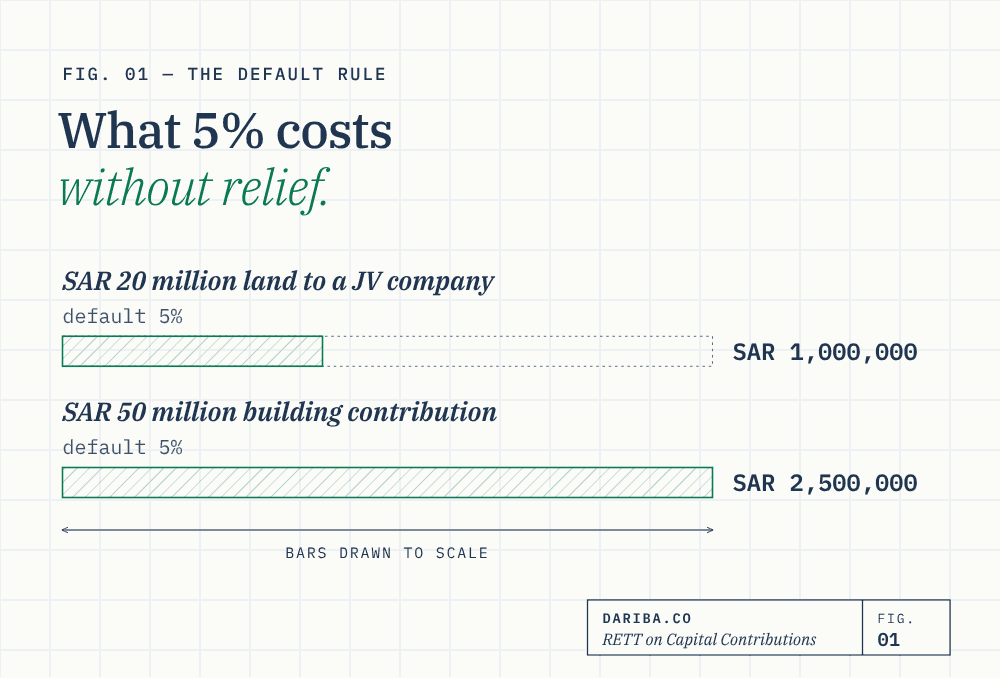
These are gross tax illustrations, not a finding that every transfer to a joint venture or newly formed company is ultimately taxable. Consider all applicable exclusions and exemptions before treating the figure as a cost.
The Available Exemptions: Different routes and conditions
Article 3(a) of the Implementing Regulations for the Real Estate Transaction Tax Law, issued by the Zakat, Tax and Customs Authority (ZATCA), contains distinct routes.
| Route | Core conditions to check | Relevant period |
|---|---|---|
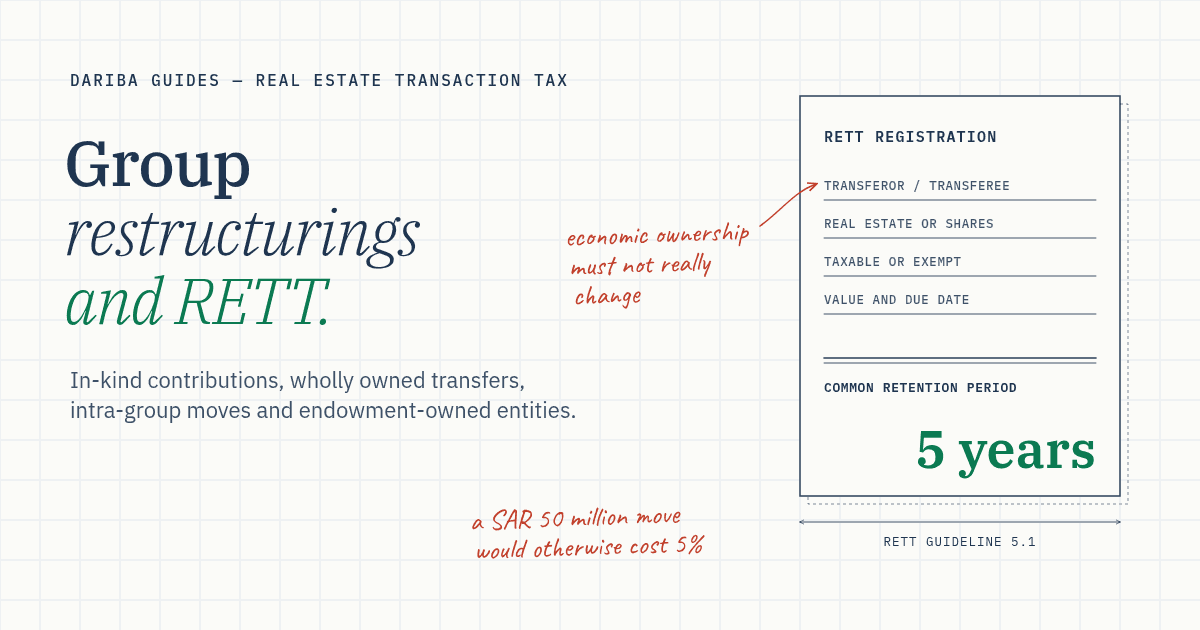
| In-kind contribution, 3(a)(11) | A person contributes property to the capital of a Saudi-established company; retain the shares or interests corresponding to that contribution; the company maintains statements audited by an accredited external auditor throughout the period. | At least five years from ownership of the contribution shares or interests. |
| Natural person to sole-owned company or fund, 3(a)(17) | Saudi-established recipient; that natural person alone owns all company interests or fund units, directly or indirectly; the person’s ownership percentage does not change. | At least five years from the property disposal. |
| Qualifying group transfer, 3(a)(18) | The relevant Saudi-established companies or funds satisfy the applicable complete-ownership limb; all interests of the recipient remain directly or indirectly owned by the same person. | At least five years from the property disposal. |
| Merger or acquisition, 3(a)(16) | Meet the separately defined transaction and its specific consideration, continuity, ownership and other conditions. | Apply that limb’s actual starting date and requirements. |
The Arabic group provision uses the same person. It does not automatically permit any two companies to qualify merely because the same several shareholders own them in matching proportions. Likewise, an entity being described as an “80% subsidiary” does not establish every direct or indirect complete-ownership fact. Test the relevant chain and each available limb.
A transfer to a cousin’s company is not automatically exempt because of kinship, nor does that description prove no relief could ever apply. A genuine qualifying contribution may, for example, require analysis under Article 3(a)(11). See the fuller restructuring exemptions guide and M&A exemption guide.
A capital increase is a separate scope question
Article 2(j) addresses acquiring new interests in a real estate company through a capital increase. Its first case covers existing partners acquiring the new interests without changing their ownership percentages. Its second covers new partners acquiring newly issued interests while the existing partners retain their pre-increase interests without disposing of them for five years from the increase.
ZATCA’s Detailed Guideline for the Real Estate Transaction Tax, Version 6, section 3.2 and Example 3, printed pages 12–13, discusses those cases. The English narrative includes a confusing “not exceeding five years” phrase; the operative Arabic provision requires retention for five years. Do not use the shorter English phrase to justify early disposal.
This interest-issue treatment does not automatically exclude an actual transfer of land into the company. If a landowner contributes property in return for newly issued equity, separately test the property transfer and the Article 3(a)(11) conditions.
Worked Example: Land contributed to a joint venture
Dariba example. Nasser contributes land with an assumed proper taxable value of SAR 30 million to a Saudi-established LLC. A developer contributes SAR 30 million cash. Assume those contributions support 50% equity for each party.
Without an applicable exemption, the property contribution’s gross RETT is SAR 1.5 million. Equal cash and land contributions do not themselves exempt it. Article 3(a)(11) may apply if the actual legal capital contribution qualifies, Nasser retains the corresponding interests for at least five years from ownership of those interests, and the company maintains the prescribed audited accounts throughout.
Do not substitute the property contribution date for the equity-ownership date without checking whether they coincide. The auditor condition remains a continuing requirement; retaining shares alone is insufficient.
If Nasser proposes a sale in year three, first check whether it is a disqualifying disposal or falls within a permitted change. Article 3(c) addresses specified changes in relation to the non-disposal condition for shares or interests. It is not a waiver of every continuing condition or a general immunity for the property’s onward sale.
If a condition is breached: correction and payment differ
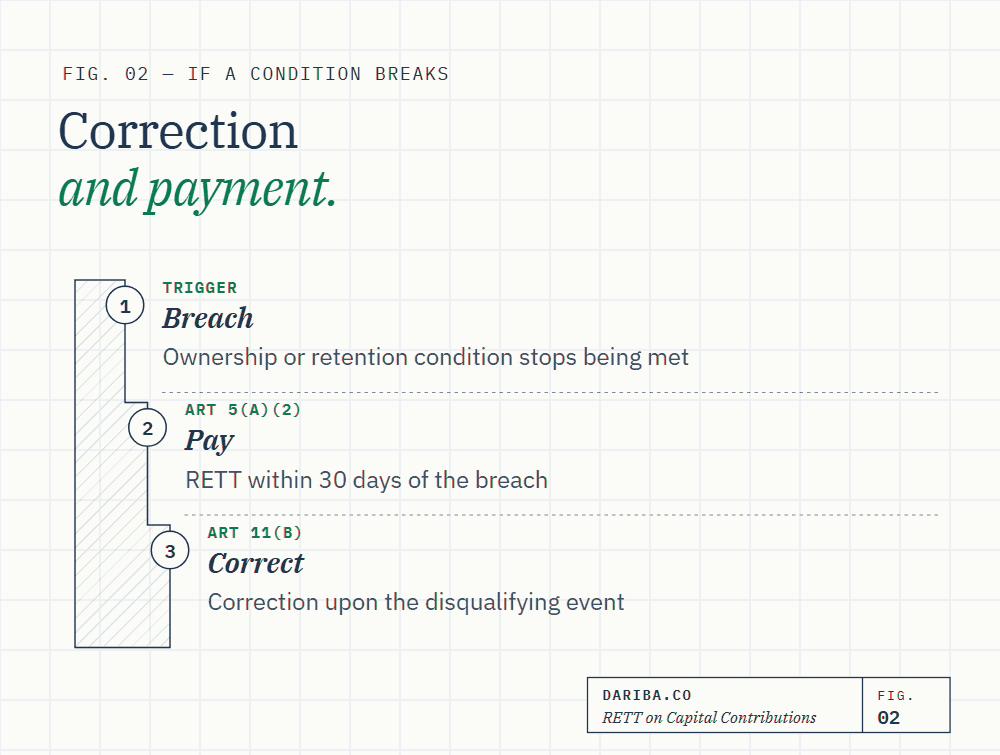
Under Article 11(b), correction of incorrect registered data within 30 days of awareness is distinct from correction upon the occurrence of an event that breaches exemption criteria or conditions. The latter must not be presented as a general 30-day filing grace period.
Under Article 5(a)(2), tax on an exempt disposal that becomes taxable through such a breach must be paid within 30 days of the breach. This payment rule does not postpone the correction obligation.
Assuming Nasser’s original exempt contribution was properly valued at SAR 30 million and a later event actually disqualifies it, the original contribution’s resulting tax is SAR 1.5 million, rather than 5% of whatever the shares fetch on the later sale. Any later share transaction also needs its own scope and exemption analysis.
Meeting the payment deadline matters, but does not guarantee the entire arrangement’s cost is “tax alone.” Disclosure failures, inaccurate values, other transactions and independently applicable penalties require separate consideration. Use the continuing conditions guide and penalty guide for the relevant rules.
Before completion, record the transferor, recipient, ownership chain, legal contribution, taxable value, chosen relief, equity acquisition and property-transfer dates, auditor evidence and proposed future changes. A five-year calendar is useful only when it tracks the right condition from the right date.
Key takeaways
- A direct property contribution differs from acquiring newly issued interests under Article 2(j).
- Article 3(a)(11) requires a Saudi-established recipient company, retention of contribution shares for at least five years from their ownership, and audited accounts throughout.
- Sole-owner and qualifying group rules have different ownership tests and five-year requirements.
- The Arabic group provision refers to the same person; a shared collection of shareholders is not automatically sufficient.
- A disqualifying event requires correction upon the event under Article 11(b); the Article 5(a)(2) payment period is a separate 30-day rule.
- Test permitted changes under Article 3(c) against its specified non-disposal condition rather than assuming all requirements are waived.
Frequently asked questions
Does incorporating a sole business always create a RETT charge?
Establish whether the actual ownership rights move between persons. A new registration or legal-form description alone is insufficient. If property is transferred, test the relevant sole-owner, contribution or other relief.
Does an 80% subsidiary make group relief impossible?
An 80% parent holding does not meet a limb requiring that parent to own all shares. But examine every actual limb, including whether the same person owns all interests directly or indirectly in both entities. The percentage label alone does not decide every possible arrangement or exemption.
Can we wait 30 days before correcting a breached exemption?
Do not assume that. Article 11(b) distinguishes correction within 30 days of awareness of incorrect registered data from correction upon the occurrence of a breach of exemption criteria or conditions. Article 5(a)(2) separately addresses payment within 30 days of the breach.
Sources
Grounded in the RETT Law (Royal Decree No. M/84, effective 10 April 2025), Implementing Regulations (ZATCA Board Resolution No. 01-03-25, 24 March 2025), and ZATCA's Detailed Guideline Version 6 (May 2026). For informational purposes only. dariba.co is an independent knowledge platform.