In brief
Identify the actual statutory real-estate transaction before testing exclusions and exemptions. A gift, will, share transfer or financing movement is not automatically a payable 5% event merely because it appears on a list of possible transactions.
A useful RETT review answers several questions in order: what rights move, whether the statutory transaction is within scope, what relief applies, how it is valued, who is responsible and when payment is due. Combining those questions into a list of taxable labels produces avoidable errors.
Start with the rights, not the transaction’s name
Article 1 of the Real Estate Transaction Tax Law includes direct or indirect transfers of real-estate ownership, permanent transfers of benefit, and transfers of benefit exceeding 50 years. Identify the actual legal rights in Saudi real estate.
Regulations Article 4(a) addresses taxable possession-for-ownership cases and their date. It should not be rewritten as a rule that every physical possession change independently creates a charge. Nor does every lease or temporary use transfer meet the Law’s benefit-duration limb.
Sales, gifts, exchanges, wills, financing and company-interest arrangements can involve relevant transactions. Their appearance in ZATCA’s introductory examples does not mean every instance produces a payable charge.
Scope and relief use different routes
| Arrangement | What needs to be established |
|---|---|
| Direct property sale or exchange | Actual ownership transfer, value, taxpayer, dates and exemptions |
| Gift or estate transaction | Actual legal effect and the appropriate gift, division or documented-will route |
| Company or fund interests | Entity definition, holding/disposal rules, related series and relief |
| Long usufruct | Actual right and duration, special valuation/timing and any exemption |
| Linked financing | Actual Article 2(l) conditions; separate financing-term-cost and security questions |
| Subdivision or co-owner partition | Applicable competent procedure and full Article 2(k) conditions |
Listed-security transactions use the relevant exemption, rather than being universally described as outside scope. State first-home support is likewise distinct: it bears eligible tax rather than turning every supported purchase into a statutory exemption.
Dariba exchange illustration
Assume Khalid transfers a Riyadh plot with a proper taxable value of SAR 8 million. Faisal transfers a Jeddah villa valued at SAR 6.5 million and pays SAR 1.5 million to balance the exchange. Assume each property disposal is taxable and no relief applies.
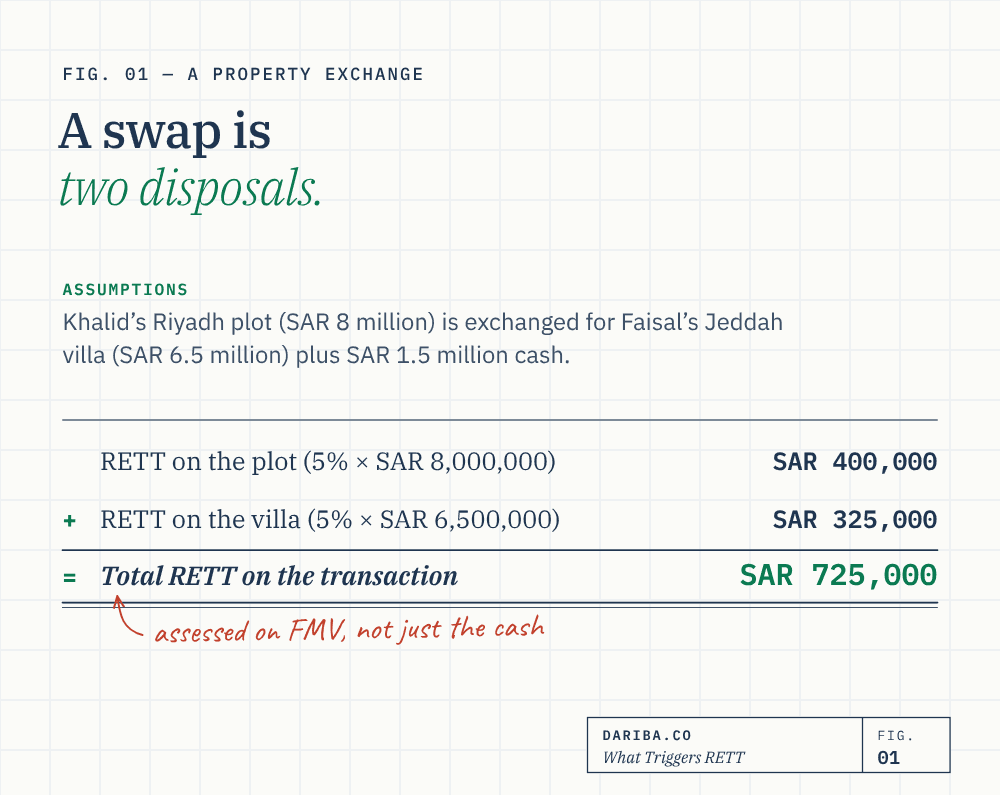
Khalid’s property disposal produces SAR 400,000 at 5%; Faisal’s produces SAR 325,000. Total tax is SAR 725,000 on those stated facts. Identify each transferor separately and avoid adding the balancing cash again to an already correctly valued property base.
These are Dariba’s assumed facts, not a guarantee that every exchange has the same payment date or no available exemption.
Company interests: separate definition from disposal
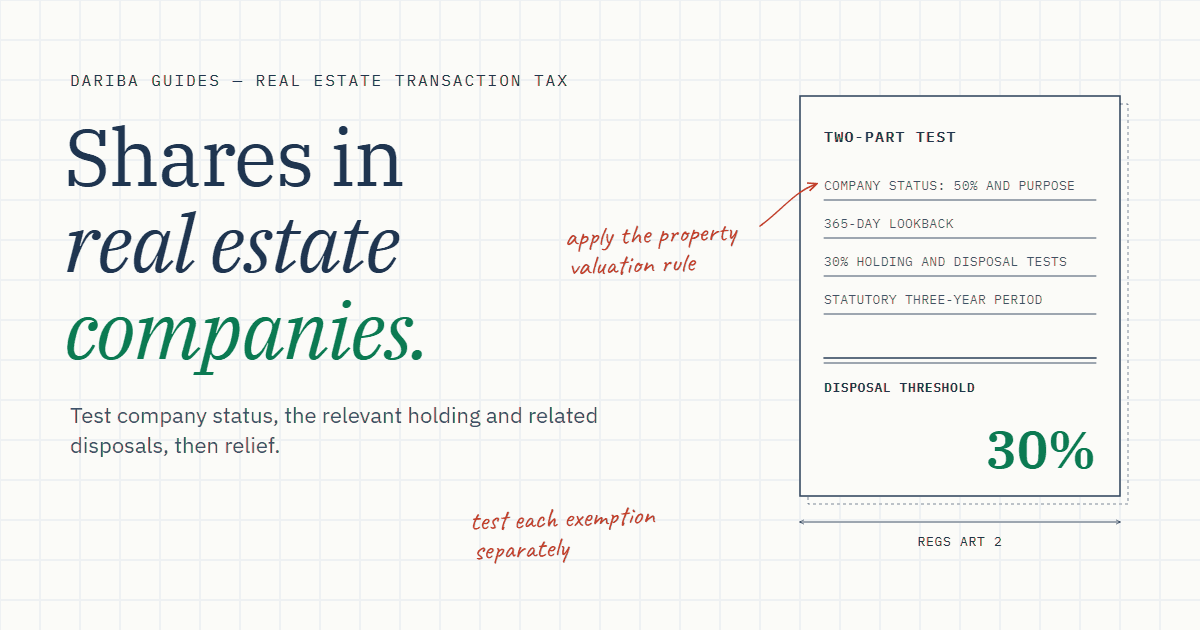
Regulations Article 2(h) concerns direct or indirect Saudi property held for the prescribed revenue-generating purpose and the 50% fair-market-value asset test, including the relevant 365-day history.
Article 2(i)‘s holding and disposal conditions, related transactions and concerted parties are additional enquiries. The related-person concerted-party presumption is rebuttable. Do not reduce the analysis to property percentage plus a single share transfer, or assume that a later threshold date overrides an earlier operative unconditional agreement.
The company-definition guide and share-disposal guide explain those distinctions. Capital increases have their own Article 2(j) conditions; they are not a universal exception whenever percentages appear unchanged.
Wills, financing and property components
A transaction implementing a documented lawful will can qualify under Article 3(a)(8), including where the actual beneficiary is not an heir. Estate division is a separate route. Neither unilateral form nor absence of cash alone decides the result.
For a standard initial seller-to-bank financed purchase, the seller is the transferor. Article 2(l)‘s later-transfer treatment has actual first-transfer tax and contract conditions. Licensed financing’s term-cost exclusion and temporary security relief are distinct; see the financing guide.
The property base may include owner-placed movable items permanently allocated to serve the property even if not attached, and closely connected rights. It does not automatically include every business asset merely sold with a building.
Dates and actual enforcement powers
Fix the relevant transaction date and payment provision separately. The grant, actual ownership transfer, earlier unconditional agreement and notarization rules are not interchangeable. Informal documentation does not itself establish a new 30-day period after every later formal step.
Law Article 6 and Regulations Article 6 address fictitious or concealed arrangements and the actual rights. They do not make every lawful planning choice evasion. Assessment and collection also have distinct disclosed, undisclosed, continuing-condition and transitional clocks; they do not all start from ZATCA’s knowledge.
Use the valuation guide, liability guide and payment-deadline guide to complete the transaction analysis.
Key takeaways
- Law Article 1 distinguishes ownership, permanent benefit and benefit exceeding 50 years; not every use or possession change is identical.
- Company definition, holding, disposal and related-transaction tests are separate enquiries.
- Documented lawful wills have their own exemption, including an actual qualifying non-heir bequest.
- Listed-security relief is an exemption; qualifying partition and conditional financing treatment use different mechanisms.
- State first-home support pays eligible tax rather than creating a universal outside-scope transaction.
- Valuation, taxpayer, transaction date, payment date and assessment clocks must be established separately.
Frequently asked questions
Does every property-related movement trigger a payable RETT charge?
No. Establish the actual rights and statutory scope, then any exclusion, exemption, taxed-once treatment and support. A property connection, an informal document or a payment alone is not the complete test.
Does 50% property value automatically make every share disposal taxable?
No. Establish the revenue-purpose and direct/indirect Saudi property/FMVs/history definition, the relevant holding and disposal tests, related transactions and concerted-party rules, dates and relief. The company definition alone is not the charge.
Is a documented will to a non-heir automatically taxable?
No. Article 3(a)(8) has a separate documented-lawful-will exemption. Establish legal validity and actual implementation rather than treat non-heir status or a unilateral transaction as automatic tax.
Is the bank the transferor on its initial financed purchase?
In an ordinary seller-to-bank purchase the seller is the transferor. Law Article 7's statutory responsibility is separate from the bank or customer funding payment. The later linked financing transfer needs Article 2(l)'s actual conditions.
Does a failed partition or group exemption prescribe the tax automatically?
No. Establish the actual transfers, value and any other relief. Article 2(k)'s failed conditions do not themselves prescribe a cash-top-up-only base, and group relief uses the actual same-person and other conditions rather than an unrestricted same-persons label.
Sources
- ZATCA — Real Estate Transaction Tax Law (Arabic)Articles 1–3, 5–9 and 14 as relevant
- ZATCA — RETT Implementing Regulations (Arabic)Articles 1–5, 7–9 and 11
- ZATCA — Detailed RETT Guideline, Version 6, May 2026Sections 1.3, 3.4, 4.1–4.5 and 6; Examples 1 and 7–9
Reviewed against the controlling Arabic RETT Law and Implementing Regulations and ZATCA's Detailed RETT Guideline Version 6 (May 2026). Dariba illustrations assume stated rights, values and eligibility. Actual scope, exemption and historical-period requirements need their own evidence. General information; Dariba.co is independent of ZATCA.