In brief
The treaty distinguishes fixed places, six-month project/service conditions, agency, insurance and independent professionals. Current MLI choices qualify the activity exemptions without importing reserved PE rules.
A Saudi engagement by an Austrian enterprise needs the actual permanent-establishment and income provisions, rather than one universal six-month safe harbour. A short visit may still involve a fixed place, contracting authority or an insurance enterprise; an individual’s independent work has a separate article.
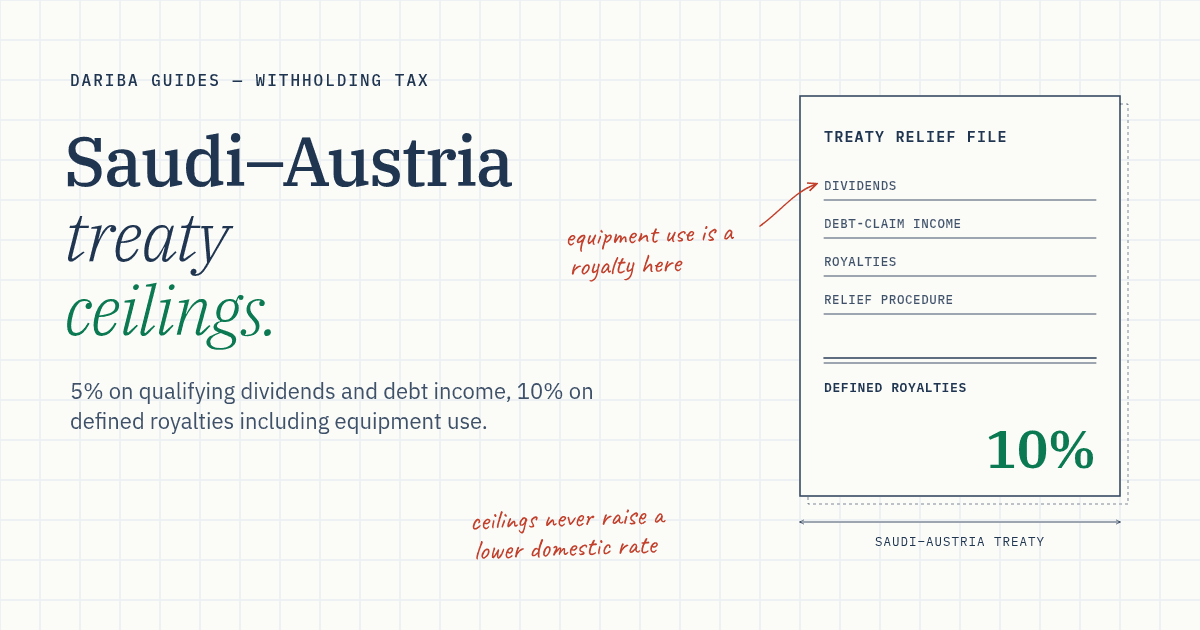
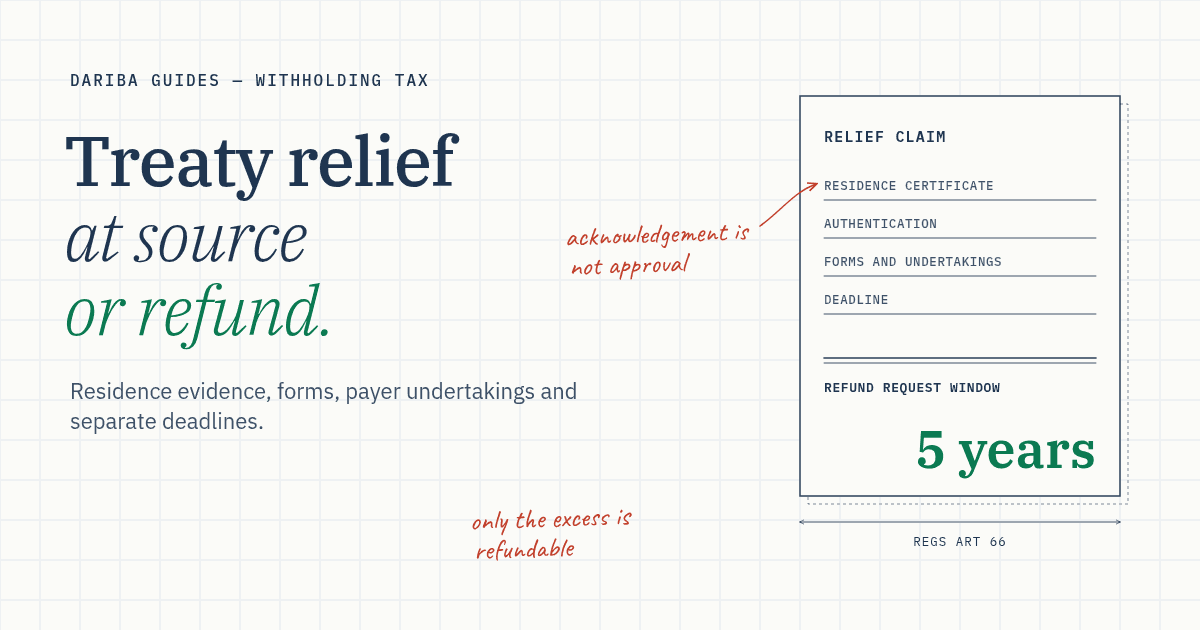
This guide explains selected treaty Articles 5, 7 and 14, with the relevant matched MLI limits. The withholding guide addresses dividends, debt income, royalties and the relief procedure. Treaty taxing permission and an actual domestic charge remain distinct.
Start with a fixed place and the actual enterprise
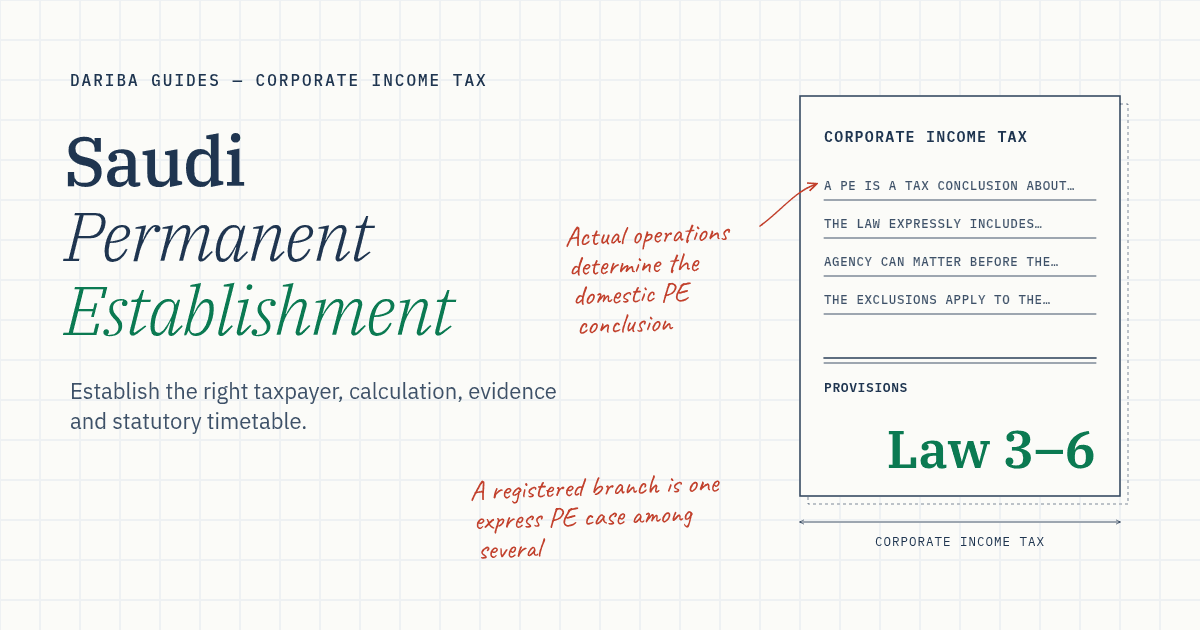
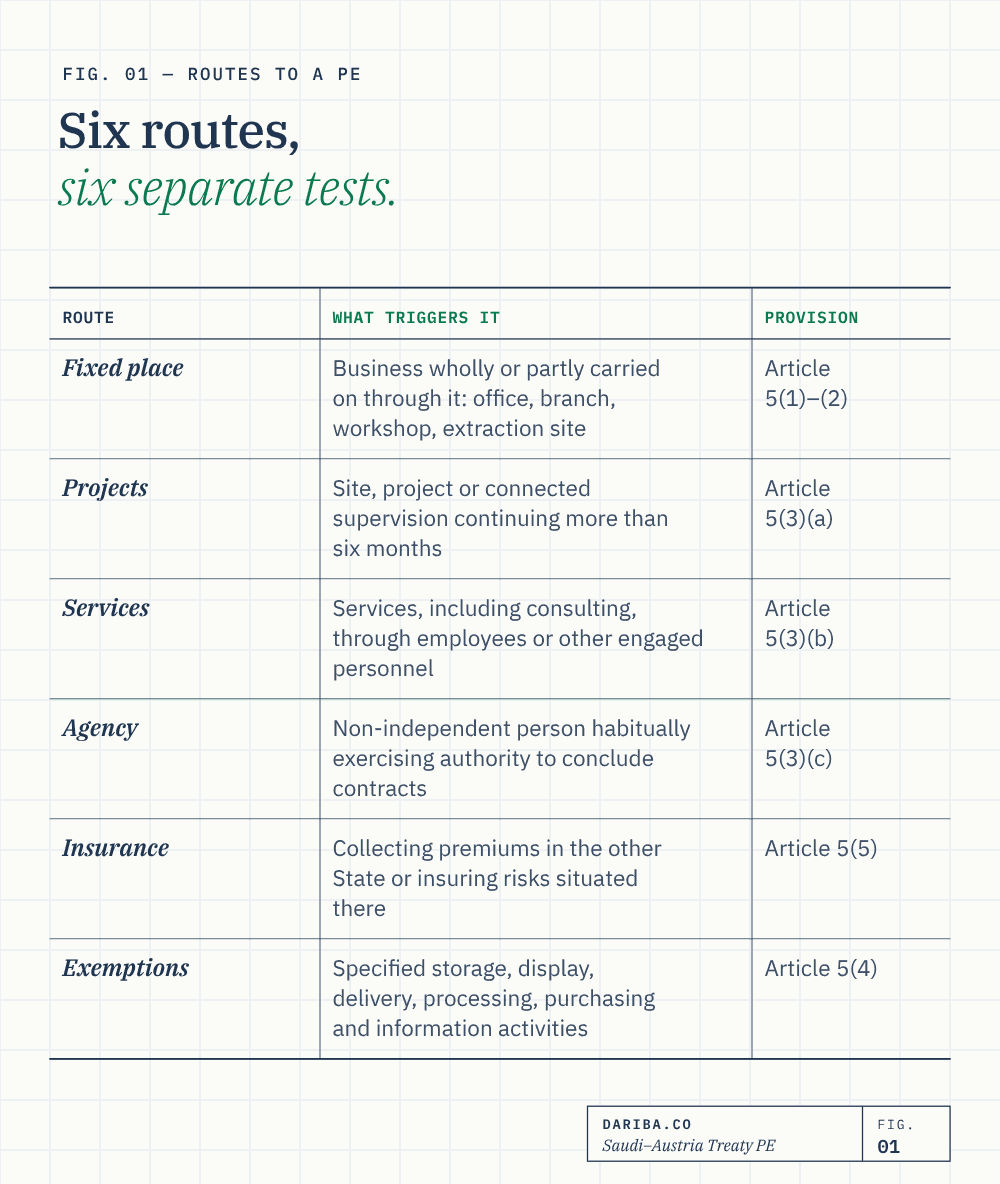
Article 5(1)–(2) addresses a fixed place through which an enterprise’s business is wholly or partly carried on, with examples including management, branch, office, factory, workshop and extraction sites. The project and service durations in paragraph (3) do not erase those separate routes.
Dariba recommendation: identify the enterprise, premises, personnel, functions, contractual authority, project periods and actual activities. Group control alone is not a permanent establishment under Article 5(8), but that does not prevent another paragraph from applying on the actual facts.
Source: Articles 4–5, pp. 5–8.
Distinguish the project and service duration tests
Article 5(3)(a) covers the stated building site, construction, assembly/installation project and connected supervisory activities where the site, project or activities continue more than six months.
Paragraph (3)(b) separately covers enterprise services, including consulting, furnished through employees or other engaged personnel. The same or connected project’s relevant in-country activities must aggregate more than six months within any twelve-month period.
Keep the treaty’s aggregation, same/connected-project and in-country conditions. Exactly six months is not more than six months for these selected duration limbs, but does not establish that all other establishment routes fail. Do not replace months with an invented fixed day count or carry the French consolidation’s continuous-service wording into the Austria treaty.
Source: Article 5(3)(a)–(b), p. 7.
Keep agency and insurance routes separate
Article 5(3)(c) addresses the stated non-independent person with authority to conclude contracts in the enterprise’s name who habitually exercises that authority. Article 5(6) gives the independent-agent rule and its wholly/almost-wholly devoted activity condition. A contract label alone does not establish independence.
Article 5(5) separately deems an insurance enterprise to have an establishment where it collects premiums in the other State or insures risks situated there. The selected wording should not be replaced by an invented universal six-month condition or an unstated reinsurance exception. Identify the insurer, risks, premium activity and actual treaty facts.
Austria reserves against MLI Article 12 and Article 14. Do not import a generic principal-contract-conclusion expansion or MLI contract-splitting rule that is not matched for this agreement. This does not endorse artificial arrangements or disapply the actual treaty and anti-abuse provisions.
Sources: Article 5(3)(c), (5)–(6), pp. 7–8; Austria consolidated MLI position, pp. 23 and 25.
Read activity exemptions with the matched MLI option
The original Article 5(4) lists specified storage, display/delivery, processing, purchasing/information and other stated activities. Both relevant positions choose MLI Article 13 Option A, with the identified Article 5(4) notification. For the applicable period, the relevant activity or combined activity must retain the preparatory or auxiliary character required by that matched modification.
Austria reserves against MLI Article 13(4), the separate anti-fragmentation paragraph. Keep the Option A activity qualification distinct from that reserved paragraph. Neither a warehouse label nor the absence of the MLI anti-fragmentation paragraph proves that a substantive sales, service or insurance business is exempt.
Sources: original Article 5(4), p. 7; Austria consolidated MLI position, Option A and Saudi notification, pp. 23–25; Saudi position, Article 13; MLI Article 13.
Attribute profits and separate export and local components
Article 7(1)–(2) addresses profits attributable to the establishment and the independent-enterprise comparison. Paragraph (3) separately addresses the stated merchandise/machinery/equipment exports and services exercised in the first State, while preserving the actual local activities in a mixed contract under Articles 5 and 7.
Dariba analysis: retain contractual components, actual place/functions and supporting attribution. A foreign invoice or one exported component does not exempt every local activity. Article 7(4) includes the stated banking, insurance, inland transportation and service businesses but excludes an individual’s independent personal services.
Paragraph (5) distinguishes actual expense reimbursements from the specified internal royalty, commission, service/management and financing charges, with its banking qualification. Paragraph (6) preserves income governed separately elsewhere in the treaty. Gross service receipts and attributable business profit should not silently become the same tax base.
Source: Article 7, pp. 10–11.
Apply the individual’s separate alternative tests
Article 14(1) has alternative independent-services routes: a regularly available fixed base; presence amounting to or exceeding 183 days in the fiscal year; or the specified resident-payer/establishment-borne remuneration for host-State activity exceeding EUR 125,000 in the fiscal year.
The third route requires its payer/bearer and amount conditions together. Exactly EUR 125,000 does not exceed that limb’s threshold; another route can still apply. Exactly 183 days meets the presence limb. Establish the actual individual’s activity, income attribution, currency evidence and period rather than borrowing the enterprise’s six-month test.
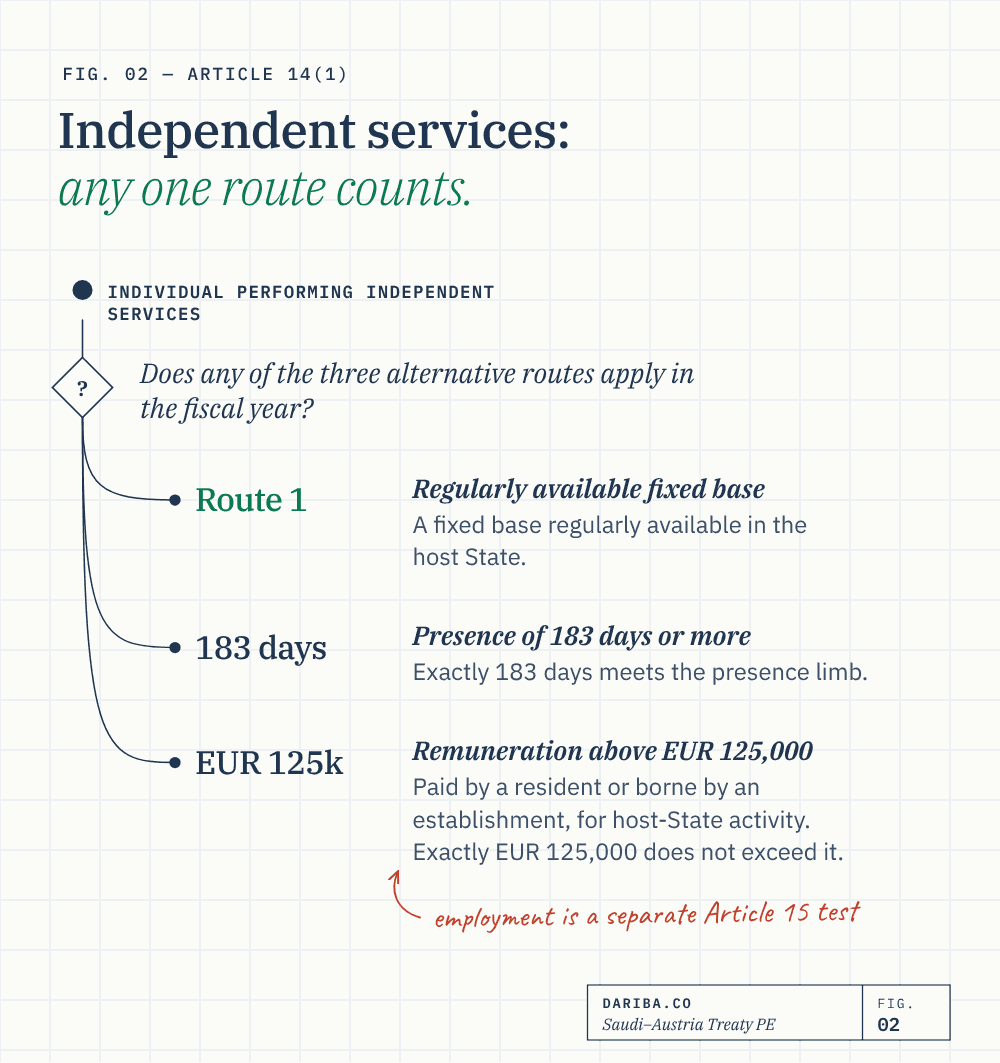
Employment is a separate Article 15 analysis, including its own cumulative conditions. The independent-services amount threshold should not be presented as a general payroll exemption.
Source: Article 14, p. 19, and Article 15, p. 20.
Preserve applicable periods, anti-abuse and evidence
Austria’s 2023 extension of its MLI covered-agreement list is material. The Ministry’s implementation report identifies 1 January 2024 for the stated withholding effects and distinguishes other-tax effect dates by applying State. MLI Articles 29 and 35 require the relevant notification and period analysis. Do not date every Austria treaty modification from the two States’ original MLI entry into force.
Apply the principal-purpose test where effective, retain the actual matched reservations and preserve domestic/treaty classification separately. The inability to download the RIS synthesis during this review is recorded; the authentic treaty, 2023 consolidated position, Saudi position and Ministry report support the selected analysis. Full historical/later-notification reconstruction and actual taxpayer conclusions remain open.
Dariba recommendation: keep project and service schedules, premises and contracting-authority evidence, personnel and insurer/risk information, component and profit-attribution records, applicable text/period and actual claim/decision together. The WHT relief procedure is a separate step when the actual payment falls within withholding.
Sources: Austria consolidated position, extension and Article 35 choice; Ministry implementation report, pp. 3–4; MLI Articles 7, 29 and 35.
Key takeaways
- A duration test does not replace all fixed-place and other establishment routes.
- Projects and same/connected enterprise services have distinct six-month wording.
- Insurance and contracting authority require separate factual review.
- Option A activity qualifications differ from the reserved MLI anti-fragmentation rule.
- An individual has separate fixed-base,183-day and specified EUR 125000 remuneration alternatives.
- Apply the actual MLI notification and State/period effect rules.
Sources
- ZATCA: authentic English Saudi–Austria treatyArticles 1–5, 7, 10–15, 25 and 28; actual text and conditions, including controlling-language provision.
- OECD: Austria consolidated MLI position, August 2023Extended covered-agreement list, reservations and matching notifications; Saudi agreement and relevant Articles 4/7/8/12–16/35.
- OECD: Saudi deposited MLI positionAustria covered agreement and matching choices/reservations; unilateral choices do not establish modification.
- OECD: authentic English MLIArticles 7, 13, 16, 29 and 35: benefit, selected PE, procedure and effect-date framework.
- Austrian Ministry of Finance: MLI implementation reportReport as at 30 September 2025, pp. 3–4: second notification and 1 January 2024 withholding effects; other taxes distinguished by State.
- ZATCA: treaty-withholding implementation circularJanuary 2025, sections 3.2 and 4: actual classifications and relief/refund evidence.
- Saudi Income Tax Implementing Regulations, ArabicArticles 5/63: domestic source, category, exceptions and payment requirements.
- Saudi Income Tax Law, ArabicArticles 5/68: domestic charge and withholding distinct from treaty permission.
- OECD: current MLI signatories and partiesDeposit/force information and current official position links; effect dates separately established.
- Austrian Ministry: current bilateral treaty listSaudi entry: signature 19 March 2006, entry into force 1 June 2007 and original application from 2008. Current official page checked 6 November 2026.
- Austrian legal portal: treaty plus MLI synthesis listingOfficial listing read; direct request returned HTTP 503. Independent download/hash verification of the synthesis is not claimed.
General information from selected official treaty, MLI and Saudi sources reviewed 6 November 2026. Actual recipient, residence, income, activity, period, ownership/benefit and procedure determine the result. Dariba illustrations are original. Full historical instrument chains, individual entitlement, Austrian tax outcomes and independent legal certification are not implied.