In brief
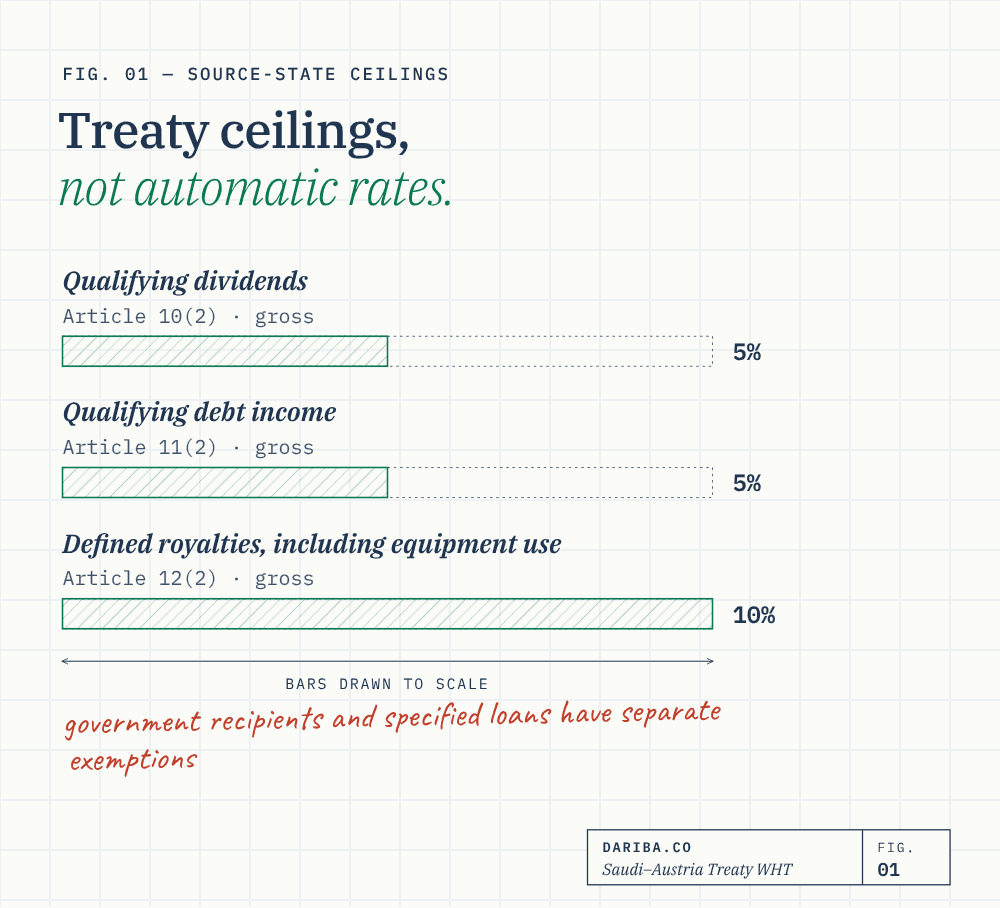
Ordinary gross ceilings are 5% for dividends, 5% for debt income and 10% for royalties, subject to the beneficial-recipient, specific exemption, connection, anti-abuse and procedure conditions.
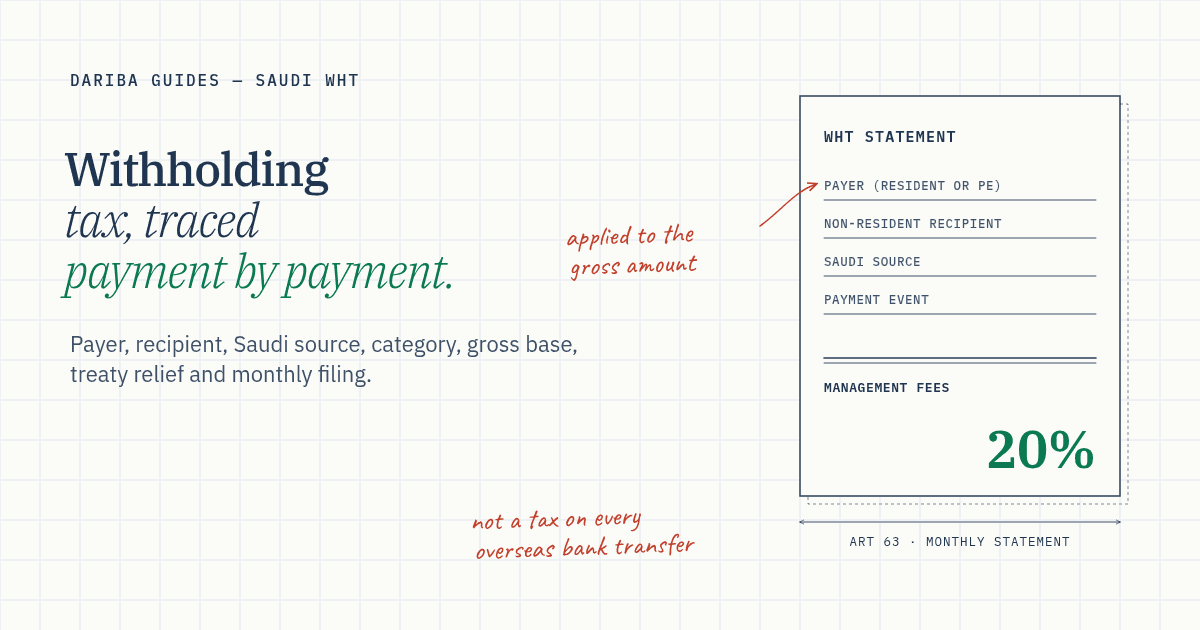
A Saudi payment to an Austrian resident starts with domestic source and classification, followed by the Saudi–Austria treaty’s actual income article. An invoice address, Austrian bank account or treaty-country selection does not establish entitlement to a reduced rate.
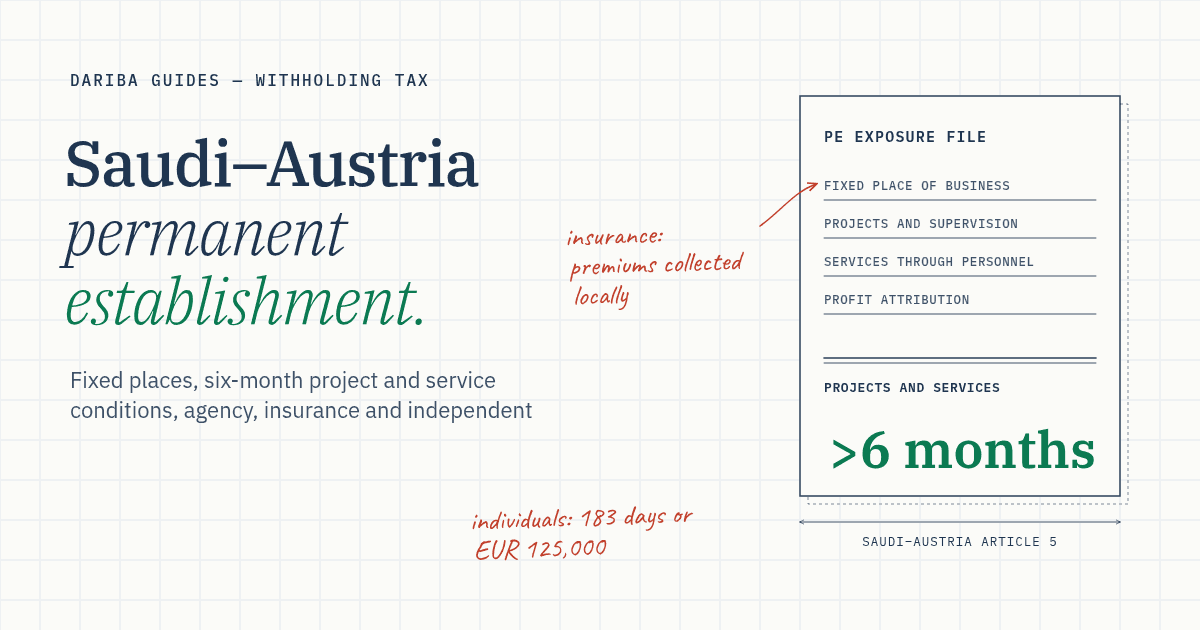
The selected ordinary gross ceilings are 5% for qualifying dividends, 5% for qualifying debt income and 10% for defined royalties, with separate exemptions and exceptions. These are ceilings, not commands to increase a lower applicable domestic rate. The business and permanent-establishment guide explains the separate service and activity analysis.
Establish the resident, covered tax and applicable period
Articles 1–4 govern persons, taxes and residence. Article 4(1) includes its stated State/public bodies and qualifying exempt-purpose entities; it should not be replaced by a blanket assertion that every exempt entity is either excluded or automatically entitled. Identify the actual recipient and applicable definition. Individual dual residence follows Article 4(2); the non-individual effective-management rule in Article 4(3) is not automatically replaced by MLI Article 4 because both relevant positions reserve against that modification.
The Austrian Ministry’s treaty list records signature on 19 March 2006, entry into force on 1 June 2007 and original application from 2008. Treaty Article 28 contains the original tax-specific commencement rules. Later MLI effects require a separate analysis.
Austria added the Saudi agreement in its 28 August 2023 extended covered-agreement list. The Ministry’s implementation report identifies 1 January 2024 for withholding effects for the stated group including Saudi Arabia; other taxes have their own State/period rules. Do not transplant France’s MLI date or equate an MLI signature, deposit, entry into force and entry into effect.
Sources: treaty Articles 1–4 and 28, pp. 2–6 and 28–29; Austria consolidated MLI position, extension and reservations; Ministry implementation report, pp. 3–4; official Austrian treaty list.
Apply the dividend ceiling and government-recipient exemption separately
Under Article 10(2), qualifying dividends paid to a beneficial owner resident in the other State have a 5% gross source-State ceiling. The selected paragraph does not introduce another treaty’s corporate holding percentage or minimum holding period. It does not affect tax on the distributing company’s underlying profits.
Article 10(3) separately exempts dividends paid to the other State’s Government, its local authority, or the stated agency/instrumentality, including a financial institution, wholly owned by that State or local authority. Majority ownership or a public-sector description is not a substitute for the actual condition.
Article 10(5) disapplies paragraphs (1)–(3) where the beneficial owner’s holding is effectively connected with the stated source-State permanent establishment or fixed base, directing the case to Article 7 or 14. Establish the actual recipient, ownership, holding and connection before applying either the ordinary ceiling or exemption.
Source: Article 10, pp. 13–14. MLI Article 8 is reserved against by Austria; no universal additional 365-day holding test is imported here: Austria consolidated position, p. 22.
Test each debt-income exemption against its own facts
Article 11(2) sets a 5% gross ceiling where the recipient is the beneficial owner. Paragraph (3) has distinct exemption routes:
- The payer is the Government of the source State or its local authority.
- The recipient is the other State’s Government/local authority or the stated wholly owned agency or instrumentality, including a financial institution.
- The payment is to the stated other agency or instrumentality in relation to loans made under an agreement between the two Governments.
- The loan is granted, insured or guaranteed by a public institution for export-promotion purposes.
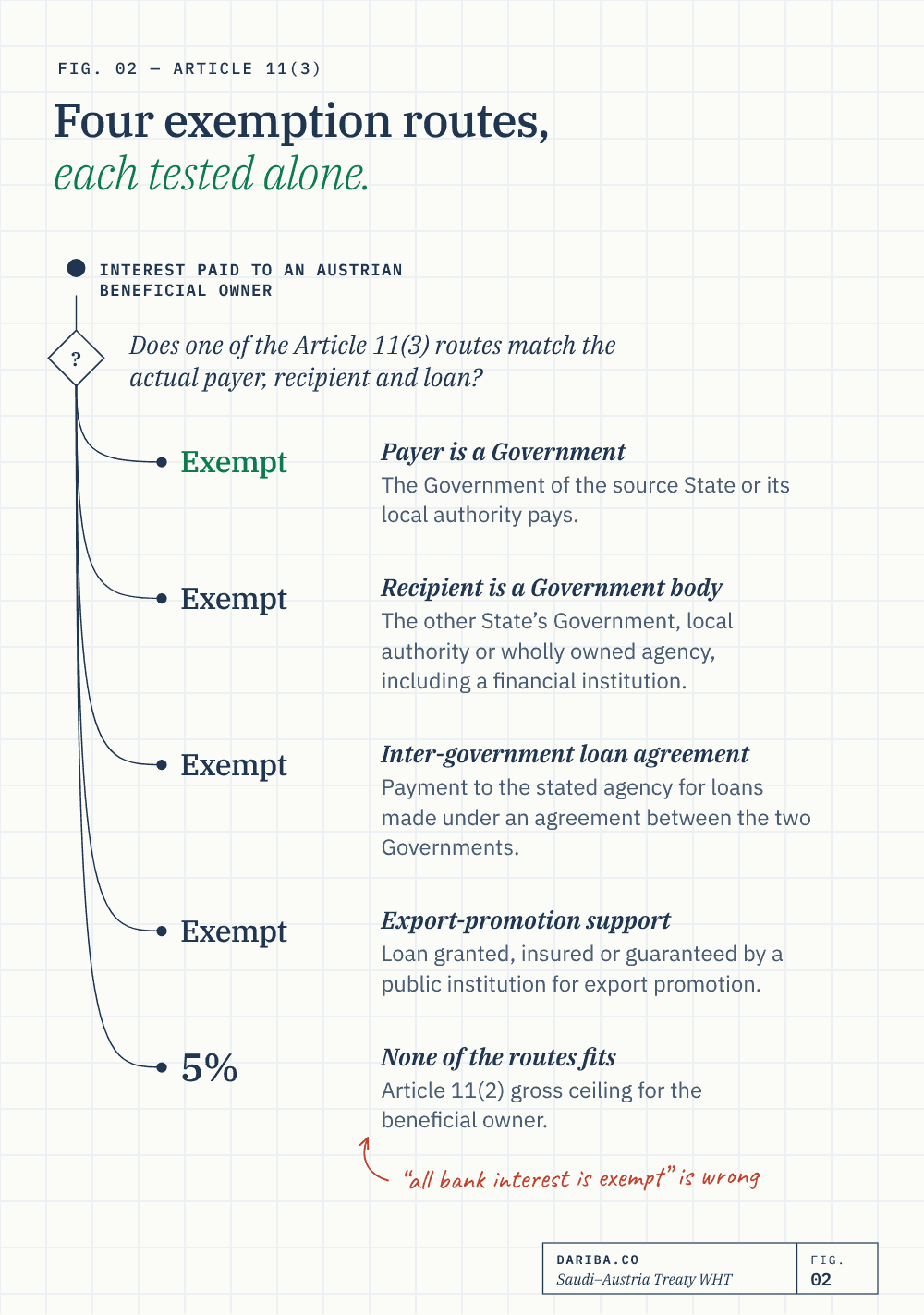
Do not collapse those routes into “all bank interest is exempt”. Keep the actual payer/recipient, ownership, government agreement, loan and public export-financing evidence. Article 11(4) excludes penalty charges for late payment from its debt-income definition; that classification exclusion does not itself establish that the amount is free from every domestic tax.
Article 11(5) addresses effective connection with a permanent establishment or fixed base. Paragraph (6) supplies the treaty source rule, including the specified establishment-borne indebtedness. Paragraph (7) limits the article’s benefit to the arm’s-length amount where a special relationship produces an excess; the excess needs its own applicable-law analysis.
Source: Article 11, pp. 15–16, read with ZATCA’s treaty-withholding circular, debt classification and procedure sections.
Classify royalties, including equipment use, before applying 10%
Article 12(2) sets a 10% gross ceiling for the beneficial recipient. Its paragraph (3) definition includes the stated copyright, patents, trademarks, designs/models/plans, secret formulas/processes, industrial/commercial/scientific experience, and use or right to use industrial, commercial or scientific equipment.
That equipment wording differs from the selected France treaty definition. Establish the actual contract: an equipment lease, full transfer of ownership, financed acquisition, independent technical service, copyright licence and access to hosted software can require different classification. The domestic category and treaty category are separate steps.
Article 12(4) addresses a right/property effectively connected with the stated permanent establishment or fixed base. Paragraphs (5)–(6) retain treaty source and special-relationship/excess conditions. Do not extend the royalty ceiling to an unrelated management or consulting fee merely because the invoice mentions technology.
Source: Article 12, pp. 17–18, read with the actual Saudi categories in Implementing Regulations Article 63, pp. 34–35.
Keep the numerical illustration conditional
The following is Dariba’s original illustration, not an official worked example. Assume a SAR 100,000 gross royalty, an actual Austrian treaty resident and beneficial recipient, a payment within Article 12, no effective-connection exception, supported anti-abuse entitlement, and completion of the applicable relief procedure.
| Assumed computation | Result |
|---|---|
| Domestic royalty category: SAR 100,000 × 15% | SAR 15,000 |
| Conditional treaty ceiling: SAR 100,000 × 10% | SAR 10,000 |
| Arithmetic difference, subject to all stated assumptions | SAR 5,000 |
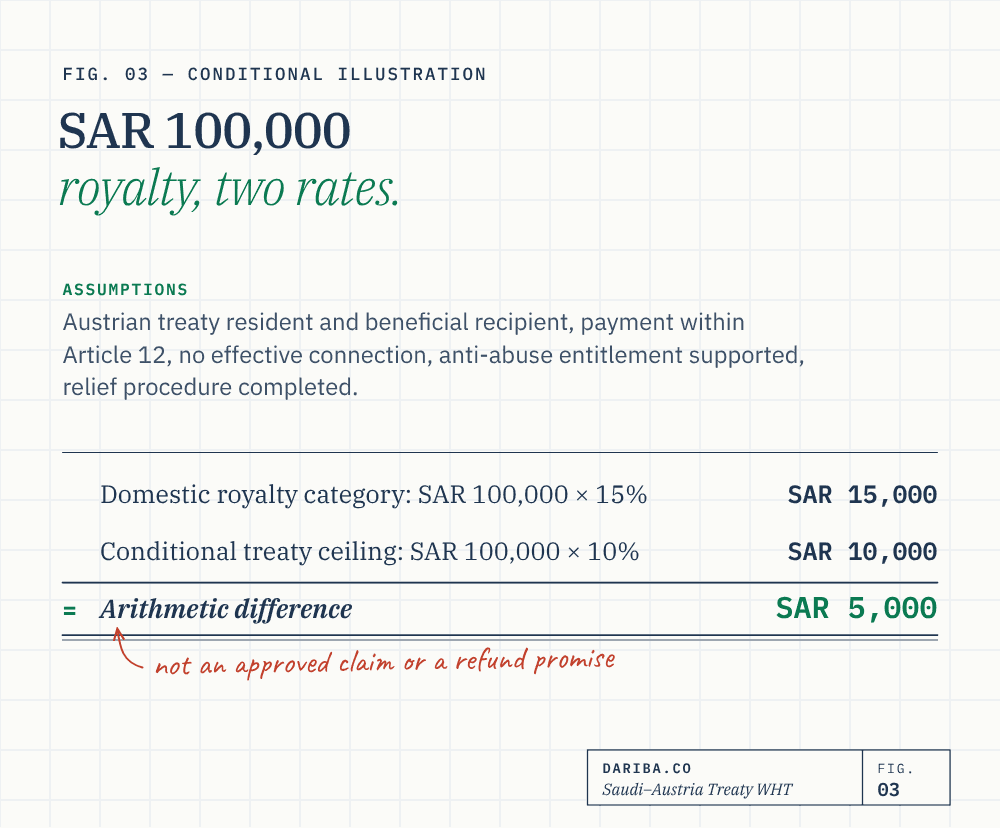
This comparison does not approve a claim, establish beneficial ownership, price a gross-up contract, determine VAT or promise that a refund has been issued. A 10% treaty royalty ceiling also does not increase a genuinely lower applicable domestic category.
Sources: Article 12(2) and current Arabic Regulations Article 63.
Apply anti-abuse and the actual relief procedure
Read the MLI Article 7(1) principal-purpose test with the matched positions and applicable period. A formal residence certificate does not decide the commercial purpose, actual recipient, income character or every treaty condition. The current consolidated Austrian position and Saudi deposited position need to be read together; a unilateral option is not a matched modification.
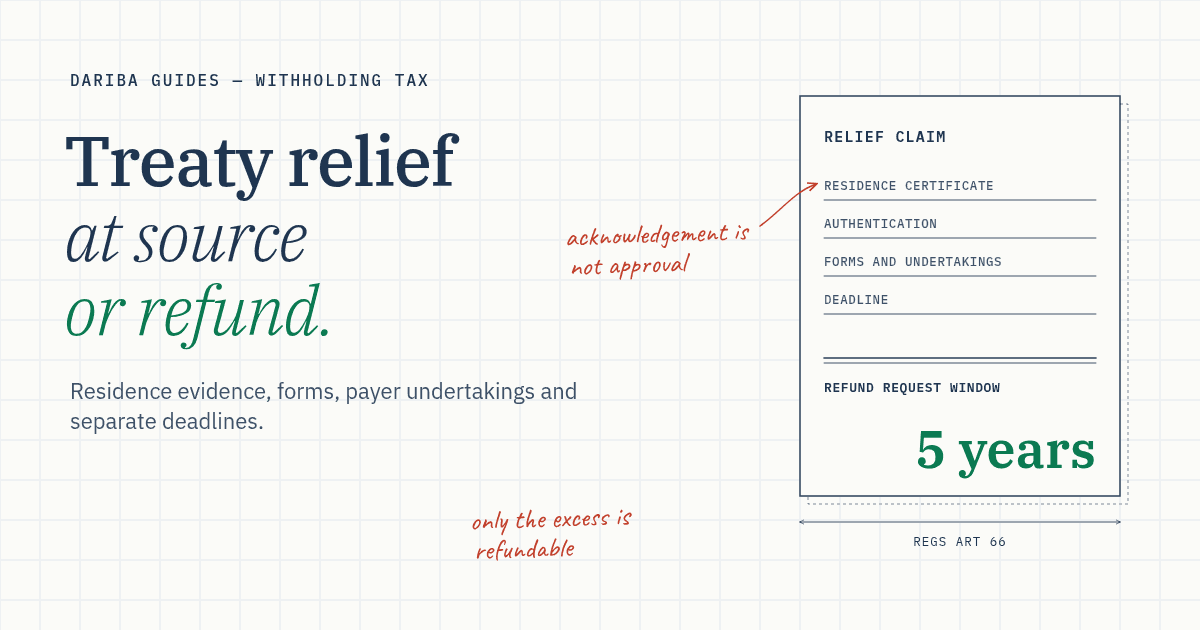
ZATCA’s treaty-withholding circular sections 4.1–4.2 distinguishes supported relief at source from domestic withholding followed by a refund. Retain the actual required forms, residence and authentication/Apostille evidence, undertakings, claim and decision. An application acknowledgement is not approval. Use the relief/refund guide for the detailed process.
Treaty Article 25 gives its MAP route and three-year first-notification period. Austria’s reservation to the first sentence of MLI Article 16(1) means an automatic “either competent authority” promise should not replace the applicable residence-authority route. MAP is separate from domestic filing, objection and refund deadlines; Austria choosing MLI arbitration does not alone establish matched arbitration with Saudi Arabia.
Sources: MLI Articles 7 and 16; Austria consolidated position, Article 16 reservation, p. 26; treaty Article 25, pp. 26–27; ZATCA circular section 4, pp. 15–17.
Retain the payment file and scope limits
Dariba recommendation: retain the actual contract/components, recipient and residence evidence, beneficial-owner analysis where required, domestic source/category, treaty article and applicable period, government/export-loan evidence where relevant, establishment/fixed-base analysis, anti-abuse evidence, claim/approval and remittance/refund records. A treaty ceiling is the end of that analysis, not a replacement for it.
This guide covers selected withholding-payment provisions and their primary exceptions. It does not certify every historical notification, actual taxpayer entitlement, Austrian tax credit or Zakat computation. The Austrian RIS portal lists a synthesized MLI attachment, but direct retrieval was unavailable during this review; it is not represented as independently downloaded or hash-verified. The treaty, current deposited positions and Ministry implementation report are identified separately.
Key takeaways
- Establish the actual treaty resident and income category.
- Ordinary ceilings are 5%,5% and 10%, with separate specified exemptions.
- Government and export-financing routes require their actual conditions.
- Equipment use is included in the stated royalty definition; unrelated services are not automatically royalties.
- A lower applicable domestic rate is not increased by a treaty ceiling.
- Effective connection, excess, anti-abuse and relief procedure remain separate.
Sources
- ZATCA: authentic English Saudi–Austria treatyArticles 1–5, 7, 10–15, 25 and 28; actual text and conditions, including controlling-language provision.
- OECD: Austria consolidated MLI position, August 2023Extended covered-agreement list, reservations and matching notifications; Saudi agreement and relevant Articles 4/7/8/12–16/35.
- OECD: Saudi deposited MLI positionAustria covered agreement and matching choices/reservations; unilateral choices do not establish modification.
- OECD: authentic English MLIArticles 7, 13, 16, 29 and 35: benefit, selected PE, procedure and effect-date framework.
- Austrian Ministry of Finance: MLI implementation reportReport as at 30 September 2025, pp. 3–4: second notification and 1 January 2024 withholding effects; other taxes distinguished by State.
- ZATCA: treaty-withholding implementation circularJanuary 2025, sections 3.2 and 4: actual classifications and relief/refund evidence.
- Saudi Income Tax Implementing Regulations, ArabicArticles 5/63: domestic source, category, exceptions and payment requirements.
- Saudi Income Tax Law, ArabicArticles 5/68: domestic charge and withholding distinct from treaty permission.
- OECD: current MLI signatories and partiesDeposit/force information and current official position links; effect dates separately established.
- Austrian Ministry: current bilateral treaty listSaudi entry: signature 19 March 2006, entry into force 1 June 2007 and original application from 2008. Current official page checked 6 November 2026.
- Austrian legal portal: treaty plus MLI synthesis listingOfficial listing read; direct request returned HTTP 503. Independent download/hash verification of the synthesis is not claimed.
General information from selected official treaty, MLI and Saudi sources reviewed 6 November 2026. Actual recipient, residence, income, activity, period, ownership/benefit and procedure determine the result. Dariba illustrations are original. Full historical instrument chains, individual entitlement, Austrian tax outcomes and independent legal certification are not implied.