In brief
Apply CIT assessment and correction periods, examination safeguards, notices and written agreement without confusing them with objection deadlines.
An assessment review needs two parallel files: the technical merits of the tax adjustment and the procedure governing the examination, notice and time limit. Income Tax Law Articles 61–62 and 65 and Implementing Regulations Articles 58–59 supply different parts of that framework. A strong response addresses both without assuming that a procedural question excuses the next deadline.
Identify the assessment and its statutory basis
Law Article 62(a) permits ZATCA to correct or adjust the tax shown in a return to comply with the Law and to assess where no return was filed. Article 62(c), subject to Article 65, permits an additional assessment where tax previously accepted proves incorrect, with notification of the additional assessment and its reasons and a right to object under the applicable rules.
Dariba recommendation: identify the taxpayer, period, original return, earlier assessment, changed items and stated legal basis. An earlier acceptance does not by itself establish that an additional assessment is impossible. Equally, the power to make an adjustment must be considered alongside the relevant time limit and procedural requirements.
Field examination has access and document safeguards
Law Article 61(b) and Regulations Article 59 address examination during the taxpayer’s working hours. Regulations Article 59(2) permits examination without advance notice, including gathering information about another taxpayer, subject to other applicable laws. Paragraph (3) provides for examination at the taxpayer’s location or ZATCA’s offices under an official letter, a receipt for records removed from the taxpayer’s premises and a visit to verify the nature of the business.
Electronic records do not remove the information duty. Paragraph (4) addresses supplying requested information on paper when required. Paragraph (6) requires documents to be returned within fifteen days after completion of examination, while permitting ZATCA to keep copies where needed.
Dariba recommendation: retain the official correspondence, an inventory of originals removed, receipts, supplied copies and the examination-completion date. The absence of advance notice is not, by itself, a conclusion that the examination is invalid. A document-handling issue should be documented and addressed through the proper route.
Support the figures rather than rely on the audit opinion alone
Regulations Articles 57(3), 58 and 59 address evidence and cooperation. ZATCA can obtain relevant information concerning the taxpayer, another taxpayer and applicable treaty obligations; the stated powers can extend to persons outside ordinary CIT filing.
An external audit does not substitute for evidence supporting a particular exemption, deduction or transaction. Non-cooperation can lead to the stated enforcement measures and an assessment using available information. Where the estimate route is relevant, the estimated-assessment guide explains its separate conditions.
The CIT confidentiality guide explains how protection and permitted disclosure of tax information fit with lawful information requests. A commercial confidentiality clause should not be treated as an automatic answer to a statutory demand.
The ordinary five-year period starts from the filing deadline
Law Article 65(a) permits a reasoned assessment or amendment within five years from the end of the period prescribed for filing the return for the relevant tax year. The reference point is the statutory filing deadline, rather than the tax-year end, the date the taxpayer happened to file early or the date an examination began.
Dariba illustration — stipulated deadline: if the applicable return-filing deadline is 30 April 2026, adding five years gives 30 April 2031 for this ordinary-period illustration. It assumes no written agreement, ten-year case or separate applicable rule. It does not determine the validity of an actual assessment or promise that every event on that date has the same legal consequence.
Dariba recommendation: first establish the correct filing deadline for the actual year and return category, then identify the power and date relied on for assessment. A VAT five-year calendar-year-end rule should not be copied into the CIT calculation.
Ten years and written agreement are separate routes
Article 65(b) permits assessment or amendment within ten years from the prescribed filing deadline if the taxpayer did not file its return, or if the return proves incomplete or incorrect with intent to evade tax. The non-filing condition and the intent-qualified inaccurate-return condition should be kept distinct. The text does not say that every innocent error automatically creates the latter ten-year case.
Article 65(a) also permits action at any time where the taxpayer agrees in writing. Identify the actual consent, taxpayer, period and proposed action before relying on that wording. An ordinary document submission should not simply be assumed to constitute the specified written agreement.
Regulations Article 59(8) addresses deemed acceptance after the stated five-year period without an assessment notification, expressly subject to Law Article 65(b). Analyse those conditions and any separate applicable basis rather than treating elapsed time alone as proof of complete finality.
Distinguish clerical corrections from errors in applying the rules
Regulations Article 59(9) permits correction of arithmetic or material errors within ten years from the prescribed filing deadline, at the taxpayer’s request or on discovery by ZATCA or the oversight bodies. It describes arithmetic operations and substitution of an incorrect figure and similar errors.
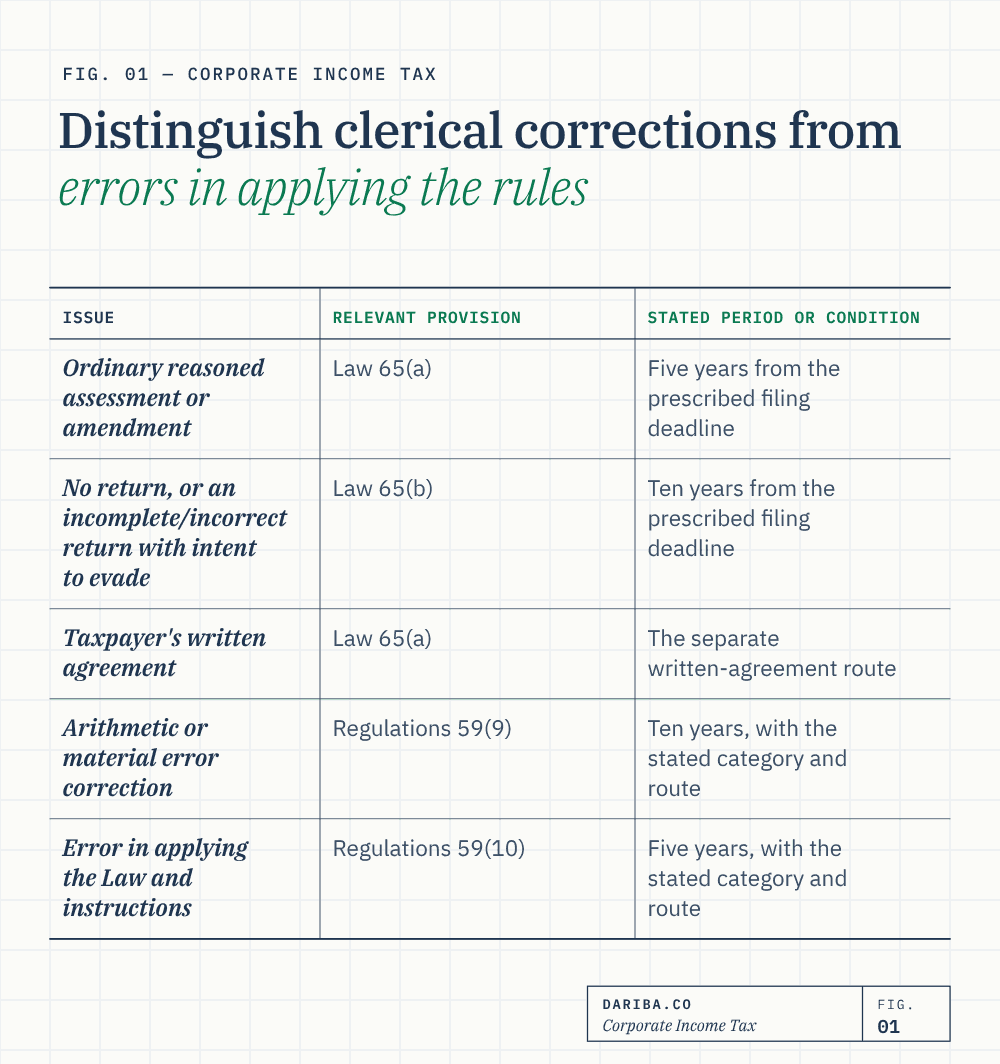
Paragraph (10) separately permits correction of an error in applying the Law and instructions within five years from that deadline, through the stated routes. These are different categories; a disagreement over deductibility does not become an arithmetic error merely because the revised tax can be expressed as a number.
| Issue | Relevant provision | Stated period or condition |
|---|---|---|
| Ordinary reasoned assessment or amendment | Law 65(a) | Five years from the prescribed filing deadline |
| No return, or an incomplete/incorrect return with intent to evade | Law 65(b) | Ten years from the prescribed filing deadline |
| Taxpayer’s written agreement | Law 65(a) | The separate written-agreement route |
| Arithmetic or material error correction | Regulations 59(9) | Ten years, with the stated category and route |
| Error in applying the Law and instructions | Regulations 59(10) | Five years, with the stated category and route |
Read the notice and protect the separate objection timetable
Law Article 62(b) requires notice by registered official letter or another means establishing receipt. Regulations Article 59(7) requires notification of the adjustments, reasons, resulting tax and penalties, objection right and prescribed objection period. Record the notice and its receipt evidence alongside the assessment calculation.
Use the current committee filing and evidence guide and settlement guide for the applicable challenge route. Older committee provisions reproduced in a compilation should not be substituted for the current procedural framework. A request for discussion, a complaint about wording and a filed objection are different acts.
Dariba analysis: an apparent notice defect can be material, but it does not establish every legal consequence without reviewing the applicable rule and facts. Preserve the point while addressing the earliest relevant procedural deadline. Do not assume that an ongoing audit or informal negotiation automatically extends the objection period.
Turn the assessment into an item-by-item response
Maintain a schedule for each adjustment: amount, provision, facts, source documents, computation, reason for agreement or challenge and requested outcome. Keep a separate schedule for notice, assessment authority, time limits, consent and submissions. This makes the technical and procedural positions independently reviewable.
An overpayment following correction still requires the applicable refund process. A payment demand or instalment request invokes the separate collection rules. Neither an objection nor a favourable accounting entry should be treated as automatically completing all subsequent steps.
Key takeaways
- The ordinary period starts from the prescribed filing deadline.
- Non-filing and intentional inaccurate returns have a ten-year route.
- Written agreement and correction powers require separate analysis.
- Examination access includes document-handling safeguards.
- Assessment and objection clocks are different.
Sources
- Saudi Income Tax Law, current amended Arabic textArticles 61–62 and 65: examinations, assessments and periods; Article 72: overpayment compensation; Article 78: accountant liability.
- Income Tax Implementing Regulations, current amended Arabic textArticles 57–59 and 66: certification, information and examination safeguards, correction periods and the refund procedure.
General information only. Actual supplies, facts, applicable periods and controlling Arabic legislation determine the result. Official examples are distinguished from Dariba analysis and original illustrations. Seek advice or clarification where the arrangement or source material leaves a specific issue unresolved.