In brief
Apply CIT estimation triggers, transport bases, profit minimums, ancillary-work estimates and disposal valuations without confusing them with tax rates.
Estimated assessment is a statutory computation route with particular triggers and minimums. It is not a general election to replace an inconvenient accounting result with a preferred percentage. Income Tax Law Articles 34 and 63(b), together with Implementing Regulations Article 16, distinguish transport activities, limited small activities and specified compliance failures.
Establish why an estimated assessment is available
Article 34(a) addresses specified foreign airline, shipping and land or sea transport branches operating in the Kingdom that do not provide evidence of their tax base under the Law. Article 34(b) authorises the specified approval of estimated methods for other sectors under regulatory bases and rates.
Regulations Article 16(1) addresses activities with interwoven global and local expenses where accurately separating the Saudi share is difficult and true local accounts cannot be provided. Article 16(2) separately addresses small activities with limited income whose activity does not require accounts or records. Neither is a blanket exemption from statutory record obligations.
Dariba recommendation: identify the precise paragraph and supporting facts. The estimated assessment route and the underlying question of whether the person has Saudi tax exposure are separate. Residence, source, permanent establishment and an applicable treaty still require analysis.
Compliance failures can lead to estimation
Law Article 63(b) and Regulations Article 16(3) address late or missing returns, inaccurate or missing records, inability to substantiate return information, failure to follow required record forms and specified Arabic-record or translation failures. The regulation expressly connects the estimate to the taxpayer’s facts and circumstances.
Article 16(3)(a) permits ZATCA to accept and process a late return supported by audited financial statements based on proper books when submitted before the estimated assessment is issued, with applicable penalties remaining. This is not automatic acceptance or a general cancellation rule for an estimate already issued.
Dariba recommendation: complete missing information promptly and document when it was submitted relative to assessment. Use the records and evidence guide to address the original weakness. A dispute about the assessment still needs the current objection and committee filing procedure.
The transport rule determines a base, not a 5% tax rate
Law Article 34(a) and Regulations Article 16(1) use 5% of the specified Saudi gross income as the tax base for the stated foreign transport cases. The regulation includes passenger tickets, excess baggage, freight, mail and other income from journeys starting in the Kingdom and ending at the agreed final destination, including an intermediate stop, regardless of where travel documents are sold or issued.
Dariba illustration — assume this route applies, the ordinary 20% CIT category applies and no treaty or exemption changes the result: specified gross income of SAR 10 million produces a base of SAR 500,000 at 5%. Applying 20% CIT to that base gives SAR 100,000. The 5% is a base percentage in this calculation; it is not 5% withholding on every transport payment.
An overseas ticket sale does not, by itself, remove a journey starting in the Kingdom from this regulatory definition. Equally, the provision should not be presented as automatically covering every worldwide journey or every logistics business. Keep the actual route, activity and legal basis in the calculation.
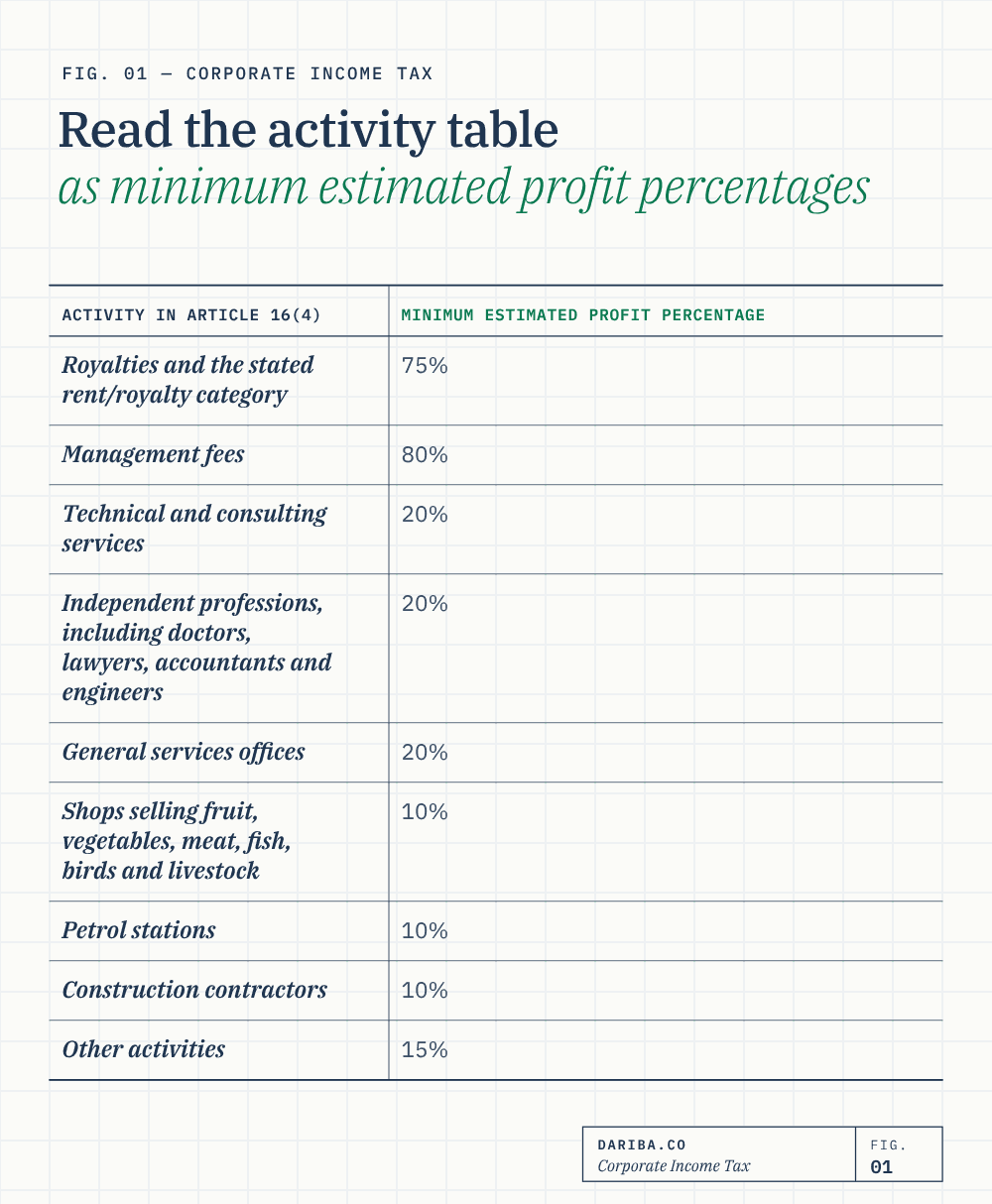
Read the activity table as minimum estimated profit percentages
Regulations Article 16(4) determines estimated net profit using relevant evidence, facts and indicators, subject to the following minimum percentages of the taxpayer’s revenue. These are profit percentages for this estimated assessment provision, not the domestic withholding-rate table.
| Activity in Article 16(4) | Minimum estimated profit percentage |
|---|---|
| Royalties and the stated rent/royalty category | 75% |
| Management fees | 80% |
| Technical and consulting services | 20% |
| Independent professions, including doctors, lawyers, accountants and engineers | 20% |
| General services offices | 20% |
| Shops selling fruit, vegetables, meat, fish, birds and livestock | 10% |
| Petrol stations | 10% |
| Construction contractors | 10% |
| Other activities | 15% |
The Arabic first category is “الإتاوات والريع”. Establish its application to the actual revenue rather than assume that every receipt described in English as rent necessarily has identical treatment. An activity description needs a factual classification, and the percentages are minimums rather than a promise that ZATCA must accept a lower result demonstrated by a taxpayer’s unsupported estimate.
Dariba illustration — assume technical services are properly assessed under Article 16(4): SAR 2 million of revenue at the 20% minimum produces estimated profit of SAR 400,000. If the ordinary 20% CIT rate applies without relief, tax on that amount is SAR 80,000. This does not make the contractual payment subject to a 20% technical-services withholding rate. The withholding guide applies its own scope and categories.
Do not subtract subcontractors again from the estimated revenue
Article 16(5) does not recognise deductions from gross revenue, such as subcontractor amounts, when making an estimated assessment. The estimated-profit method should not be combined with a second expense deduction that the provision excludes.
Dariba analysis: distinguish a genuine disagreement about what constitutes the taxpayer’s revenue from an attempted deduction of an expense from that revenue. They are different issues. Retain the contract and invoices, establish the legal revenue amount and then apply the proper method. A supplier cost does not stop being an expense merely because it is described as a pass-through in a spreadsheet.
Unpriced ancillary work has a specific revenue estimate
Article 16(6) addresses work accompanying supply contracts to the Kingdom where its value is not separately detailed in the contract. Revenue for each ancillary activity performed inside the Kingdom is estimated at 10% of the entire contract value.
The provision estimates revenue for that activity; it does not state a universal 10% profit margin, tax rate or exclusion for all imported goods. It also refers to each qualifying activity, so identifying the actual activities and whether they are separately priced matters.
Dariba recommendation: retain the scope, pricing breakdown and performance evidence before signing a combined supply-and-services contract. A document prepared after assessment does not automatically establish that the original contract separately priced the work or that the work was performed outside the Kingdom.
Asset disposals without proper accounts have separate valuation rules
Regulations Article 16(7) governs estimated capital gains when the seller lacks proper accounts. It distinguishes the asset categories:
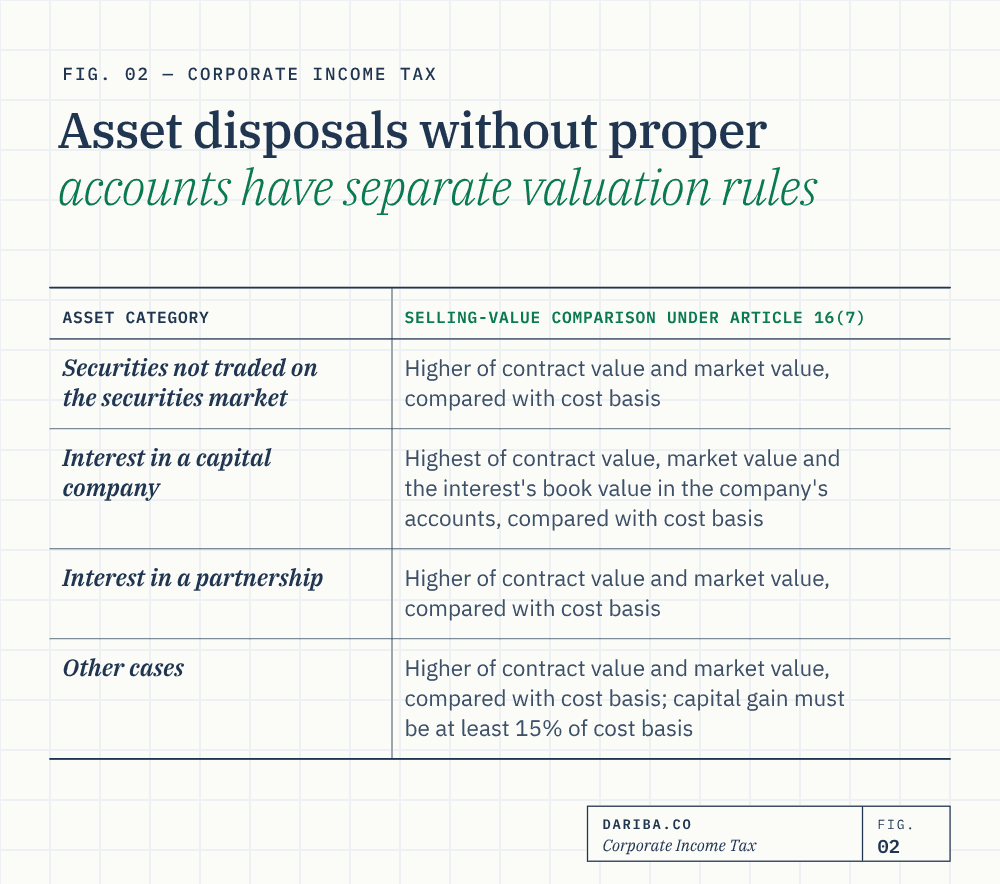
| Asset category | Selling-value comparison under Article 16(7) |
|---|---|
| Securities not traded on the securities market | Higher of contract value and market value, compared with cost basis |
| Interest in a capital company | Highest of contract value, market value and the interest’s book value in the company’s accounts, compared with cost basis |
| Interest in a partnership | Higher of contract value and market value, compared with cost basis |
| Other cases | Higher of contract value and market value, compared with cost basis; capital gain must be at least 15% of cost basis |
The 15% minimum in paragraph (d) is attached to its “other cases” category. Do not insert that floor into every securities or company-interest calculation merely because all four appear in the same paragraph. Identify any actual exemption and the applicable tax route separately; a valuation method is not itself a finding that every disposal is taxable.
Sellers and buyers need a transaction timetable
Article 16(7)(e) requires the selling partner to notify ZATCA of the sale and pay the resulting capital-gains tax within sixty days of the sale, and states the buyer’s joint responsibility with the seller for the resulting amounts due to ZATCA. This needs transaction-specific review; it should not be recast as unlimited responsibility for every unrelated historical liability.
Dariba recommendation: request the seller’s tax analysis, valuation evidence and payment arrangements during due diligence. Do not assume the ordinary annual return date is the only deadline relevant to a share transfer. Keep the estimated assessment, actual-account computation, withholding and treaty questions separate, and use the current procedural route for any contested assessment.
Key takeaways
- Estimation requires an applicable statutory route.
- The transport 5% is a tax-base percentage.
- Activity table percentages are minimum estimated profits.
- Subcontractor deductions cannot simply be taken again.
- Unpriced ancillary-work revenue has a separate rule.
- Disposal valuations depend on the asset category.
Sources
- Saudi Income Tax Law, current amended Arabic textArticles 34 and 63(b): estimated assessments; Article 59: confidentiality, permitted disclosures, recipient duties and written consent.
- Income Tax Implementing Regulations, current amended Arabic textArticle 16: estimated methods and conditions; Articles 58–59: information requests and examination procedures.
General information only. Actual supplies, facts, applicable periods and controlling Arabic legislation determine the result. Official examples are distinguished from Dariba analysis and original illustrations. Seek advice or clarification where the arrangement or source material leaves a specific issue unresolved.