In brief
WHT requires payer, recipient, source, category and payment analysis. Current Article 63 rates are distinguished from Decision 1776’s historical related-party row and application clause; actual periods and later instruments remain relevant.
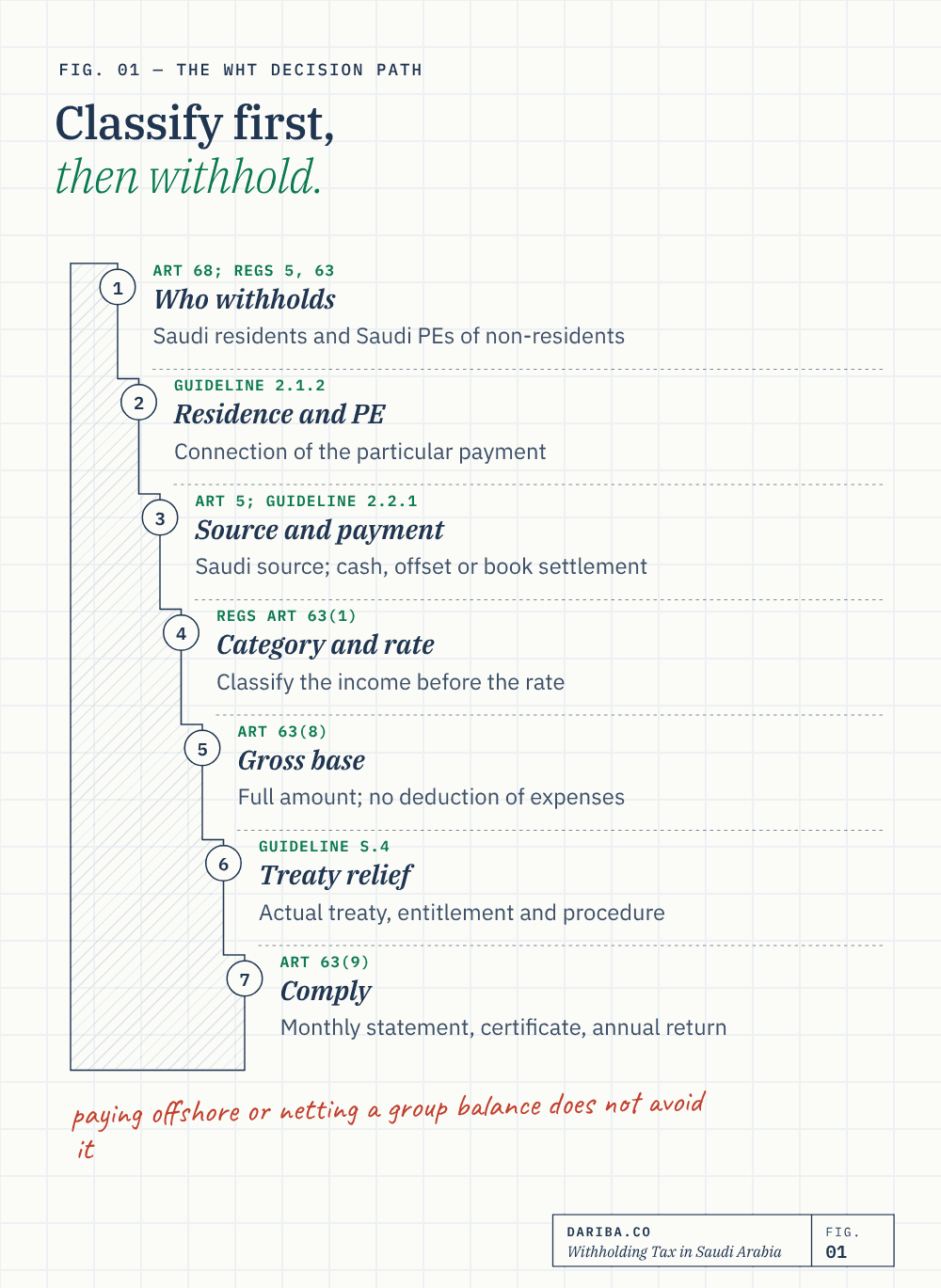
Saudi withholding tax (WHT) depends on the payer, actual recipient, Saudi source, type of income and payment event. It is not a tax on every overseas bank transfer. Equally, a Saudi business cannot avoid it merely by paying offshore, netting a group balance or having the work performed remotely.
Identify the person responsible for withholding
Income Tax Law Article 68 establishes the framework, read with Implementing Regulations Articles 5 and 63. ZATCA’s General Withholding Tax Guideline, second version May 2026, section 2.1, pp. 11–14, includes Saudi residents whether subject to income tax or not, and Saudi permanent establishments of non-residents.
A Zakat-paying company or government body can therefore have a WHT obligation. A resident natural person’s payments require the connection to that person’s activity; an individual’s purely private overseas spending is not automatically business withholding.
Identify the legal payer and actual obligation. A payment-processing location or shared-service bank account does not by itself change which person made the relevant Saudi-source payment.
Establish residence and the actual permanent-establishment connection
Residence is different from nationality or shareholder ownership. A foreign-owned Saudi company can be resident, while a Saudi-owned foreign company can be non-resident. The applicable residence conditions and actual establishment matter.
Guideline section 2.1.2, Example 2, p. 15, treats payments connected with the recipient’s Saudi permanent-establishment activity through that establishment’s income-tax return. The existence of some Saudi branch does not automatically remove withholding from every unrelated payment to the foreign enterprise.
Conversely, a Saudi permanent establishment can itself withhold when paying its foreign head office or another non-resident. Apply the connection to the particular payment, not a single entity-wide label. Do not import the VAT establishment test as if it were the income-tax test.
Identify both the Saudi source and the payment event
Law Article 5 and Regulations Article 5 govern source. Technical/consultancy services to a Saudi resident or connected to Saudi activity can be Saudi-source regardless of where performed. Other categories have their own source conditions; foreign performance does not decide them all.
Guideline section 2.2.1, p. 17, treats payments broadly, including cash, in-kind settlement, offset and book adjustments discharging liabilities. The location/method of payment is not the source test. Distinguish actual settlement from a mere unpaid accounting accrual rather than applying one bank-transfer-only rule.
Pure goods purchases and capital-gains income require different analysis from service withholding. A mixed goods/services contract needs the actual consideration separated on supportable facts; a goods label does not erase installation, maintenance or technical services.
Select the rate only after classifying the income
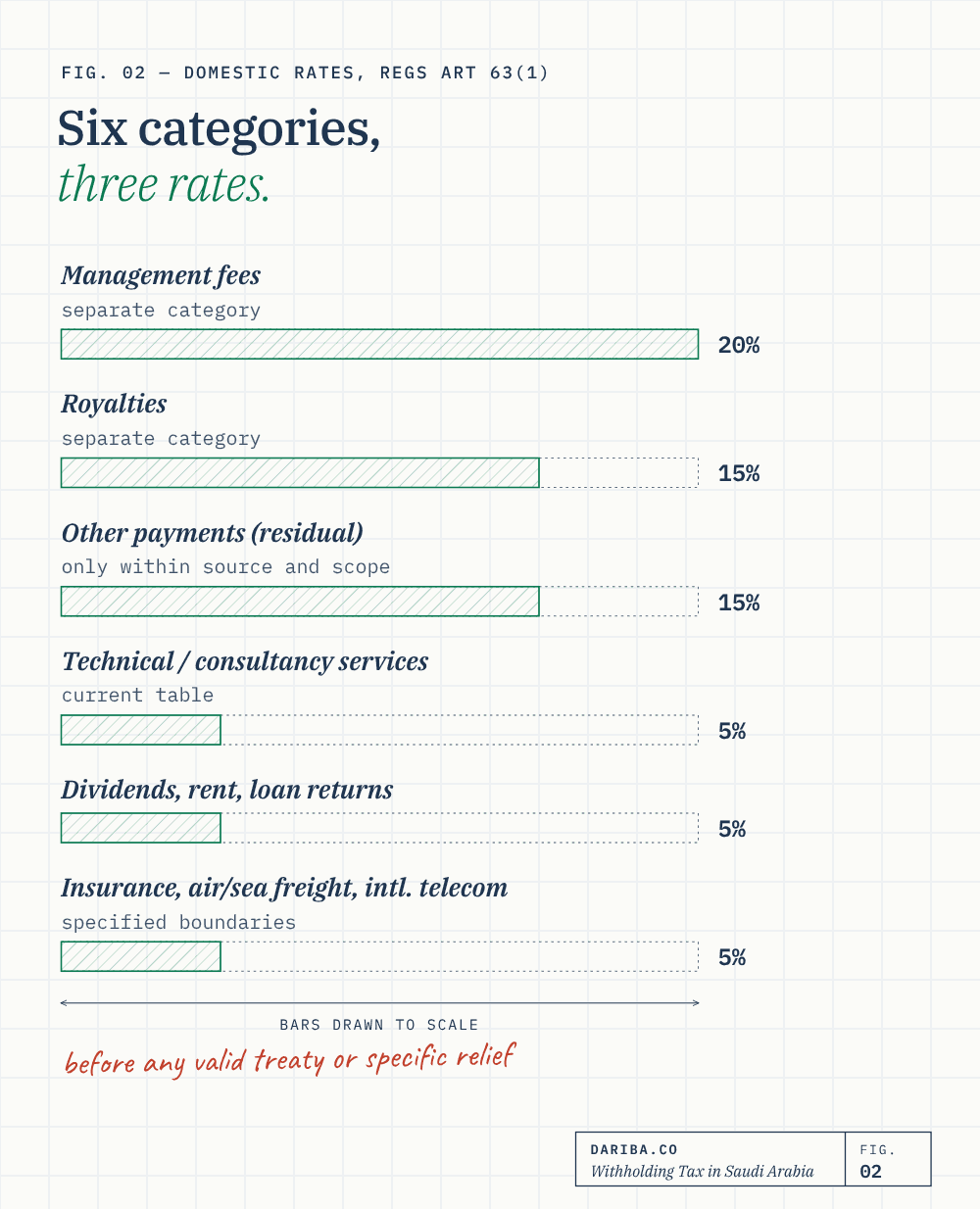
Current Arabic Regulations Article 63(1), p. 34, and guideline section 3, p. 28, specify the domestic categories. These rates assume a payment within scope before any valid treaty or specific relief.
| Payment category | Domestic WHT rate |
|---|---|
| Management fees | 20% |
| Royalties | 15% |
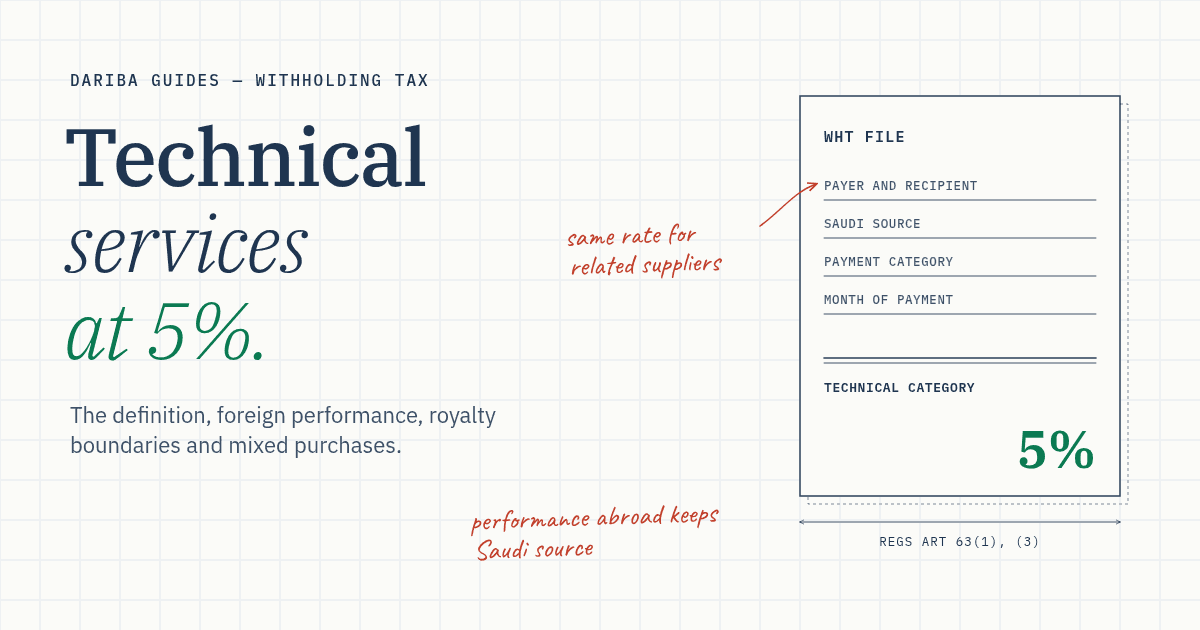
| Technical/consultancy services | 5% |
| Dividends, rent and loan returns | 5% |
| Qualifying insurance/reinsurance, air-ticket/air/sea freight and international telecom categories | 5% |
| Other payments within the residual category | 15% |
Definitions and exceptions matter: a management service is not every invoice labelled support, and a technical service is not everything delivered online. International freight/telecom categories have specific boundaries. The residual rate is not authority to withhold from a payment that fails the source/scope tests.
Distinguish the current table from the older related-party row
Ministerial Decision 1776 dated 18/5/1435 AH, clause First(i), p. 4, replaced two rows of the then withholding table. Its historical wording placed technical/consultancy and international-telephone services paid to a head office or related company in a 15% row, while identifying the stated other-recipient category at 5%. The official original is useful evidence of that amendment; it is not the current table in isolation.
The current Arabic Regulations Article 63(1), p. 34, lists technical and consultancy services in the 5% category. Its table carries later amendment notes. Management fees remain a separate 20% category, royalties a separate 15% category, and residual payments have their own scope and rate.
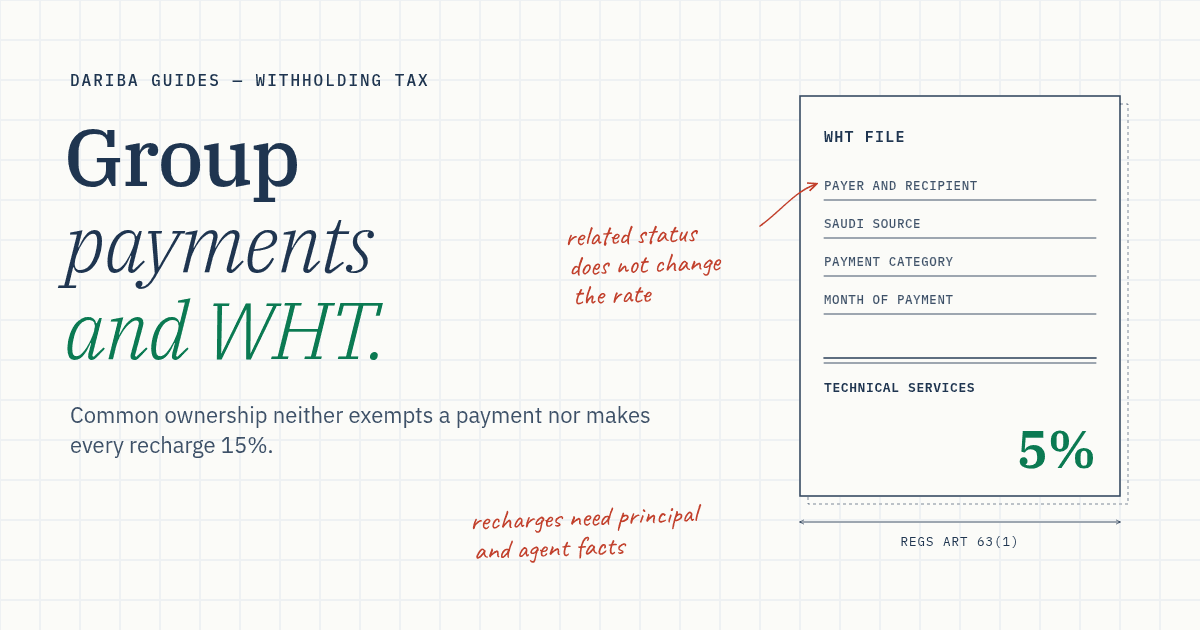
Dariba analysis: do not revive the older 15% technical-service row solely because the present recipient is a head office or related company. First classify the actual payment under the current provisions. Equally, do not describe every group payment as a 5% technical service: an actual management fee, royalty or other category requires its own treatment. The technical-services guide and group-payment guide address those distinctions.
Decision 1776’s clause Second, also on p. 4, states application from its date, including the specified objected cases where assessments had not become final. That is the original instrument’s own application clause. A historical payment or disputed assessment needs the actual period, applicable amendments and procedural status examined; the old clause does not supply a general current-rate or reopening conclusion.
Sources: official SAMA-hosted Decision 1776, First(i) and Second, p. 4, read alongside current Arabic Regulations Article 63(1), p. 34. The current table and the historical original serve different period-specific purposes; the full standalone chain of every later decision is not certified here.
Official examples show why the transaction chain matters
Guideline Example 1, p. 15, considers technical services provided by a foreign head office to its Saudi permanent establishment for onward customer services. The payment is within withholding; any income-tax expense deduction has its own conditions.
Example 5, p. 22, considers a Saudi branch’s allocated share of a head office’s global insurance policy. On the stated pure-premium facts, the 5% insurance category applies, provided the amount does not include separate head-office services.
Dariba analysis: routing through a group entity does not automatically create a management fee, a non-taxable reimbursement or a second identical service. Identify the underlying supply, principal/agent capacity, allocation and any added services before selecting the category.
Apply the gross base and actual tax-bearing terms
Article 63(8) applies the percentage to the full relevant amount, without deducting the recipient’s expenses or treating the payer’s expense deductibility as the WHT base. WHT is different from net-profit income tax.
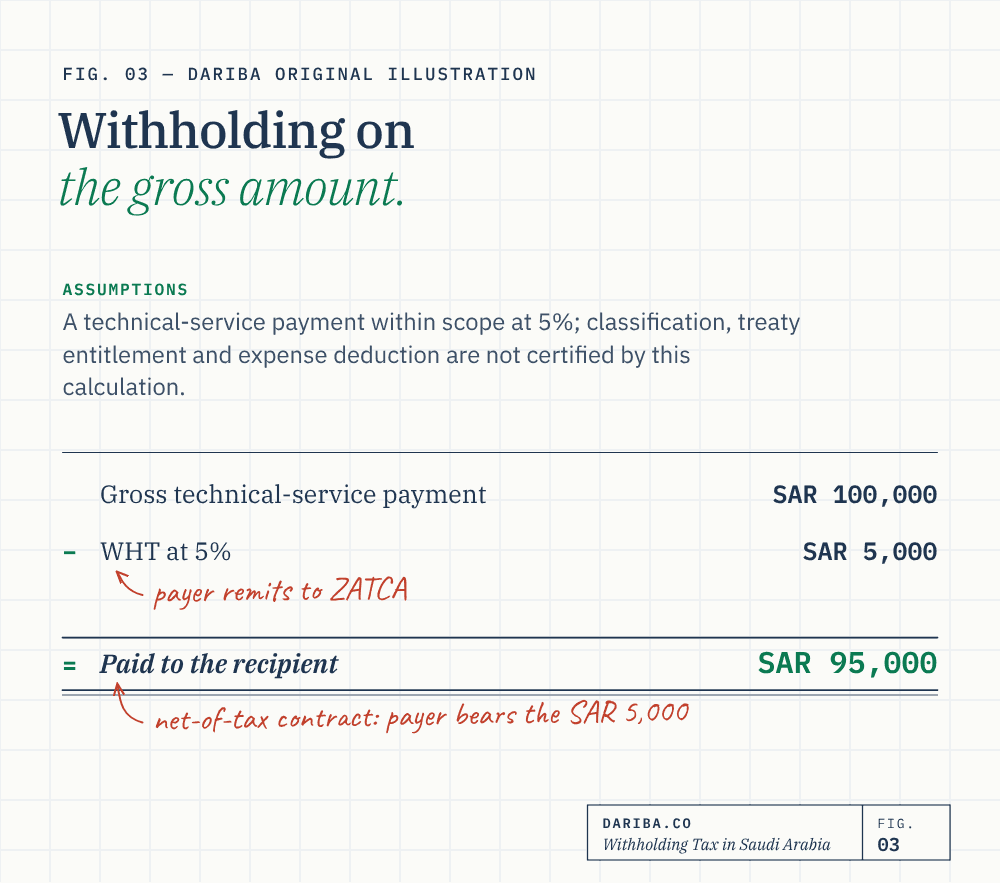
Dariba original illustration: a SAR 100,000 gross technical-service payment at 5% yields SAR 5,000 WHT and SAR 95,000 paid to the recipient. If the contract instead promises the recipient SAR 95,000 net and the payer bears the tax, the same assumptions give a SAR 100,000 gross amount and SAR 5,000 tax. Contractual net/gross terms must be established rather than assuming the supplier accepts a deduction.
This calculation does not certify the service classification, treaty entitlement or expense deduction. Foreign-service VAT/reverse charge is a separate question; paying WHT does not settle VAT or create an input-VAT credit.
Treaty and permanent-establishment relief require actual support
Guideline section 4, p. 29, recognizes possible treaty exemption/reduction under an applicable Saudi agreement. A foreign address or generic residence certificate alone does not decide the treaty article, recipient entitlement, permanent-establishment connection or required procedure.
Review the actual treaty in force for the payment period, supporting residence/recipient facts and the relevant ZATCA mechanism. This guide does not prescribe a universal treaty rate or certify direct relief for every payment without the required evidence.
Where income is included in a Saudi taxpayer/permanent-establishment tax base and tax has been withheld, the specific Article 68 credit interaction requires review. Do not promise a refund or treat every non-resident’s WHT as creditable against someone else’s tax.
Complete monthly, annual and evidence obligations
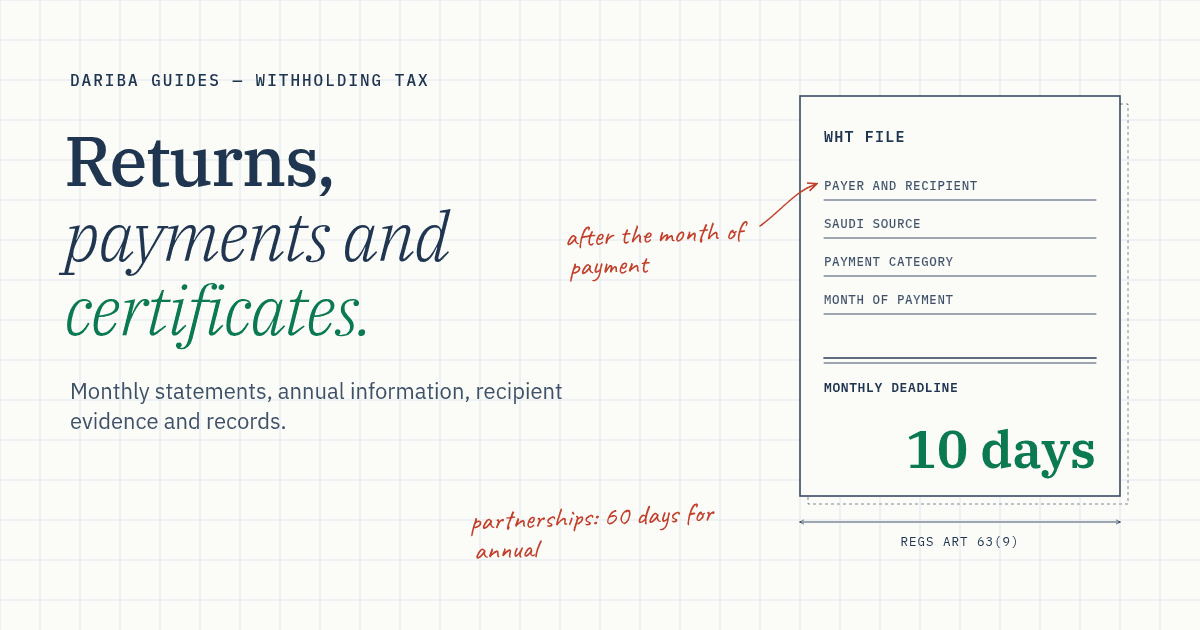
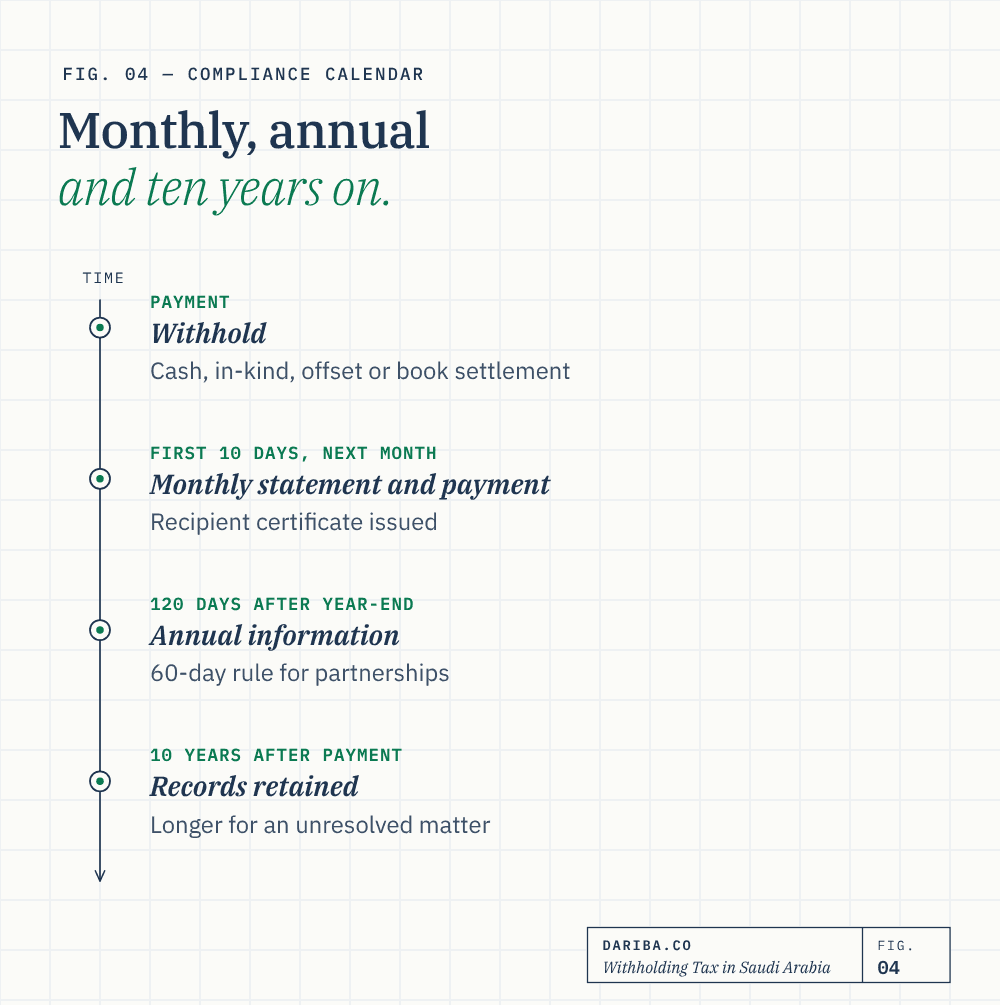
Current Article 63(9), pp. 35–36, and guideline section 5, pp. 30–31, connect withholding to the monthly statement/payment, recipient certificate, annual information and records. Monthly filing/payment ordinarily falls within the first ten days of the following month, with the actual applicable deadline checked.
Annual reporting is generally within 120 days of fiscal year-end, with a 60-day rule for partnerships. Records are retained at least ten years after payment and longer for an unresolved matter. See the compliance guide for the distinctions, including nil monthly versus annual reporting.
Dariba recommends making payer/recipient, source, settlement, classification, treaty and document checks part of payment approval. The technical-services guide and group-payments guide apply these questions to common arrangements without treating an invoice description as a final tax conclusion.
Key takeaways
- A resident Zakat payer or government body can have a WHT obligation.
- Residence, nationality and actual permanent-establishment connection are different tests.
- Cash, offsets and liability-discharging settlements can trigger payment analysis.
- Classify the income before selecting the current domestic rate.
- Use the full relevant gross base and actual contractual tax-bearing terms.
- Treaty, return, certificate and input-VAT questions require separate support.
- Decision1776’s older15% head-office/related technical-service row is historical; use the currentArticle63 table for the actual payment period.
- Related-party status does not replace classification among technical services, management, royalties and other payments.
Sources
- Official Arabic Income Tax Implementing RegulationsArticles 1 and 5, pp. 3–6; Article 63, pp. 34–36: actual source, current rates, definitions, gross base and reporting. Current Article 63(1),p.34 is distinguished from the original1776historicalrows.
- ZATCA General Withholding Tax guidelineSecond version May 2026, sections 1-5, pp. 8–32; Examples 1-5, payer/source, rates, exemptions and administration.
- Ministerial Decision 1776 dated18/5/1435AH, official SAMA-hosted originalFirst(i)andSecond,p.4:historical15%head-office/related technical/consultancy/telecomrow and 5%other-recipientrow; applicationfromdate includingstatednonfinalobjectedcases. Readasoriginalhistoryagainstcurrentamendedtable,notunqualifiedcurrentrates.
General information only. Actual supplies, facts, applicable periods and controlling Arabic legislation determine the result. Official examples are distinguished from Dariba analysis and original illustrations. Seek advice or clarification where the arrangement or source material leaves a specific issue unresolved.