In brief
Eligible tax losses require origin, annual-limit and continuity analysis. Article 21(d), traced to originalM/70, prevents oil and gas losses from offsetting the other base despite a common taxpayer or combined return.
The carried loss is a tax figure
Income Tax Law Article 21 permits eligible net operating losses to be carried into later tax years, subject to the annual limits in the Regulations. The loss is the excess of allowable deductions over the relevant taxable income, not simply the negative result in the financial statements. Non-deductible expenses, exempt income and depreciation adjustments can materially change the amount.
Regulations Article 11 therefore starts with adjusted operating losses established under the Law and Regulations. Reconcile the loss-year computation to the audited accounts and preserve its history. A large accounting deficit is not evidence that the same amount is available to offset a later year’s taxable profit.
Apply the 25% annual limit to the correct profit
Article 11(1) permits carry-forward without a specified time limit, while restricting the annual deduction to 25% of annual profit according to the taxpayer’s return. Establish the adjusted profit and eligible opening losses before applying that limit. The permitted use cannot exceed the losses actually available.
Dariba illustration: assume an ordinary company subject wholly to 20% CIT has SAR 8 million of eligible losses and SAR 2 million of current adjusted profit before loss relief. The cap is SAR 500,000; the remaining base is SAR 1.5 million and CIT is SAR 300,000, before any other applicable credits. SAR 7.5 million remains in the loss register. This is an original illustration, not a numbered ZATCA example.
An indefinite period does not guarantee permanent availability
Article 11(2) excludes losses before the effective date of Council of Ministers Decision 3, identified there as 10 April 2000, losses arising during a tax-exemption period, and losses from activities not subject to income tax. Where taxable and non-taxable activities coexist, maintain separate loss origins. Do not assume that all investment losses can shelter the trading business.
Article 11(3) also requires losses determined from proper accounts audited by an accountant licensed in the Kingdom. Annual filing obligations still apply to a loss-making taxpayer. Missing returns and evidence must be resolved; the reviewed provisions do not justify a blanket statement that every unfiled loss year is automatically and irreversibly forfeited in every circumstance.
Ownership changes have an express statutory rule
Law Article 43(b), as amended by Royal Decree M/131, expressly addresses a change in a capital company’s ownership or control reaching 50% or more of the non-Saudi interest. It restricts deduction of the non-Saudi share of losses incurred before the change in later years, unless the company continues the same activity.
It is therefore incorrect to say that Saudi legislation contains no specific ownership-change restriction. It is also too broad to say that any 50% change automatically cancels all losses. Preserve the statutory interest, timing and same-activity conditions. Regulations Article 11(4) must be read with the amended Law; the current compilation itself flags that amendment in its footnote.
Test the same-activity exception on the actual business
For an acquisition, document the pre-change activity, transaction structure, ownership/control movement and continuing operations. The Law provides the exception but does not, in the provisions reviewed here, prescribe a universal revenue percentage or safe period that certifies “same activity”. A continuing commercial registration alone should not be presented as conclusive evidence for a materially changed business.
Dariba’s recommendation is to assess loss continuity during transaction diligence, before the purchase price assumes the losses have full tax value. Where the business model, assets or functions change substantially, obtain a specific view or clarification rather than extrapolating an automatic answer from the company’s name or industry code.
Distinguish qualifying group transfers and other loss rules
Law Article 43(c) excludes the specified transfers referred to in Article 9(m) from the ownership/control-change treatment. Article 9(m) has its own wholly owned group-transfer conditions. This is a defined statutory route, not a general statement that every reorganisation is neutral for loss purposes.
Article 21 also confines a natural person’s operating-loss calculation to the activity’s income and deductions, and separates the stated natural-gas and oil/hydrocarbon tax bases. Partnerships and partner-interest basis rules require their own analysis. Do not move a company’s loss to a shareholder or another group member merely because accounting statements are consolidated.
Preserve the statutory oil and gas loss separation
Law Article 21(d) expressly separates net operating losses for a taxpayer carrying on both oil/hydrocarbon production and natural-gas investment. The original Royal Decree M/70, First(8), with Council Decision 369, confirms the added provision.
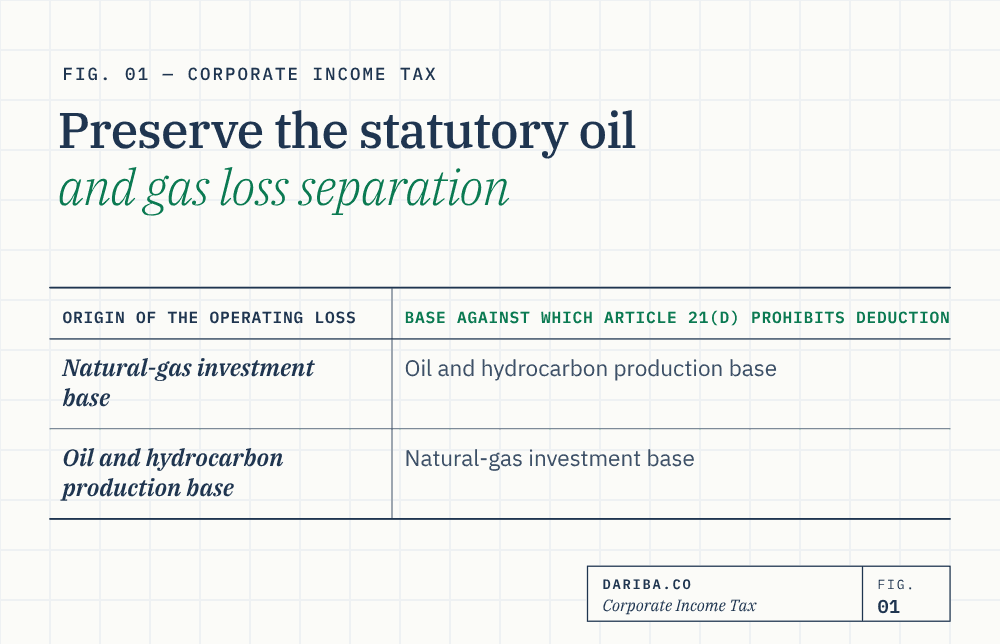
| Origin of the operating loss | Base against which Article 21(d) prohibits deduction |
|---|---|
| Natural-gas investment base | Oil and hydrocarbon production base |
| Oil and hydrocarbon production base | Natural-gas investment base |
Dariba illustration — classification only: assume a taxpayer has SAR 4 million of profit in its gas base and a SAR 1 million operating loss in its oil-production base, with no other facts or adjustments specified. The common taxpayer cannot treat the gas base as SAR 3 million solely by subtracting that oil loss. This illustration does not calculate the oil operation’s tax or establish the loss’s future eligibility.
Keep separate origin, adjustments, carry-forward and utilisation schedules for the two bases. Regulations Article 57(8)‘s single return with separate base and tax details does not merge those schedules. Nor does Article 21(d) replace the ordinary eligibility, annual-limit and ownership/continuity rules applicable to the particular loss.
M/70’s clause Second applies its clause First from 1 January 2018. The later Ministerial Decision 2568 uses a tax-year-starting clause for its regulatory amendments. Preserve the actual wording and period facts; the gas scope and separate-base guide compares those instruments. Neither a later publication date nor the payment date alone should replace the required historical-period analysis.
Source: original M/70, First(8) and Second, Gazette issue 4719, 13 April 2018, p. 5, alongside current Law Article 21(d), p. 15. These are statutory loss-pool rules, distinct from group consolidation or an accounting offset.
Model the actual loss balance rather than a fixed effective rate
With SAR 100,000 of eligible losses and SAR 2 million of adjusted profit, the same 25% cap would be SAR 500,000, but only SAR 100,000 is available. Under the same wholly 20%-CIT assumption, the base is SAR 1.9 million and tax is SAR 380,000 before other credits. The cap does not guarantee an effective 15% tax rate.
The cash-flow model should therefore track eligible opening losses, current profit, the annual ceiling, actual utilisation and the closing balance year by year. Keep mixed-ownership allocation and credits separate from this simple illustration. The available deduction and accounting recognition of a deferred-tax asset are different conclusions.
Preserve an auditable loss register
Maintain each loss year’s filed computation, audited accounts, adjustments, assessments, subsequent amendments, use and closing amount. Add ownership/control events and the continuity conclusion. Reconcile the register when the financial year changes; a short period should not create an extra copy of the same loss.
The deductions guide explains how the underlying tax result is established. The commercial objective is a supportable amount available to the right taxpayer in the right year. Neither an indefinite carry-forward period nor a profitable forecast substitutes for eligibility, continuity and the annual utilisation calculation.
Key takeaways
- Carry-forward uses the adjusted tax loss rather than the accounting deficit.
- The annual deduction is limited by both the 25% ceiling and available losses.
- Excluded origins and audited-account requirements remain relevant.
- Article 43 expressly restricts specified ownership or control changes.
- The same-activity exception requires the actual business facts.
- An indefinite period does not guarantee an available deduction.
- Article21(d) prohibits both gas-to-oil and oil-to-gas operating-loss offsets.
- One return and one taxpayer do not merge the two loss pools.
Sources
- Saudi Income Tax Law, current amended Arabic textRelevant Articles 7, 9, 17–23 and 43. The current amended Law governs over older translations or inconsistent subordinate summaries.
- Income Tax Implementing Regulations, current amended Arabic textArticles 8–11 and 14 as applicable. Decision 25 financing amendments and the Article 11 footnote to amended Law Article 43 are retained.
- ZATCA Guideline on the Conditions of Deductible Expenses, second version May 2026General section 2.1 and relevant financing/head-office examples. Original Dariba calculations are distinguished from official examples.
- Umm Al-Qura issue4719: Royal DecreeM/70 and Council Decision 36913April2018,p.5. M/70 dated11/7/1439:Firsteightamendments,including21(d)two-waylossseparation;SecondappliesFirstfrom1January2018. Council369Thirdjointimplementationprocessreadseparately;notactualtaxpayerallocationapproval.
General information only. Actual supplies, facts, applicable periods and controlling Arabic legislation determine the result. Official examples are distinguished from Dariba analysis and original illustrations. Seek advice or clarification where the arrangement or source material leaves a specific issue unresolved.