In brief
The treaty and protocol distinguish fixed places, farms/equipment, projects/services, agents, insurers and independent individuals. Matched MLI agency, activity and contract rules require their actual conditions.
An Egyptian enterprise’s Saudi engagement needs the actual treaty, integral protocol and matched MLI conditions. The six-month project/service tests are not general permission to disregard fixed premises, an agent, an insurer or a natural-resource equipment operation.
The Egypt WHT guide covers financial income, royalties and government-recipient conditions. This companion focuses on Articles 5, 7 and 14, Protocol clauses 2–3 and the relevant MLI modifications. Treaty taxing permission and an actual domestic charge remain separate.
Start with the fixed place and the protocol’s additions
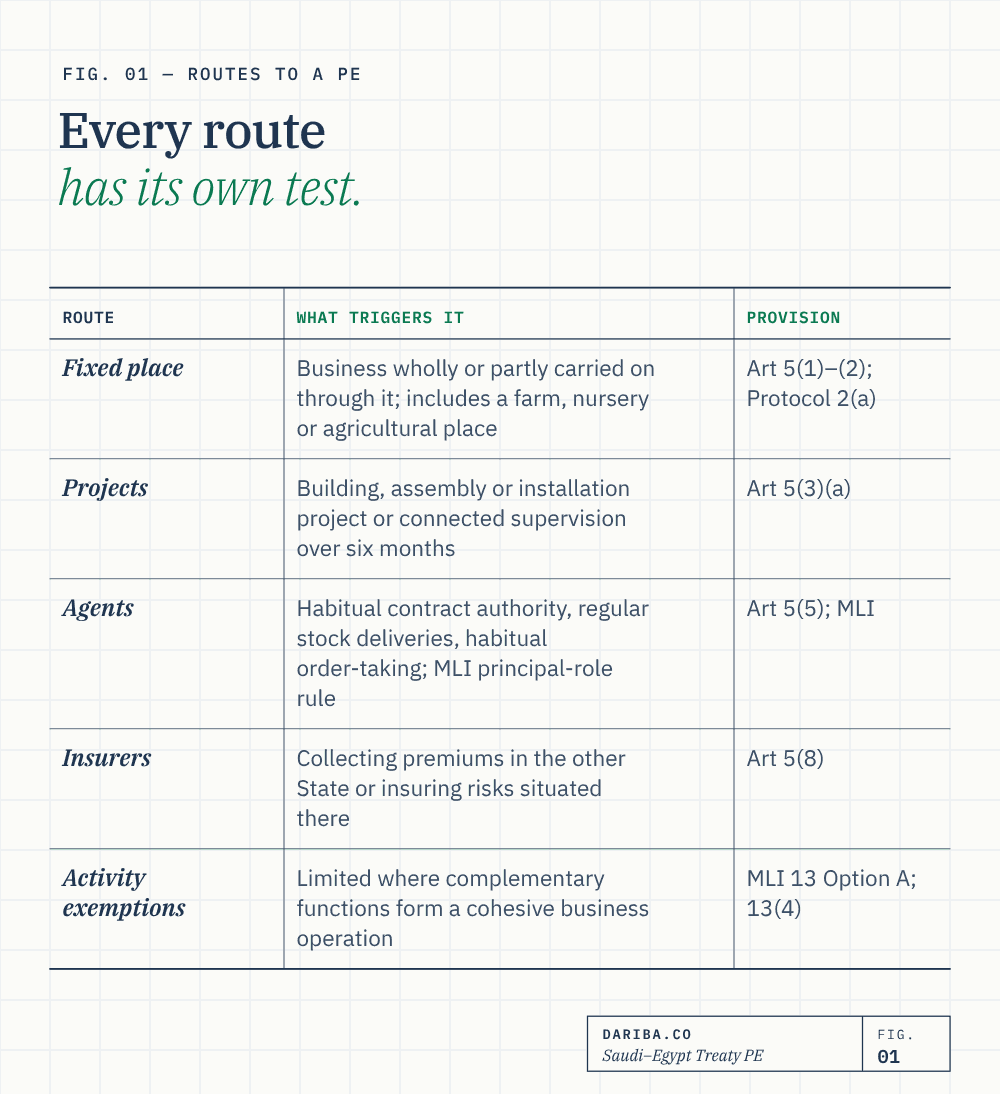
Article 5(1)–(2) covers a fixed place through which the enterprise’s business is wholly or partly carried on. Its listed examples include management, branch, office, factory, workshop, extraction sites and a sales outlet.
Protocol 2(a) expressly includes a farm, nursery or other place carrying on agricultural activity. Clause 2(b) addresses substantial equipment connected with a natural-resource extraction/exploration site, used in the enterprise’s activity whether owned or rented, or installed by it. Those routes should not be replaced by one project-duration test.
Article 5(7) says control of another company does not by itself create a permanent establishment. That does not prevent an actual fixed-place, agency, activity or other applicable provision from doing so.
Sources: Article 5; Protocol 2.
Distinguish project duration, services and contract splitting
Article 5(3)(a) addresses the stated building/construction, assembly/installation project or connected supervision continuing more than six months. Paragraph (3)(b) separately covers enterprise services, including consulting, through employees or engaged personnel for the same or connected project, aggregating more than six months in any twelve-month period.
Matched MLI Article 14 additionally addresses qualifying connected activities at the relevant project/place during different periods by closely related enterprises. Its conditions include the stated more-than-30-day periods. It is not a rule to add every day worked by every group member anywhere in the country.
Egypt’s Article 14(3)(b) reservation concerns specified natural-resource provisions listed for Ireland and the Netherlands; it is not an across-the-board reservation for the Saudi agreement. Saudi Arabia has no Article 14 reservation. Keep the actual treaty project/service wording, MLI compatibility and closely-related-enterprise tests together.
Sources: Article 5(3); Egypt reservation; Saudi Article 14; MLI Articles 14–15.
Review actual contract activity and agent independence
Original Article 5(5) includes the specified habitual contract authority, regular stock deliveries and habitual order-taking routes. Both parties notify 5(5)(a) under MLI Article 12(5) and 5(6) under Article 12(6).
For the applicable period, the matched contract rule therefore includes the specified habitual principal role leading to contracts routinely concluded without material modification, covering the identified enterprise-name, property/right-to-use and service contracts. A signature placed offshore does not alone answer the question. The original stock and order-taking limbs must also be considered on their own wording; the MLI compatibility rule does not simply erase every existing agency route.
The matched independent-agent rule requires actual independent business and ordinary-course activity. Acting exclusively or almost exclusively for closely related enterprises defeats that exception under the stated rule. An agency contract’s label or separate legal incorporation is not conclusive.
Sources: Article 5(5)–(6); Egypt matching notifications; Saudi matching notifications; MLI Articles 12/15.
Keep insurer and activity-exemption rules separate
Article 5(8) treats an insurance enterprise as having a permanent establishment where it collects premiums in the other State or insures risks situated there. The posted clause does not state a universal reinsurance exclusion or an independent-agent condition. Do not import another treaty’s insurer exception into this one.
Both positions choose MLI Article 13 Option A and notify Article 5(4). For its applicable period, the selected listed/combinations of activities require the prescribed preparatory or auxiliary character. The original storage/display wording is not a blanket warehouse exemption for a substantive operating business.
The matched Article 13(4) anti-fragmentation provision addresses complementary functions forming part of a cohesive business operation, with its specified same/closely-related enterprise and place conditions. That is distinct from Article 14’s project-period aggregation. Neither rule means that every related entity is automatically one taxable establishment.
Sources: Article 5(4)/(8); Egypt Article 13 choice and Saudi notification; Saudi Article 13; MLI Article 13.
Attribute business profits and separate export/local components
Article 7(1)–(2) addresses profits attributable to the permanent establishment and the separate independent-enterprise comparison. Protocol 3 separately addresses profits from exporting goods and local activities within an export contract, with the Article 5 establishment condition.
Dariba analysis: retain the goods, local services, personnel, place and profit-attribution evidence. An exported component does not automatically shelter every local activity; an establishment also does not turn all the enterprise’s worldwide receipts into attributable profit.
Article 7(3) distinguishes actual reimbursements from the specified internal royalties, commissions/management charges and financing, with its banking qualification. Paragraph (8) includes the stated commercial/service businesses but excludes an individual’s employed or independent personal services. Paragraph (7) preserves separately governed income articles, including the actual royalty definition.
Sources: Article 7; Protocol 3. Actual domestic computation, deductions and transfer pricing remain separate steps.
Apply the individual’s own fixed-base and presence tests
Article 14(1) concerns an individual performing professional or other independent activities. Its alternatives are a regularly available fixed base, with the income attributable to it, or presence reaching 183 days or more in a twelve-month period beginning or ending in the relevant fiscal year, with the stated host-State activity income.
Exactly 183 days meets that presence limb. It is not the enterprise’s six-month service test or Austria’s separate EUR remuneration test. Article 14(2) identifies professional examples; actual capacity and activity determine the applicable article. Employment has the separate Article 15 rules.
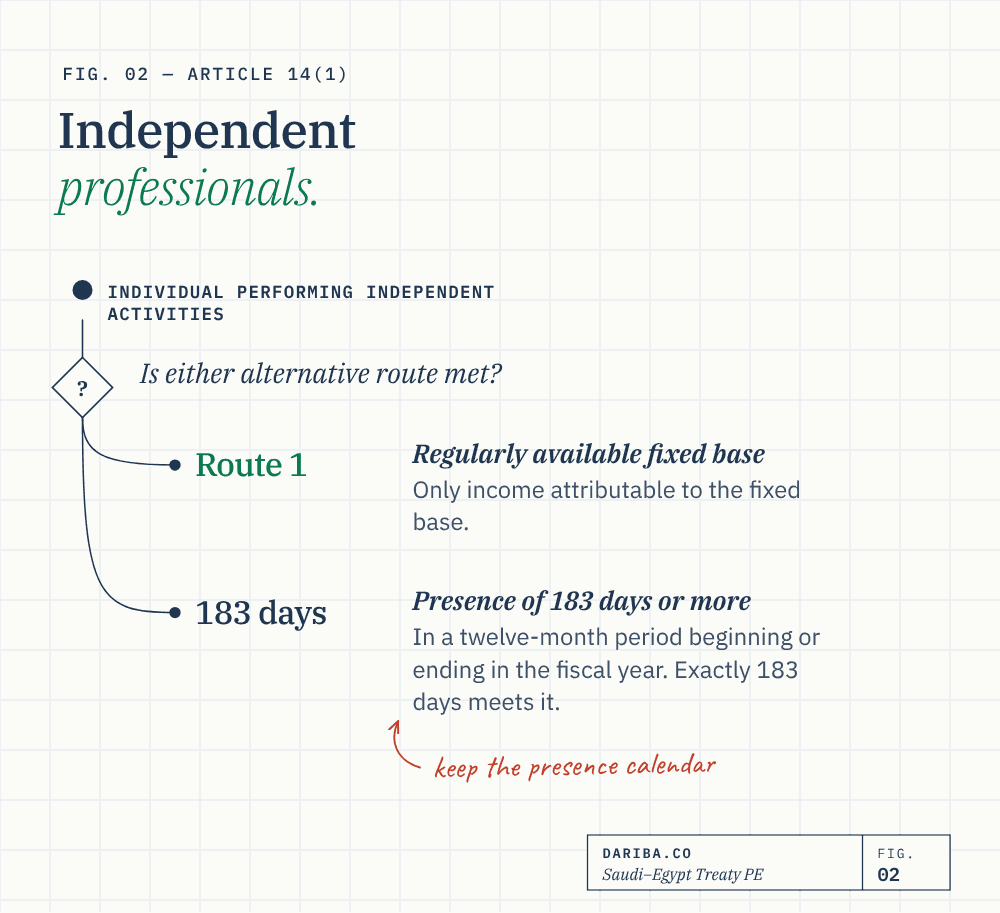
Dariba recommendation: retain the actual person’s presence calendar, fixed-base availability, engagements, work locations and income attribution. Company invoicing, a professional qualification or an offshore payment account does not resolve all those facts.
Source: Articles 14–15.
Match the period, anti-abuse and actual claim evidence
Original treaty Article 28 and the later MLI Articles 34–35 must be applied separately. The treaty entered into force on 1 July 2017 according to ZATCA’s current entry; the original following-January rules differ from MLI effect. The later MLI force date is Egypt’s 1 January 2021, compared with Saudi Arabia’s 1 May 2020.
For the selected matched default, withholding effects begin 1 January 2021; other taxes use the separate six-calendar-month taxable-period commencement rule. MAP uses Article 35(4), not an assumption that every tax and procedural case has the same start date. Apply the actual period, relevant notification and matched reservation before relying on a modification.
Original Article 27 and matched MLI Article 7 retain the purpose-based benefit analysis. Keep the actual arrangements and commercial facts with the resident, premises, personnel, agency, insurer, connected-project and profit schedules. The treaty relief procedure is a separate requirement where the actual payment falls within withholding.
Sources: Articles 24/27/28; current MLI status; both deposited positions; MLI Articles 7/34/35. Full later/historical instrument chains, competent-authority agreements and actual taxpayer entitlement remain open.
Key takeaways
- Fixed-place, farm/equipment and insurer provisions are separate from duration tests.
- Project duration and same/connected service aggregation have different wording.
- Matched MLI principal-role agency and independent-agent conditions matter.
- Preparatory/auxiliary, anti-fragmentation and project-period aggregation are distinct tests.
- Individuals have separate fixed-base and 183-day alternatives.
- Actual applicable periods, anti-abuse, attribution and relief evidence remain necessary.
Sources
- ZATCA: Saudi–Egypt treaty and integral protocol, ArabicSelected Articles 4/5/7/10–15/24/27–28; Protocol 1–5. Actual direct holding, government definition, loan fees, software/equipment/connected assistance, farm/equipment and export conditions.
- OECD: Egypt MLI position on deposit, 30 September 2020Deposited 35-page position, rather than provisional signature list; Saudi agreement 54 and matched notifications/reservations.
- OECD: Saudi MLI position on deposit, 23 January 2020Egypt agreement 8; Articles 4/8 reservations; matched 7/12/13/14/16 conditions. Actual original scan tables read.
- OECD: authentic English MLIArticles 7/12–16/28–29/34–35. Actual compatibility, effect and closely-related tests; no unilateral-option assumption.
- OECD: current MLI signatories and partiesEgypt deposit 30 September 2020/force 1 January 2021; Saudi deposit 23 January 2020/force 1 May 2020; effects separately derived from Article 35.
- ZATCA: treaty withholding implementation circularJanuary 2025, classification and section 4 relief-at-source/refund conditions, evidence, authentication and decisions.
- Saudi Income Tax Implementing Regulations, ArabicArticle 63 domestic categories and exceptions; a treaty ceiling does not increase a lower applicable domestic rate.
- Saudi Income Tax Law, ArabicDomestic source and withholding framework, including Articles 5/68. Treaty permission and actual domestic charge remain distinct.
- ZATCA: current Egypt treaty entryCurrent public catalog record checked 7 November 2026; signature 8 April 2016 and force 1 July 2017. Links the reviewed Arabic treaty/protocol.
General source-based information reviewed 7 November 2026. Actual recipient, residence, ownership, activity, applicable period, protocol agreement, benefit and procedure determine the result. Dariba illustrations are original. Full historical/later instrument chains, competent-authority agreements, Egyptian domestic outcomes and individual entitlement are not certified.