In brief
Ordinary gross ceilings are 5/10% dividends and 10% debt income/royalties, with specified government exemptions. The protocol adds loan fees, named institutions and agreed-entity conditions; lower domestic rates remain lower.
A Saudi payment to an Egyptian resident requires the actual domestic classification, treaty income article, beneficial recipient and supporting procedure. The Saudi–Egypt treaty and its integral protocol cannot be reduced to one rate for every Egyptian invoice.
Selected ordinary gross ceilings are 5% or 10% for dividends, 10% for debt income and 10% for royalties, with specified government-recipient exemptions. A treaty ceiling does not increase a lower applicable domestic rate. Use the Egypt business and establishment guide for services and activity conditions.
Establish treaty residence and the actual applicable period
Article 4 governs residence. Protocol clause 1 includes specified established, generally tax-exempt legal persons maintained for the stated religious, charitable, educational/scientific or employee pension/benefit purposes. Neither an exemption label nor an Egyptian bank account alone establishes the actual treaty resident.
Article 4(3) uses effective management for a dual-resident non-individual. Saudi Arabia reserves against MLI Article 4, so Egypt’s notification alone does not replace that rule with the MLI entity tie-breaker.
ZATCA’s current treaty entry records signature on 8 April 2016 and entry into force on 1 July 2017. Original Article 28 gives tax-specific effects from the following January: distinguish the original 2018 application from later MLI effects.
The OECD status records Saudi MLI force on 1 May 2020 and Egypt on 1 January 2021. Applying MLI Article 35(1) to the matched deposited positions yields the default 1 January 2021 withholding effect and the separate six-calendar-month taxable-period rule for other taxes. These are not one universal date for every assessment or MAP case; Article 35(4) treats MAP separately.
Sources: Articles 4/28 and Protocol 1; Saudi Article 4 reservation; Egypt deposited position; current MLI status; MLI Article 35.
Apply the actual dividend holding condition
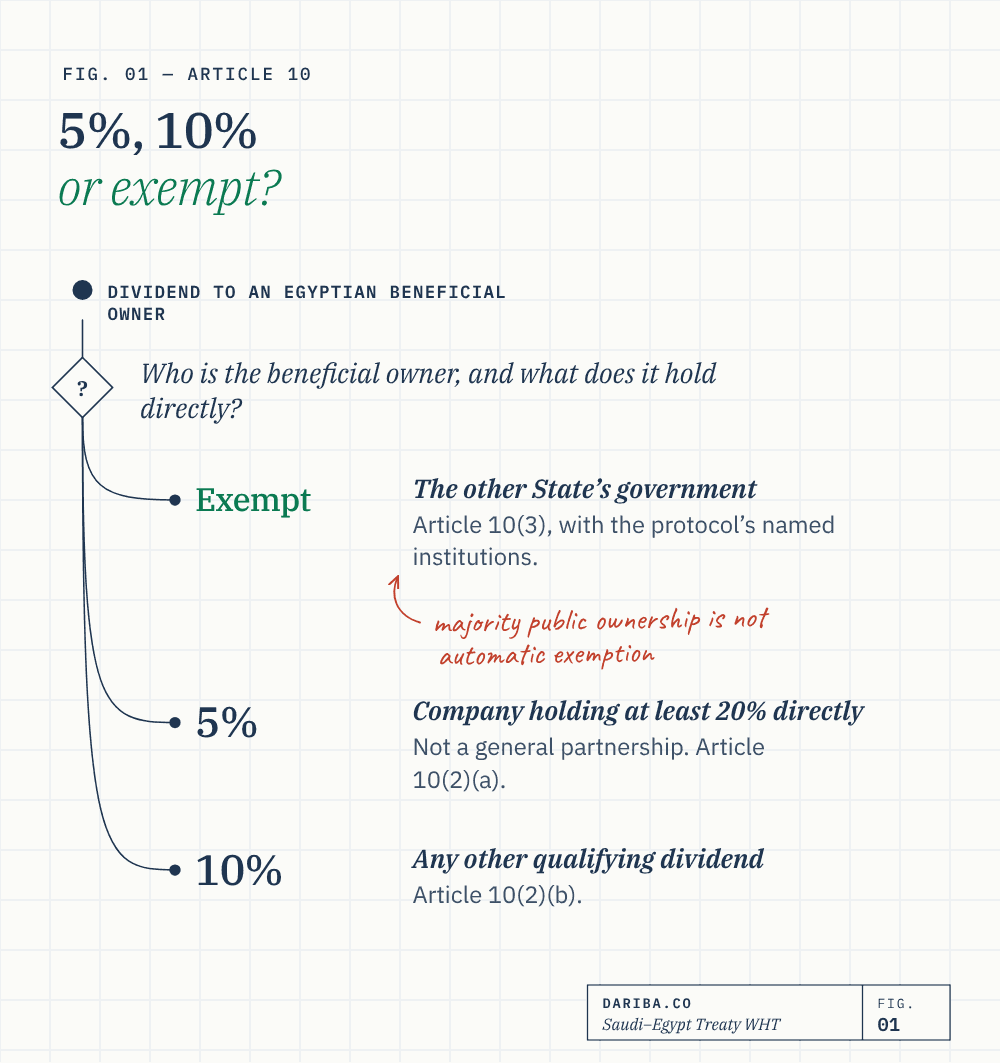
Article 10(2)(a) sets a 5% gross ceiling where the beneficial owner is a company, other than a general partnership, holding at least 20% directly of the payer’s capital. Paragraph (2)(b) gives a 10% ceiling in other qualifying cases. A group-wide or indirect holding does not simply satisfy the direct-capital condition.
Saudi Arabia reserves against MLI Article 8. Do not import a universal 365-day holding period into this dividend clause solely because Egypt notified it. Conversely, the absence of that MLI period does not remove residence, beneficial ownership, anti-abuse or procedure requirements.
Article 10(5) redirects its stated effectively connected holdings from the ordinary paragraphs (1)–(2) to Article 7 or 14. The separate paragraph (3) government exemption and protocol definition must be read on their own wording.
Sources: Article 10; Saudi Article 8 reservation.
Test the government exemption and protocol definition
Articles 10(3), 11(3) and 12(3) exempt the stated dividend, debt-income and royalty payments where the other State’s government is the beneficial owner. Protocol clause 4 expands that term for these provisions.
For Egypt it identifies the Central Bank of Egypt, the specified Egyptian social insurance fund, and the stated wholly or mainly government-owned institution/legal person under an advance agreement between the two competent authorities. The Saudi side has its own listed monetary, pension and social-insurance institutions and corresponding agreed-entity route.
Do not treat majority public ownership as automatic exemption. Retain the actual recipient, listed status or applicable advance agreement and beneficial-owner evidence. Nor does the protocol turn every commercial bank, intermediary or entity using a government-associated name into the government.
Sources: Articles 10(3), 11(3), 12(3); Protocol 4. Actual competent-authority agreements and institutional succession require their own evidence.
Include the protocol’s loan-fee wording in classification
Article 11(2) has a 10% gross debt-income ceiling, subject to beneficial ownership and the stated residence conditions. The protocol’s clause 5 expressly includes payments for obtaining loans, such as arrangement/management services, and the related guarantees.
That wording matters when an invoice separates financing, arrangement and guarantee amounts. It should not be replaced by “only periodic interest”, or extended to every unrelated consulting fee. Establish the actual service and financing connection, domestic category and treaty definition.
Article 11(4) excludes late-payment penalty charges from its debt-income definition. Paragraphs (5)–(7) separately retain effective connection, the payer/establishment-borne source rule and the arm’s-length limit for special-relationship excess. A definition exclusion is not itself exemption from all Saudi tax.
Sources: Article 11; Protocol 5; domestic Regulations Article 63. An ordinary treaty ceiling of 10% does not raise a genuinely applicable 5% domestic charge.
Read software, equipment and technical assistance within royalties
Article 12(2) sets a 10% gross ceiling for qualifying royalties. Paragraph (4) expressly covers the stated copyright and industrial rights, computer programs, equipment use, experience/know-how, and technical assistance or knowledge connected with the identified rights or property.
The actual contract still matters. A licence/right to use, full transfer, equipment lease, hosted service and independent professional engagement need classification on their terms. The connected-assistance wording does not make every engineering, support or consulting payment a royalty.
Paragraphs (5)–(7) address the stated establishment/fixed-base connection, source and special-relationship excess. Keep those conditions distinct from the paragraph (3) government exemption and Protocol 4 definition.
Source: Article 12, read with the domestic categories and exceptions in Article 63.
Keep the numerical comparison conditional
This is Dariba’s original illustration, not an official example. Assume SAR 100,000 gross consideration actually within Article 12, an eligible Egyptian treaty resident and beneficial owner, no applicable connection exception, satisfied anti-abuse conditions and the correct relief procedure. Assume the ordinary domestic royalty category applies.
| Conditional computation | Amount |
|---|---|
| Domestic royalty: SAR 100,000 × 15% | SAR 15,000 |
| Treaty royalty ceiling: SAR 100,000 × 10% | SAR 10,000 |
| Arithmetic difference | SAR 5,000 |
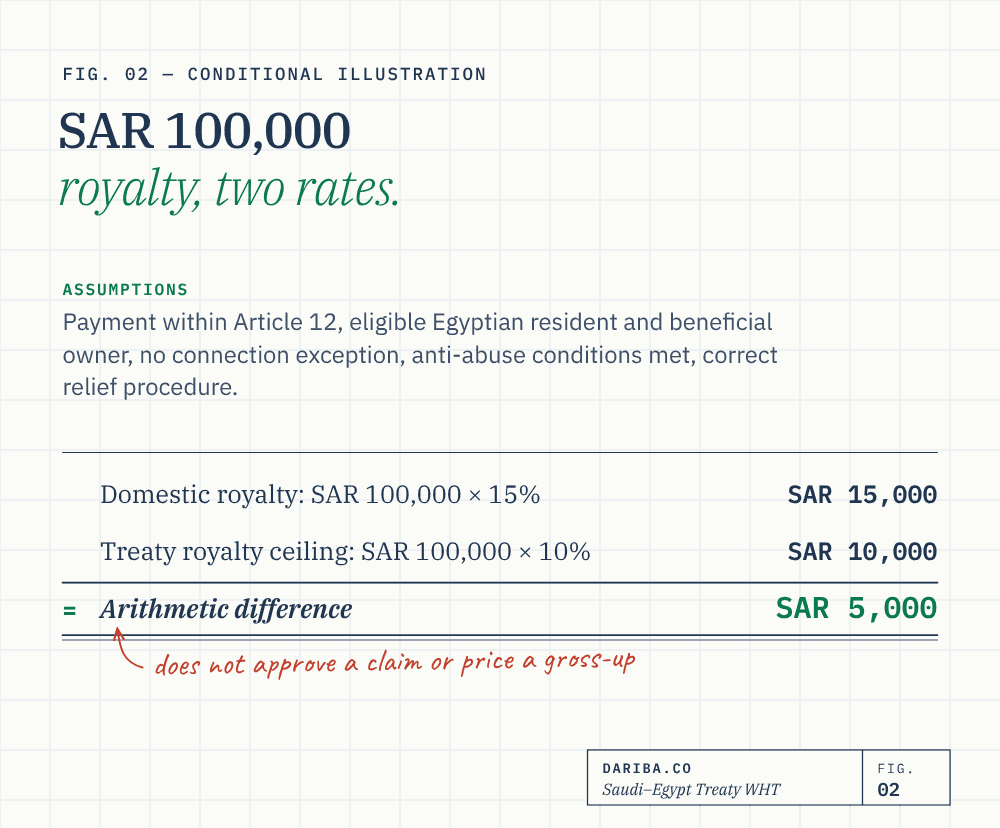
These figures do not approve a claim, classify a real software contract, price a gross-up or establish VAT. A government exemption requires its own actual facts; a higher treaty ceiling does not override a lower applicable domestic rate.
Sources: Article 12(2); Regulations Article 63.
Apply anti-abuse and the actual relief process
Original Article 27 contains a purpose-based anti-abuse provision. Both deposited MLI positions identify it for Article 7, so apply the matched principal-purpose framework for the actual period, including its object-and-purpose test. A residence certificate does not by itself resolve commercial purpose, beneficial ownership or every income condition.
ZATCA’s treaty-withholding circular section 4 distinguishes supported relief at source from domestic withholding followed by refund. Retain the actual forms, residence/authentication or Apostille evidence, undertakings, remittance and claim/decision. An application acknowledgement is not approval. Use the relief and refund guide.
Original Article 24 gives a three-year first-notification MAP period. For applicable MLI cases, matched Article 16 permits presentation to either State’s competent authority, subject to its actual scope and Article 35(4); MAP does not replace domestic filing, payment, objection or refund deadlines and does not promise arbitration or a favourable result.
Sources: Article 24/27; Egypt deposited Articles 7/16; Saudi deposited Articles 7/16; MLI Articles 7/16/35; ZATCA circular section 4.
Dariba recommendation: keep the contract/components, actual recipient, residence/beneficial-owner file, domestic source/category, treaty/protocol provision, matched MLI period, government agreement where relied on and actual relief records together. Full historical/later instrument chains, actual competent-authority agreements, Egyptian domestic credits and individual entitlement are not certified here.
Key takeaways
- The direct 20% dividend holding test and other-case ceiling are distinct.
- Government exemption requires the actual beneficial recipient and protocol definition.
- Mainly government-owned entities need the stated advance competent-authority agreement.
- Debt income includes specified loan-arrangement/management and guarantee payments.
- Royalties expressly include software, equipment and connected technical assistance; actual contract classification still matters.
- A treaty ceiling does not increase a lower domestic rate, and relief is a separate process.
Sources
- ZATCA: Saudi–Egypt treaty and integral protocol, ArabicSelected Articles 4/5/7/10–15/24/27–28; Protocol 1–5. Actual direct holding, government definition, loan fees, software/equipment/connected assistance, farm/equipment and export conditions.
- OECD: Egypt MLI position on deposit, 30 September 2020Deposited 35-page position, rather than provisional signature list; Saudi agreement 54 and matched notifications/reservations.
- OECD: Saudi MLI position on deposit, 23 January 2020Egypt agreement 8; Articles 4/8 reservations; matched 7/12/13/14/16 conditions. Actual original scan tables read.
- OECD: authentic English MLIArticles 7/12–16/28–29/34–35. Actual compatibility, effect and closely-related tests; no unilateral-option assumption.
- OECD: current MLI signatories and partiesEgypt deposit 30 September 2020/force 1 January 2021; Saudi deposit 23 January 2020/force 1 May 2020; effects separately derived from Article 35.
- ZATCA: treaty withholding implementation circularJanuary 2025, classification and section 4 relief-at-source/refund conditions, evidence, authentication and decisions.
- Saudi Income Tax Implementing Regulations, ArabicArticle 63 domestic categories and exceptions; a treaty ceiling does not increase a lower applicable domestic rate.
- Saudi Income Tax Law, ArabicDomestic source and withholding framework, including Articles 5/68. Treaty permission and actual domestic charge remain distinct.
- ZATCA: current Egypt treaty entryCurrent public catalog record checked 7 November 2026; signature 8 April 2016 and force 1 July 2017. Links the reviewed Arabic treaty/protocol.
General source-based information reviewed 7 November 2026. Actual recipient, residence, ownership, activity, applicable period, protocol agreement, benefit and procedure determine the result. Dariba illustrations are original. Full historical/later instrument chains, competent-authority agreements, Egyptian domestic outcomes and individual entitlement are not certified.