In brief
Independent professional activity uses a threshold of at least 183 days in the specified twelve-month period after the identified MFN change. Employment uses more than 183 days in the fiscal year or the resident-employer alternative. Public service, students and researchers have separate conditions.
The Saudi–France treaty does not use one 183-day rule for every person working between the countries. Independent professional activity, employment, public service, study and research have different provisions. Classify the person and payment before counting days or describing an exemption.
This guide explains selected Articles 10, 10 A and 11–13, with the MFN change to Article 10(1), the actual-inclusion safeguard and anti-abuse conditions. The business-activities guide addresses Article 14; an invoice from a company should not automatically receive the personal-services treatment described here.
Establish residence, period and the domestic charge first
Treaty Articles 1 and 4 require the actual residence analysis. Citizenship, an employer’s country or an invoice address does not independently establish the individual’s treaty residence. Dual residence requires the applicable Article 4 analysis; a day count used in an income article is not automatically the residence test.
The French administration’s official commentary, BOI-INT-CVB-SAU, paragraph 1, records renewal for five years from 1 January 2024. The authentic instruments, applicable amendments, MFN operation and MLI remain relevant. The administration’s consolidated text expressly describes itself as a reading aid rather than an authentic replacement.
A treaty allocation permits or limits taxation; it does not itself create a domestic charge, payroll obligation or tax rate. Identify the relevant domestic law and actual income before calculating liability. A host-State taxing permission should not be presented as proof that all wages or professional receipts there are taxed alike.
Source: consolidated Articles 1–4, pp. 6–7, read with the authentic instruments and current official commentary.
Apply the current independent-profession day test
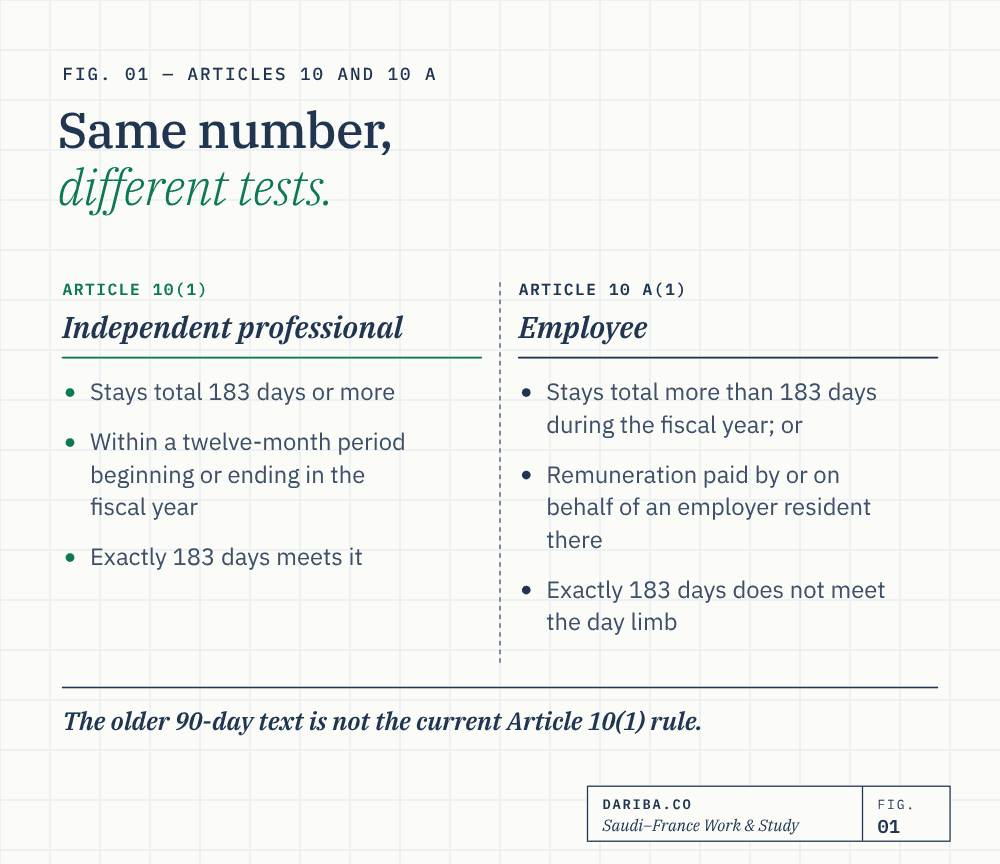
Article 10(1) generally reserves a resident’s independent professional income to the residence State unless the individual’s stays in the other State total 183 days or more within a twelve-month period beginning or ending in the fiscal year concerned. In that case, income from the activities in that other State may be taxed there. Paragraph (2)‘s examples include independent scientific, artistic, educational, medical, legal, engineering, architectural, dental and accounting activities.
The older authentic compilation’s Article 10(1) displays 90 days in the fiscal year. The French administration’s consolidation replaces that selected wording under Article 18 A(3) and identifies the Saudi–Turkey convention’s entry into force on 1 April 2009 as the MFN basis. The Turkey convention’s Article 14(1)(b) supplies the relevant 183-day/twelve-month wording.
Do not reproduce the old 90-day test as the current rule. Equally, this identified MFN change does not import every provision of the Turkey convention into France. The French consolidation’s Article 10(1) does not add Turkey Article 14(1)(a)‘s separate fixed-base limb. Retain the actual France provision, MFN trigger, applicable period and income attributable to activities in the host State.
Sources: authentic compilation Article 10, p. 5; current consolidated Article 10 and its footnote, p. 10, with Article 18 A(3), p. 16; Saudi–Turkey convention Article 14, p. 18. This selected reading does not certify all possible later MFN comparisons.
Employment uses a different threshold and employer alternative
Subject to Article 11, Article 10 A(1) generally reserves employment remuneration to the residence State unless the employment is exercised in the other State. For employment exercised there, the other State may tax the remuneration if either:
- The individual’s stays there total more than 183 days during the fiscal year concerned; or
- The remuneration is paid by, or on behalf of, an employer resident in that other State.
These are alternatives. A short assignment does not automatically prevent host-State taxation when the resident-employer condition is met. The selected France text does not use a rolling twelve-month period for this employment limb or insert a third condition about remuneration borne by a permanent establishment. Do not replace it with another treaty’s standard three-condition formulation.
Dariba recommendation: identify where the employment is actually exercised, the relevant fiscal year, days of presence, legal and actual employer facts, and who pays or on whose behalf payment is made. A foreign payroll bank account does not by itself determine the employer-residence condition.
Source: authentic Article 10 A, p. 5, also displayed in the current consolidation at p. 10.
Keep the exact 183-day boundary visible
The following are Dariba comparison scenarios, limited to the stated threshold limb. They do not decide residence, employer status, other provisions, domestic tax or actual day-count methodology.
| Assumed established facts | Selected treaty threshold result |
|---|---|
| Independent professional: 91 days plus 92 days within the relevant twelve-month window, split across two fiscal years | 183 days meets Article 10(1)‘s at-least-183 threshold if the window begins or ends in the fiscal year concerned. Looking only at each fiscal year’s subtotal can miss the rolling-window test. |
| Employee: exactly 183 days in the fiscal year | Does not meet Article 10 A(1)(a)‘s more-than-183 threshold. The separate resident-employer alternative and other provisions still require review. |
| Employee: 182 days plus another two days in the same fiscal year | 184 days exceeds the Article 10 A(1)(a) threshold on the assumed count. This is taxing permission, not a calculated domestic charge. |
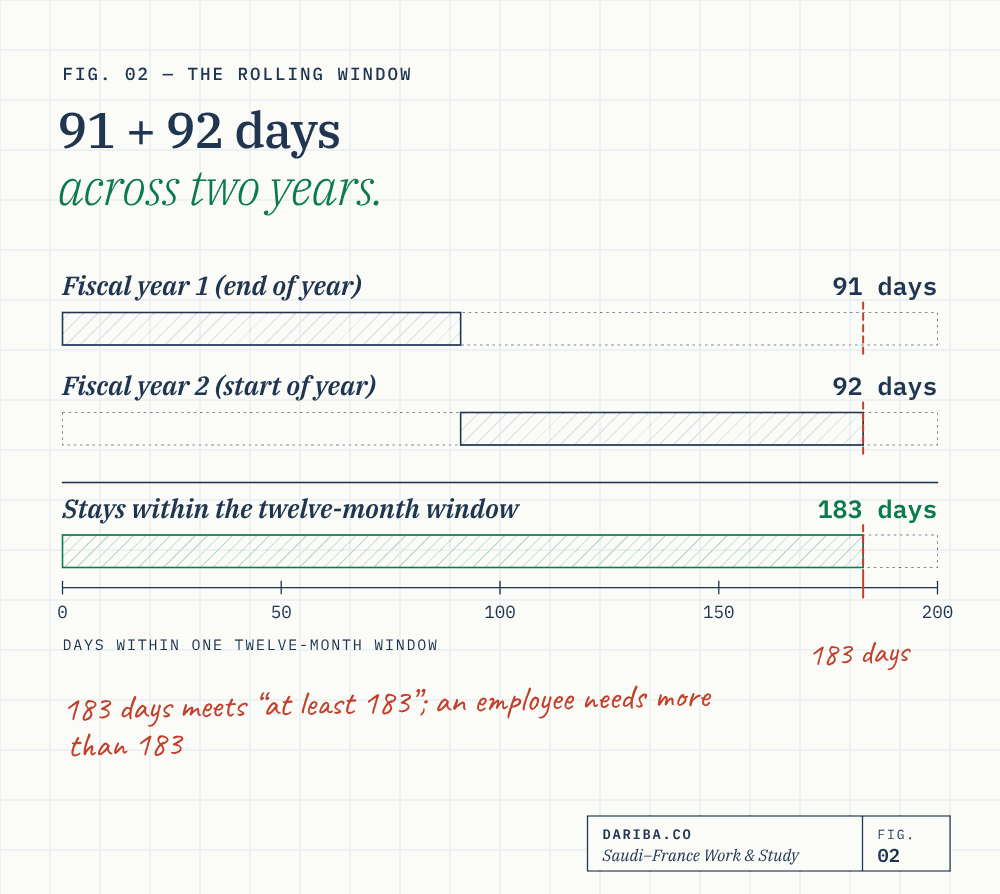
The statutory periods must not be collapsed into one calendar spreadsheet field. Keep the relevant year and rolling-window schedules separately where the classification requires them, and establish the actual treatment of travel days before relying on a total.
Separate international-traffic employment and public service
Article 10 A(2) addresses employment exercised aboard a ship or aircraft operated in international traffic. It allows taxation in the State where the enterprise’s place of effective management is situated. Establish those specific facts rather than assuming the employee’s employer address, vessel flag or flight destination resolves the paragraph. This is an employment provision, not a conclusion about the airline’s own profits.
Article 11 separately addresses remuneration and pensions paid by a State, its territorial authorities or public-law legal persons for services to the stated public body. It generally reserves taxation to that paying State, except for services rendered within an industrial or commercial activity carried on by the stated public body.
A public ownership label does not establish every condition, and the exception needs its own analysis. Article 11’s pension wording should not be turned into a general rule for every private pension. Identify the payer’s legal capacity, services and activity before applying the allocation.
Source: authentic Articles 10 A(2) and 11, p. 5, also displayed across consolidated pp. 10–11.
Students and trainees have two distinct payment routes
Article 12(1) concerns a student or trainee who is, or was immediately before the visit, resident in the other State and visits solely for study or training. Amounts received for maintenance, education or training are exempt in the host State when they arise from sources outside that State.
Paragraph (2) separately addresses remuneration for services performed in the host State by a person meeting its residence and visit-purpose conditions. The services must relate to the studies or training or the remuneration must be necessary to supplement the resources available for maintenance.
Do not apply the outside-source requirement from paragraph (1) as though paragraph (2) could never cover local services. Conversely, a student identity card alone does not establish that every local salary or business receipt qualifies. Retain the immediate pre-visit residence, visit purpose, funding source, services and relevant necessity or study connection.
Source: authentic Article 12, pp. 5–6, also displayed in the consolidation at p. 11.
Teachers and researchers need the purpose and research exception
Article 13(1) addresses a teacher or researcher who is, or was immediately before the visit, resident in the other State and stays solely to teach or conduct research. Remuneration for those activities is exempt in the host State for a period not exceeding two years.
Paragraph (2) excludes research undertaken principally for the particular benefit of specified persons rather than in the public interest. A university address or research job title does not by itself resolve that purpose. Retain the appointment, actual activity, visit dates, research objectives and beneficiary arrangements.
The selected text does not independently resolve every change of purpose, extension or disputed timing issue. Do not invent a reset on each visit or an automatic retrospective clawback rule for every longer stay. Apply the actual provision and seek clarification where the facts or period leave the result unresolved.
Source: authentic Article 13, p. 6, also displayed in the current consolidation at p. 11.
Apply the remaining safeguards and the correct procedure
Article 18 A(2) addresses income allocated to the other State that is not actually included in that State’s tax base. Notwithstanding other treaty provisions, it allows domestic-law taxation in that situation, with the express exclusion of dividends and exceptions for Saudi citizens, the stated companies more than 50% Saudi-citizen-owned, and qualifying Saudi temporary investment-development exemptions. Do not omit the relevant exception or replace actual inclusion with an invented universal positive-cash-tax test.
The MLI Article 7(1) principal-purpose test can also deny a benefit where obtaining it was one of the principal purposes, unless granting it accords with the relevant provisions’ object and purpose. Keep residence, classification, actual tax-base treatment, exceptions and anti-abuse evidence together. A residence certificate alone does not decide all these matters.
Where an actual Saudi payment falls within withholding, use the applicable treaty relief-at-source or refund process. ZATCA’s withholding circular is not a universal payroll or student-grant application procedure. Establish the domestic obligation and correct process for the payment rather than filing a WHT claim solely because a treaty article exists.
Sources: Article 18 A(2), consolidated p. 16; MLI Article 7(1), pp. 9–10, displayed in the consolidation at p. 5; ZATCA treaty-withholding circular, section 4, pp. 15–17. This focused guide leaves the complete country schedule, all historical periods and individual entitlements open.
Key takeaways
- Establish the individual’s residence, payment category, period and domestic charge first.
- Current Article 10(1) uses 183 days or more in the specified twelve-month period, replacing the older 90-day wording through the identified MFN route.
- Article 10 A uses more than 183 days in the fiscal year or the resident-employer alternative.
- Government-service remuneration and pensions require the stated payer and service facts, with an exception for industrial or commercial activity.
- Students have separate routes for support from outside the host State and remuneration for local services.
- Teaching and research relief has a two-year maximum and a specific exception for research undertaken principally for private benefit.
- Actual inclusion in the tax base, express exceptions, anti-abuse rules and the correct claim process remain separate.
Sources
- French tax administration: treaty consolidated for MLI and MFNReading aid: Articles 10, 10 A and 11–13 at pp. 10–11; Article 18 A at p. 16; principal-purpose test at p. 5. Authentic instruments remain applicable.
- French tax administration: authentic convention compilationArticles 10, 10 A and 11–13 at pp. 5–6: distinguish the older 90-day text from the identified MFN change; retain the employment, public-service and education conditions.
- ZATCA: Saudi–Turkey tax conventionArticle 14(1)(b), p. 18, compared with the identified Article 18 A(3) MFN footnote. Other Turkey treaty provisions are not imported wholesale.
- OECD depositary: Multilateral InstrumentArticle 7(1), pp. 9–10: principal-purpose test read with both deposited positions and the French consolidation.
- OECD depositary: France MLI deposited positionRelevant matching map retained; a unilateral notification alone does not modify a treaty.
- OECD depositary: Saudi MLI deposited positionFrance covered agreement and relevant matching map retained with applicable MLI effect dates; no complete audit of later notifications is claimed.
- ZATCA: Implementation of Withholding Tax under Double Taxation AgreementsSection 4, pp. 15–17, applies where the actual payment is within withholding; this is not a universal payroll or student application procedure.
- French official commentary: BOI-INT-CVB-SAU, 10 July 2024Paragraph 1 records renewal for five years from 1 January 2024. Official page rechecked 6 November 2026; direct retrieval of the renewal’s legal original is not claimed.
General information based on selected official instruments reviewed 6 November 2026. Actual person, residence, services, employer/payer, purpose, presence, period, tax-base treatment and domestic law determine the result. Consolidation is a reading aid; authentic instruments govern. Dariba scenarios are original and do not certify individual liability or the full country schedule.