In brief
Apply the specific Hong Kong residence rules and distinguish residence-only debt income from 5% dividend and 5%/8% royalty ceilings before claiming Saudi withholding relief.
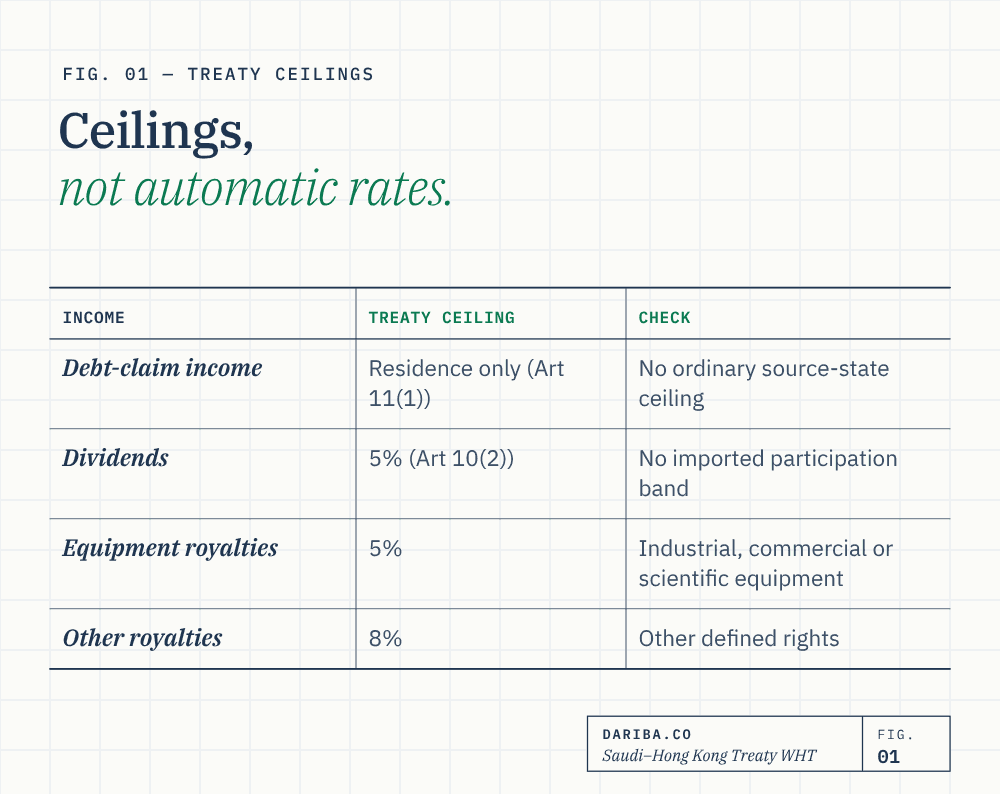
The Saudi-Hong Kong Agreement does not apply one withholding rate to every payment. Ordinary qualifying debt-claim income is allocated exclusively to the recipient’s residence jurisdiction, dividends have a 5% source-tax ceiling, and royalties have separate equipment and other-rights ceilings. Each result depends on the correct income classification and treaty entitlement.
The original Protocol is equally important. It defines Hong Kong residence in specific terms and qualifies the treatment of export business and insurance. Read it with the Agreement signed on 24 August 2017 and the effective MLI modifications. The PE companion addresses projects, agency, stock delivery and attributable profit.
Apply the Hong Kong residence definition in the original Protocol
Article 4 must be read with original Protocol 3. For Hong Kong, the Protocol includes a company incorporated there or, where incorporated elsewhere, normally managed or controlled there. It has corresponding rules for other constituted persons and separately includes the Hong Kong government.
The individual rules include ordinary residence and alternative presence tests of more than 180 days in a year of assessment or more than 300 days across two consecutive years of assessment, one being the relevant year. These are residence provisions, not the enterprise service-PE test.
For Saudi Arabia, the Protocol includes the government and stated public bodies, as well as qualifying generally exempt or untaxed legal persons maintained for the specified charitable, educational, religious, scientific, similar or employee-benefit purposes. It excludes a person liable to Saudi tax only on Saudi-source income from the residence definition.
Dariba analysis: establish the actual Protocol limb and preserve the supporting evidence. Do not replace the Hong Kong corporate definition with an invented requirement that every resident be taxed on worldwide income. Equally, a Hong Kong bank account or invoice address does not establish incorporation, normal management or control, beneficial ownership or treaty-abuse conditions.
A dual-resident entity still requires Article 4(3)‘s place-of-effective-management tie-breaker. Hong Kong’s MLI Article 4 reservation means that a different treaty’s competent-authority entity tie-breaker cannot simply be substituted.
Separate original commencement from the MLI dates
The Agreement entered into force on 1 September 2018. Article 28 applies it in Saudi Arabia to relevant withholding payments from 1 January 2019 and other taxable years beginning from that date. In Hong Kong, its original commencement is years of assessment beginning from 1 April 2019.
The IRD synthesised text, commencement section, p. 3, states different dates for the MLI modifications:
| Jurisdiction | Relevant withholding events | Other taxes |
|---|---|---|
| Saudi Arabia | From 1 January 2024 | Taxable periods beginning on or after 23 September 2023 |
| Hong Kong | From 1 April 2023 | Years of assessment beginning on or after 1 April 2024 |
These dates reflect the relevant reservations and internal-procedure notification. The OECD’s consolidated notification deposited on 22 February 2024 retains 21 February 2023 for the Saudi agreement; later entries for other jurisdictions do not restart the Saudi dates.
The synthesised text is an official reading aid. The authentic Agreement, original Protocol and MLI remain the legal instruments. This Agreement and Protocol expressly provide that English prevails on divergence of interpretation among their authentic texts.
Debt income: Article 11 ordinarily gives the residence jurisdiction the taxing right
Article 11(1) says debt-claim income arising in one contracting party and paid to a resident of the other is taxable only in that other party. It does not provide an ordinary 5% source-state ceiling. Subject to the article’s limitations and actual entitlement, that residence-only allocation can remove Saudi tax that domestic law would otherwise impose.
Paragraph 2 includes debt-claims of every kind, whether secured or unsecured and whether or not carrying participation rights in the debtor’s profits. Government securities, bonds, debentures and the specified premiums and prizes are included. Penalty charges for late payment are excluded from the definition; their remaining classification must be considered rather than treating the exclusion itself as a tax exemption.
Official example and its limits: ZATCA’s January 2025 Implementation of Withholding Tax under the Double Taxation Agreement, section 3.2.9, gives a generic State X lender example. Where the applicable treaty allocates debt income exclusively to the residence state, the recipient is the beneficial owner and no relevant PE changes the result, that state has the exclusive taxing right. This is not an official Hong Kong-specific ruling; Article 11 and the actual facts must supply the country-specific conclusion.
Dariba illustration: assume SAR 100,000 is qualifying debt income, the applicable domestic loan-return charge is 5%, Article 11 entitlement is established and neither connection, excess nor an anti-abuse rule changes the result. The domestic amount would be SAR 5,000; the assumed treaty allocation removes that source-state charge. This is an original illustration without a gross-up assumption. Principal repayment, an independent arrangement fee and a late charge each require their actual classification.
Apply the connection and special-relationship limitations
Article 11(3) disapplies paragraph 1 where the beneficial owner’s relevant debt-claim is effectively connected with a PE or fixed base in the source jurisdiction. Article 7 or 14 then applies as appropriate. The inquiry concerns the debt-claim’s actual connection; the lender’s mere possession of some Saudi PE is not the complete test.
Paragraph 4 limits Article 11 treatment to the amount that would have been agreed without the relevant special relationship. The excess remains taxable under the parties’ laws with due regard to other treaty provisions. A group financing agreement therefore needs support for the amount as well as for the lender’s residence and capacity.
Unlike some other treaties, Article 11 here has four paragraphs and no separate payer-residence source paragraph. Do not copy another agreement’s source deeming rule into it. Establish Saudi source and the treaty allocation under the instruments actually applicable to the payment.
Dividends: the 5% ceiling has its own conditions
Article 10(2) limits source taxation to 5% of gross dividends where the beneficial owner is a resident of the other contracting party. The paragraph does not divide the ceiling into participation bands or impose its own ownership percentage. Hong Kong reserves against MLI Article 8, so a 365-day holding condition from that provision is not a matched addition here.
Paragraph 3 defines dividends by the relevant corporate rights and source-jurisdiction treatment. Paragraph 2 preserves the distributing company’s tax on its profits; reducing shareholder withholding does not remove company-level tax.
Paragraph 4 addresses a holding effectively connected with a PE or fixed base. Paragraph 5 separately limits source-jurisdiction taxation of a foreign company’s distributions and undistributed profits, subject to its actual resident-recipient and effective-connection exceptions. Those provisions do not classify every branch transfer or group remittance as an exempt dividend.
Royalties: distinguish equipment from other defined rights
Article 12(2) has two ceilings where the recipient is the beneficial owner:
- 5% of gross royalties for the use of, or right to use, industrial, commercial or scientific equipment.
- 8% of gross royalties in other cases within the article’s definition.
Paragraph 3 covers the stated copyrights, broadcasting material, patents, trademarks, designs, models, plans, secret formulas or processes, equipment and information concerning industrial, commercial or scientific experience. The software words expressly found in the Singapore treaty are not repeated here. That textual difference does not prove that every software-related payment falls outside royalties: actual copyright, other rights, know-how or service consideration still needs analysis.
Dariba illustration: on an assumed SAR 100,000 qualifying equipment royalty the ceiling is SAR 5,000; on an assumed SAR 100,000 other defined royalty it is SAR 8,000. If the latter correctly attracts 15% under domestic law, the domestic amount is SAR 15,000 before treaty relief. These are original illustrations. The ceiling does not raise a lower applicable domestic charge or establish that an equipment package contains only rental.
Paragraph 4 preserves effective-connection treatment. Paragraph 5 generally locates royalties by payer residence, with its PE/fixed-base liability-and-bearing qualification. Paragraph 6 addresses special-relationship excess. Review these provisions before applying a gross percentage to the full invoice.
Classify genuine services before applying a royalty rate
The Hong Kong royalty definition does not expressly absorb technical services or assistance in the manner of the Saudi-Malaysia treaty. An enterprise’s genuine services may require Article 7 business-profits analysis, while consideration for a qualifying right or know-how may fall within Article 12. Article 7(7) preserves separately applicable income articles.
Dariba recommendation: identify deliverables, the rights retained and granted, how the customer may use the work, personnel activity, separate pricing and any continuing licence. A service description is evidence of the agreement, not a substitute for its legal substance. Resolve material uncertainty in mixed software, implementation, equipment and support arrangements before instructing accounts payable to apply a single rate.
Original Protocol 4(c) separately preserves domestic law for insurance activities. A general no-PE business-profits statement should not be used to promise treaty exemption for every insurance payment.
Keep treaty abuse and government status in their proper place
The effective MLI principal-purpose test can deny a benefit where obtaining it was one of an arrangement’s principal purposes, unless granting it accords with the relevant provisions’ object and purpose. Article 27 also preserves the parties’ internal anti-avoidance and anti-evasion laws and measures. A residence certificate or a qualifying income label does not displace those conditions.
Government inclusion in the Protocol’s residence definition is also distinct from an income-specific exemption. Do not import the Singapore treaty’s Article 26 government-income exemption into this Agreement; Hong Kong Article 26 addresses members of government missions. The ordinary debt allocation in Article 11 is itself different from a government-only exemption.
Implement relief and preserve the relevant dispute routes
Prepare a payment file that explains source, domestic category, treaty article, residence, recipient capacity, beneficial ownership where relevant, connection, amount and anti-abuse analysis. Match it to the contracts and actual performance.
ZATCA’s circular, section 4, distinguishes benefit at source from domestic withholding followed by a refund application. Satisfy the applicable procedure and documentation; an entitlement conclusion alone does not complete the administrative steps. See the treaty-relief guide.
The effective MLI modification to Article 24(1) permits a case to be presented to either competent authority. The three-year period runs from first notification of the treaty-inconsistent taxation. Historic cases require review of the applicable commencement rules: Hong Kong’s Article 35 reservations mean that the general immediate MAP commencement shortcut must not be assumed. Domestic objections and payment obligations remain separate, and the authorities’ obligation to endeavour to resolve a justified case does not guarantee a particular outcome.
Key takeaways
- Original Protocol 3 defines Hong Kong residence for incorporated companies and other specified persons.
- Article 11 ordinarily allocates qualifying debt-claim income exclusively to the recipient’s residence jurisdiction.
- Effective PE/fixed-base connection and special-relationship excess qualify the debt conclusion.
- Qualifying dividends have a 5% gross source-tax ceiling without an imported participation band.
- Equipment royalties have a 5% ceiling; other defined royalties have an 8% ceiling.
- The royalty definition does not expressly reproduce Singapore’s computer-software words or Malaysia’s technical-services wording.
- The applicable MLI dates and either-authority MAP wording require their actual period conditions.
- Residence, beneficial ownership, anti-abuse and relief administration remain separate parts of the file.
Sources
- Saudi-Hong Kong Double Taxation Agreement and original Protocol, signed 24 August 2017Articles 4, 5, 7, 10-12, 24, 27 and 28; original Protocol 1-4. English expressly prevails on divergence of interpretation.
- Hong Kong Inland Revenue Department, synthesised Saudi-Hong Kong agreement incorporating the MLICommencement p.3; residence and PE pp.8-11; business profits pp.12-13; dividends, debt and royalties pp.15-18; effective MAP wording pp.25-26; PPT p.28; Protocol pp.31-34. An official reading aid, not a replacement for authentic instruments.
- Hong Kong MLI reservations and notifications, deposited by China on its behalf, 25 May 2022Reservations against MLI Articles 4, 8 and 12-15; Article 16 notifications; Article 35 reservations and taxable-period election. Do not substitute mainland China’s distinct treaty position.
- Hong Kong consolidated MLI internal-procedure notifications, deposited 22 February 2024Saudi entry, p.2, retains 21 February 2023. Later Mexico/Vietnam entries do not restart Saudi commencement.
- Saudi Arabia MLI reservations and notifications, deposited 23 January 2020Covered agreement and actual matching with Hong Kong’s positions, including dispute procedure.
- Multilateral Convention to Implement Tax Treaty Related Measures to Prevent BEPSArticles 7, 12-16 and 35; respect the Hong Kong reservations and internal-procedure notification before applying a modification.
- Saudi Income Tax Law, current amended Arabic textDomestic source, liability and withholding framework remain distinct from treaty limitations.
- Saudi Income Tax Implementing Regulations, current amended Arabic textArticle 63 actual domestic payment categories and rates; equipment, royalty, debt and services classification remain necessary.
- ZATCA Implementation of Withholding Tax under the Double Taxation Agreement, January 2025Sections 3.2.9-3.2.10 and 4: generic debt-income example, royalty classification and separate benefit-at-source/refund procedures. Not an official Hong Kong-specific worked case.
General information only. Apply the actual facts, period, Saudi domestic law and authentic treaty instruments. This Agreement and original Protocol expressly give English priority on divergence of interpretation. MLI matching, income classification and entitlement need their own evidence. Official examples and Dariba original illustrations are distinguished; seek clarification where a material issue remains unresolved.