In brief
No local signature does not settle PE exposure: the original agreement separately addresses habitual stock delivery, alongside fixed-place, construction and service tests.
A Hong Kong enterprise can have Saudi PE exposure even where its local representative does not sign contracts. The Saudi-Hong Kong Agreement separately addresses a person who habitually maintains stock and regularly delivers from it on the enterprise’s behalf. Its storage and display exclusions do not expressly include delivery.
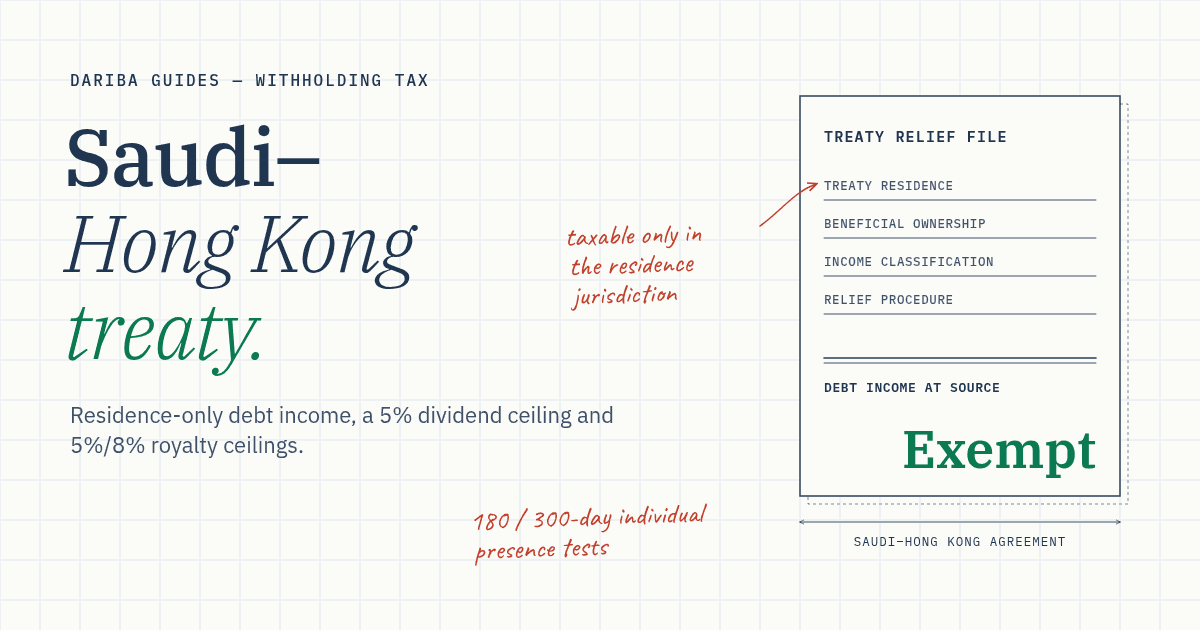
That distinction can be material for distribution, fulfilment and project arrangements. Read Article 5 with the original Protocol, the actual MLI reservations and Article 7’s profit-attribution rules. The withholding companion explains the related residence, debt-income, dividend and royalty provisions.
Review every PE route before relying on a visit count
Articles 4 and 5 require the actual resident enterprise to be identified. Original Protocol 3 supplies the specific Hong Kong residence definition; a dual-resident entity also needs the effective-management analysis. A group name or invoicing address alone does not identify the claimant.
Article 5(1) concerns a fixed place through which business is wholly or partly carried on. Paragraph 2 lists a management location, branch, office, factory, workshop and natural-resource extraction location. A person may need to consider that route even where no formal Saudi branch has been registered.
Construction, services and agency have separate provisions. Their thresholds and conditions should not be treated as a universal permission to conduct every activity below a particular day count.
Original Protocol 4(b) includes the stated commercial activities and enterprise services within business profits, but excludes personal services performed by an individual as an employee or independently. The enterprise analysis here does not replace Articles 14 and 15 for the relevant personal services.
Keep the construction and service thresholds distinct
Article 5(3)(a) covers a building site, construction, assembly or installation project and connected supervisory activities only where the site, project or activities last more than six months. This is a months-based threshold; do not silently replace it with 183 days.
Paragraph 3(b) covers services, including consultancy, through employees or other engaged personnel. Activities of that nature must continue in the contracting party for the same or a connected project for periods aggregating more than 183 days within any twelve-month period.
Dariba illustration: assume 95 Saudi service days and a further 89 nonoverlapping Saudi service days relate to the same or a connected project within one relevant twelve-month window. Their total is 184 days, exceeding 183. Exactly 183 does not meet this specific strict threshold, but does not dispose of fixed-place, agency or another applicable test. This is an original illustration, not an official ZATCA case.
Maintain the actual personnel locations, project links, work dates and periods of interruption. The text does not provide a complete manual for every partial day or overlapping team. Do not invent an employee-day multiplier or assume that 31 December resets a rolling window. Obtain clarification where a material counting issue remains unresolved.
Storage and display exclusions do not expressly cover delivery
Article 5(4)(a)-(b) refers to facilities or stock solely for storage or display of the enterprise’s goods. The word delivery is absent from those limbs. Paragraph 4(c) separately addresses stock solely for processing by another enterprise, and paragraph 4(d) a fixed place solely for purchasing or collecting information for the enterprise.
Paragraph 4(e) has an express preparatory-or-auxiliary condition for other activities. Paragraph 4(f) requires a combination of the listed activities to have that character overall. The sole-purpose, ownership and overall-activity conditions must remain visible in the analysis.
Dariba recommendation: document actual warehouse functions rather than rely on the lease description. Identify whose inventory is held, who takes orders, who releases stock, who delivers and what other functions occur. A premises arrangement called storage is not necessarily restricted to the storage activity specified in the treaty.
The absence of delivery from an exclusion does not by itself establish every condition of a PE. It means that the taxpayer must assess the applicable fixed-place and agency provisions rather than assume an express delivery safe harbour.
No signing authority does not dispose of the stock-delivery limb
Article 5(5)(a) addresses a person who has and habitually exercises authority to conclude contracts in the enterprise’s name, with the stated activity exception. The actual delegation and course of contracting are more useful evidence than the signature location alone.
Paragraph 5(b) separately addresses a person without that authority who habitually maintains stock in the contracting party and regularly delivers from it on behalf of the enterprise. A no-signature declaration therefore leaves a material part of this treaty’s agency analysis unanswered.
Dariba analysis: a fulfilment arrangement should be reviewed for habitual stock maintenance, regular delivery, the representative’s role and the enterprise on whose behalf it acts. A one-off consignment and an ongoing stock-release operation are different factual propositions, although the text supplies no universal delivery-frequency safe harbour.
Paragraph 6 preserves the independent-agent provision where the agent acts in the ordinary course of its business. Establish those conditions rather than decide solely from a contract calling the intermediary independent. Paragraph 7 says that corporate control alone does not create a PE; it does not remove PE exposure established by actual facilities or activities.
Do not import unmatched MLI PE modifications
Hong Kong’s deposited position reserves against the entirety of MLI Articles 12, 13 and 14 and includes the related Article 15 reservation. Consequently, do not replace this agreement’s agency wording with the MLI expanded principal-role test, add an unmatched activity-exclusion option or anti-fragmentation rule, or mechanically apply MLI contract-splitting aggregation.
This is a different outcome from Malaysia’s matched PE modifications and from Singapore’s differently selected activity options. The original Hong Kong stock-delivery provision nevertheless remains important: a reservation against a new MLI agency rule does not repeal an existing agency limb.
The effective MLI principal-purpose test still requires its own review, including the object-and-purpose exception. Absence of a mechanical aggregation rule should not be presented as a guarantee that artificial division across group contracts secures treaty benefits.
Separate merchandise exports from activities through a PE
Original Protocol 4(a) states that profits from merchandise exports to the other contracting party are not taxed there. Where export contracts include other activities carried on there through a PE, profits from those activities may be taxed there.
Dariba analysis: identify the actual export, local activities and PE connection, and support the allocation with contracts, functions, delivery terms, pricing and costs. An export label does not shelter every local activity, while inclusion of a local activity does not justify taxing the full international invoice as PE profit.
Protocol 4(c) separately preserves each party’s internal law for insurance activities. Do not turn the general Article 7/no-PE rule into a blanket insurance exemption. The Protocol also does not contain the temporary-exhibition sales provision found in the Singapore agreement; country-specific clauses cannot be borrowed simply because the commercial situation seems similar.
Attribution must follow Article 7 even where an alternative method is used
Article 7(1) permits taxation only of business profit attributable to the PE. Paragraph 2 uses the distinct-and-separate-enterprise standard under the stated comparable activities and conditions. A PE finding and the amount of taxable profit are therefore separate decisions.
Paragraph 4 is especially relevant when records or local methods are discussed. It preserves the specified customary apportionment of enterprise profits or other domestically prescribed method, but requires the result to accord with Article 7’s principles. It does not permit an unrestricted gross-revenue assessment merely because a domestic method exists.
Dariba illustration: assume a supported attribution identifies SAR 3 million of PE revenue and SAR 2.4 million of allowable PE expenses. The resulting profit is SAR 600,000 before other applicable adjustments. This is an original illustration of revenue less assumed qualifying costs, not an approved margin or a conclusion that every cost in an actual project is deductible.
Paragraph 5 prevents attribution merely from purchasing goods for the enterprise. Paragraph 6 requires year-to-year consistency unless a good and sufficient reason supports change. Paragraph 7 preserves the separately applicable income articles. Note the actual paragraph numbers: this Article 7 has seven paragraphs, unlike some other reviewed Saudi treaties.
Apply the internal-charge restrictions in both directions
Article 7(3) permits qualifying PE-business expenses, including executive and general administrative expenses incurred locally or elsewhere. It then restricts specified internal royalties, rights fees, service or management commissions and financing amounts, distinguishing actual-expense reimbursements. The financing limb has a banking-enterprise exception.
The paragraph also addresses amounts charged by the PE in the reverse direction to head office or other offices. A one-way review of only head-office invoices misses part of the treaty rule.
Separate actual external costs, their PE business purpose and allocation from the specified internal charges. A cost-recharge label does not prove actual reimbursement, and the banking qualification does not make every category of a bank’s internal fee deductible. The head-office deduction guide explains the linked domestic and evidential questions.
Prepare a conclusion that survives a change in facts
The PE file should identify the taxpayer, residence basis, premises, personnel, project links, stock functions, actual contract authority and agent independence. Explain which Article 5 routes were considered and the facts supporting any exclusion. If a PE exists, add the profit bridge, attribution method, supporting records and internal-charge analysis.
Stock moving to a Saudi fulfilment location, a representative gaining authority, an extended project or a change in functions may change the conclusion. Build those events into contract and tax review rather than rely indefinitely on an original no-PE certificate.
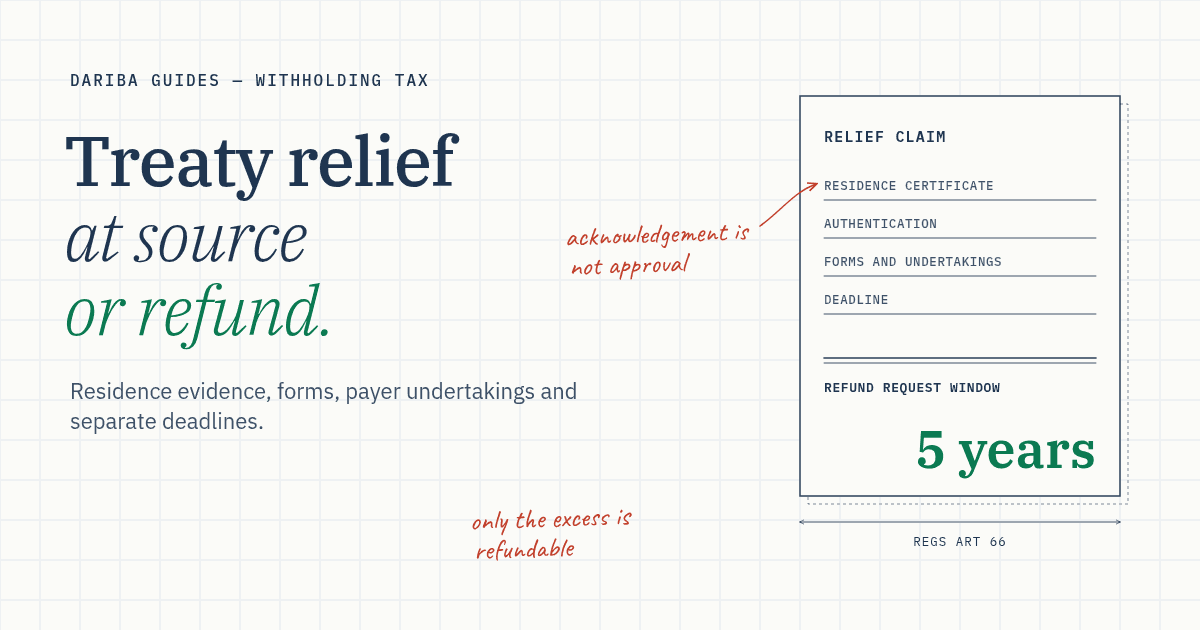
Withholding classification, registration, tax returns, VAT establishment and treaty relief are separate decisions. ZATCA’s treaty-withholding circular addresses relief administration; it does not provide an official Hong Kong stock-delivery worked example. Connect the payment guide to the PE file before claiming a reduced rate or residence-only taxation.
Key takeaways
- Construction and connected supervision use more than six months; services use more than 183 days.
- The service test requires the same or connected project and a rolling twelve-month period.
- Habitual stock delivery can be relevant even without contract-concluding authority.
- The storage/display exclusions do not expressly include delivery.
- Hong Kong reserves the expanded MLI agency, activity-exclusion and contract-splitting rules.
- The original Protocol distinguishes merchandise exports from other activities carried on through a PE.
- Article 7(4) permits specified apportionment or domestic methods only if the result accords with Article 7.
- Internal charges, actual expenses, method consistency and other income articles remain separate attribution questions.
Sources
- Saudi-Hong Kong Double Taxation Agreement and original Protocol, signed 24 August 2017Articles 4, 5, 7, 10-12, 24, 27 and 28; original Protocol 1-4. English expressly prevails on divergence of interpretation.
- Hong Kong Inland Revenue Department, synthesised Saudi-Hong Kong agreement incorporating the MLICommencement p.3; residence and PE pp.8-11; business profits pp.12-13; dividends, debt and royalties pp.15-18; effective MAP wording pp.25-26; PPT p.28; Protocol pp.31-34. An official reading aid, not a replacement for authentic instruments.
- Hong Kong MLI reservations and notifications, deposited by China on its behalf, 25 May 2022Reservations against MLI Articles 4, 8 and 12-15; Article 16 notifications; Article 35 reservations and taxable-period election. Do not substitute mainland China’s distinct treaty position.
- Hong Kong consolidated MLI internal-procedure notifications, deposited 22 February 2024Saudi entry, p.2, retains 21 February 2023. Later Mexico/Vietnam entries do not restart Saudi commencement.
- Saudi Arabia MLI reservations and notifications, deposited 23 January 2020Covered agreement and actual matching with Hong Kong’s positions, including dispute procedure.
- Multilateral Convention to Implement Tax Treaty Related Measures to Prevent BEPSArticles 7, 12-16 and 35; respect the Hong Kong reservations and internal-procedure notification before applying a modification.
- Saudi Income Tax Law, current amended Arabic textDomestic source, liability and withholding framework remain distinct from treaty limitations.
- Saudi Income Tax Implementing Regulations, current amended Arabic textArticle 63 actual domestic payment categories and rates; equipment, royalty, debt and services classification remain necessary.
- ZATCA Implementation of Withholding Tax under the Double Taxation Agreement, January 2025Sections 3.2.9-3.2.10 and 4: generic debt-income example, royalty classification and separate benefit-at-source/refund procedures. Not an official Hong Kong-specific worked case.
General information only. Apply the actual facts, period, Saudi domestic law and authentic treaty instruments. This Agreement and original Protocol expressly give English priority on divergence of interpretation. MLI matching, income classification and entitlement need their own evidence. Official examples and Dariba original illustrations are distinguished; seek clarification where a material issue remains unresolved.