In brief
The treaty has three dividend tiers, a 5% ordinary debt-income ceiling and separate qualifying debt exemptions. It distinguishes equipment-use royalties from other royalties.
The Saudi–Iceland Double Taxation Convention took effect on 1 January 2026. A Saudi payer claiming relief should first identify the payment and the beneficial owner. The treaty separately addresses qualifying public and pension recipients, corporate shareholdings and financing by independent institutions.
| Payment to a qualifying Icelandic beneficial owner | Treaty provision | Source-tax ceiling or allocation |
|---|---|---|
| Dividend to the other state, a specified subdivision or local authority, or a recognised pension fund | Article 10(2)(a) | 0% |
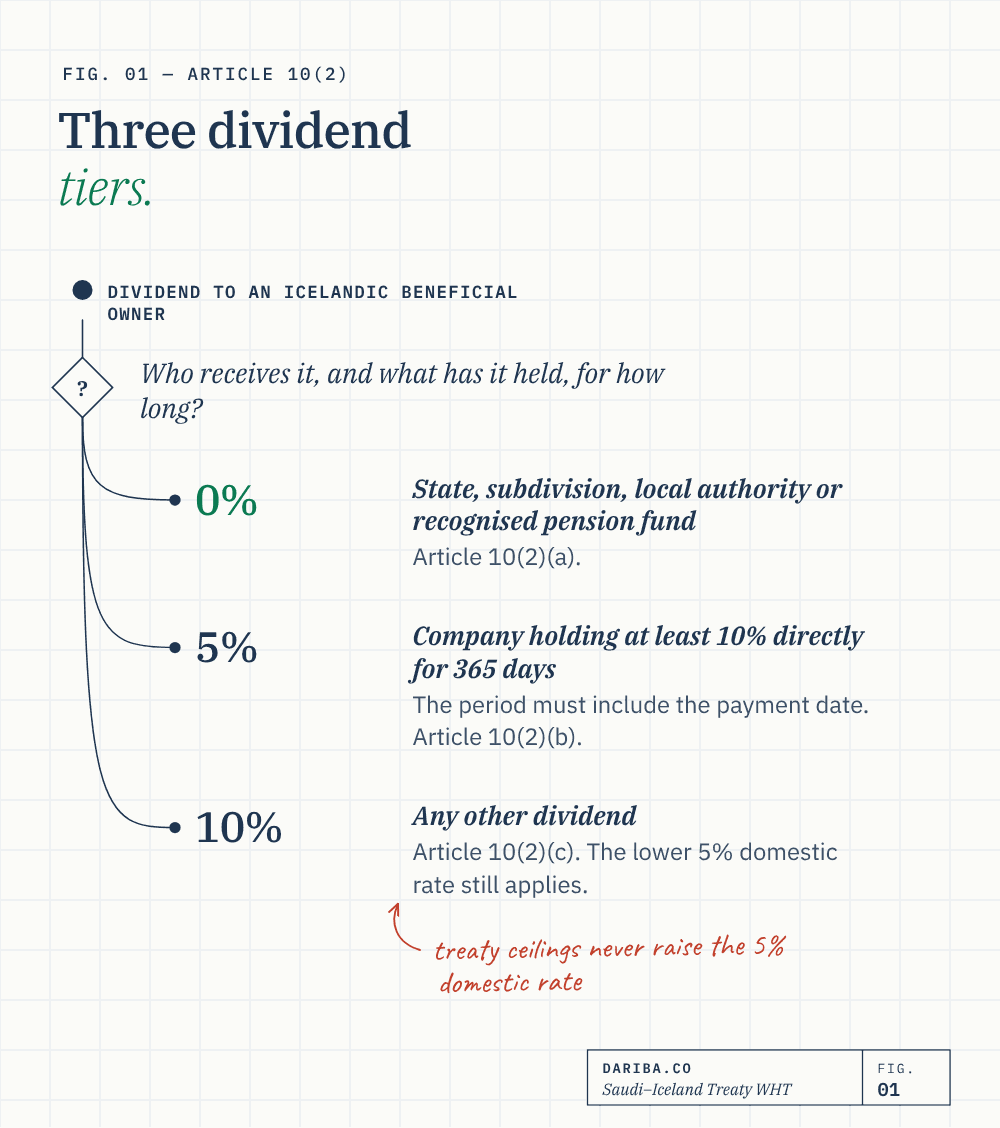
| Dividend to a company directly holding at least 10% of capital throughout a qualifying 365-day period | Article 10(2)(b) | 5% |
| Other dividend | Article 10(2)(c) | 10% |
| Ordinary debt-claim income | Article 11(2) | 5% |
| Debt-claim income qualifying under Article 11(3) | Article 11(3) | Taxable only in the beneficial owner’s residence state |
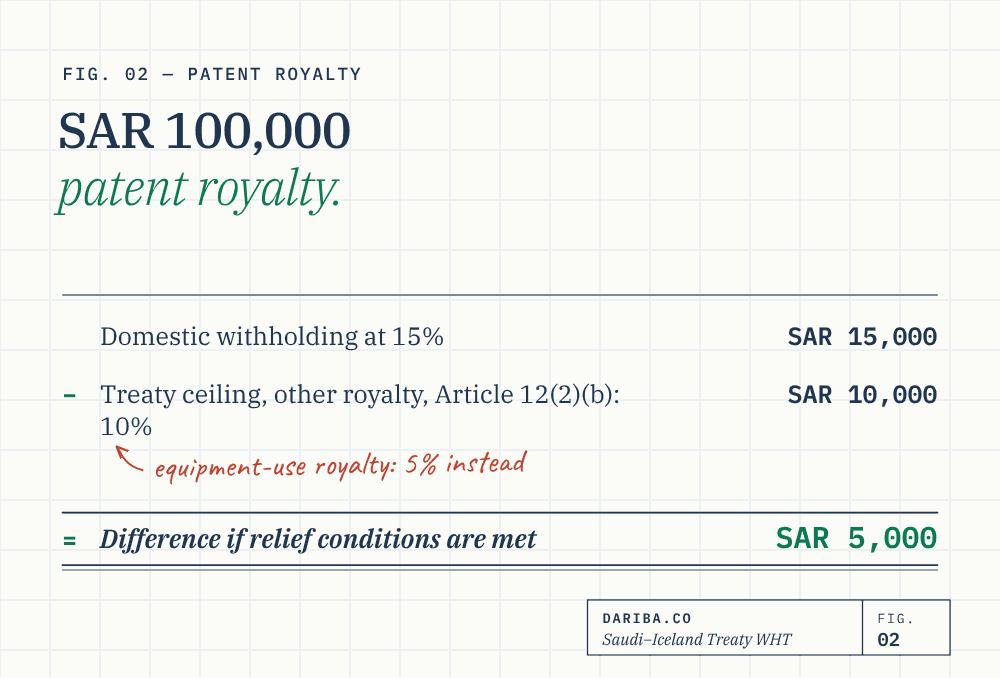
| Equipment-use royalty | Article 12(2)(a) | 5% |
| Other royalty | Article 12(2)(b) | 10% |
Check the holding period and qualifying recipient
The 365-day period must include the dividend payment date. Article 10(2)(b) directs the calculation to disregard ownership changes directly resulting from the specified corporate reorganisations. Retain the share register and any restructuring documents. Confirm recognised pension fund status where applicable. The ordinary 5% Saudi domestic dividend rate still applies when it is lower than the treaty ceiling.
Test each debt exemption separately
Article 11(3) covers income beneficially owned by listed government or recognised pension recipients, payments by those entities, and specified government-backed loans. It also covers debt income derived by an unrelated financial institution dealing wholly independently with the payer. The clause defines the qualifying financing business. Obtain the funding, relationship and loan evidence needed for that particular route.
Article 11(4) excludes penalties for late payment. Paragraphs 5–7 address effective connection, source and special-relationship excess. Paragraph 5 expressly refers to paragraphs 1 and 2, so examine the exact exemption limb and the other applicable provisions if the debt is connected with a Saudi establishment.
Classify the royalty and document relief
For an equipment or technology contract, identify the rights the customer receives and whether payment includes separate services. Article 12 distinguishes equipment-use and other royalties and addresses effective connection and special-relationship excess. Dariba illustration. A qualifying SAR 100,000 patent royalty has a SAR 10,000 treaty ceiling. At a domestic rate of 15%, the difference would be SAR 5,000 if the relief conditions are met.
Article 27 contains a principal purpose test. Retain the commercial rationale, residence and beneficial ownership evidence, contract and payment calculation. Follow section 4 of ZATCA’s Tax Circular on Implementation of Withholding Tax Under the Double Taxation Agreement for relief at source or a refund.
Key takeaways
- Article 10(2) provides 0%, 5% and 10% dividend tiers, with a 365-day rule in the corporate 5% tier.
- Article 11(3) includes a route for qualifying unrelated financial institutions dealing wholly independently.
- Article 12 uses 5% for equipment royalties and 10% for other royalties.
- Article 27 contains the treaty’s principal purpose test.
Sources
- Saudi–Iceland Convention for the Avoidance of Double Taxation with Respect to Taxes on Income and the Prevention of Tax Evasion and AvoidanceArticles 3, 10–12 and 27–28.
- ZATCA, Saudi–Iceland ConventionEntry into force on 1 December 2025 and effect from 1 January 2026.
- ZATCA Tax Circular on Implementation of Withholding Tax Under the Double Taxation AgreementSection 4 on relief at source and refunds.