In brief
Apply Saudi income-source rules to offshore services, goods contracts, finance, insurance, assets and PE income, then assess the correct tax and relief route.
Saudi income-source rules determine the connection between a receipt and Saudi Arabia. They do not, by themselves, determine the taxpayer, exemption, rate, deduction or collection mechanism. Treating every Saudi-source receipt as a withholding payment can therefore produce the wrong result, just as treating every offshore bank receipt as foreign-source can.
Income Tax Law Article 5 sets out the principal source categories. Implementing Regulations Articles 5–6 provide further rules for lending, insurance, technical services, goods and service performance. Apply those provisions to the actual transaction before considering any treaty limitation.
Start with the statutory source category
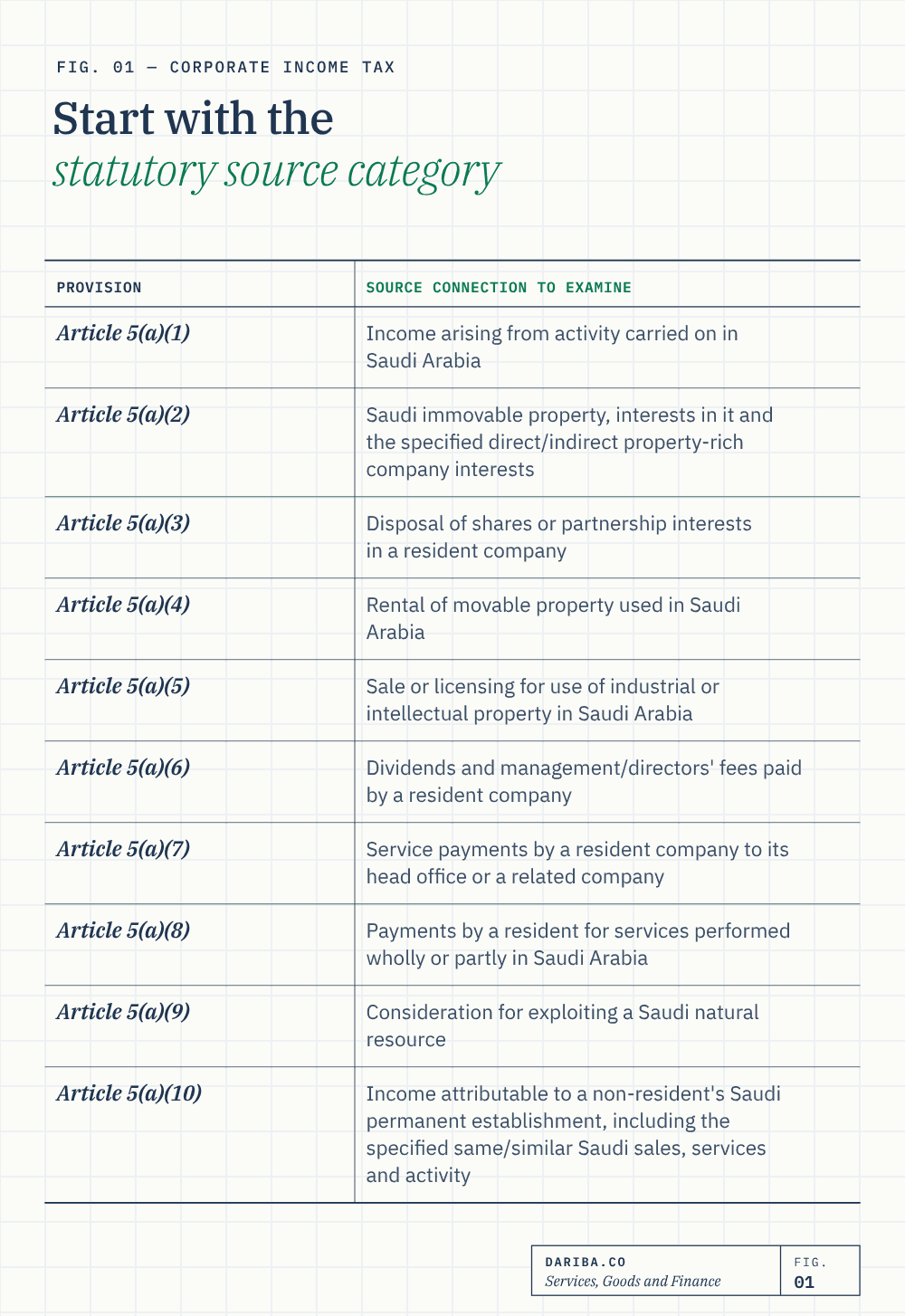
Article 5(a) identifies the following domestic connections. The table summarises the source provisions, rather than imposing tax on every receipt without the other applicable conditions.
| Provision | Source connection to examine |
|---|---|
| Article 5(a)(1) | Income arising from activity carried on in Saudi Arabia |
| Article 5(a)(2) | Saudi immovable property, interests in it and the specified direct/indirect property-rich company interests |
| Article 5(a)(3) | Disposal of shares or partnership interests in a resident company |
| Article 5(a)(4) | Rental of movable property used in Saudi Arabia |
| Article 5(a)(5) | Sale or licensing for use of industrial or intellectual property in Saudi Arabia |
| Article 5(a)(6) | Dividends and management/directors’ fees paid by a resident company |
| Article 5(a)(7) | Service payments by a resident company to its head office or a related company |
| Article 5(a)(8) | Payments by a resident for services performed wholly or partly in Saudi Arabia |
| Article 5(a)(9) | Consideration for exploiting a Saudi natural resource |
| Article 5(a)(10) | Income attributable to a non-resident’s Saudi permanent establishment, including the specified same/similar Saudi sales, services and activity |
Dariba recommendation: identify the category and supporting facts for each material revenue stream. Several provisions can be relevant to one arrangement; a general bank-transfer description does not resolve their application.
Ignore the payment location as a substitute for source analysis
Article 5(b) states that the place of payment does not determine source. A foreign account, offshore treasury settlement or foreign currency therefore does not, by itself, remove a Saudi connection established by the actual income category.
Article 5(c) treats an amount paid by a Saudi permanent establishment to a non-resident as though paid by a resident company for this purpose. The payer’s foreign legal incorporation should not obscure the relevant local establishment’s payment.
Dariba analysis: distinguish the person owing the consideration, the activity or asset generating it, the actual recipient and the method of settlement. An overseas payment-processing centre can be administratively convenient without changing those underlying facts.
Apply the technical-service rule even when work is offshore
Regulations Article 5(3) identifies income from technical and consultancy services where the service is provided to a Saudi resident or is connected with activity carried on in Saudi Arabia. Offshore performance does not by itself defeat that specified source connection.
Separately, Article 6(1) treats services as performed in Saudi Arabia where the work, or part of it, required to achieve the service is carried on there, even remotely; the supplier’s physical presence is not a prerequisite under its wording. Article 6(2) also addresses work aboard an aircraft or vessel operating for a person carrying on activity in Saudi Arabia.
These provisions should not be collapsed into a claim that every service purchased from abroad is identical. Establish whether the actual supply is technical/consultancy, management, another service, intellectual-property rights or something else, and identify the applicable source provision.
Official example: ZATCA’s General Withholding Tax Guideline, second version May 2026, section 2.1.2, Example 1, considers technical services supplied by a foreign head office to its Saudi permanent establishment for onward services to Saudi customers. The example treats the payment within withholding on its facts. It does not mean every payment involving a head office is a management fee or that an expense is automatically deductible because tax was withheld.
Separate imported goods from associated Saudi work
Regulations Article 5(6) identifies income from sales of goods manufactured or produced in Saudi Arabia. A foreign buyer does not automatically make that income foreign-source.
Article 5(7) provides a different rule for contracts supplying goods into Saudi Arabia, including their shipping and insurance. Those contracts are not treated as arising from Saudi activity unless they include associated work such as inland transport, installation, maintenance or training performed in Saudi Arabia. In that case the provision identifies the associated work as arising from Saudi activity.
Dariba original illustration: assume a genuine imported-equipment supply is separately and supportably priced at SAR 9 million, with installation performed in Saudi Arabia priced at SAR 1 million. Under the stated Article 5(7) facts, the installation component requires Saudi-source analysis; the provision does not simply turn the entire SAR 10 million into Saudi activity. These assumed prices do not certify a reasonable allocation or the final withholding or PE treatment.
Dariba recommendation: retain the actual scope, delivery and installation obligations, pricing support and evidence of performance. An arbitrary invoice split cannot substitute for a commercial allocation, and describing embedded engineering or technical services as equipment does not eliminate their separate analysis. The goods-contract rule is also not a general exclusion for independently supplied insurance or freight; identify the actual arrangement and its relevant provision.
Examine the alternative lending connections and the narrow interbank exception
Regulations Article 5(1) identifies loan returns where the debt is secured by movable or immovable property in Saudi Arabia, the borrower is Saudi resident, or the loan is connected with activity carried on through a Saudi permanent establishment. These are alternative connections, rather than three cumulative requirements.
The same paragraph defines loan returns broadly by reference to the use of money, including the stated lending and securities income. The transaction’s legal and economic character remains relevant; an amount called a fee is not automatically outside that analysis.
It excludes returns on qualifying interbank deposits retained with the resident borrowing bank for no more than ninety days, subject to the specified annual statement approved by the Saudi monetary authority identifying the lending banks, addresses, period and returns paid. A short-term group-company loan is not an interbank deposit merely because it lasts fewer than ninety days.
Dariba recommendation: verify the parties, actual deposit period and required statement before relying on the exclusion. If that particular exception does not apply, continue with the remaining domestic and treaty analysis; do not treat failure of one exception as proof of every other tax condition.
Apply the insurance source alternatives to the actual cover
Regulations Article 5(2) treats insurance or reinsurance premiums as Saudi-source where the insured property is in Saudi Arabia, the insured person is resident there, or the insurance concerns activities or risks connected with Saudi activity. Establish the actual insured interest and risk, not just the location of the insurer or the group policy’s issuing office.
Official example: the General Withholding Tax Guideline, section 2.2.2.1, Example 5, considers a Saudi branch’s allocated share of its head office’s global insurance policy. Its stated pure-premium facts support the insurance withholding category, subject to the example’s qualification that separate head-office services are not included. The global nature of the policy does not, by itself, eliminate the local premium analysis.
Dariba analysis: distinguish an actual premium allocation from claims handling, administration, a guarantee or another group service. Pricing, source, withholding category and an insurance enterprise’s net-profit computation are separate matters. The insurance computation guide addresses the latter.
Review resident-company and permanent-establishment income separately
Regulations Article 5(4) addresses a resident capital company’s income from its operations and branches inside or outside Saudi Arabia. An overseas branch receipt cannot simply be excluded because its customer and bank account are abroad. Consider the applicable exemptions, foreign tax treatment and actual treaty separately.
For a non-resident’s permanent establishment, Law Article 5(a)(10) includes the specified same/similar Saudi goods sales, services and activity. It should not be assumed that an invoice issued by the foreign head office automatically falls outside the Saudi computation.
Regulations Article 5(5) also addresses movable and immovable property income belonging to or connected with Saudi activities carried on through a resident. Trace the asset, activity and relevant person before choosing the computation.
Dariba recommendation: keep the resident capital company’s computation distinct from the attribution of profits to a non-resident’s PE. The residence guide and PE guide explain why those are different legal routes. A treaty may restrict the domestic result; its actual text and entitlement conditions govern.
Determine the collection mechanism and treaty result after source
The General Withholding Tax Guideline, section 2.2.2.1, distinguishes income-source classification from collection. Share-disposal gains and other capital gains require the general income-tax analysis rather than being automatically treated as gross withholding payments. Exempt-income and other taxpayer conditions must still be checked.
Likewise, income directly connected with a recipient’s Saudi PE requires the appropriate PE treatment. The existence of an unrelated local branch does not automatically settle every payment to the foreign enterprise. Apply the particular income’s connection.
For royalties and intellectual-property transactions, distinguish an outright disposal from licensing rights. Article 5(a)(5) can establish a Saudi source without deciding that every sale or payment has the same royalty withholding treatment. Source is the beginning of that classification, rather than the final percentage.
Use the withholding framework, exempt-income guide and treaty relief procedure to complete the analysis. A useful conclusion identifies the source provision, payer and recipient, actual income character, applicable computation and any supported relief for the relevant period.
Key takeaways
- Payment location does not determine income source.
- Technical services have a specific domestic source rule.
- Imported goods and associated Saudi work require separation.
- Lending and insurance contain alternative source connections.
- The short interbank-deposit exception has evidence conditions.
- Source, withholding, exemptions and treaty relief are distinct questions.
Sources
- Saudi Income Tax Law, current amended Arabic textArticle 5: ten source categories, payment-location rule and treatment of PE payments; Articles 2 and 6 supply distinct taxpayer/base context.
- Income Tax Implementing Regulations, current amended Arabic textArticles 5–6: alternative finance/insurance source connections, interbank exception, technical services, resident-company/property/goods income and service performance.
- ZATCA General Withholding Tax Guideline, second version May 2026Sections 2.1.2 and 2.2.2.1, Examples 1 and 5: stated head-office technical service and global pure-premium allocation facts; source versus collection categories.
General information only. Actual supplies, facts, applicable periods and controlling Arabic legislation determine the result. Official examples are distinguished from Dariba analysis and original illustrations. Seek advice or clarification where the arrangement or source material leaves a specific issue unresolved.