In brief
The treaty offers distinct dividend, financing and royalty outcomes. Residence, beneficial ownership, permanent-establishment connections and anti-abuse rules determine whether relief is available.
An Irish counterparty does not by itself settle Saudi withholding tax. The Ireland–Saudi Arabia Convention can change the result substantially, but the analysis starts with the actual recipient and income. A financing return, an equipment royalty, a copyright licence and a service fee do not necessarily follow the same article. The Protocol and applicable Multilateral Instrument (MLI) modifications form part of that review.
Establish residence and the relevant period
Convention Articles 1 and 4 address treaty residence. Incorporation, a billing address or an Irish bank account should not substitute for determining the recipient’s treaty status. Article 4(1) excludes a person liable to tax only on income sourced in that state. Protocol paragraph 2 expressly includes specified exempt religious, charitable, educational, scientific and pension-purpose legal persons; it is not a general exemption for every untaxed entity.
For a dual-resident company, Article 4(3) uses the place of effective management. Saudi Arabia’s reservation means MLI Article 4 does not replace that rule for this treaty. Management evidence therefore matters alongside the residence certificate.
The Convention entered into force on 1 December 2012. For Saudi withholding, Article 27(2)(b)(i) gives effect to amounts paid from 1 January 2013. The official synthesised text identifies 1 January 2021 for the MLI’s ordinary withholding-tax modifications and taxable periods beginning from 1 November 2020 for other taxes, with a separate MAP rule. Historical payments require the rules applicable to their period.
Apply the dividend exemption before assuming 5%
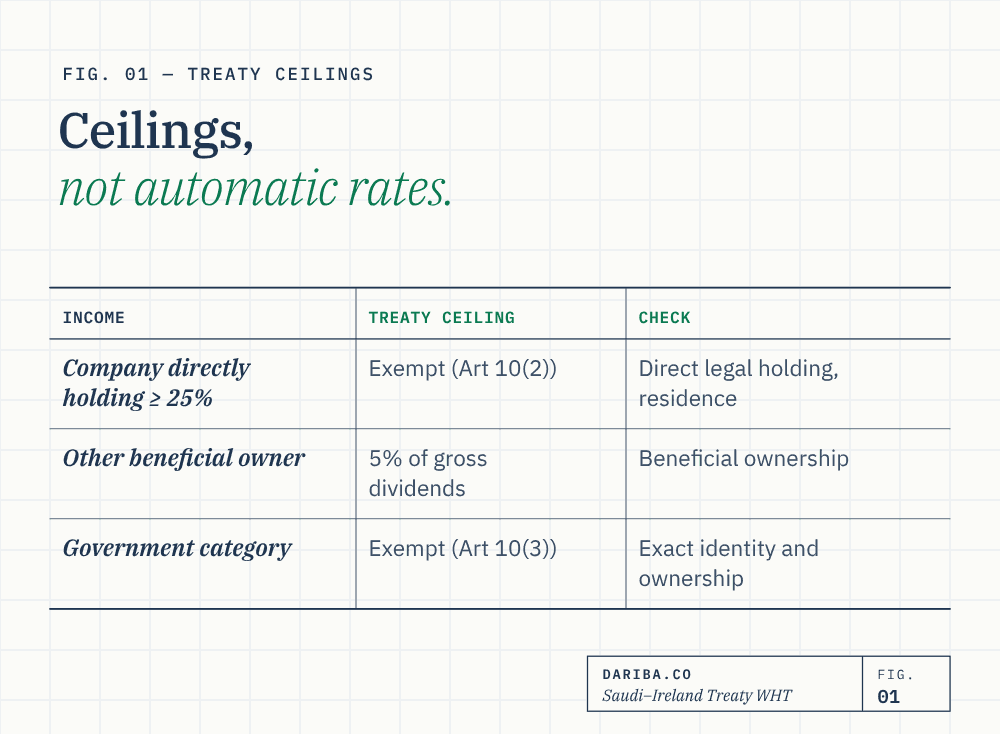
Article 10(2) permits a source-state tax ceiling of 5% of gross dividends where the beneficial owner is resident in the other state. It also expressly exempts dividends paid to a company, other than a partnership, resident in the other state that directly holds at least 25% of the payer’s capital. Article 10(3) provides a separate exemption for the listed governments, central monetary bodies and wholly government-owned institutions, agencies or funds.
| Recipient and holding | Treaty source-state treatment | Practical evidence |
|---|---|---|
| Qualifying resident company, other than a partnership, directly holding at least 25% of capital | Dividend exemption under Article 10(2) | Direct legal holding, residence, distribution and entitlement |
| Other qualifying resident beneficial owner | Ceiling of 5% of gross dividends | Beneficial ownership and treaty eligibility |
| Recipient satisfying the specific Article 10(3) government category | Exemption under that paragraph | Exact identity and required ownership status |
An indirect group holding is not the direct holding specified in Article 10(2). Exactly 25% meets the stated percentage; 24% does not. MLI Article 8’s 365-day holding rule is not imported here: Saudi Arabia reserved against that entire article. This does not remove the principal purposes test or permit temporary, artificial holdings to be accepted without examination.
ZATCA’s WHT Implementation under Double Taxation Agreements, section 3.2.8, gives an official example of a State X recipient passing Saudi dividends to a beneficial owner in State Y. The circular explains why a conduit cannot obtain relief merely by receiving the payment. Applied to an Irish holding structure, Dariba’s analysis is to examine distribution rights, onward-payment obligations and actual control of the income, rather than rely solely on the share register.
Distinguish debt-claim income from every financing charge
Article 11(1) allocates qualifying debt-claim income exclusively to the other-state resident beneficial owner. For an eligible Irish beneficial owner receiving Saudi-source debt-claim income, that allocation removes Saudi source-state tax under this article. It does not establish that Ireland imposes no tax.
Article 11(2) covers debt claims and specified securities returns, but excludes late-payment penalties. Arrangement fees, service charges and other amounts need their own classification. Under Article 11(3), an effectively connected Saudi PE or fixed base can move the income to Article 7 or 14. Article 11(4) limits the article’s protection to the amount that would have been agreed absent the special relationship; the excess needs separate analysis.
The circular’s section 3.2.9 official example assumes qualifying debt-claim income, residence-state-only treaty treatment, beneficial ownership and no Saudi PE. It illustrates the allocation mechanism, not a blanket exemption for all cross-border funding. The Ireland provision supplies the specific treaty rule; the actual loan, rights, pricing and Saudi connection supply the facts.
Separate equipment royalties from other royalties
Article 12(2) caps qualifying source-state tax at 5% of gross royalties for the use of, or right to use, industrial, commercial or scientific equipment, and 8% in other royalty cases. Article 12(3) identifies copyright, patents, trademarks, designs, models, plans, secret formulae or processes, equipment and relevant experience or know-how.
Contract terminology does not determine the category. A service using the supplier’s equipment is not automatically a payment for the customer’s right to use that equipment. Conversely, a right to exploit protected content cannot be converted into ordinary consultancy by changing the invoice description. The agreement, actual rights, deliverables and allocation of a mixed price must support the analysis. Article 7(7) preserves the treatment of income separately addressed by another article.
Article 12(4) addresses effective connection with a PE or fixed base; Article 12(5) identifies the source, including relevant PE-borne royalties; Article 12(6) confines the ceiling to the arm’s-length amount where special relationships produce an excess. ZATCA’s section 3.2.10 official example explains that both residence and source states may tax royalties, with the source-state ceiling governed by the actual treaty. It does not supply a universal royalty rate.
Keep calculations and branch remittances distinct
Dariba original illustrations: assume current-period Saudi-source payments, an eligible Irish beneficial owner, genuine entitlement, no effectively connected Saudi PE or fixed base, and arm’s-length amounts. A SAR 1,000,000 qualifying equipment royalty has a treaty ceiling of SAR 50,000; a separate SAR 1,000,000 copyright royalty has a ceiling of SAR 80,000. These are maximum treaty source-state amounts, not a rule increasing any lower domestic liability. No gross-up, VAT or residence-state tax is modelled.
A separate SAR 1,000,000 dividend paid to an eligible Irish company directly holding 30% of the Saudi payer’s capital can fall within Article 10(2)’s exemption, assuming all conditions. A 20% direct holding does not meet that participation exemption; the ordinary qualifying dividend ceiling would be SAR 50,000. These assumptions are Dariba’s, not ZATCA’s worked facts.
An Irish company’s Saudi branch is different. Protocol paragraph 5 expressly permits tax on remittances or deemed remittances of branch profits, capped at 5%. Do not apply a subsidiary-dividend participation exemption to erase that separate rule.
Test treaty abuse and assemble the claim file
MLI Article 7(1)’s principal purposes test can deny a benefit where obtaining it was one of the principal purposes of an arrangement or transaction, subject to its object-and-purpose qualification. A residence certificate is necessary evidence for the procedure, but does not settle beneficial ownership, income classification, effective connection or anti-abuse questions.
ZATCA’s circular section 4 provides benefit-at-source and refund routes. The source route involves a portal application, foreign tax residence certificate, prescribed request, authentication or apostille and the resident withholding person’s undertaking. The refund route first pays domestic withholding and requires additional authorisation, return/payment evidence and the specified resident letter. Plan the route before payment and retain the supporting analysis. Follow the treaty-relief procedures guide for the detailed evidence and time-limit discussion.
The useful conclusion is transaction-specific: identify the qualifying person, classify each payment, test the applicable exception and preserve a claim file that explains the result. For personnel, projects or a local presence, complete the Ireland treaty PE analysis before accepting an exemption.
Key takeaways
- A qualifying company with a direct 25% capital holding can obtain the dividend exemption.
- Other qualifying dividends generally face a 5% source-state ceiling.
- Qualifying debt-claim income is taxable only in the beneficial owner’s residence state.
- Royalties have a 5% equipment ceiling and an 8% ceiling in other cases.
- Branch profit remittances have their own Protocol rule.
- Treaty eligibility and ZATCA claim procedures require separate evidence.
Sources
- Saudi Arabia–Ireland Double Taxation Convention and Protocol, ZATCA publicationConvention signed 19 October 2011; Articles 1–5, 7, 10–12 and 24; Protocol paragraphs 2–5. Both English and Arabic texts are equally authentic.
- Ireland–Saudi Arabia Convention and Protocol, Irish Revenue publicationOriginal Convention and integral Protocol, including the dividend participation exemption, debt-claim treatment, royalty ceilings, offshore activities and branch remittances.
- Irish Revenue, Synthesised Text of the MLI and Ireland–Saudi Arabia ConventionPrepared in consultation with the Saudi competent authority. Shows MLI modifications and effective dates; the authentic Convention and MLI remain the legal texts.
- Ireland, MLI reservations and notifications on ratificationDeposited 29 January 2019. Article 12 reservation; Article 13 Option B and Article 14 position distinguished from Saudi elections.
- Saudi Arabia, MLI reservations and notifications on ratificationDeposited 23 January 2020. Reservations under MLI Articles 4 and 8; Article 13 Option A and no Article 14 reservation. Bilateral matching controls.
- Multilateral Convention to Implement Tax Treaty Related Measures to Prevent BEPSArticles 7, 13–16 and 35: treaty abuse, PE exceptions, connected project aggregation, closely related enterprises, MAP and effect dates. Authentic Article 14 refers to the relevant treaty period.
- ZATCA Tax Circular, WHT Implementation under Double Taxation AgreementsSections 3.2.5 and 3.2.8–3.2.12 explain income classification and official examples; section 4 sets out benefit-at-source and refund procedures.
General information only. Actual supplies, facts, applicable periods and controlling Arabic legislation determine the result. Official examples are distinguished from Dariba analysis and original illustrations. Seek advice or clarification where the arrangement or source material leaves a specific issue unresolved.