In brief
The treaty has separate fixed-place, project, service, agency, insurance and offshore routes. Matched MLI provisions affect aggregation and activity exemptions; no single duration test protects every arrangement.
A short Saudi project does not automatically protect an Irish enterprise from Saudi income tax. The Ireland–Saudi Arabia Convention has several permanent-establishment (PE) routes, and its Protocol adds an important offshore rule. Each route has to be tested against the actual operation; a six-month calculation answers only part of the question.
Establish treaty access and the applicable version
Articles 1 and 4 determine access through treaty residence. For a dual-resident company, Article 4(3) uses the place of effective management; Saudi Arabia’s MLI Article 4 reservation leaves that treaty rule in place. The Ireland payment guide explains residence, beneficial ownership and the payment-specific provisions.
The official synthesised text identifies the MLI modifications and their effect dates: ordinary withholding changes apply from 1 January 2021; other taxes concern taxable periods beginning on or after 1 November 2020. MAP has a separate date. The authentic Convention, Protocol and MLI prevail over the explanatory synthesis. Do not apply a later modification retrospectively to an earlier period.
Start with the fixed place and special activity routes
Article 5(1) covers a fixed place of business through which an enterprise’s business is wholly or partly carried on. Article 5(2) lists a place of management, branch, office, factory, workshop and a place of natural-resource extraction. The project and service thresholds do not add a universal six-month minimum to this fixed-place rule.
The practical review should trace the premises used, duration and continuity, access arrangements, functions and actual business conducted there. A local address alone does not complete that analysis, but a short contract does not answer it either. Examine the facts of an office or other operating location rather than assuming the project test displaces Article 5(1).
Article 5(5) separately deems an insurance enterprise to have a PE if it collects premiums in the other state or insures risks situated there. That express route should not be overlooked in an insurance arrangement.
Test construction and service periods separately
Article 5(3)(a) covers a building site, construction, assembly or installation project, or related supervisory activities, where it continues more than six months. Article 5(3)(b) covers services, including consultancy, through employees or other engaged personnel where activities of that nature for the same or a connected project continue in the state for periods aggregating more than six months within any twelve-month period.
These are distinct provisions. A contract title, a single invoice date or the number of employees does not replace the relevant project and activity record. Maintain personnel movements, on-site and remote work records, project links, contractual scope and actual start/finish evidence. Do not mechanically convert six calendar months into a universal 183-day test.
Independent professional activity has its own Article 14 route: a regularly available fixed base, or presence amounting to at least 183 days in the specified twelve-month period, can permit source-state taxation within that article’s limits. Protocol paragraph 4(a) expressly distinguishes an individual’s employment or independent personal services from enterprise business profits. Identify the provider and capacity before choosing the test.
Aggregate connected project work where the MLI requires it
MLI Article 14(1) addresses splitting project activities among closely related enterprises. For the relevant construction/site route, it adds different qualifying periods of connected activities at the same project where the first enterprise’s aggregate activity exceeds 30 days without exceeding the relevant treaty threshold and the other qualifying periods each exceed 30 days. The treaty’s six-month threshold remains the reference; the MLI is an aggregation rule rather than a new twelve-month permission.
Dariba original illustration: two closely related Irish enterprises perform connected installation activities at the same Saudi project in different, non-overlapping periods: one for four calendar months and the other for three. Assume every required condition is met, including the relevant periods exceeding 30 days. The combined seven months exceeds the six-month threshold. Dividing the contract between two group companies therefore does not, on those assumptions, preserve the project-duration protection. This illustration does not decide every enterprise’s attribution or liability, and does not add overlapping periods twice.
The synthesis’s MLI Article 14 box contains a reference to twelve months within its description, while its introduction identifies the six-month treaty threshold. Authentic MLI Article 14(1)(a) refers to the period in the relevant treaty provision. Read these instruments together; do not rely on the isolated twelve-month wording as a safe harbour. Material historical or disputed period calculations warrant specific clarification.
Match the activity-exemption and agency provisions
Article 5(4) lists specified storage, display, delivery, processing, purchasing/information and preparatory or auxiliary activities, subject to its actual wording. Ireland selected MLI Article 13 Option B and Saudi Arabia Option A. Because those options do not match, neither option should simply be presented as a bilateral replacement. The official synthesis nevertheless includes MLI Article 13(4)’s anti-fragmentation rule.
That rule can disapply a listed activity exemption when the same or a closely related enterprise carries on complementary functions forming a cohesive business operation and the specified PE or combined-activity conditions are met. A group’s separate storage and operating entities therefore need to be considered together where the conditions apply. The mere existence of two related companies is not itself enough.
Article 5(6) addresses a person acting for the enterprise who has and habitually exercises authority to conclude contracts in its name, subject to the stated exception. Article 5(7) separately addresses independent agents acting in the ordinary course of their business. Ireland reserved against MLI Article 12, so its broader principal-role agency wording is not imported into this treaty. Test the actual retained agency rule and any fixed place instead.
For the relevant MLI anti-fragmentation and aggregation provisions, Article 15 uses factual control and specified more-than-50% ownership tests. Do not replace that definition with the dividend article’s 25% participation condition. Article 5(8) also confirms that control of a subsidiary does not by itself create a PE of the other company.
Check offshore activities before using an ordinary time test
Protocol paragraph 3(a) deems qualifying offshore activities on the continental shelf, connected with exploration or exploitation of the seabed, subsoil and their natural resources, to be carried on through a PE. It does not state a six-month minimum. An offshore engagement therefore needs a Protocol review before relying on the ordinary construction or service threshold.
The location and activity connection matter. A contract with an energy-sector customer does not by itself establish that every service is within this defined offshore rule. Preserve the work scope, actual location and relationship to exploration or exploitation.
Attribute profits and distinguish branch distributions
Under Article 7(1)–(2), the source state may tax profits attributable to the PE, applying the distinct-and-separate-enterprise principle. Article 7(3) permits relevant business expenses, including qualifying executive and general administration expenses incurred elsewhere, but restricts notional internal royalties, management/service commissions and debt charges, with the stated banking exception. Actual-expense reimbursement has its own express treatment. A group allocation spreadsheet alone does not establish a deduction.
Protocol paragraph 4(b) protects business profits from merchandise exports to the other state while preserving tax on other activities carried on through a PE in accordance with Article 7. Separate genuine export merchandise from local installation or services; do not treat a mixed contract as a complete exemption or tax the entire contract merely because one component involves a PE. Article 7(7) preserves separately addressed income articles.
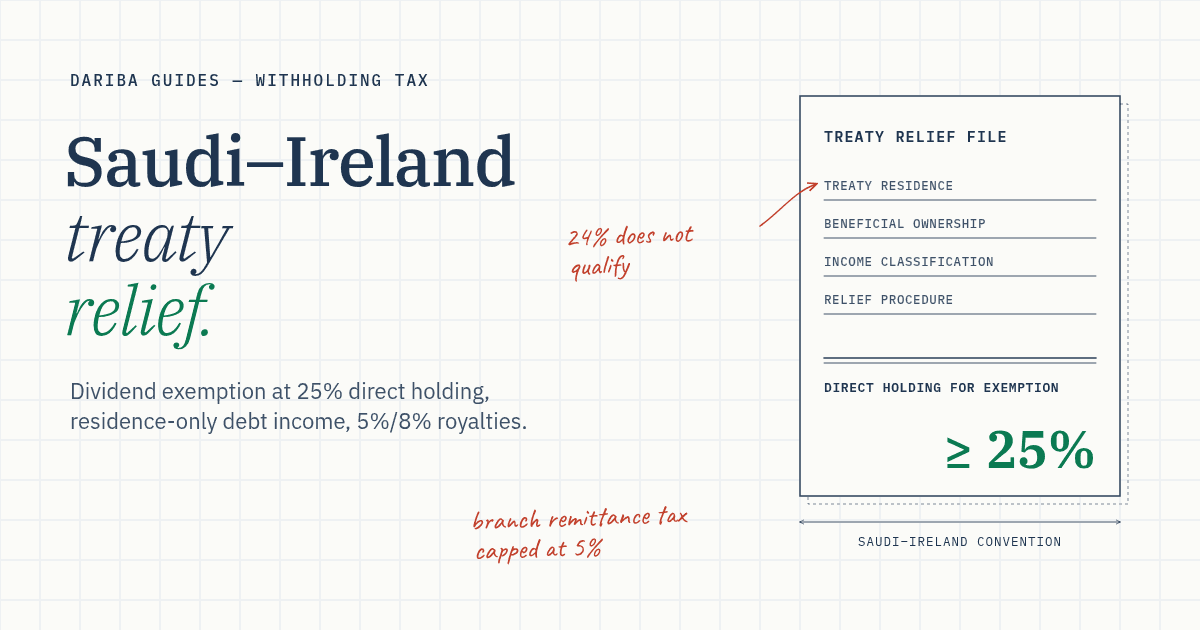
Protocol paragraph 5 permits tax on actual or deemed branch-profit remittances, subject to its 5% ceiling. That is separate from the tax on PE profits. A branch is not a subsidiary entitled to claim the corporate-participation dividend exemption by reference to ownership of itself.
Use the official service example within its assumptions
ZATCA’s WHT Implementation under Double Taxation Agreements, section 3.2.5, gives an official example of an enterprise in State R providing online consultancy to a Saudi resident or PE without creating its own Saudi PE. Under the assumed business-profits provision, the residence state has the taxing right.
For an Irish service company, that example supports the mechanism of Article 7 where the actual facts fit. It does not establish that an Irish supplier with a Saudi office, on-site personnel, connected projects, a contracting agent or offshore activities necessarily has no PE. It also does not reclassify royalties as services. Dariba’s advisory conclusion is to document the absence of every relevant PE route before using the example to support the payment position.
Preserve dispute deadlines and a coherent evidence file
Article 24, as modified by MLI Article 16, permits a treaty-inconsistent taxation case to be presented to either competent authority within three years of the first notification of the action. The synthesis states the MLI MAP rule applies to cases presented from 1 May 2020, with its qualification for previously ineligible cases. The authorities endeavour to resolve the case; a favourable outcome is not guaranteed.
Keep domestic objection and payment obligations under separate review: a treaty MAP filing is not a substitute for preserving them. Retain residence evidence, contracts, personnel and project chronology, agency authority, related-enterprise functions, expense support, profit attribution and the first notification relied on for any deadline. The resulting file should explain both why a PE exists or does not exist and how the claimed tax consequence follows.
Key takeaways
- The six-month project and service tests do not replace the fixed-place test.
- Connected construction work by closely related enterprises can require aggregation.
- Ireland’s and Saudi Arabia’s different MLI elections must be matched.
- The Protocol deems specified continental-shelf activities to create a PE.
- Taxable PE profits require supported attribution and expense analysis.
- MAP has a separate treaty deadline and does not replace domestic remedies.
Sources
- Saudi Arabia–Ireland Double Taxation Convention and Protocol, ZATCA publicationConvention signed 19 October 2011; Articles 1–5, 7, 10–12 and 24; Protocol paragraphs 2–5. Both English and Arabic texts are equally authentic.
- Ireland–Saudi Arabia Convention and Protocol, Irish Revenue publicationOriginal Convention and integral Protocol, including the dividend participation exemption, debt-claim treatment, royalty ceilings, offshore activities and branch remittances.
- Irish Revenue, Synthesised Text of the MLI and Ireland–Saudi Arabia ConventionPrepared in consultation with the Saudi competent authority. Shows MLI modifications and effective dates; the authentic Convention and MLI remain the legal texts.
- Ireland, MLI reservations and notifications on ratificationDeposited 29 January 2019. Article 12 reservation; Article 13 Option B and Article 14 position distinguished from Saudi elections.
- Saudi Arabia, MLI reservations and notifications on ratificationDeposited 23 January 2020. Reservations under MLI Articles 4 and 8; Article 13 Option A and no Article 14 reservation. Bilateral matching controls.
- Multilateral Convention to Implement Tax Treaty Related Measures to Prevent BEPSArticles 7, 13–16 and 35: treaty abuse, PE exceptions, connected project aggregation, closely related enterprises, MAP and effect dates. Authentic Article 14 refers to the relevant treaty period.
- ZATCA Tax Circular, WHT Implementation under Double Taxation AgreementsSections 3.2.5 and 3.2.8–3.2.12 explain income classification and official examples; section 4 sets out benefit-at-source and refund procedures.
General information only. Actual supplies, facts, applicable periods and controlling Arabic legislation determine the result. Official examples are distinguished from Dariba analysis and original illustrations. Seek advice or clarification where the arrangement or source material leaves a specific issue unresolved.